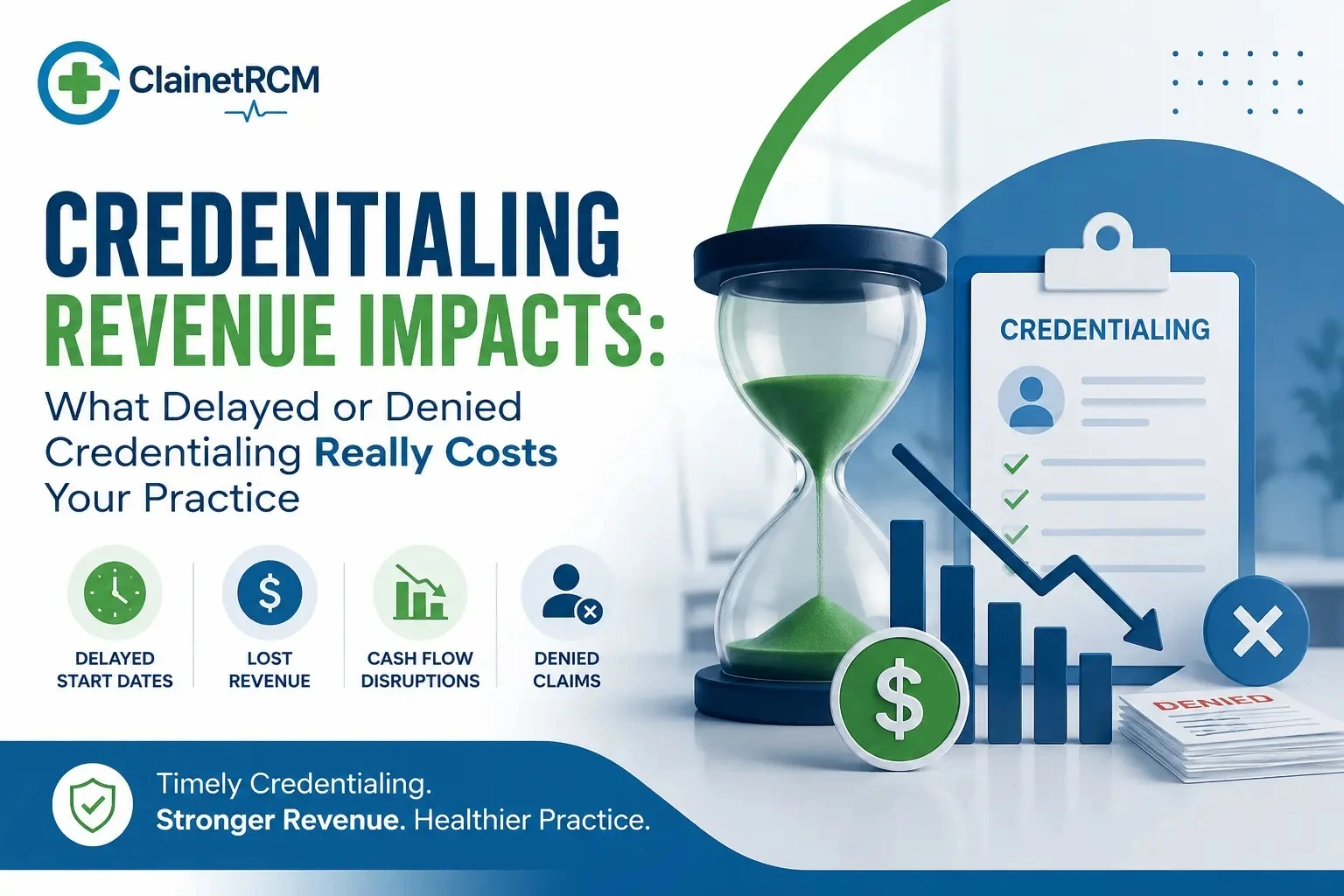
Quick answer: Credentialing revenue impacts show up in four places: the weeks a provider sits unable to bill while enrollment is pending, the claims that get denied because enrollment data does not match what a payer has on file, the network status a practice loses when a re-credentialing deadline slips, and the staff hours spent chasing payers instead of working paid claims. For a single provider, a slow or mishandled credentialing cycle can quietly cost tens of thousands of dollars before anyone notices the pattern.
If you run a practice, you have probably felt this without putting a number on it. A new hire starts seeing patients, and six weeks later someone in billing realizes half of those visits cannot be submitted yet because a major payer still has the provider listed as "in process." That gap is not a paperwork delay. It is real, earned revenue sitting in limbo, and in some cases it never gets collected at all.
This guide breaks down exactly where that money goes, gives you a way to calculate your own exposure, and lays out what actually stops the bleeding.
What "Credentialing Revenue Impact" Actually Means
Credentialing is the process by which a payer verifies a provider's license, education, training, malpractice history, and background before agreeing to reimburse that provider for care. Until that verification is complete and the provider is loaded into the payer's system, claims submitted under that provider's name generally cannot be paid, no matter how clean the coding is or how medically necessary the service was.
That single fact is why credentialing and revenue are so tightly linked. Billing, coding, and collections all depend on something that happens before a single claim is ever filed. When credentialing is slow, incomplete, or mismanaged, everything downstream of it, including medical billing and collections, stalls with it.
Most practices track denial rates. Far fewer track how much of their denial rate and their delayed cash flow actually traces back to a credentialing or enrollment problem. That blind spot is usually where the real money is hiding.
The 8 Ways Credentialing Hits Your Revenue
1. The dark revenue window before enrollment is approved
From the day a provider starts seeing patients to the day a payer approves their enrollment, every visit that provider handles with that payer's patients is effectively unbillable. Industry practitioners often call this "dark revenue," care that was delivered and earned but cannot yet be invoiced.
Standard commercial enrollment windows run anywhere from 60 to 120 days, and some plans stretch past 180 days when an application is incomplete or a committee meets on a monthly cycle. Multiply that window by a provider's average daily collections and you get a real number, often five or six figures for a single provider before they generate their first paid claim.
2. Retroactive billing limits that cap what you can recover
Some payers, including Medicare in many circumstances, allow retroactive billing back to the application date once approval comes through. Others do not, or they cap the retroactive window at 30 to 90 days regardless of how long the application actually took. If a provider's enrollment drags on for four months and the payer only allows 60 days of retroactive billing, two months of delivered care becomes permanently unrecoverable revenue, not delayed revenue.
This is the distinction most practices miss: a credentialing delay does not just push payment out. Past a certain point, it erases it.
3. Claim denials tied to enrollment mismatches
Even after a provider is credentialed, mismatched data between the credentialing file and the claim, a wrong NPI, an outdated taxonomy code, an address that does not match what the payer has on record, will trigger denials that have nothing to do with coding accuracy. These denials often get coded generically as "provider not eligible" and lumped in with unrelated billing issues, which makes them hard to isolate and fix.
If your practice already tracks denial patterns, it is worth cross-referencing them against enrollment and credentialing data specifically. Our guide on common causes of claim denials covers the seven most frequent triggers, and a meaningful share of "eligibility" denials in that category trace back to a credentialing gap rather than a patient coverage issue. A dedicated denial management process that separates credentialing-driven denials from coding-driven ones recovers money faster because each type needs a different fix.
4. Re-credentialing lapses that suspend network participation
Credentialing is not a one-time event. Most payers require re-credentialing every two to three years, and licenses, DEA registrations, and malpractice policies all carry their own separate expiration dates. Miss one renewal deadline and a payer can quietly drop a provider from network status, sometimes without much advance warning.
The financial hit here tends to be worse than a slow initial enrollment, because the practice was already billing that payer at full volume. A lapsed re-credentialing date does not just delay revenue, it can stop an established, high-volume revenue stream overnight until the provider is reinstated. Keeping license, DEA, and payer revalidation dates on a single compliance calendar, the kind of tracking covered under provider licensing, is one of the cheapest insurance policies a practice can buy against this specific loss.
5. New provider and new location onboarding drag
Adding a provider, opening a second location, or joining a new specialty network all restart parts of the credentialing process, sometimes for every payer separately. Each payer has its own application, its own portal, and its own documentation checklist. Without a coordinated system, onboarding one new physician across a full payer panel can take months of staff time spread across dozens of individual submissions.
Growth should generate revenue faster, not slower. When credentialing cannot keep pace with hiring or expansion, the practice ends up paying a new provider's salary for weeks or months before that provider can generate a dollar of billable revenue against most of the panel.
6. Administrative cost and opportunity cost
Every hour a staff member spends re-submitting a rejected application, chasing a payer for application status, or fixing a CAQH profile that triggered a hold across multiple payers simultaneously is an hour not spent working accounts receivable or following up on aged claims. That is a direct labor cost, and it is also an opportunity cost, since the AR that did not get worked that day ages further and becomes harder to collect the longer it sits.
Practices that treat credentialing as a side task for whoever has spare time usually end up paying for it twice, once in the direct delay and once in the AR that falls behind because nobody was watching it.
7. Patient retention and referral loss
When a patient discovers mid-visit, or worse, after the visit, that their provider is not actually in-network with their plan, the financial fallout is not limited to that one claim. Patients who get an unexpected bill because of a credentialing gap often do not come back, and they tend not to refer friends or family either. In specialties with long-term or recurring care relationships, cardiology, behavioral health, endocrinology, the lifetime value of a single lost patient can dwarf the cost of the original denied claim.
8. Compliance exposure and audit risk
Providers who deliver care without being properly enrolled, or who bill under another provider's NPI as a workaround during a credentialing gap, create compliance exposure that goes beyond lost revenue. Payer audits, recoupment demands, and in serious cases regulatory penalties are all downstream risks of treating credentialing as an administrative afterthought rather than a compliance-critical process tied directly to how the practice gets paid.
Do the Math: A Simple Way to Estimate Your Own Credentialing Revenue Loss
Most articles on this topic stop at "credentialing affects revenue" without giving you a way to size the problem for your own practice. Here is a straightforward framework you can run in fifteen minutes.
- Find your average daily collections per provider. Take a provider's trailing 12-month collections and divide by roughly 230 working days. That is your daily revenue benchmark per provider.
- Identify the enrollment gap in days. For a new hire, this is the number of days between their first patient visit and the date each major payer approved enrollment. For a re-credentialing lapse, it is the number of days the provider was out of network before reinstatement.
- Subtract what is recoverable. Check each payer's retroactive billing policy. Some of the gap may be billable once approval lands. Anything outside the retroactive window is a permanent loss, not a delay.
- Multiply. Daily revenue benchmark, multiplied by the non-recoverable gap in days, multiplied by the number of providers affected, gives you a conservative floor for what credentialing delays have already cost, before you even add administrative labor or lost patients to the total.
Run this once a year across every provider who joined, left, or re-credentialed in that window, and you will usually find the real number is larger than anyone in the practice assumed.
The Numbers Behind This in 2026
A few figures worth knowing as you think through your own exposure:
60 to 180 days is the typical range for commercial payer enrollment, with Medicare PECOS applications generally moving faster, often in the 30 to 60 day range, than commercial panels.
Every 2 to 3 years, most payers require formal re-credentialing, separate from the individual expiration cycles of a license, DEA registration, or malpractice policy, which is why a single missed date can trigger a network suspension that has nothing to do with the provider's actual competence or standing.
A meaningful share of what gets logged internally as "eligibility" or "coverage" denials, when reviewed closely, trace back to enrollment or credentialing data rather than the patient's actual insurance status. Practices that separate these two denial categories consistently recover more, faster, because the fix for each is completely different.
Retroactive billing allowances vary widely by payer and by state, which is exactly why a delay of the same length can cost two different practices very different amounts, depending on which payers they bill most.
Why Credentialing Keeps Breaking Down
The pattern behind most credentialing revenue loss is rarely one dramatic failure. It is usually a handful of small, recurring gaps:
- CAQH profiles going stale. An outdated attestation or an expired document in a CAQH ProView profile can quietly stall applications across every payer that pulls from it at once, since most commercial payers now source primary credentialing data from that single database.
- No single owner. When credentialing is split between billing staff, office managers, and whoever has time that week, deadlines fall through the cracks because no one person is accountable for the full calendar.
- Manual tracking. Spreadsheets and sticky notes do not send reminders. Expiration dates get missed not because staff do not care, but because nothing is actively watching the calendar.
- Payer-specific requirements treated as one-size-fits-all. Every payer has its own application, its own documentation standard, and its own timeline. Applying the same checklist to all of them guarantees rejections on the ones that need something different.
- Reactive instead of proactive follow-up. Applications submitted and then left alone until a denial or a rejection letter arrives lose weeks of time that active follow-up with the payer's credentialing committee would have recovered.
How to Stop Credentialing From Draining Revenue
Start enrollment before day one. Begin the credentialing process the moment an offer is signed, not the week a new provider starts seeing patients. Given typical timelines, this alone can shrink or eliminate the dark revenue window entirely for commercial payers.
Keep CAQH current year-round, not just at attestation time. A profile that is always accurate means one less bottleneck sitting between your providers and every payer that references it.
Build one compliance calendar for every expiration date. Licenses, DEA registrations, malpractice policies, and payer re-validation cycles should all live on the same tracking system, with alerts that fire well before the deadline, not on it.
Separate credentialing-driven denials from coding-driven denials in your reporting. Once you can see the two categories separately, you can route each to the right fix instead of treating every denial the same way.
Tie credentialing into your broader revenue cycle management process instead of running it as an isolated administrative task. Credentialing status, benefits verification, and claim submission all depend on the same underlying provider and payer data, and treating them as connected systems catches problems earlier than treating them as separate departments.
Audit your gap at least once a year. Use the calculation framework above across every provider who joined, left, or re-credentialed, and bring the finding to whoever owns the practice's finances. A number on paper tends to get more attention than a vague sense that "credentialing has been slow."
In-House vs. Outsourced Credentialing: When It Makes Sense to Bring in Help
Handling credentialing internally can work for a small, stable practice with one or two providers and a staff member who has the bandwidth to own it consistently. It tends to break down once a practice starts adding providers, expanding into new states or specialty networks, or juggling recredentialing across a growing payer panel, because at that point the process needs constant, proactive follow-up across dozens of simultaneous applications, not periodic attention.
A dedicated credentialing partner earns its cost back quickly in most cases, simply by shrinking the dark revenue window and catching re-credentialing deadlines before they lapse. The math from the framework above is usually the clearest way to decide: if your estimated annual loss from delays and lapses exceeds what a credentialing service would cost, outsourcing is the financially obvious move.
Frequently Asked Questions
It depends on provider volume, payer mix, and how long enrollment or re-credentialing gaps run, but the framework earlier in this guide (daily collections per provider multiplied by the non-recoverable gap in days) gives you a reliable, practice-specific number rather than a generic industry estimate.
Sometimes. Many payers, including Medicare in a number of cases, allow retroactive billing back to the application date once approval is granted. Others cap the retroactive window or do not allow it at all. Check each payer's specific policy before assuming any of that revenue is recoverable.
It is the value of care delivered by a provider during the period between their start date and the date a payer approves their enrollment. The care happened and was earned, but it cannot be billed until enrollment clears, and depending on the payer's retroactive billing rules, some or all of it may never be collectible.
Commercial payer enrollment typically runs 60 to 120 days, occasionally longer for complex applications or backlogged committees. Medicare PECOS enrollment tends to move faster, generally 30 to 60 days. Re-credentialing cycles for existing network providers typically run every 2 to 3 years.
Yes. Enrollment data that does not match what a payer has on file, an outdated NPI, a mismatched taxonomy code, an unattested CAQH profile, generates denials that look like billing errors but are actually credentialing errors. Reviewing denials with that distinction in mind usually surfaces a fixable pattern.
Start applications before a provider's first patient day, keep CAQH continuously current, track every expiration date on one calendar, and follow up proactively with payers instead of waiting for a rejection letter. Practices that make these four changes typically see the largest reduction in dark revenue and denied claims within the first two enrollment cycles.
The Bottom Line
Credentialing rarely gets the attention that coding or collections does, but almost everything else in the revenue cycle depends on it working correctly. A slow enrollment, a missed re-credentialing date, or a mismatched CAQH profile does not just create a paperwork headache. It creates real, calculable revenue loss, some of it delayed and some of it gone for good.
The practices that protect against this treat credentialing as a revenue function with its own calendar, its own accountability, and its own tracking, not as an administrative task that gets attention only when a payer sends a rejection letter. Run the calculation on your own providers, find out what your actual exposure looks like, and you will know exactly where to focus first.
Stop Losing Revenue to Credentialing Delays
ClainetRCM's credentialing specialists manage Medicare PECOS enrollment, CAQH profiles, and commercial payer applications end to end, with weekly status updates and no surprise fees if an application gets pended. We prioritize your highest-volume payers first and flag the gaps that are quietly costing you money.
Get a Free Credentialing Assessment
Written by
ClainetRCM Billing Team
ClainetRCM is a Boston-based revenue cycle management company specializing in medical billing, coding, and denial management for healthcare providers across all 50 states. Our AAPC and AHIMA certified coders bill 52 specialties, and our credentialing team handles Medicare, Medicaid and commercial payer enrollment end to end.