
Medical Coding
Hypomagnesemia ICD 10 Code: E83.42 Guide for Coders and Billers
Hypomagnesemia ICD 10 code is E83.42. Learn when to use it, what to avoid, documentation rules, related codes, and how to prevent denials in FY 2027.
Practical notes on denials, coding and credentialing, written by the people who do the work. We publish when we have something worth saying, not to fill a calendar.
Hypomagnesemia ICD 10 code is E83.42. Learn when to use it, what to avoid, documentation rules, related codes, and how to prevent denials in FY 2027.
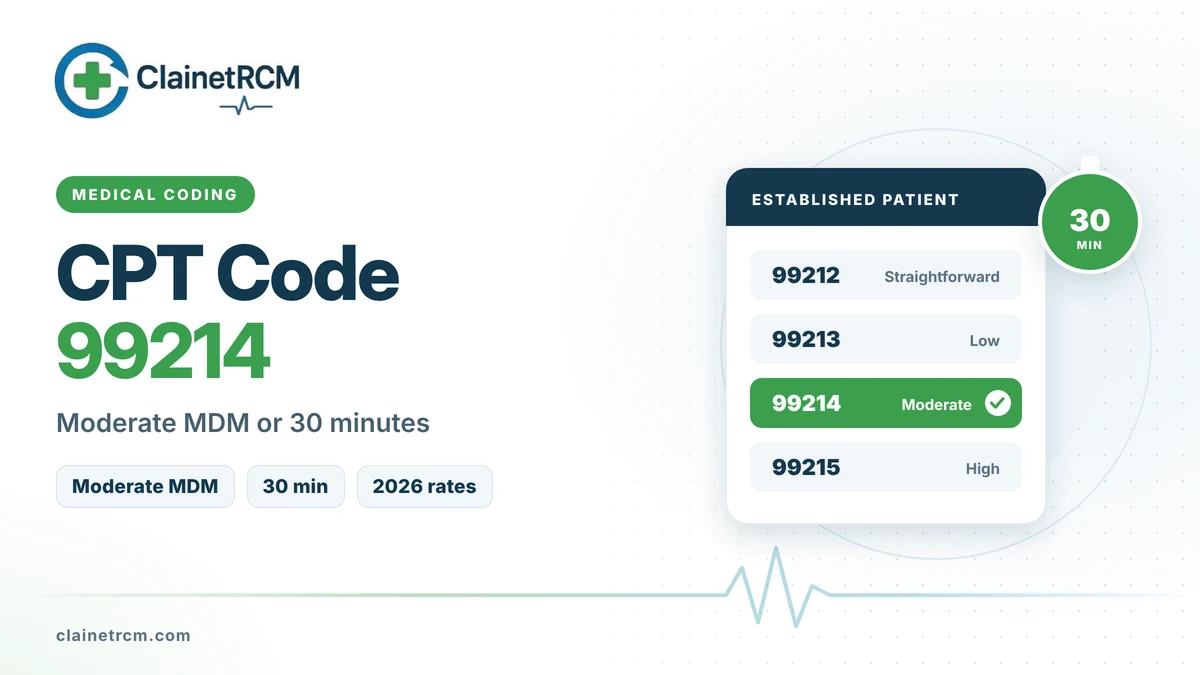
CPT code 99214 explained: moderate MDM or 30 minutes, the 2026 Medicare rate of $135.61, documentation examples, downcoding risks and 99213 vs 99214.
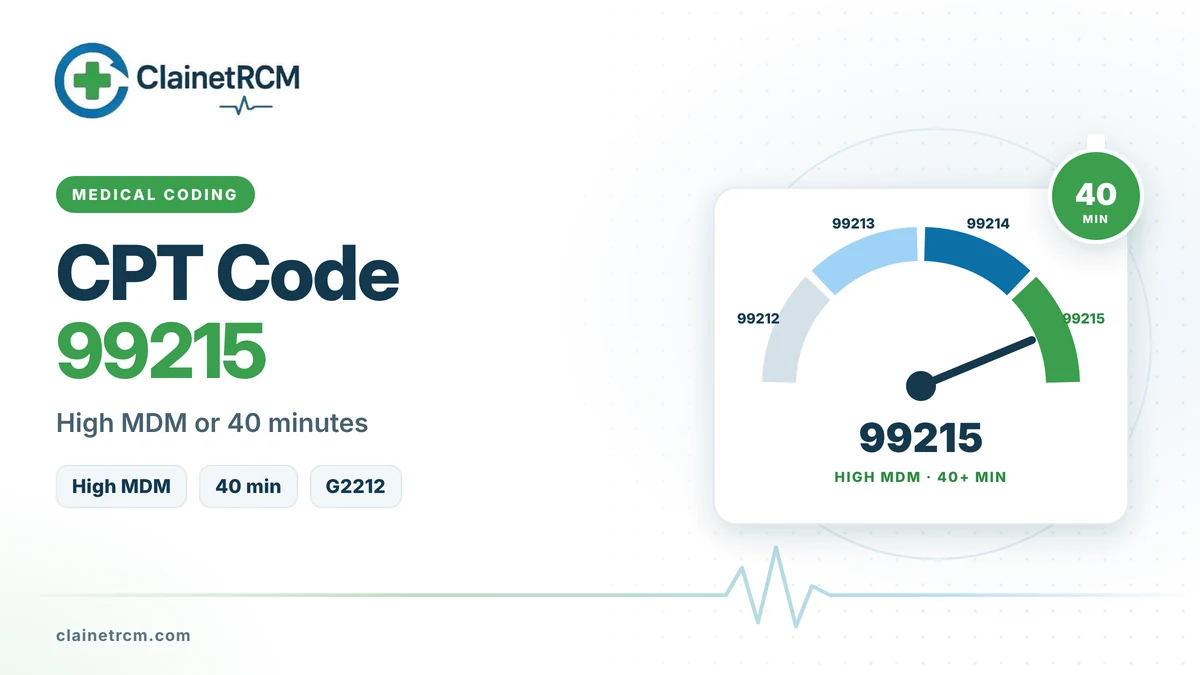
CPT code 99215 requires high MDM or 40 minutes. See the 2026 Medicare rate of $192.39, when G2212 or 99417 applies, documentation examples and audit risks.
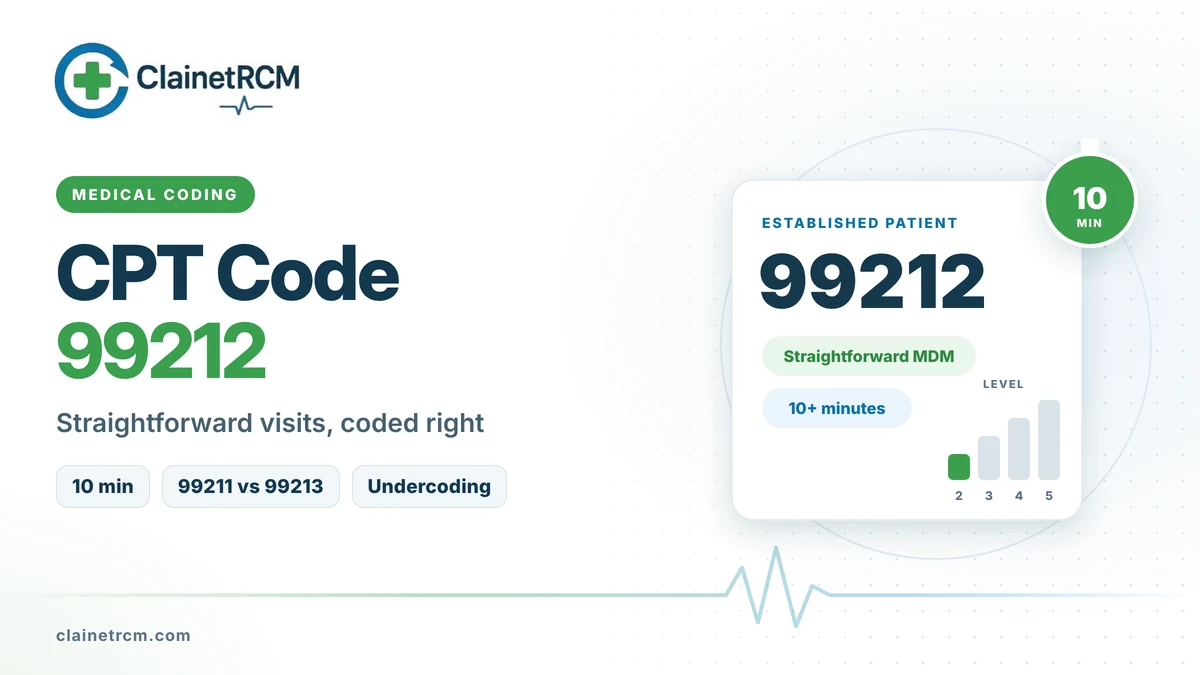
CPT code 99212 covers straightforward MDM or 10 minutes. See which visits fit, the 2026 Medicare rate of $59.45, 99211 vs 99212 vs 99213 and undercoding risks.
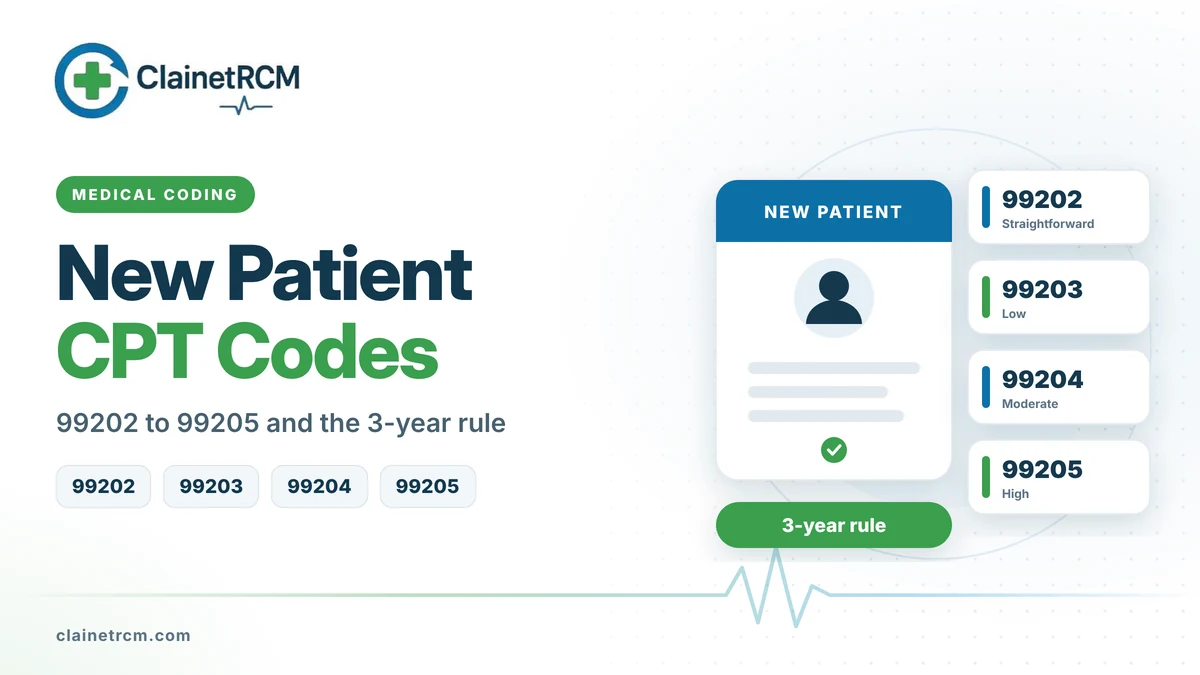
New patient CPT codes 99202 to 99205 explained: the three-year rule, MDM and time thresholds for each level, 2026 Medicare rates and common coding mistakes.
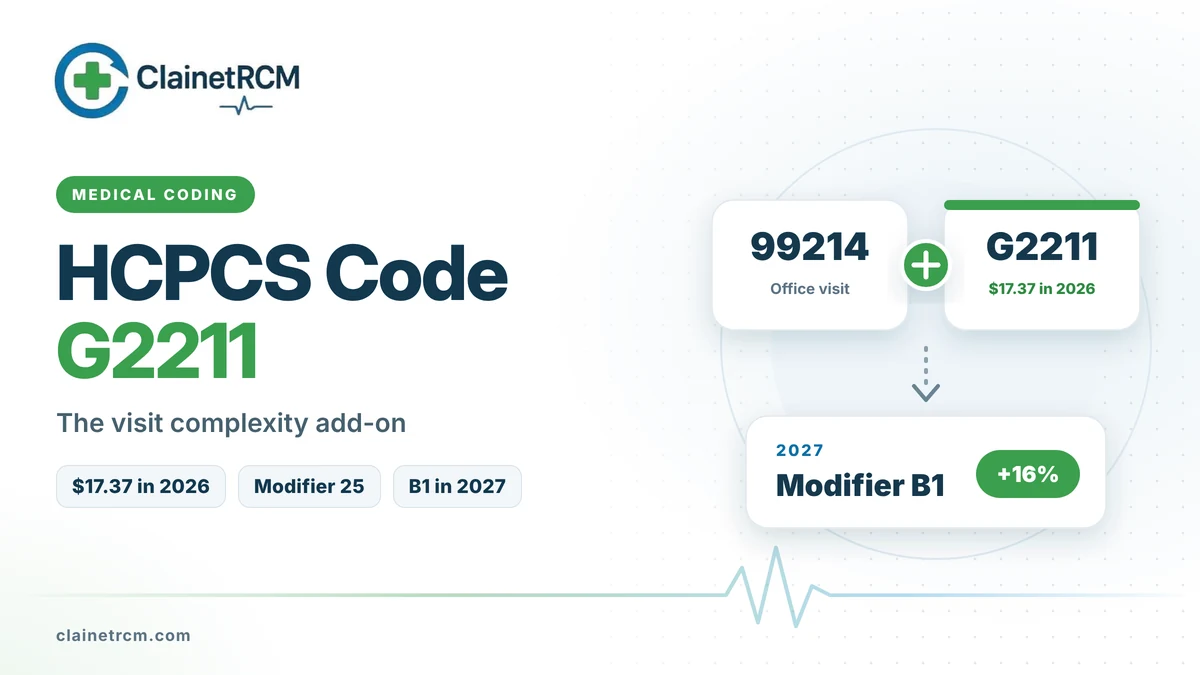
G2211 explained: who can bill the visit complexity add-on, the $17.37 rate for 2026, modifier 25 limits, home visits and the 2027 switch to modifier B1.
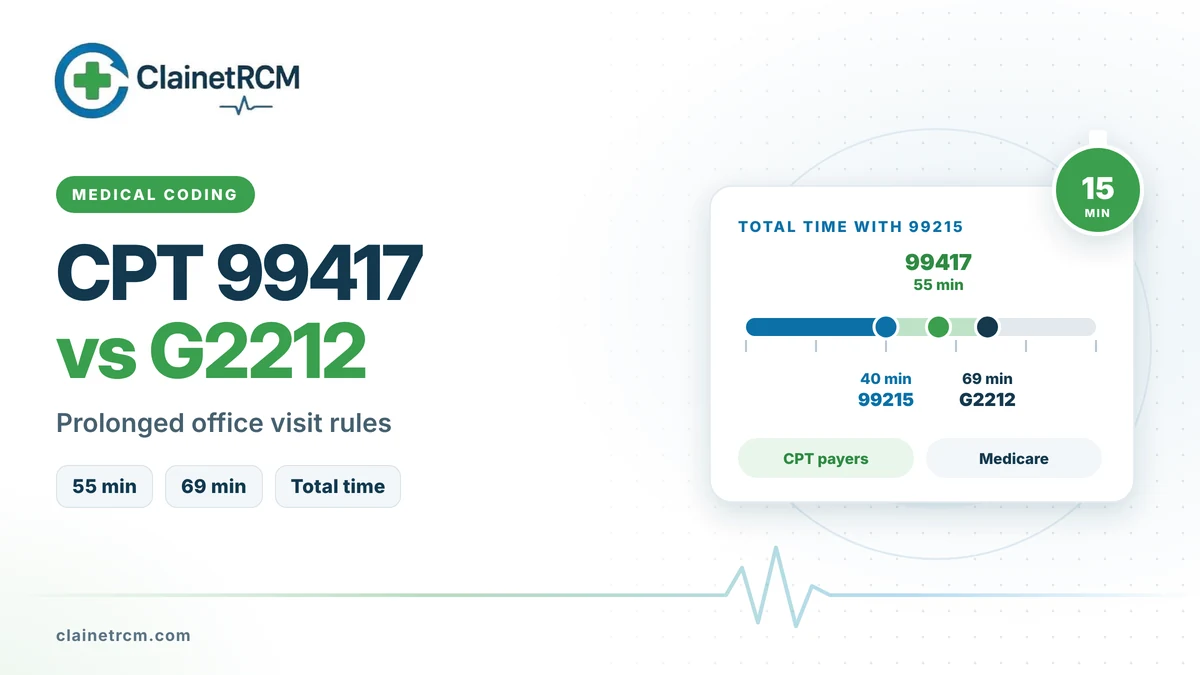
CPT code 99417 vs G2212: the 55 and 69 minute thresholds, which payers want which code, 2026 payment and how to document total time for prolonged office visits.
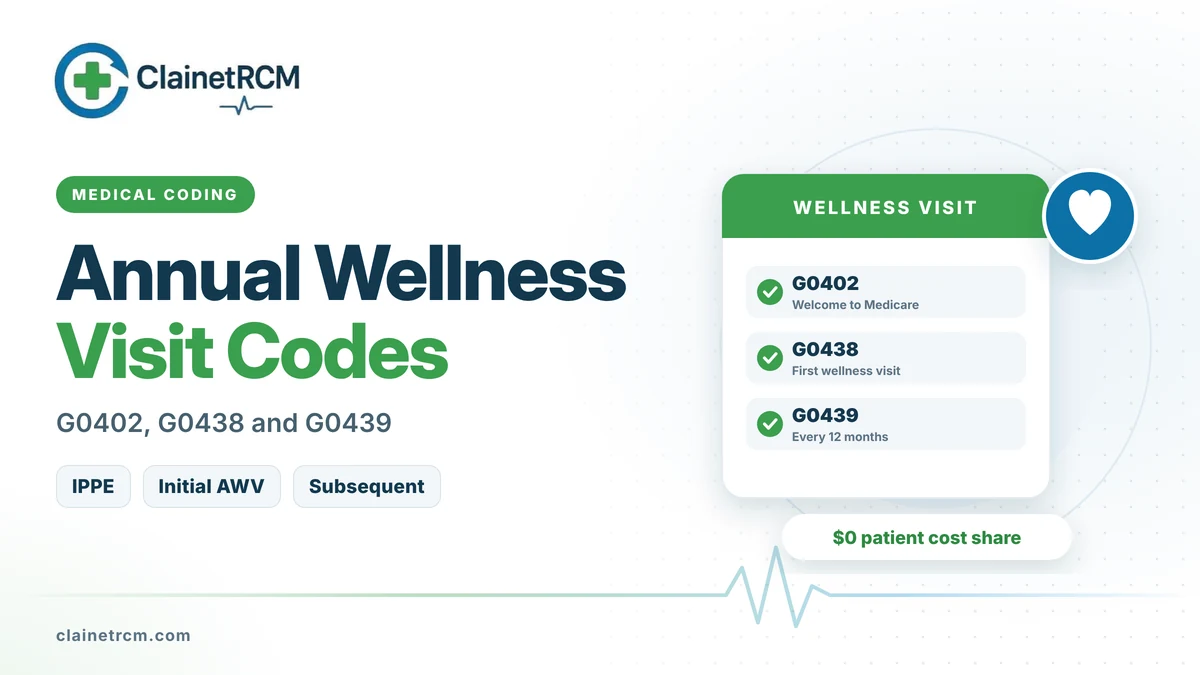
Annual wellness visit CPT codes explained: G0402 vs G0438 vs G0439, eligibility timing, required elements, 2026 rates, add-on codes and same-day E/M rules.
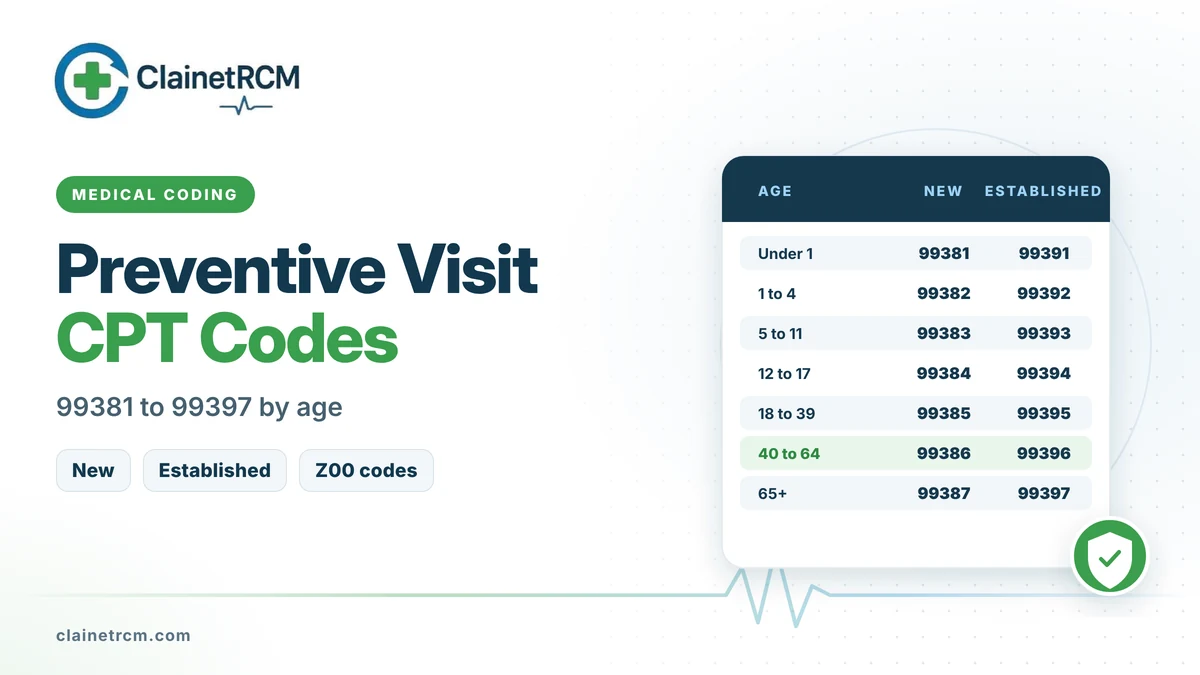
Preventive visit CPT codes 99381-99397 by age, new vs established rules, ICD-10 Z00 codes, Medicare vs commercial coverage and same-day sick visits.
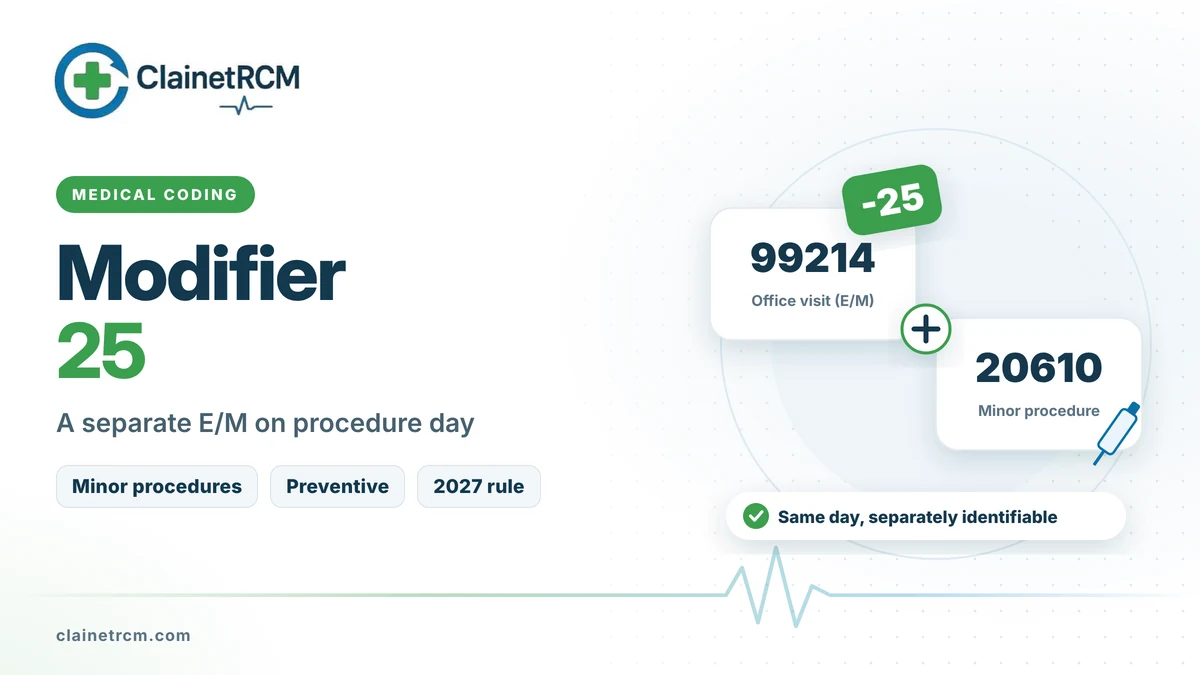
Modifier 25 rules for 2026: when an E/M is significant and separately identifiable, minor procedure examples, payer cuts and Medicare's 2027 same-day cut.
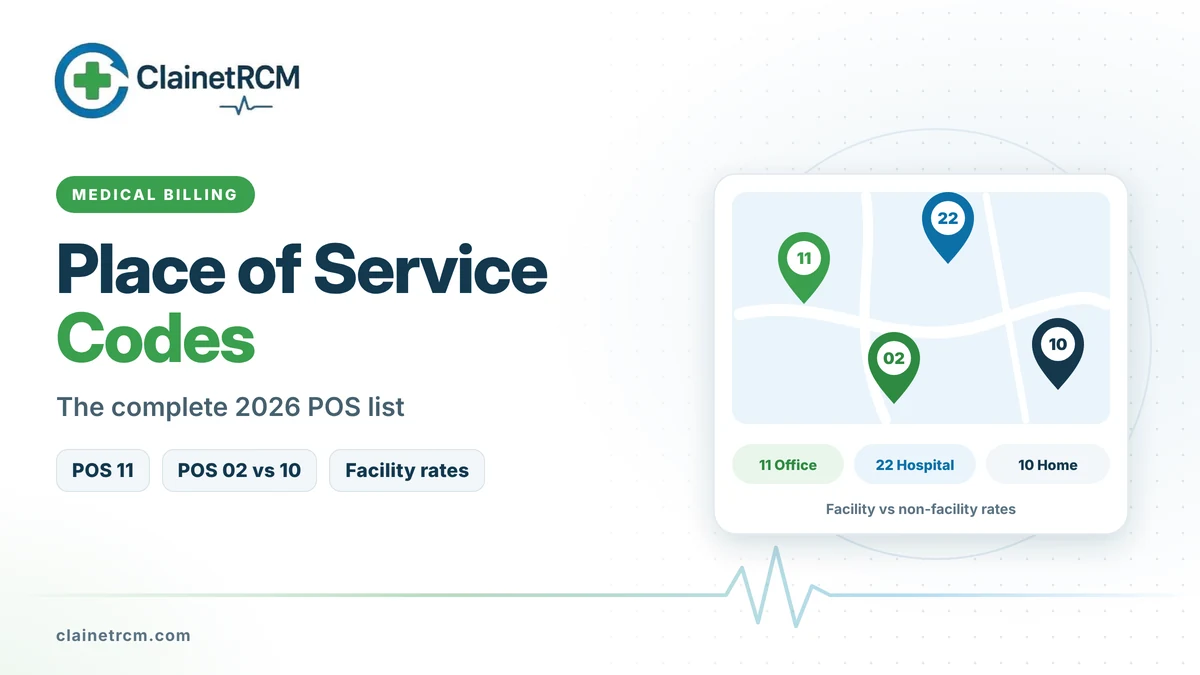
Place of service codes explained: the full CMS POS list, facility vs non-facility payment, telehealth POS 02 vs 10 and the POS errors that trigger denials.
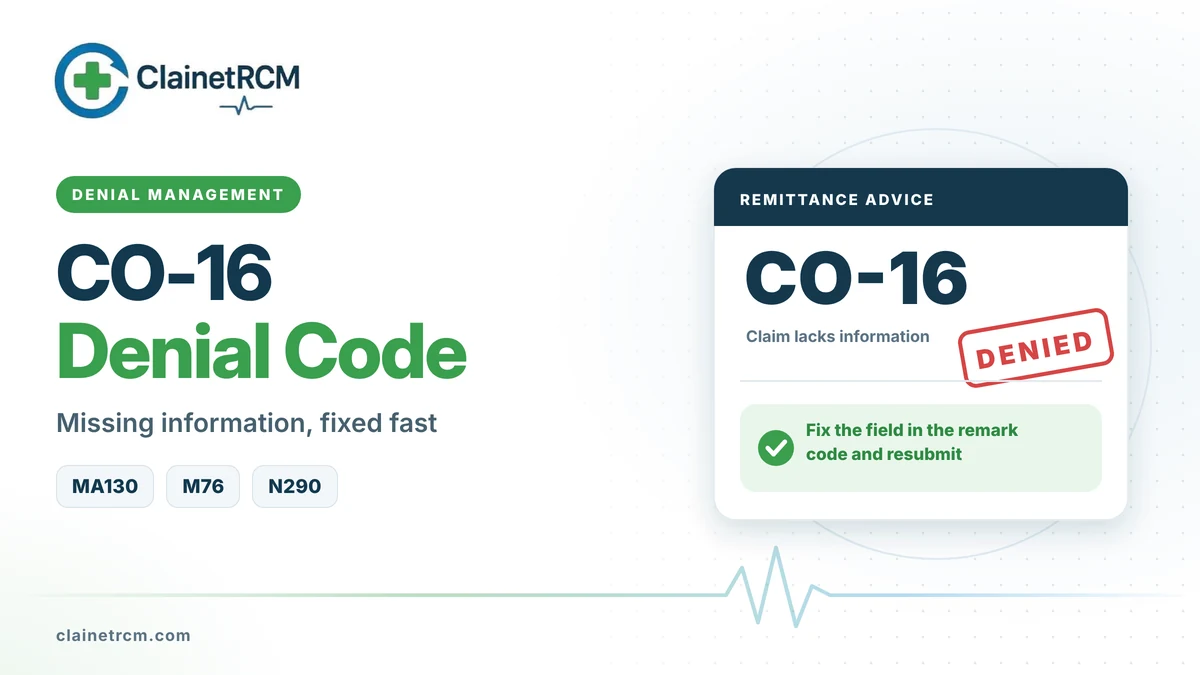
The CO-16 denial code means a claim is missing information or has a billing error. Learn how to read the paired remark code, fix the claim and prevent repeats.
The CO-97 denial code means a service was bundled into another one. Learn the NCCI edits, global period rules and modifiers behind it, and when to appeal.
The CO-197 denial code means precertification or authorization was absent. Learn the causes, retro-authorization and appeal options, and how to prevent it.
The CO-50 denial code means the payer says a service was not medically necessary. Learn the LCD and NCD checks, ABN rules and how to win the appeal.
The CO-4 denial code means a procedure code and modifier do not match, or a required modifier is missing. See common causes, fixes and prevention tips.
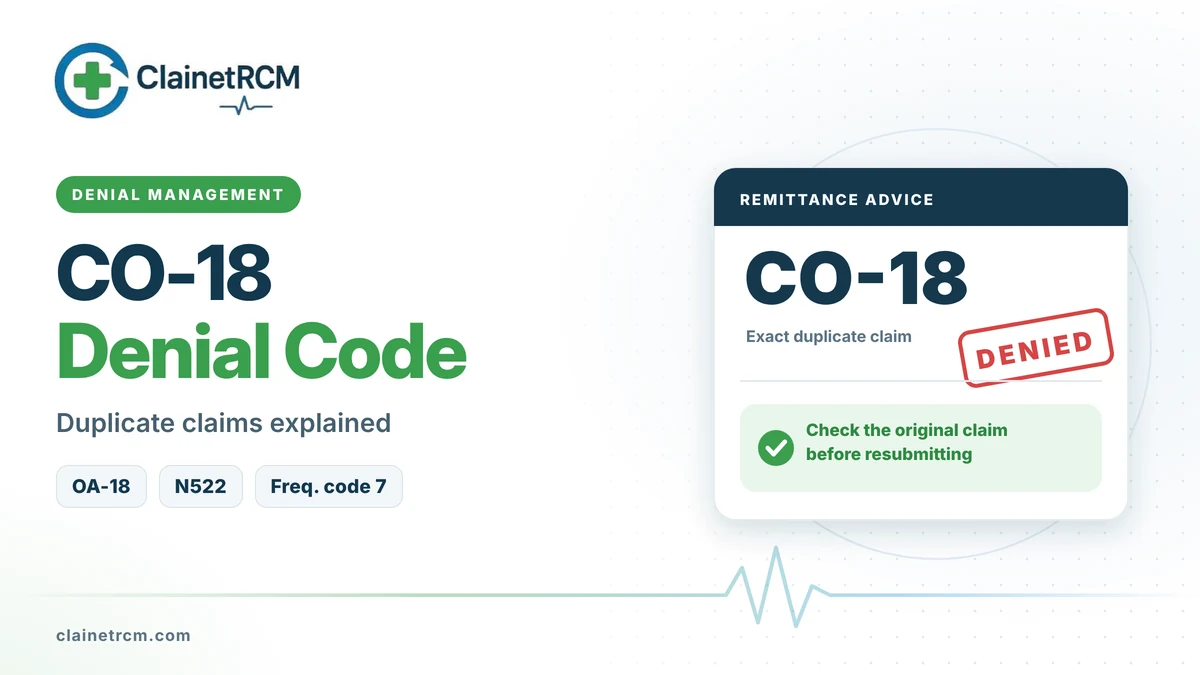
The CO-18 denial code flags an exact duplicate claim or service. Learn why it appears as OA-18 or CO-18, how to tell true duplicates apart and how to stop them.
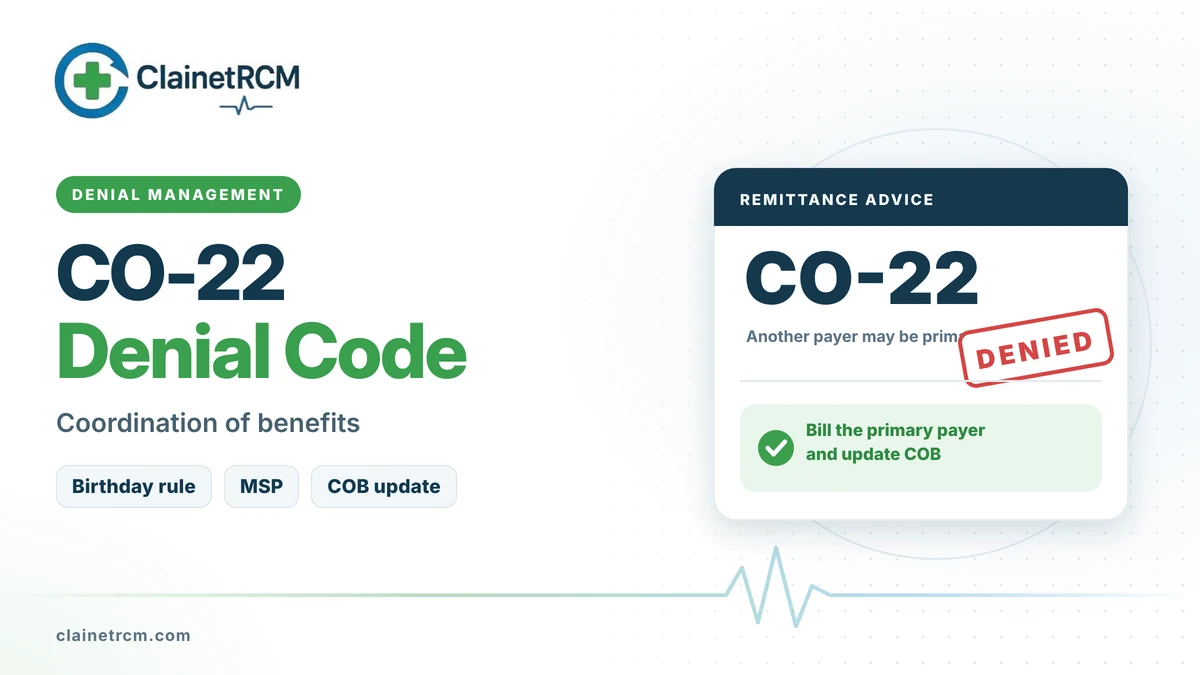
The CO-22 denial code means another payer may be primary. Learn how to confirm coverage order, update COB, apply the birthday and MSP rules and rebill fast.
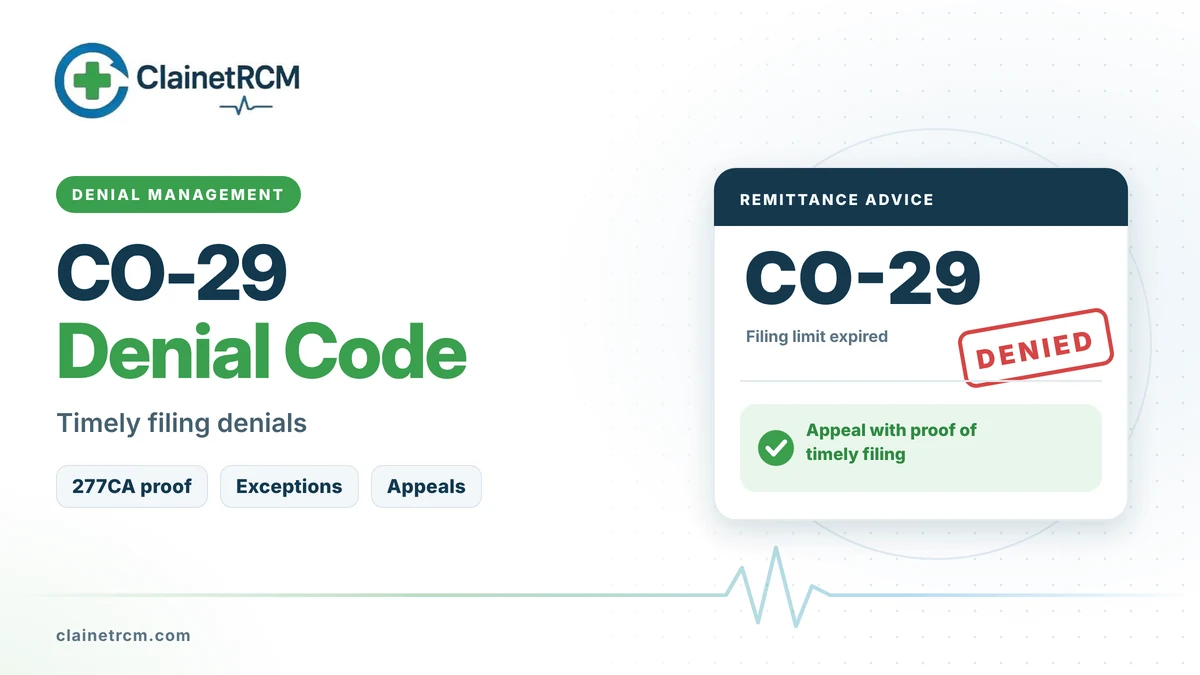
The CO-29 denial code means the filing deadline passed. Learn how to prove timely filing, which exceptions apply and when an appeal can still get you paid.
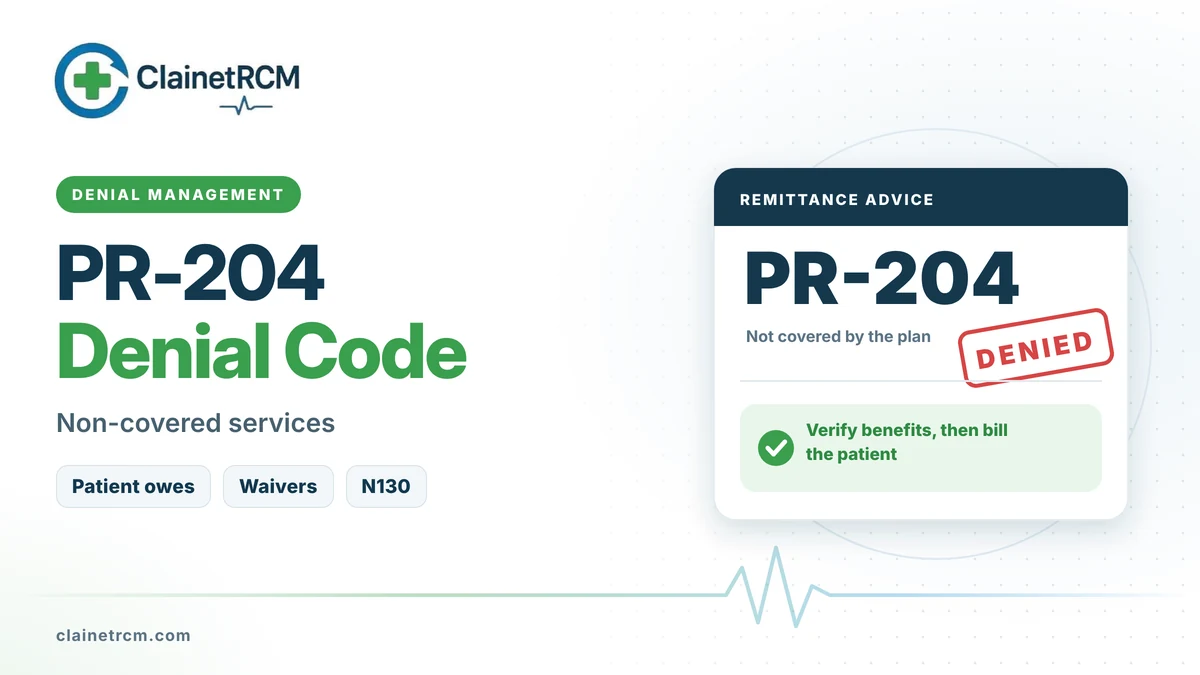
The PR-204 denial code means the service is not covered under the patient's plan. Learn when the patient owes, how to verify benefits and how to prevent it.
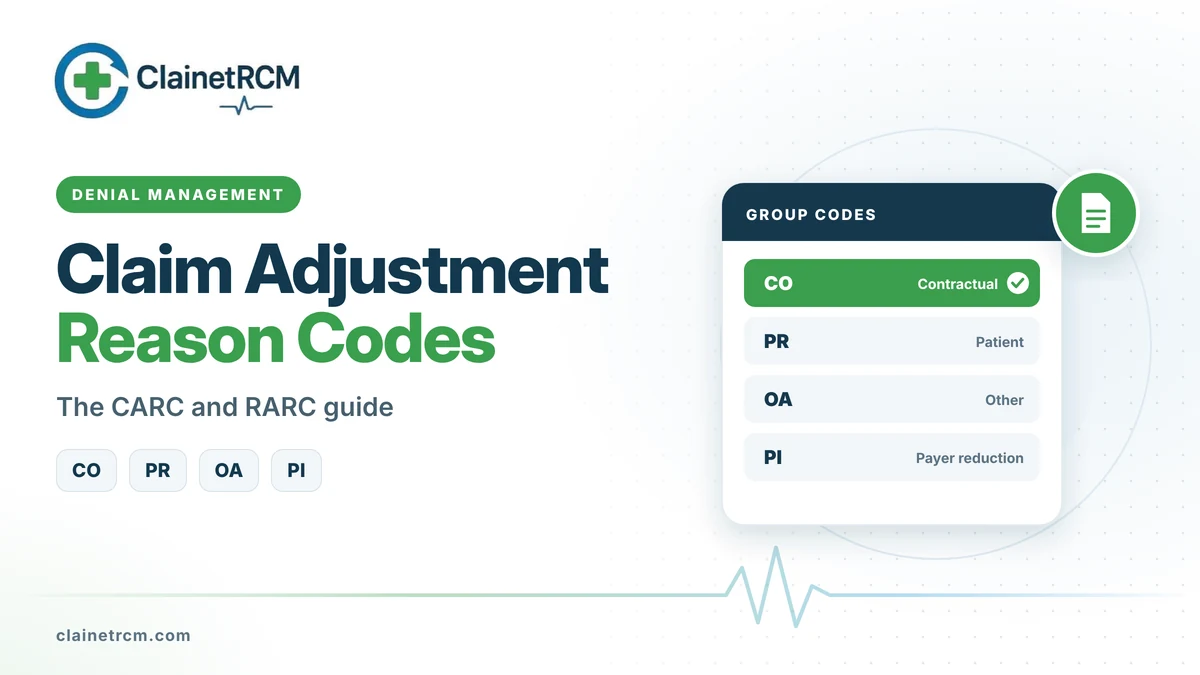
Claim adjustment reason codes explained: how group codes, CARCs and RARCs work together, the codes practices see most and what to do about each one.
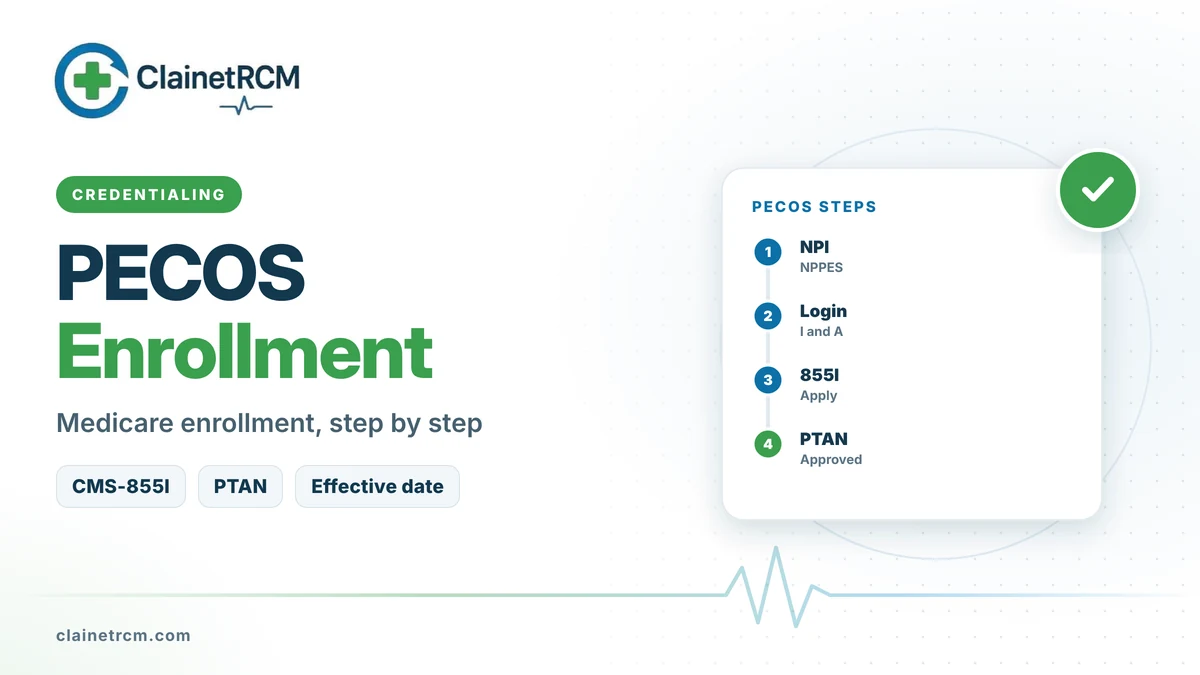
A step-by-step guide to PECOS enrollment: account setup, the right CMS-855 application, documents, fees, effective dates and realistic MAC timelines.
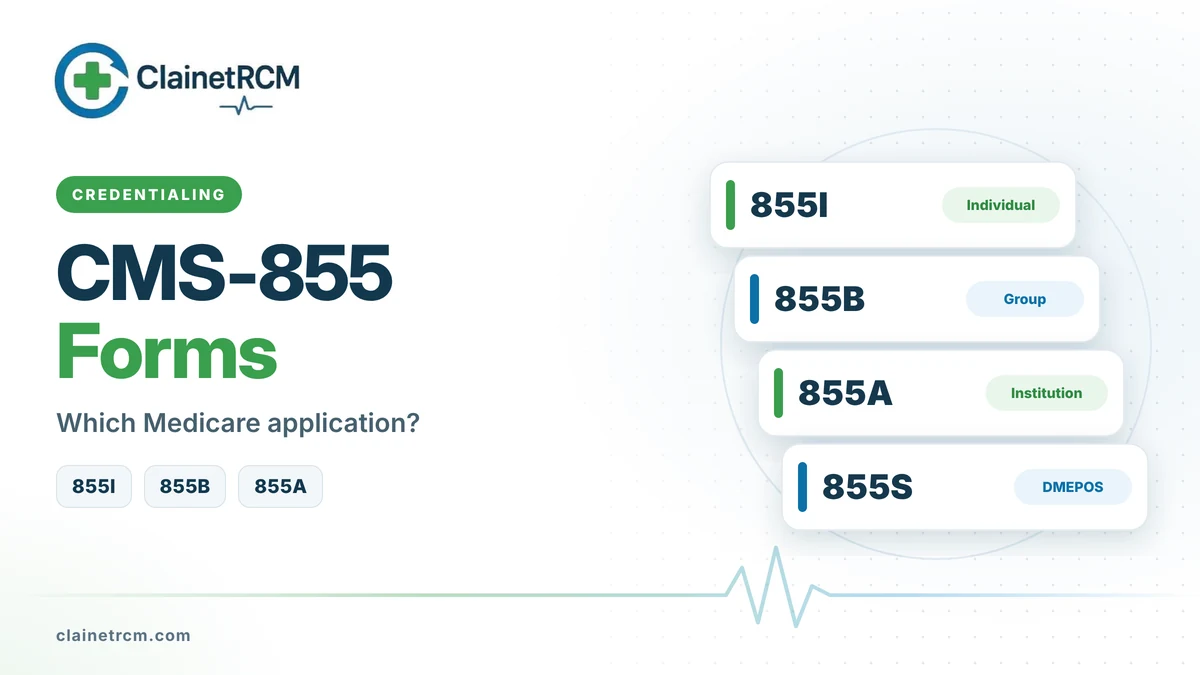
CMS-855 forms explained: when to use the 855I, 855B, 855A, 855O and 855S, what replaced the 855R, and the errors that trigger MAC development letters.
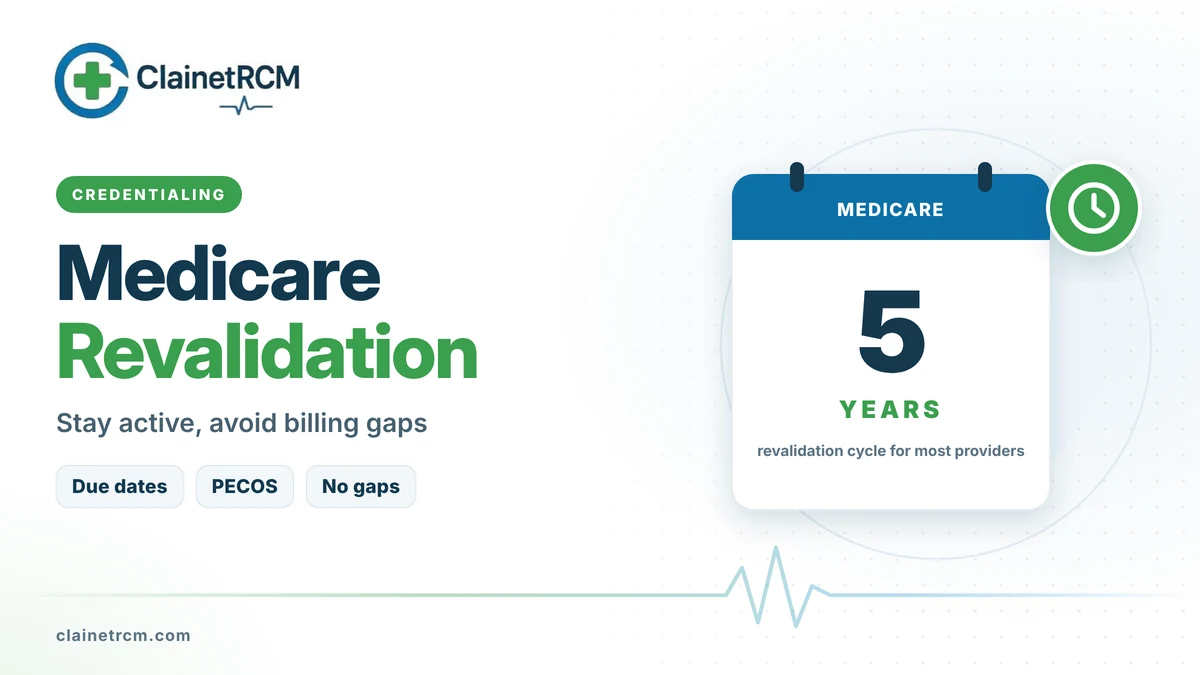
Medicare revalidation is due every five years (three for DMEPOS). Find your due date, submit in the right window and avoid deactivation and payment gaps.
CAQH ProView guide: build your profile, re-attest every 120 days, authorize health plans and fix expired or incomplete profiles that stall credentialing.
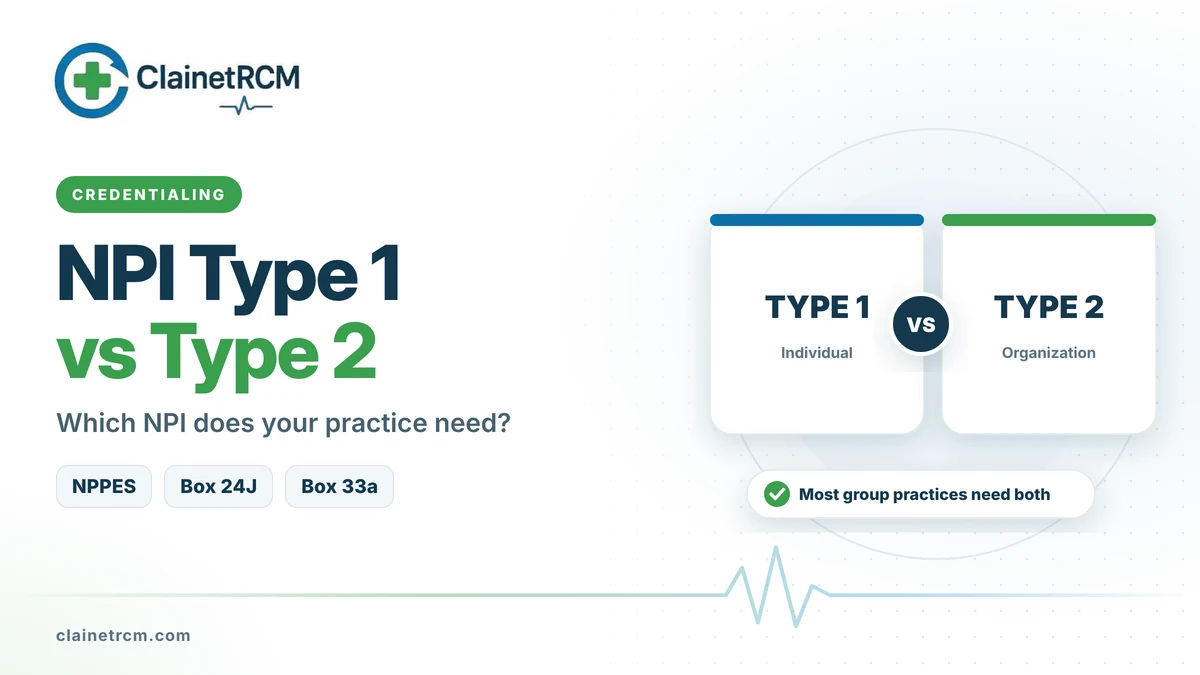
NPI Type 1 vs Type 2 explained: individual vs organizational NPIs, who needs both, how to apply in NPPES and which NPI goes in each claim form box.
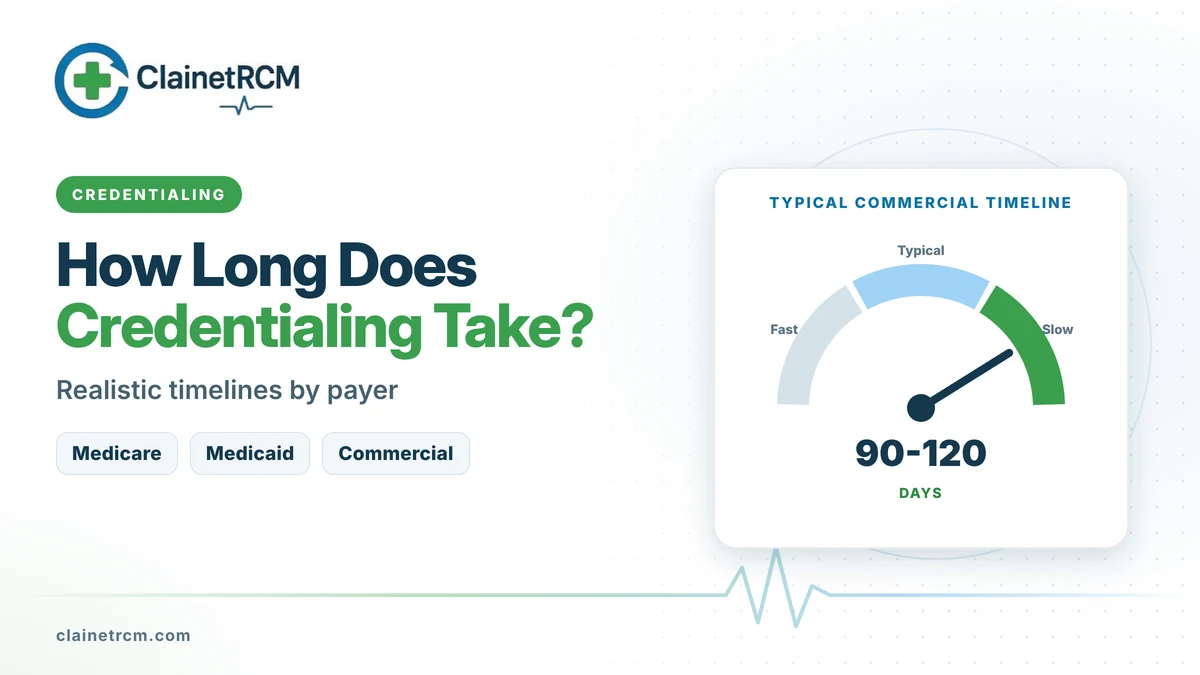
How long does credentialing take? See realistic timelines for Medicare, Medicaid and commercial payers, what slows applications down and how to plan for it.
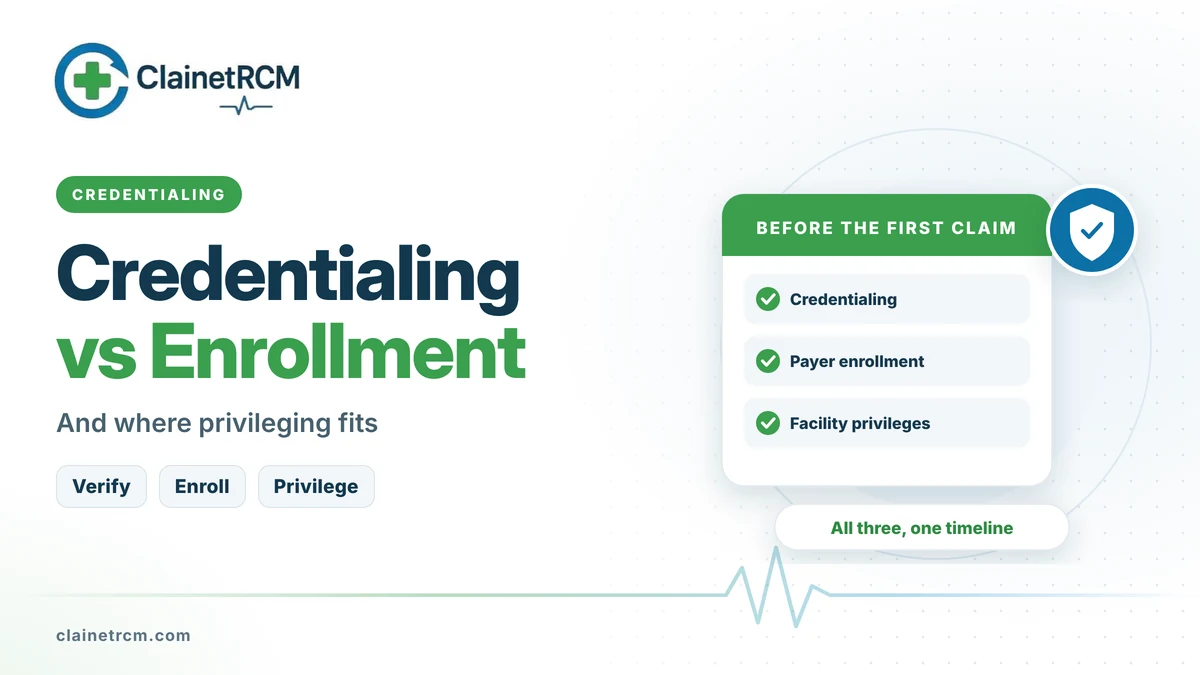
Credentialing vs enrollment vs privileging: what each process verifies, who performs it and why your practice needs all three before the first paid claim.
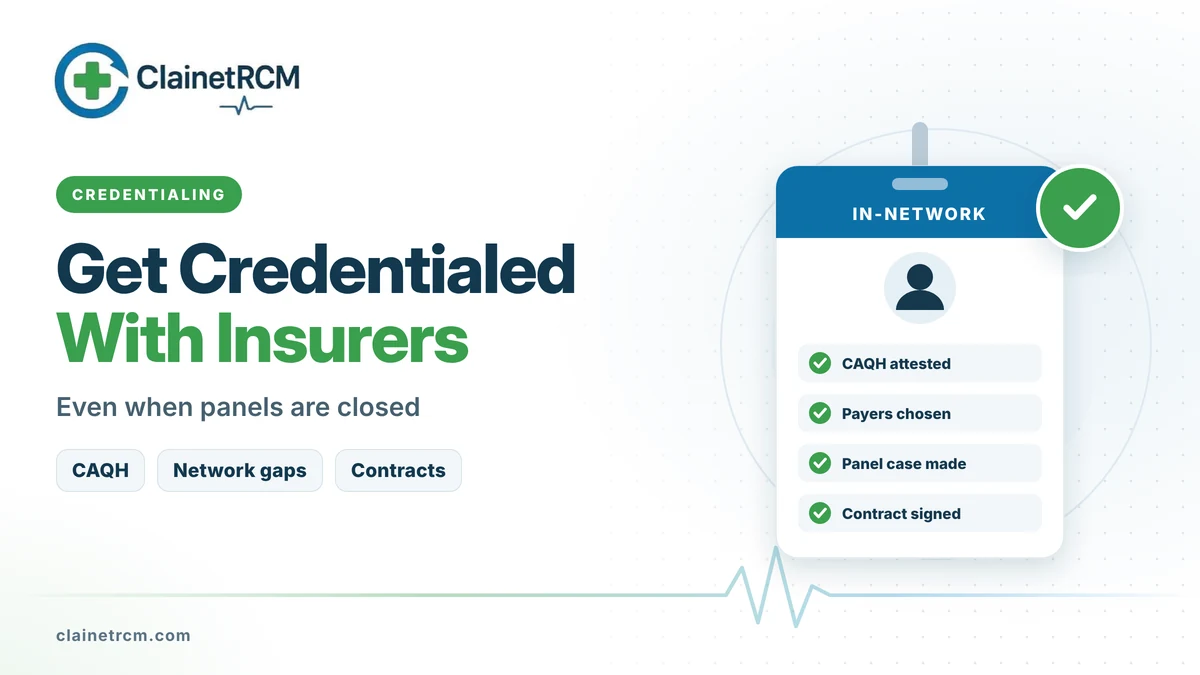
How to get credentialed with insurance companies: the step-by-step process, which payers to start with, and how to respond when a panel says it is closed.
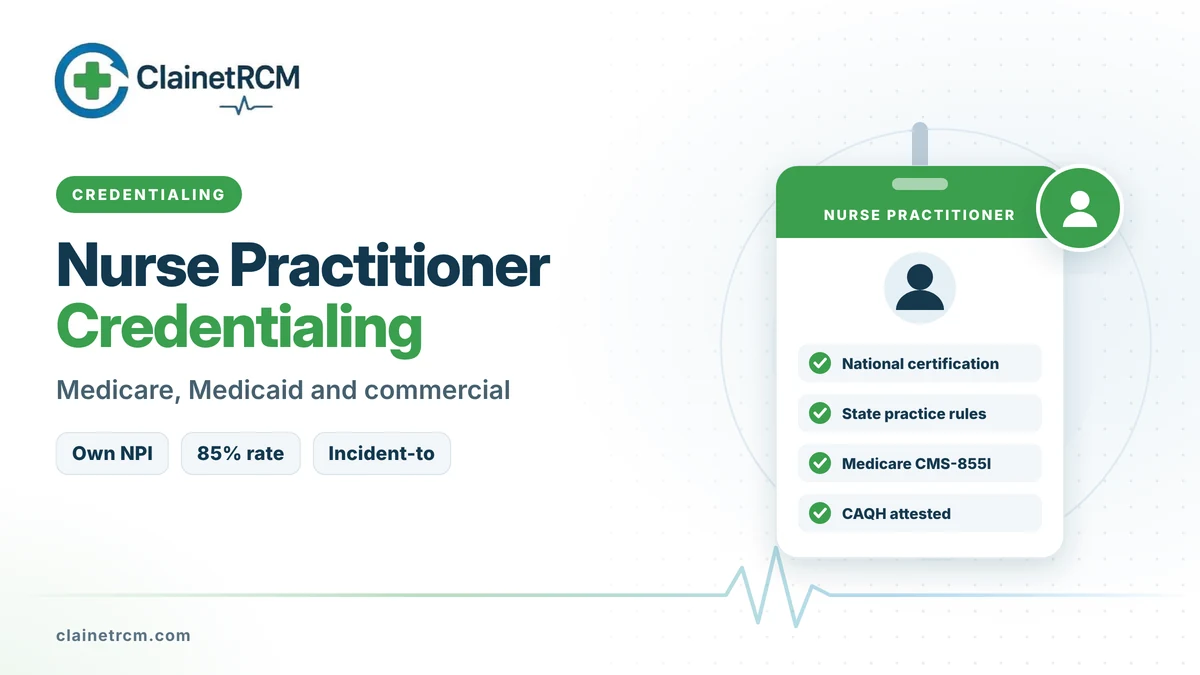
Nurse practitioner credentialing explained: Medicare requirements, state practice rules, Medicaid and commercial panels, and incident-to billing.
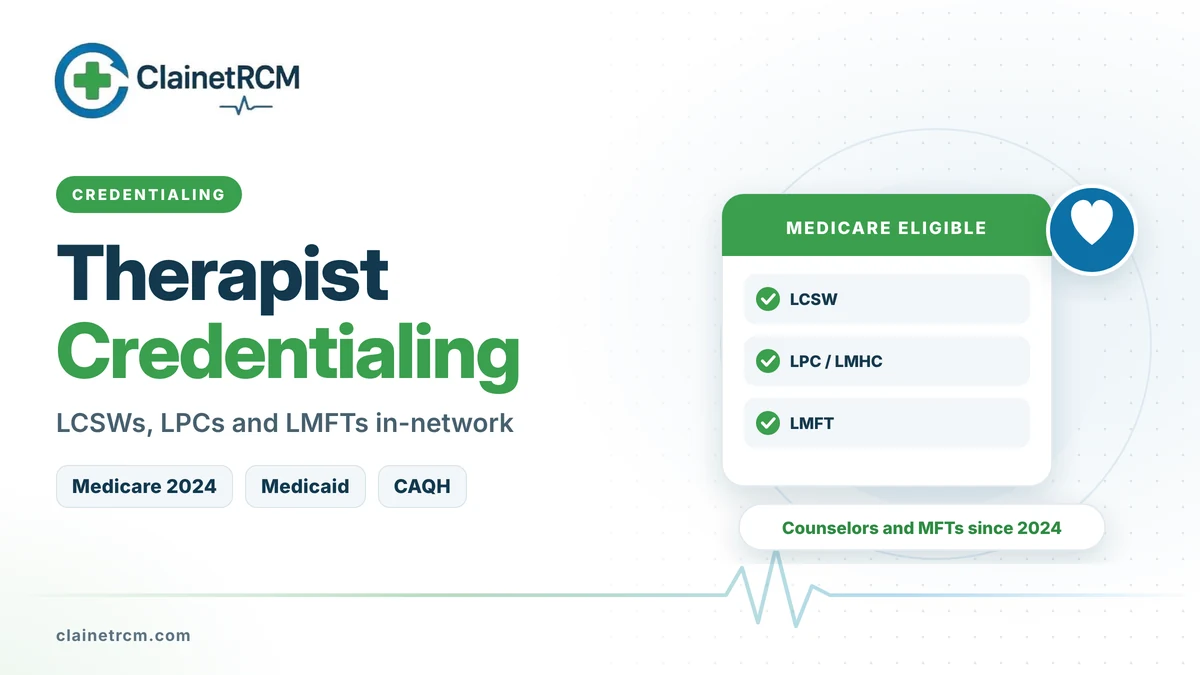
Therapist credentialing for LCSWs, LPCs and LMFTs: Medicare enrollment for counselors and MFTs, Medicaid and commercial panels, and mistakes to avoid.
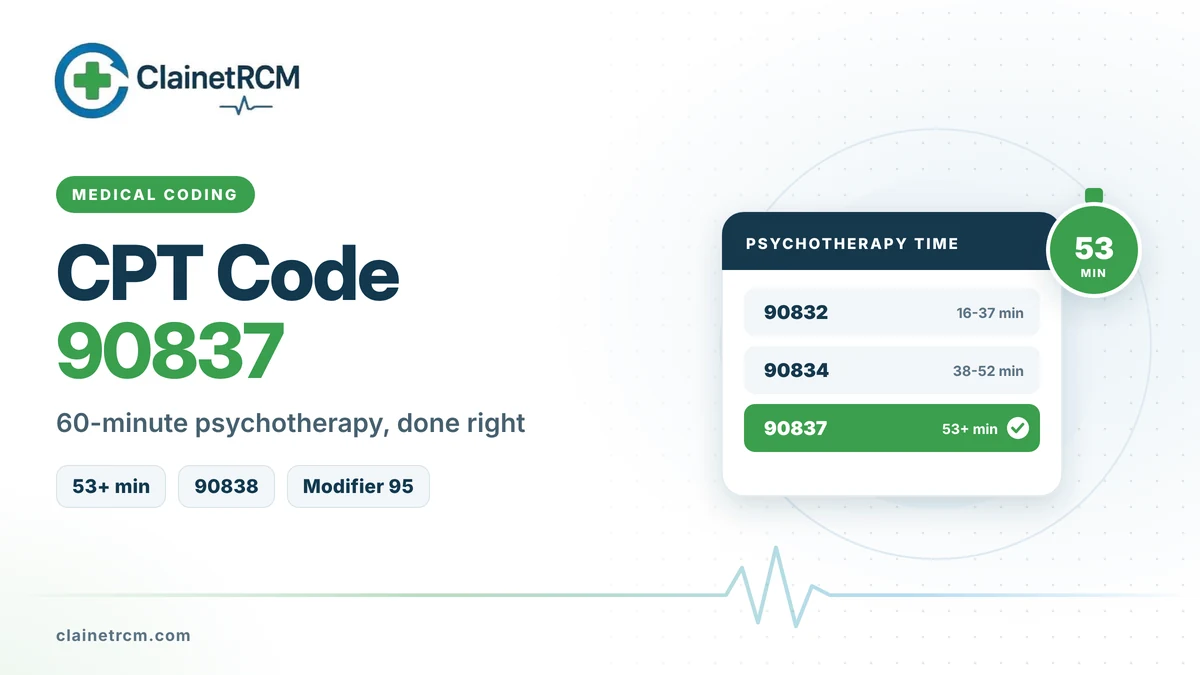
CPT code 90837 covers 53+ minutes of psychotherapy. Learn the time rules, 2026 Medicare rate, documentation payers audit, add-ons and telehealth modifiers.
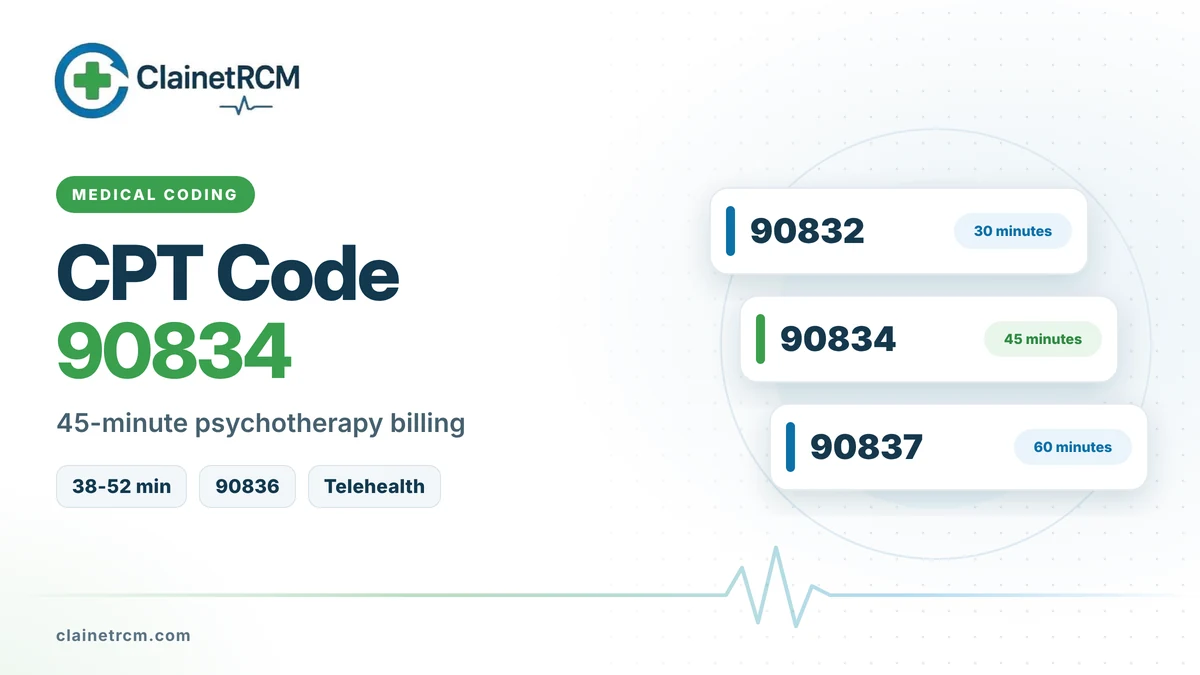
CPT code 90834 covers 38 to 52 minutes of psychotherapy. Learn how to choose between 90832, 90834 and 90837, pair it with E/M, and avoid common denials.
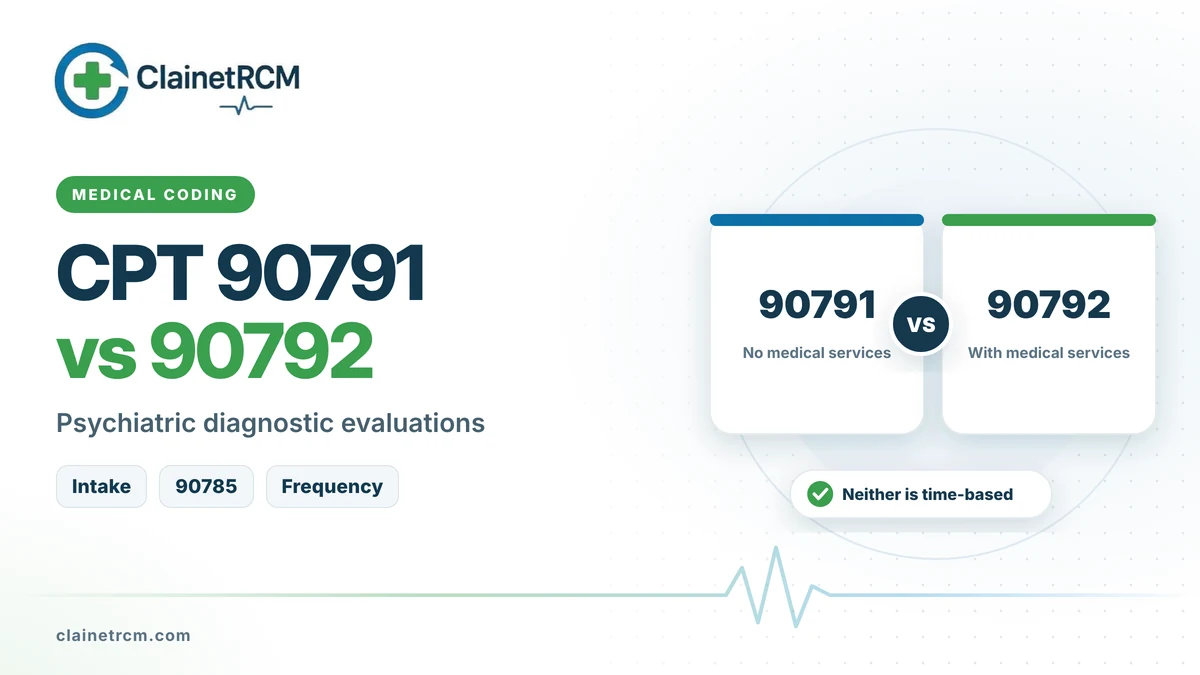
CPT code 90791 vs 90792: who can bill each psychiatric diagnostic evaluation, what each must include, 2026 Medicare rates and payer frequency limits.
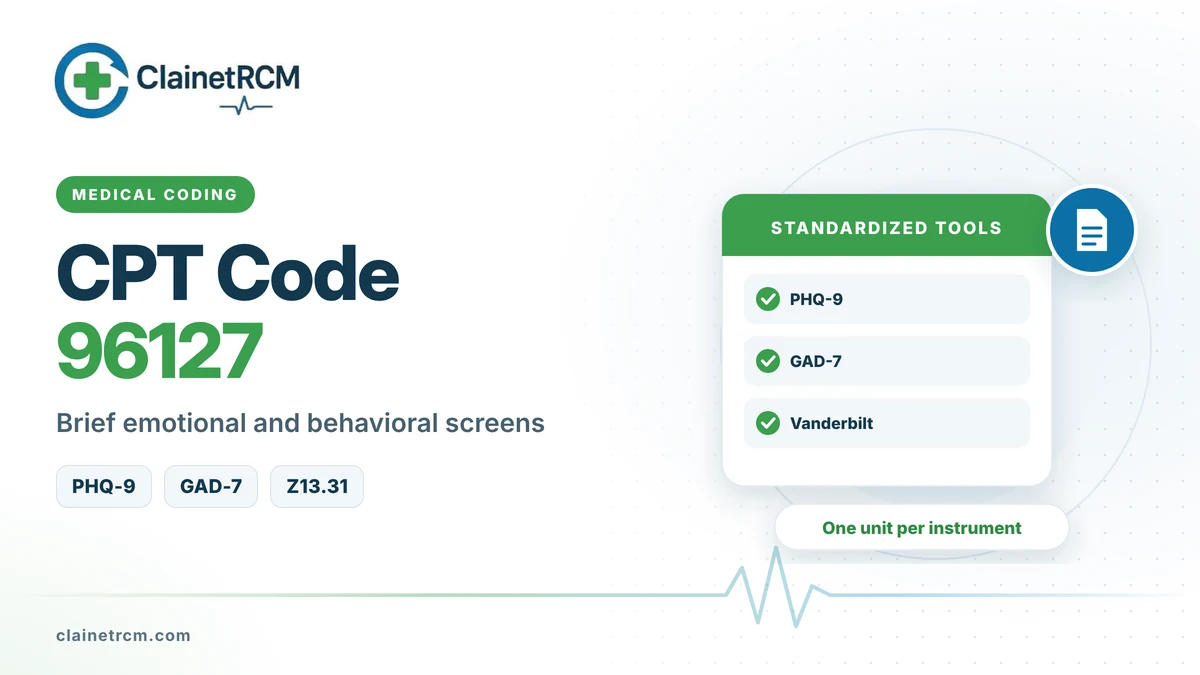
CPT code 96127 pays for standardized screening tools like the PHQ-9, GAD-7 and Vanderbilt. Learn unit limits, ICD-10 pairings, payer rules and documentation.
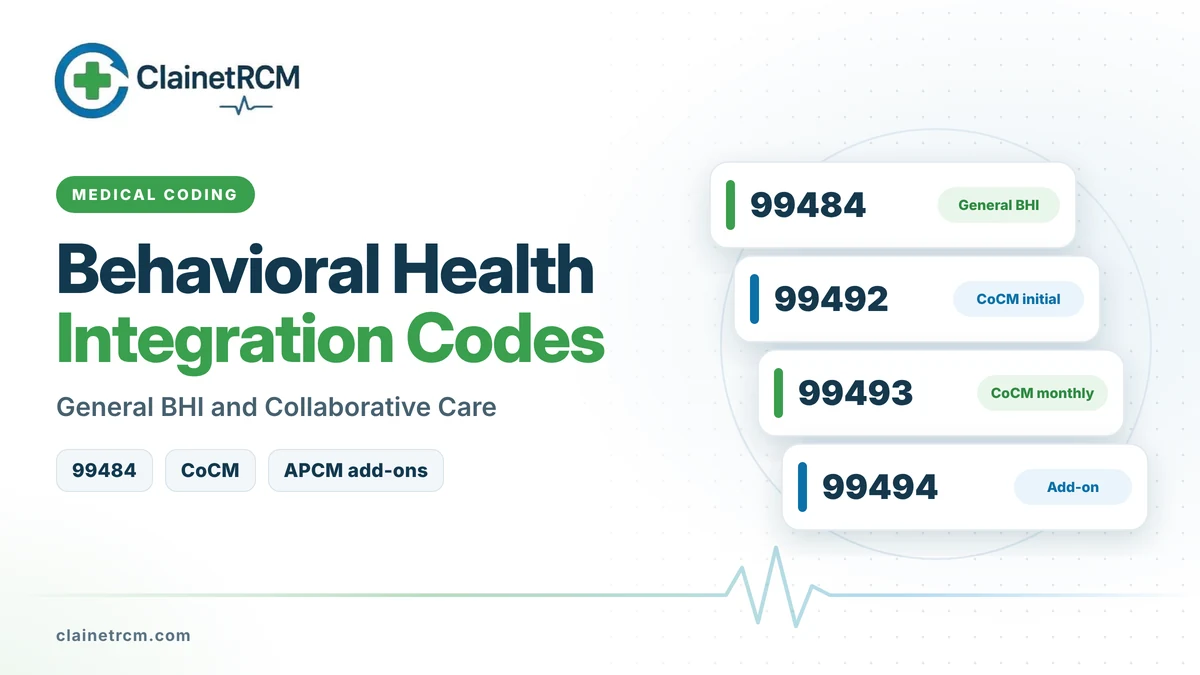
Behavioral health integration codes explained: 99484 general BHI, CoCM 99492-99494, G2214, G0323 and the 2026 APCM add-ons, with time rules and billers.
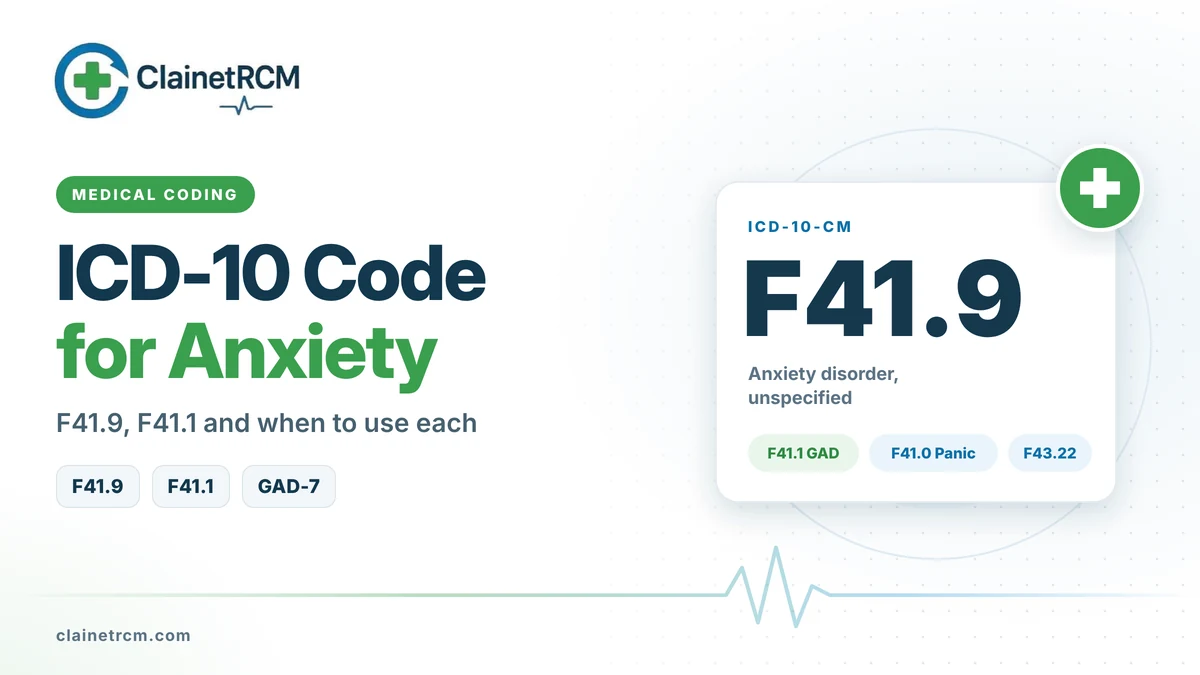
The ICD-10 code for anxiety is F41.9 when unspecified and F41.1 for generalized anxiety disorder. See related codes, documentation tips and billing pairings.
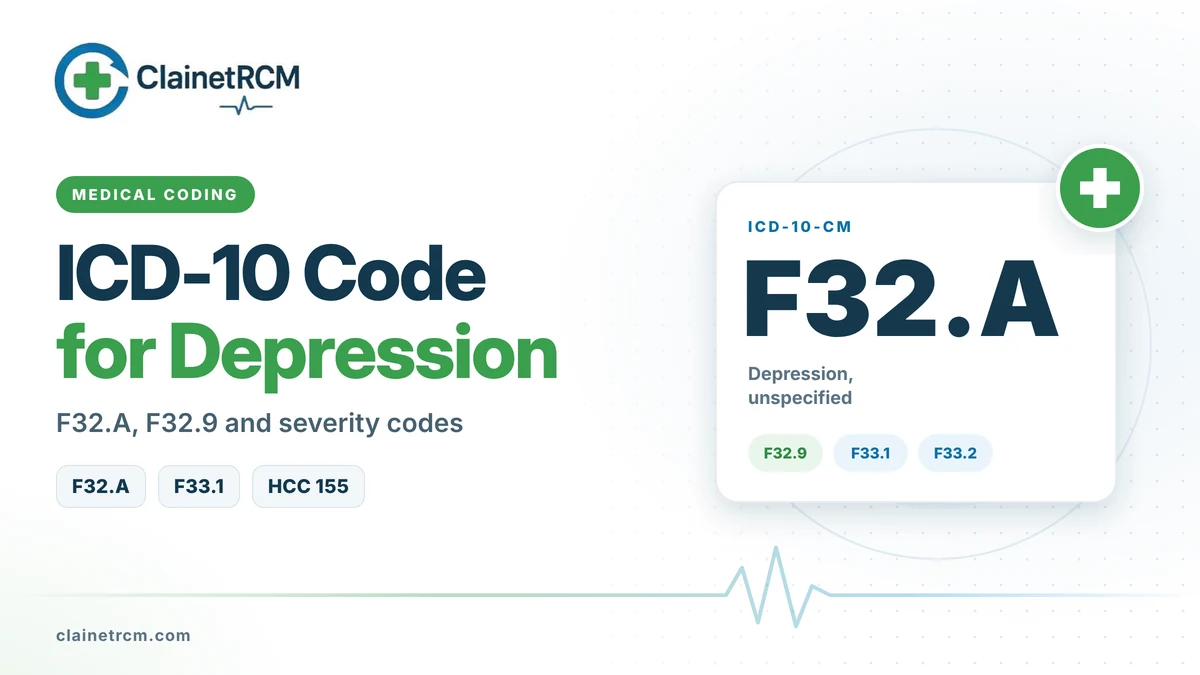
The ICD-10 code for depression depends on documentation: F32.A, F32.9 or F32 and F33 severity codes. Learn which to use and how it affects TMS and Spravato.
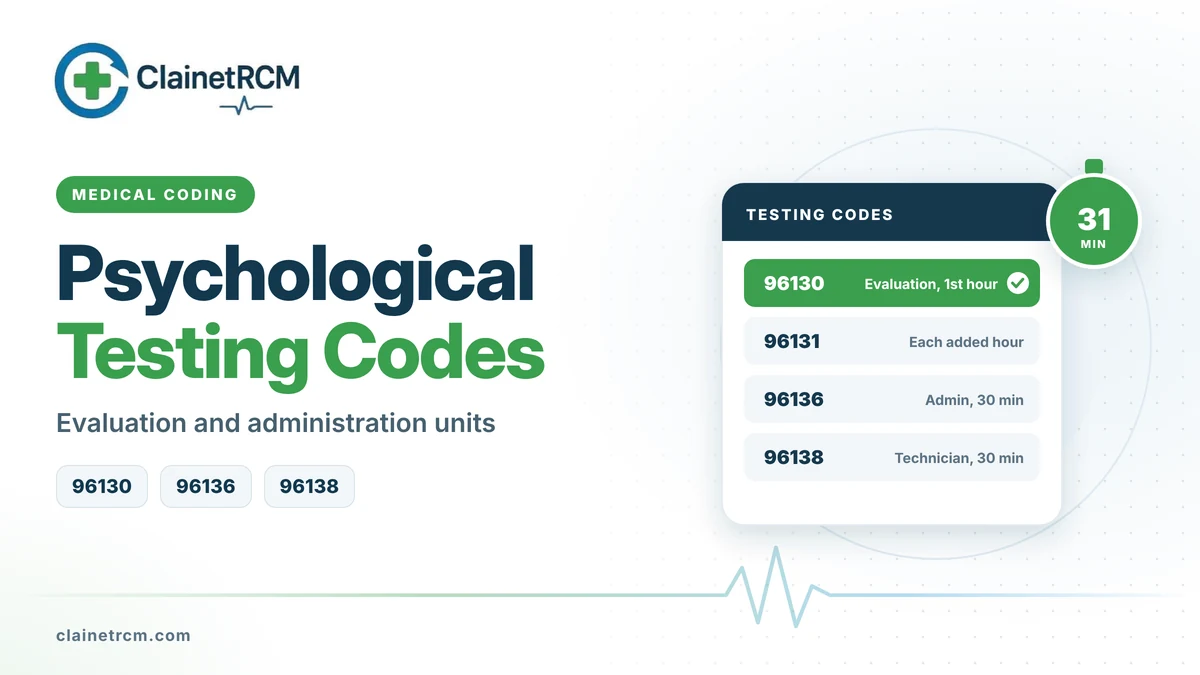
Psychological testing CPT codes explained: evaluation services 96130-96133, test administration 96136-96139, time thresholds, add-on units and denials.
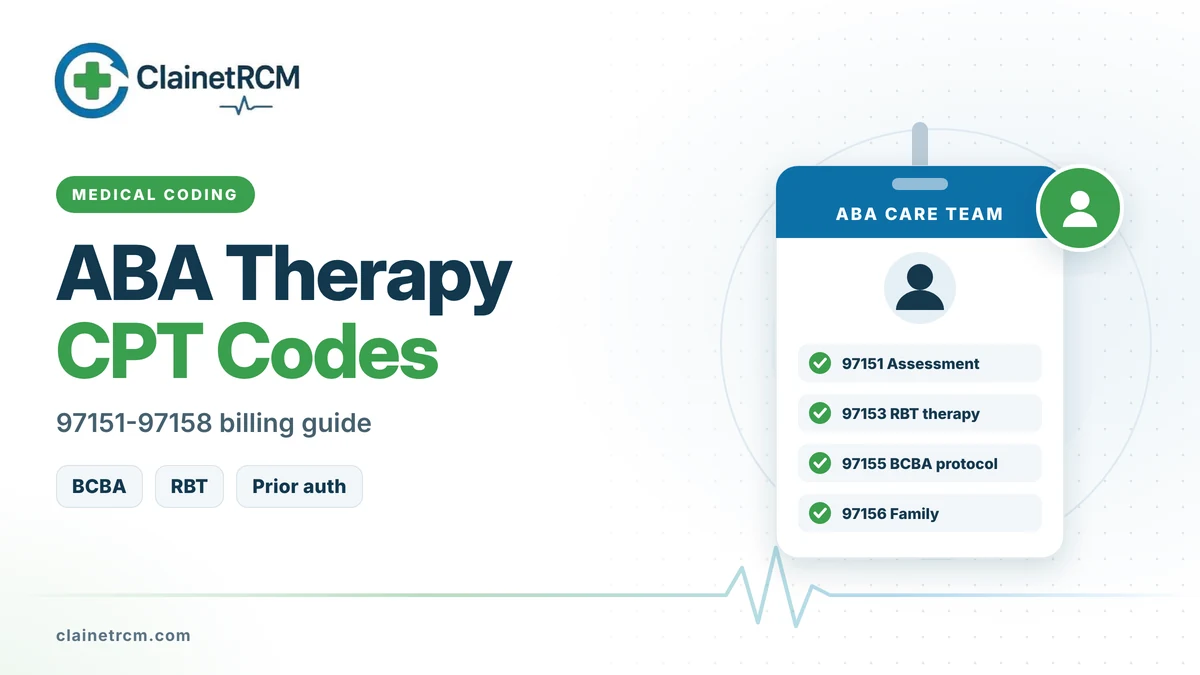
ABA therapy CPT codes 97151-97158 explained: what each code covers, who can bill it, 15-minute unit rules, modifiers and the authorization pitfalls to avoid.
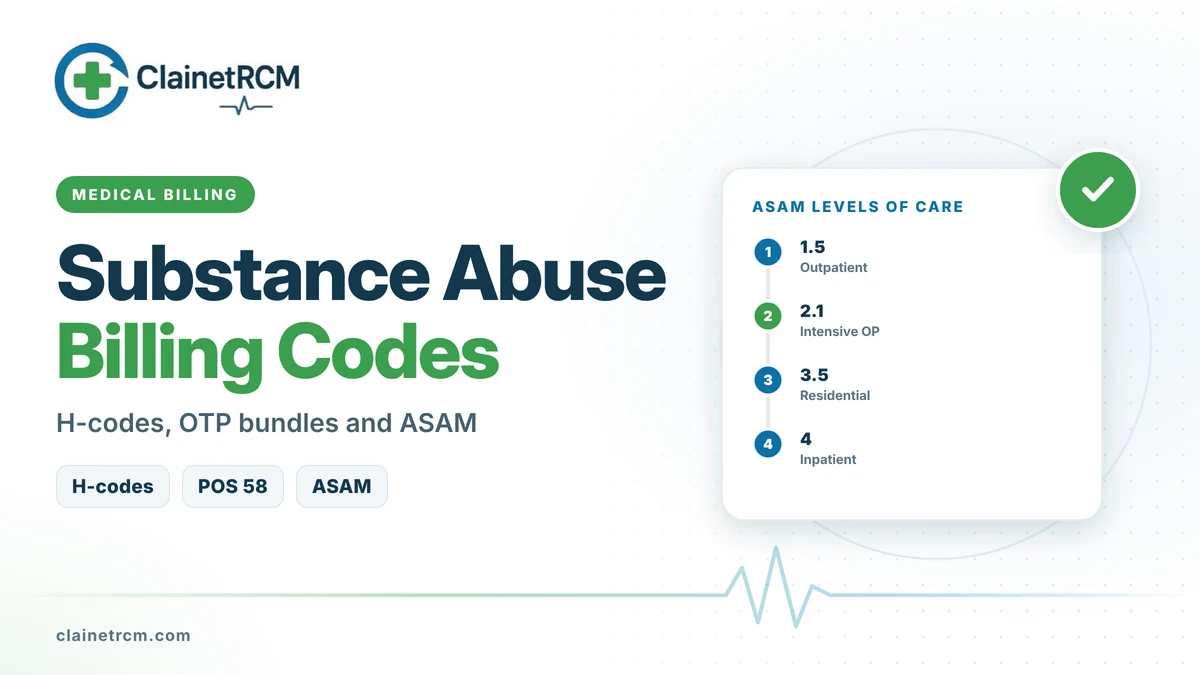
Substance abuse billing codes explained: Medicaid H-codes, Medicare OTP bundles, office-based OUD G-codes, SBIRT, and how ASAM levels of care map to billing.
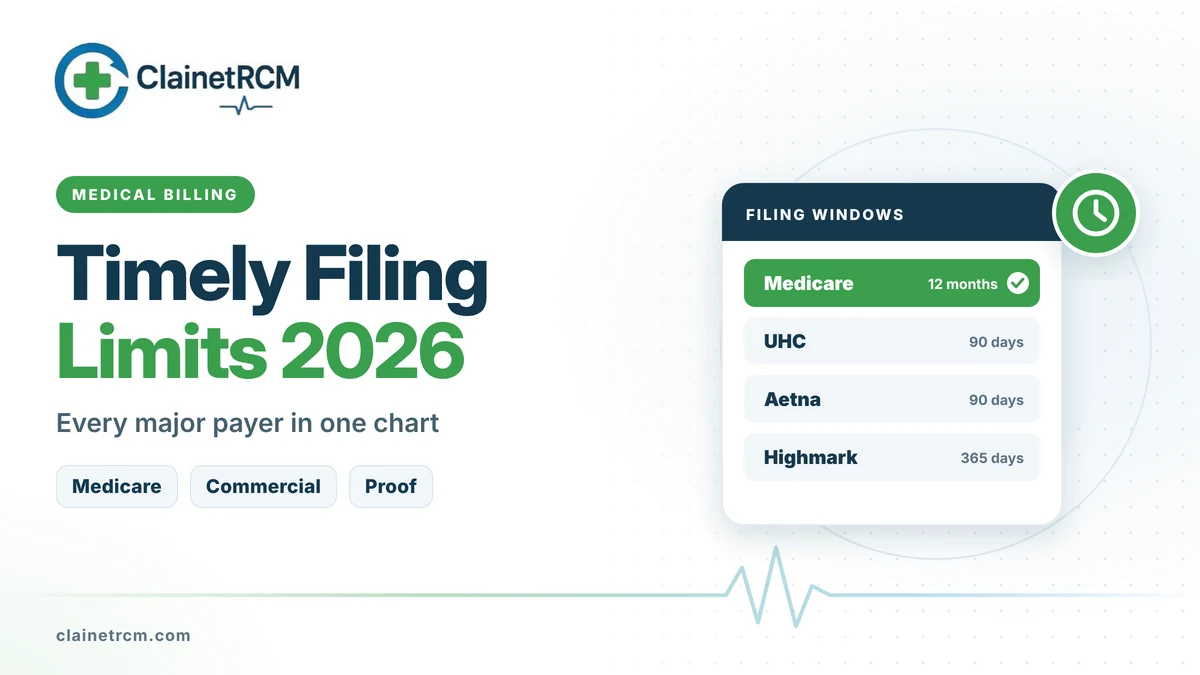
Timely filing limits for Medicare, Medicaid, UHC, Aetna, Cigna, BCBS, Humana and TRICARE in one 2026 chart, plus corrected claim rules and proof of filing.
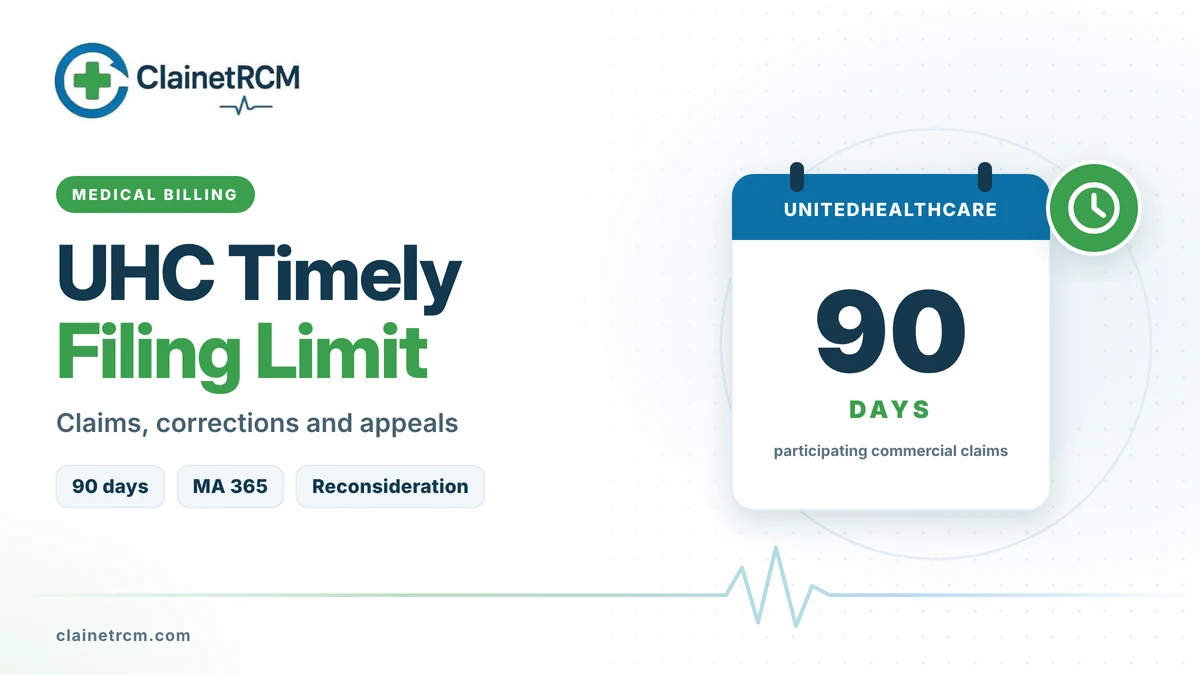
The UHC timely filing limit is 90 days for participating commercial providers. See Medicare Advantage, Community Plan, secondary claim and appeal deadlines.
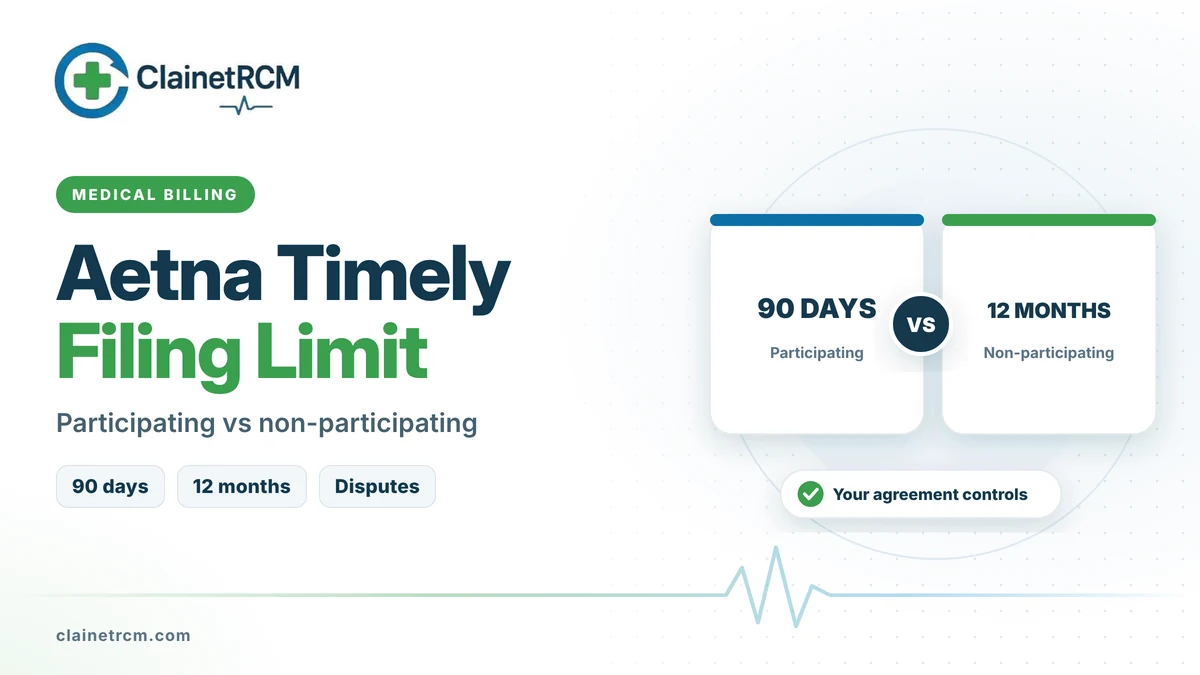
The Aetna timely filing limit is commonly 90 days for participating providers and 12 months for non-participating. See corrected claim and appeal deadlines.
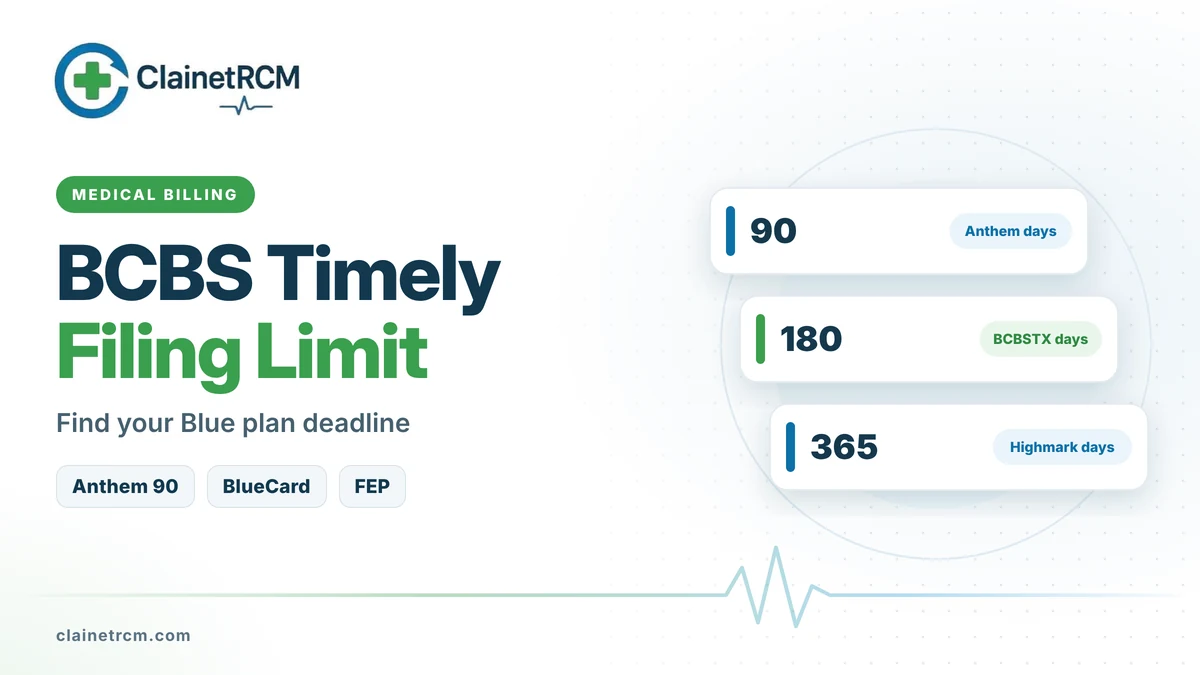
The BCBS timely filing limit varies by Blue plan, from 90 days at Anthem to 365 days at Highmark. Compare major plans, BlueCard rules and FEP deadlines.
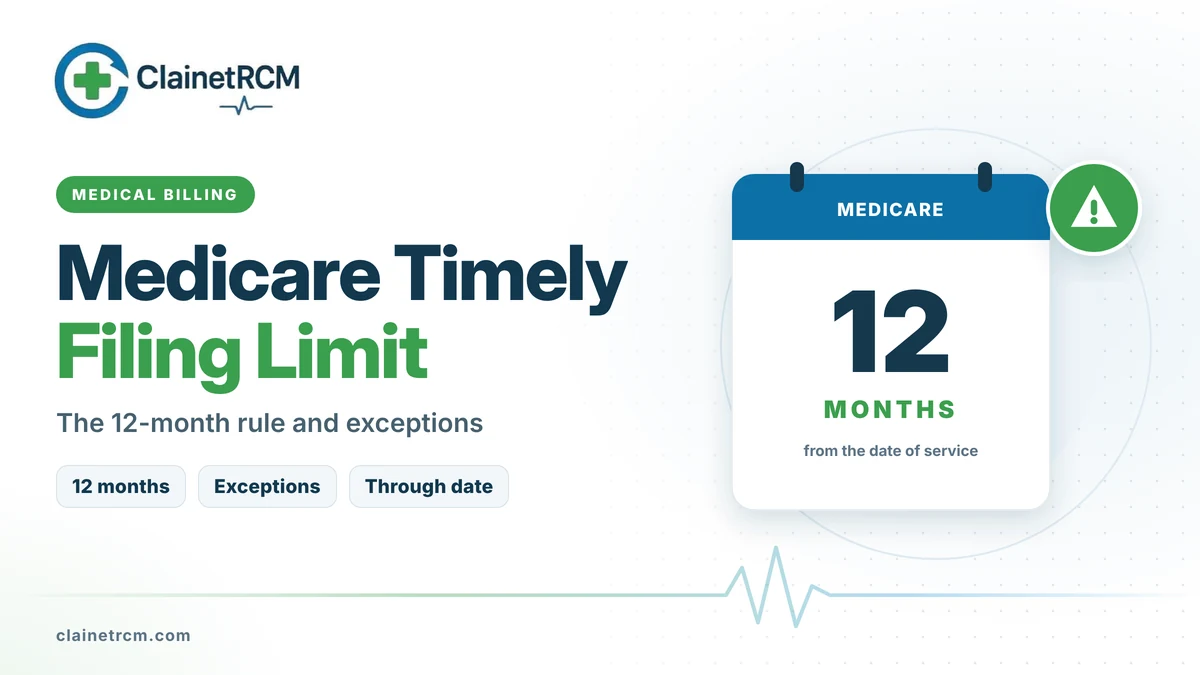
The Medicare timely filing limit is 12 months from the date of service. Learn how span dates count, the exceptions CMS allows and how to handle late claims.
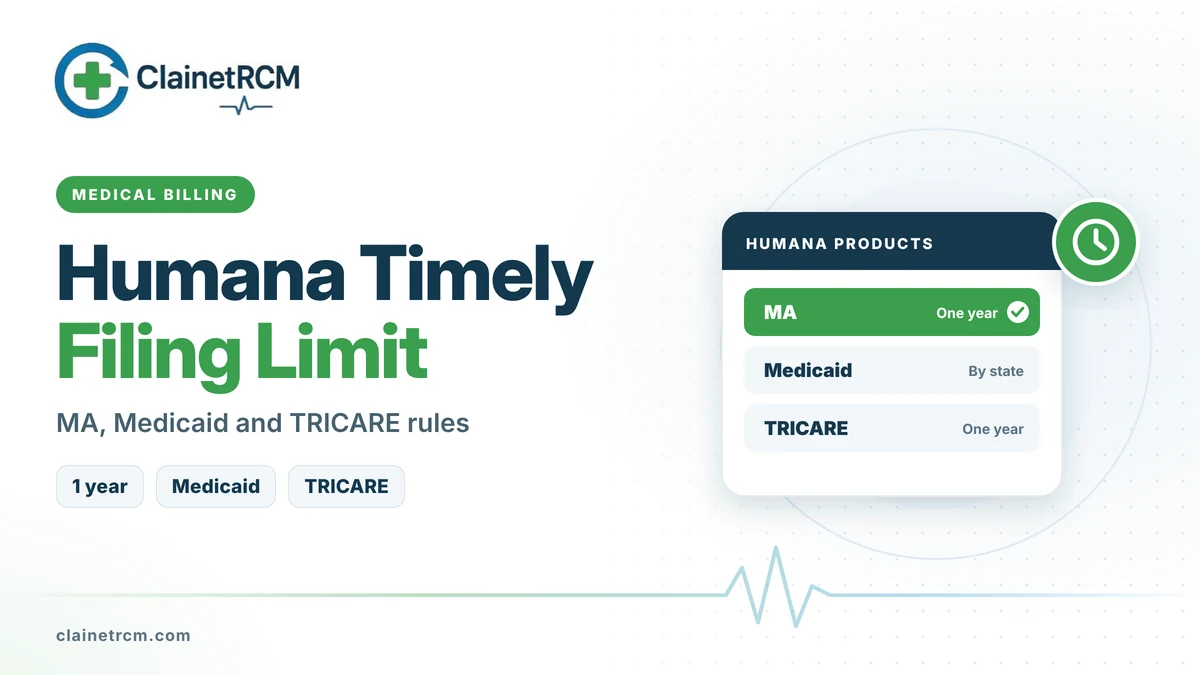
The Humana timely filing limit is one year for Medicare Advantage claims unless your agreement differs. See Medicaid, TRICARE, corrected claim and appeal rules.
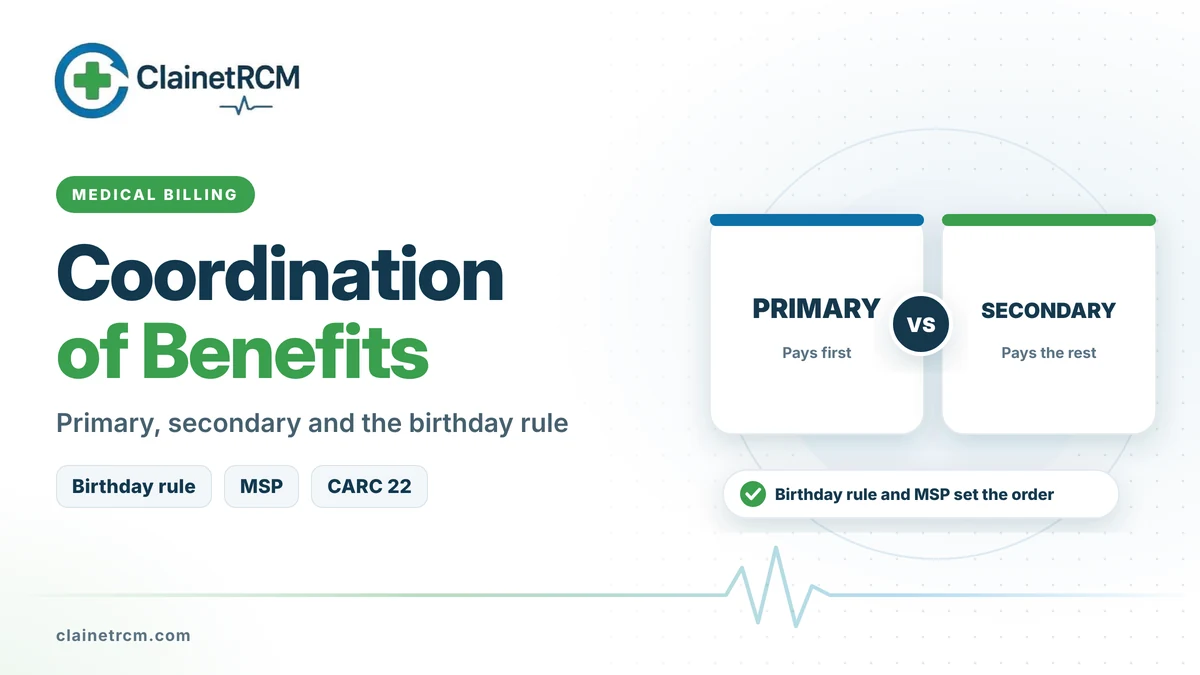
Coordination of benefits explained: the birthday rule, Medicare Secondary Payer rules, Medicaid as payer of last resort and how to bill secondary claims.
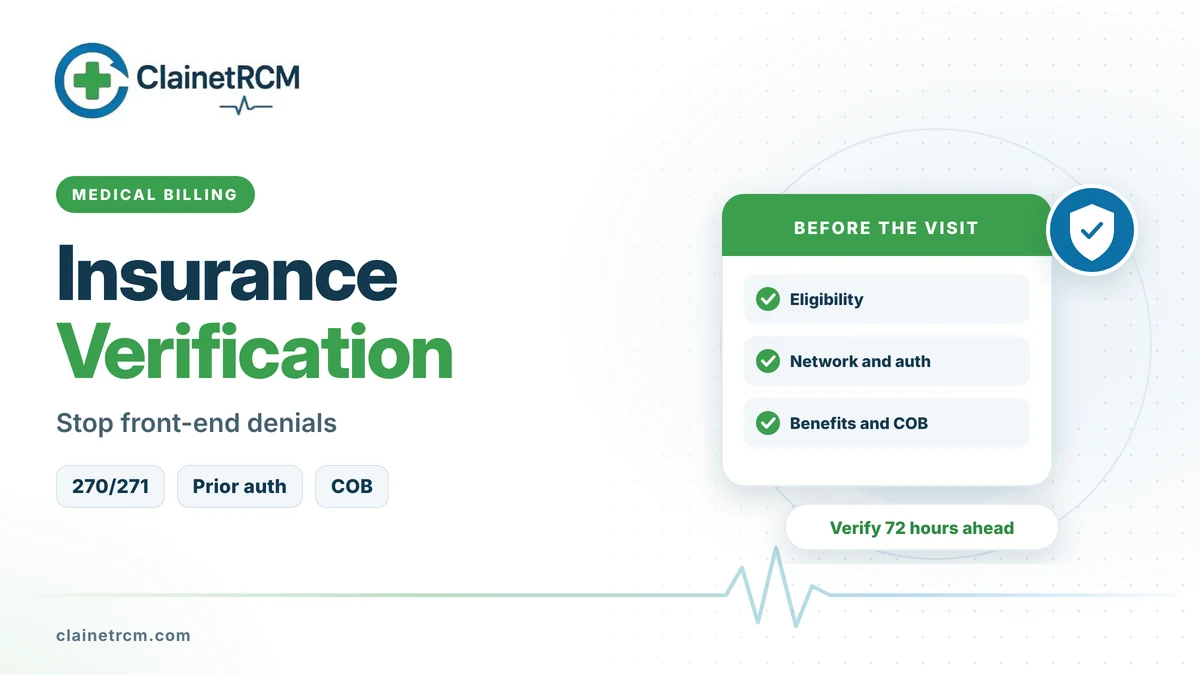
Use this insurance verification checklist before every visit: eligibility, plan type, network status, benefits, prior authorization, COB and cost estimates.
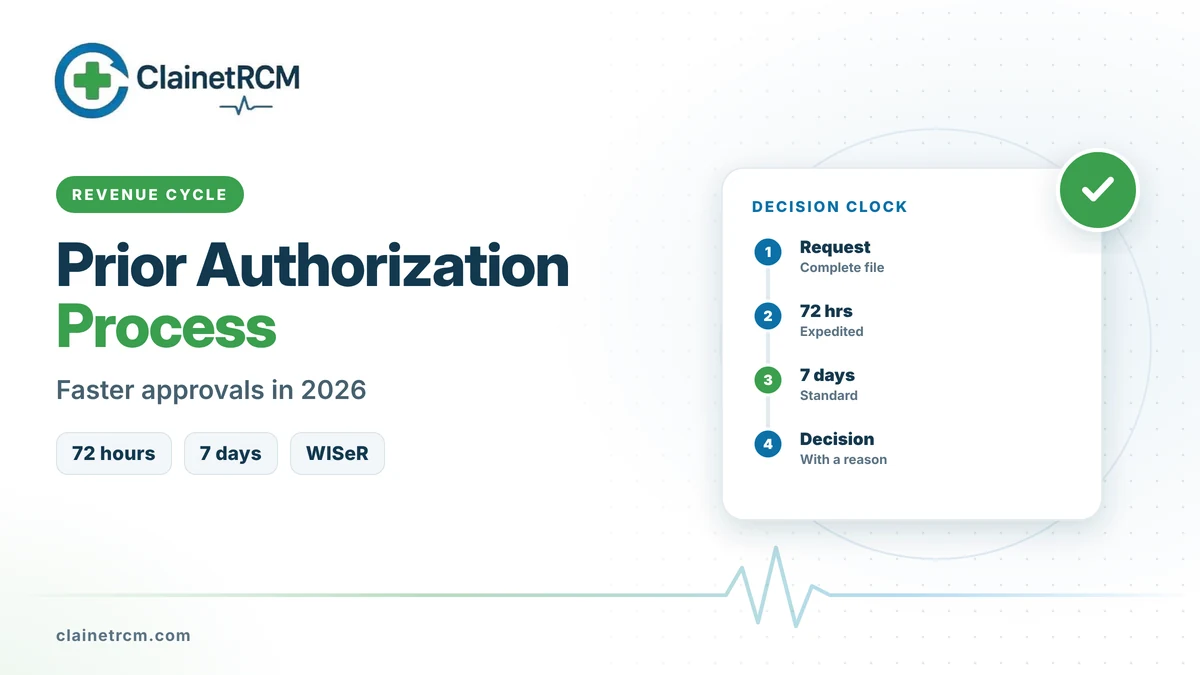
The prior authorization process explained: how to request, track and expedite approvals, peer-to-peer reviews, and what CMS-0057-F and WISeR change in 2026.
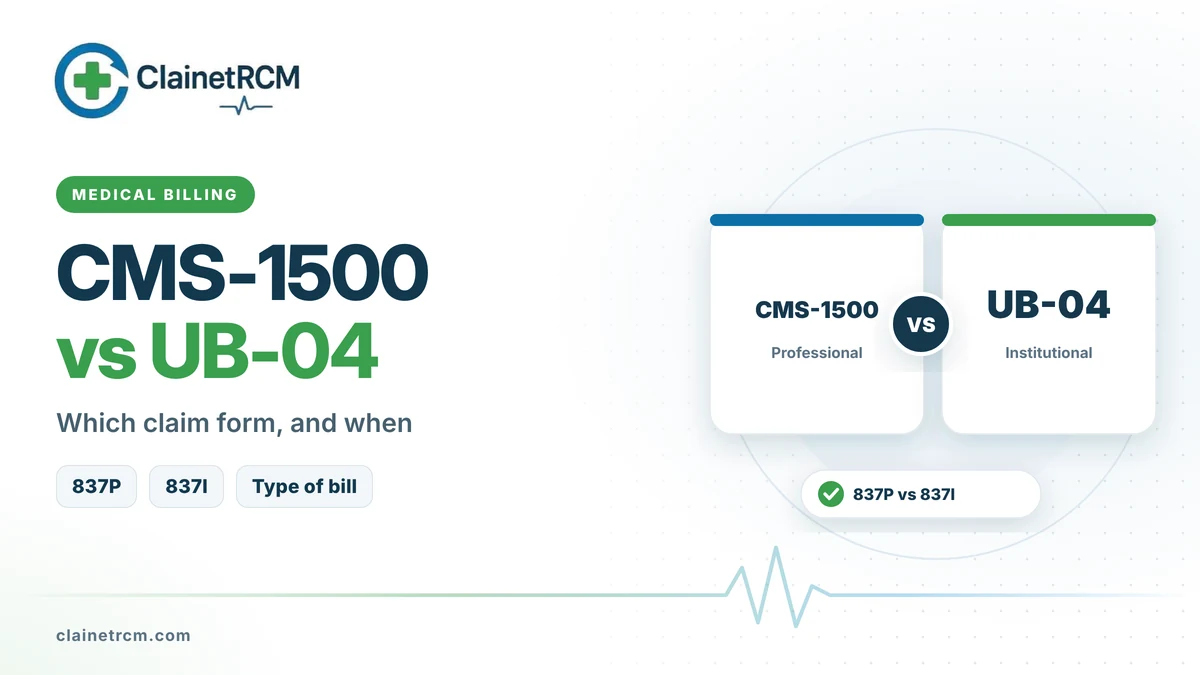
CMS-1500 vs UB-04: professional vs institutional claims, who files each form, the 837P and 837I equivalents, key fields and the errors behind most rejections.
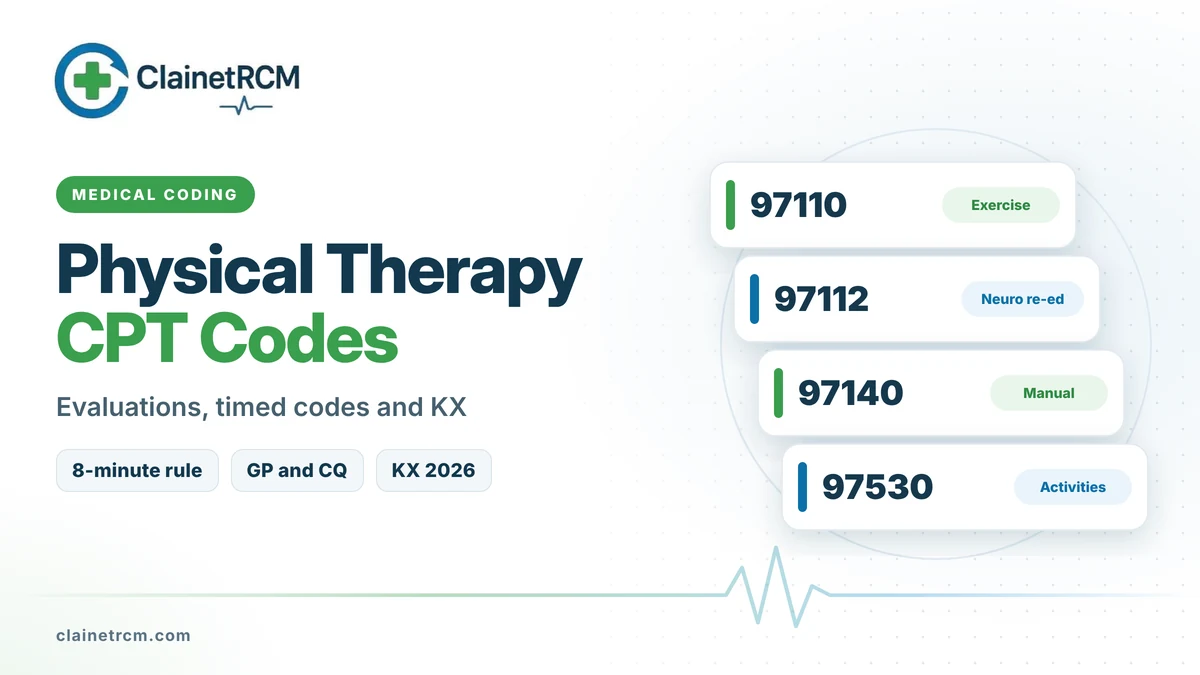
Physical therapy CPT codes explained: evaluations 97161-97164, the most billed timed codes, the 8-minute rule, GP and CQ modifiers and the 2026 KX threshold.
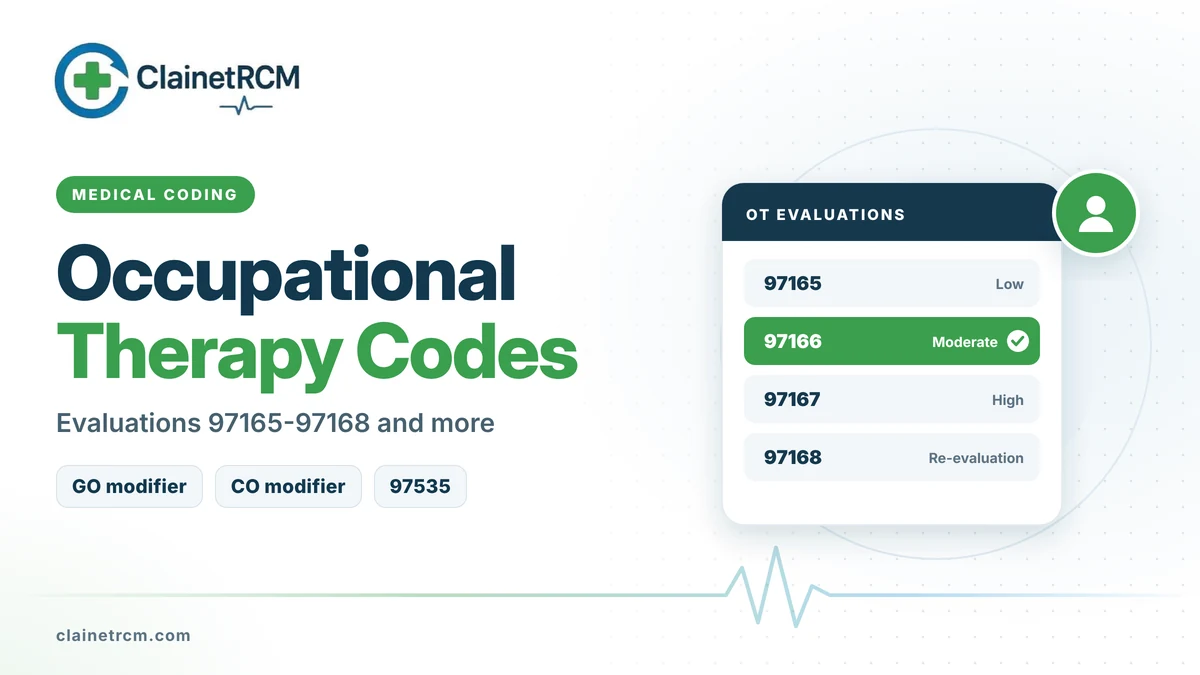
Occupational therapy CPT codes explained: evaluation levels 97165-97168, common treatment codes, GO and CO modifiers and Medicare therapy rules for 2026.
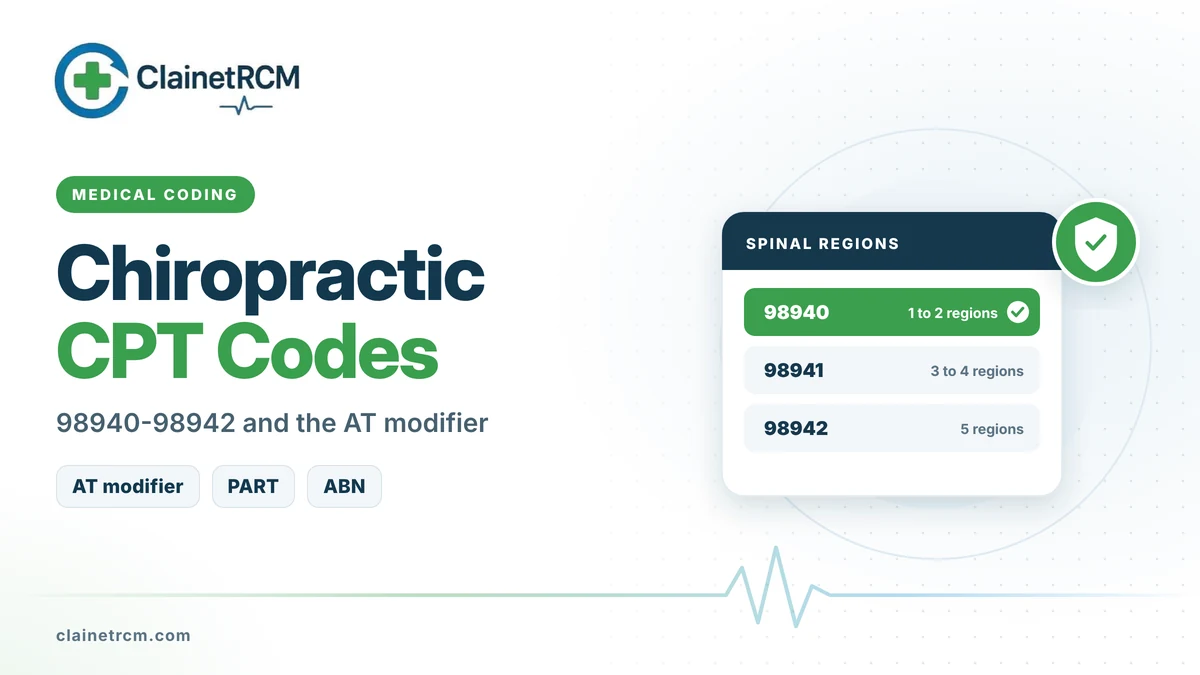
Chiropractic CPT codes 98940-98942 explained: spinal regions, the AT modifier, active vs maintenance care, the new ABN, GA and GZ, and billing therapies.
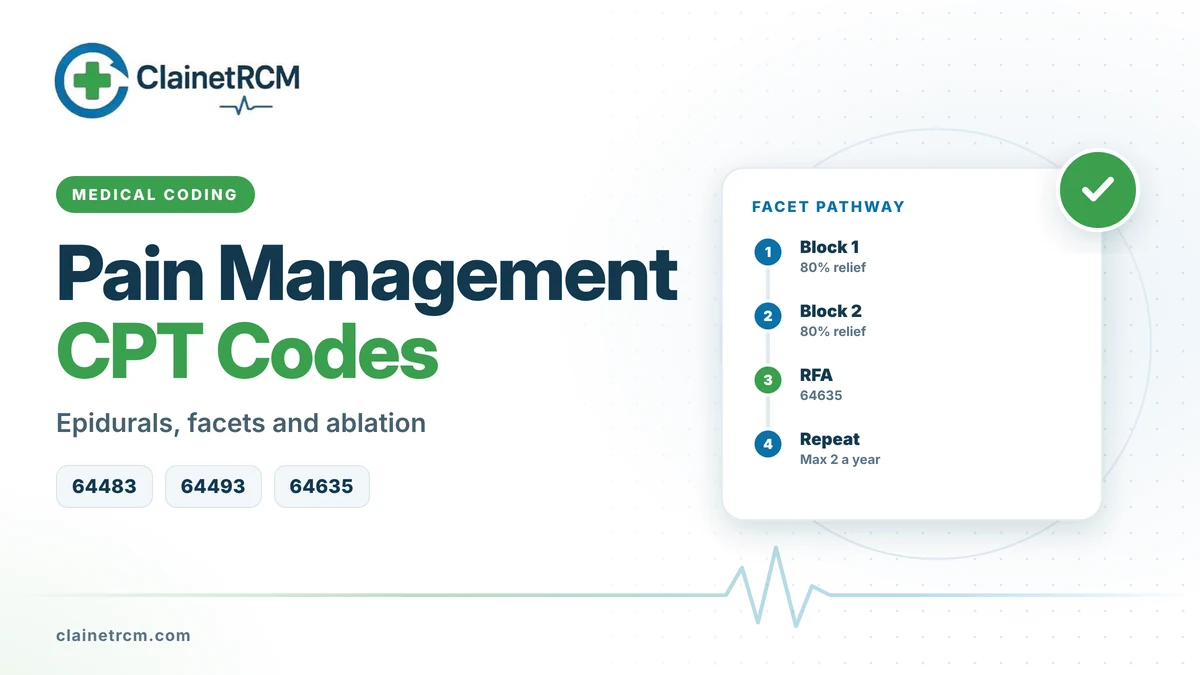
Pain management CPT codes for epidural steroid injections, facet blocks and radiofrequency ablation, with imaging rules and Medicare LCD frequency limits.
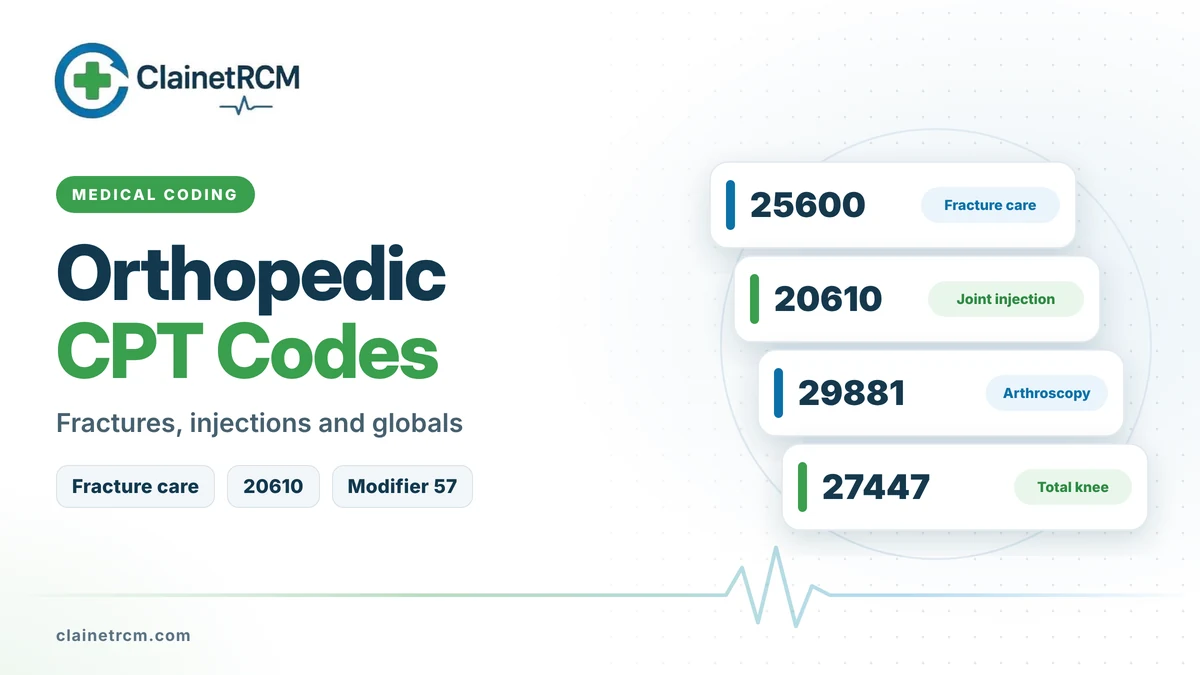
Orthopedic CPT codes explained: fracture care, joint injections, arthroscopy, casting and joint replacement, plus the global period rules practices often miss.
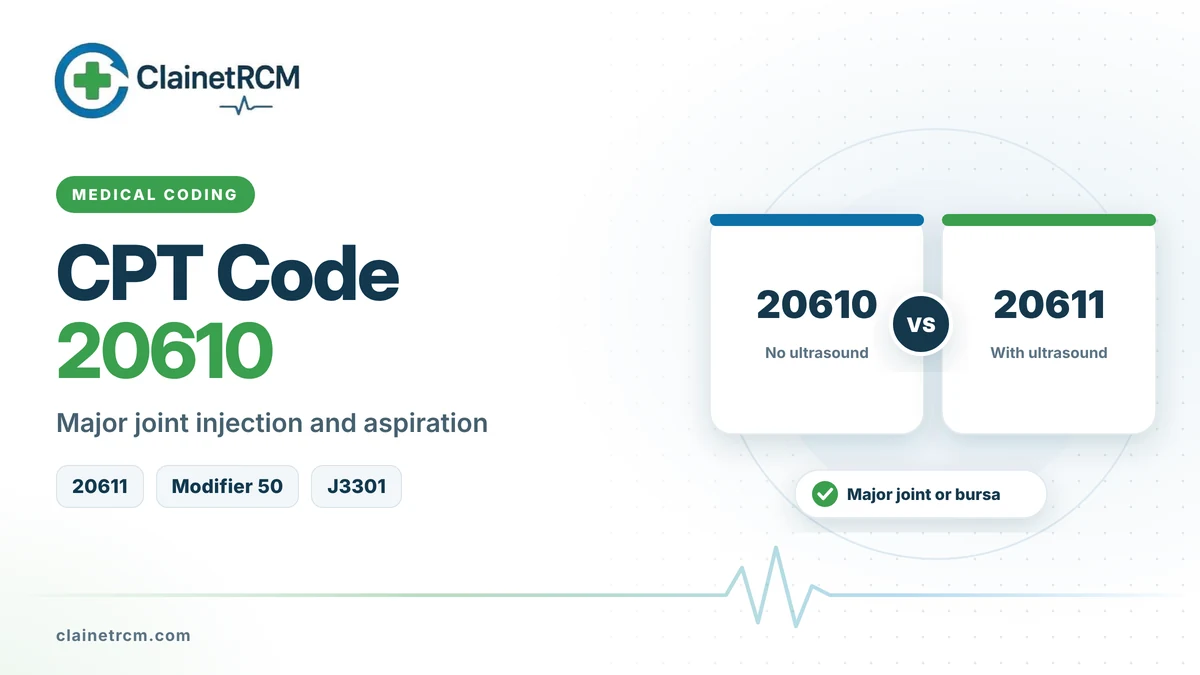
CPT code 20610 covers major joint injection or aspiration without ultrasound. Learn 20610 vs 20611, drug codes, bilateral billing, modifier 25 and 2027 changes.
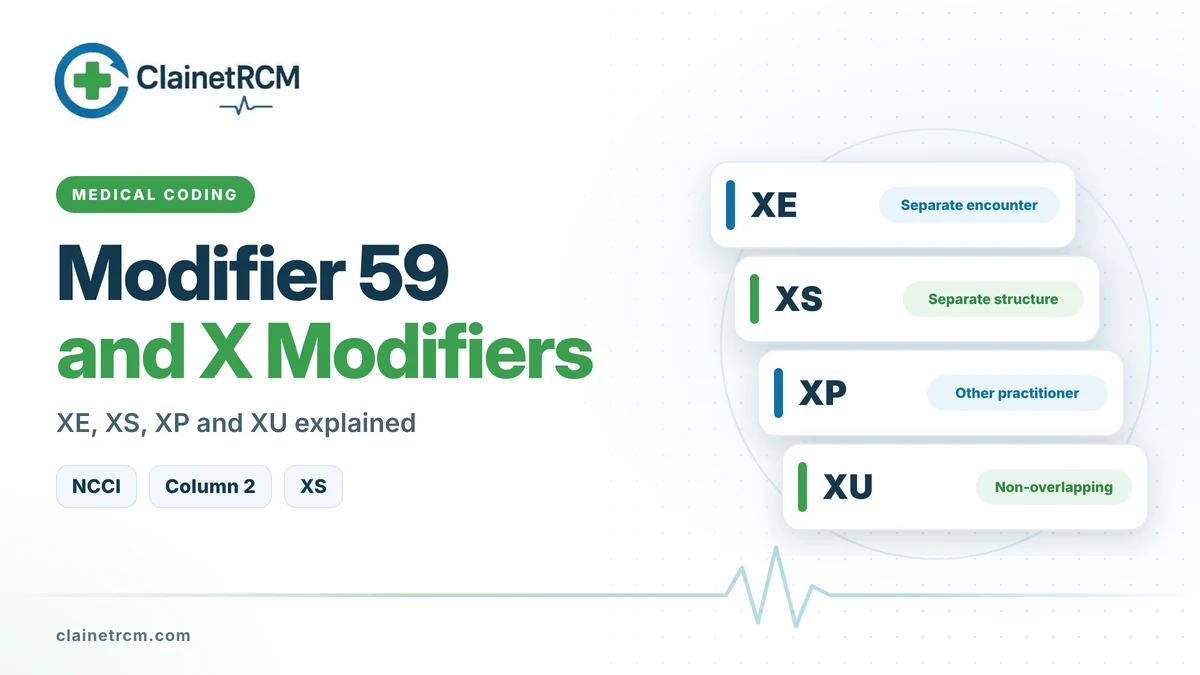
Modifier 59 marks a distinct procedural service. Learn when it applies, how the XE, XS, XP and XU modifiers refine it, and the NCCI edits that require them.
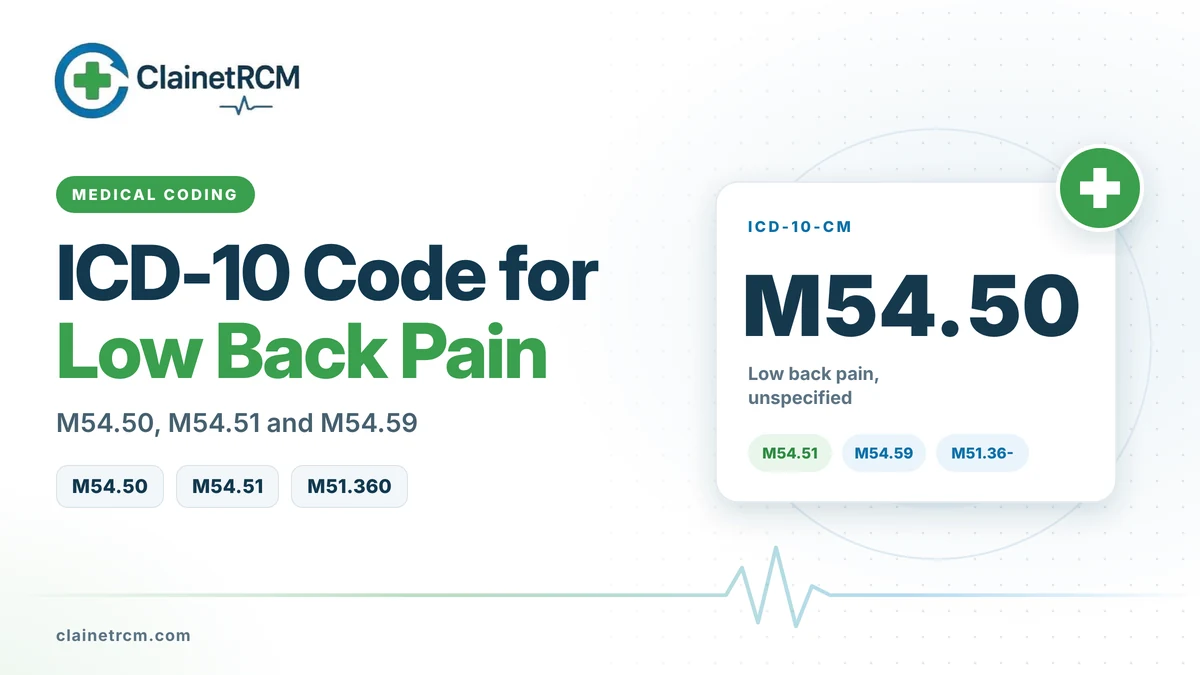
The ICD-10 code for low back pain is M54.50 unless vertebrogenic (M54.51) or other specified (M54.59). See sciatica, radiculopathy and disc degeneration codes.
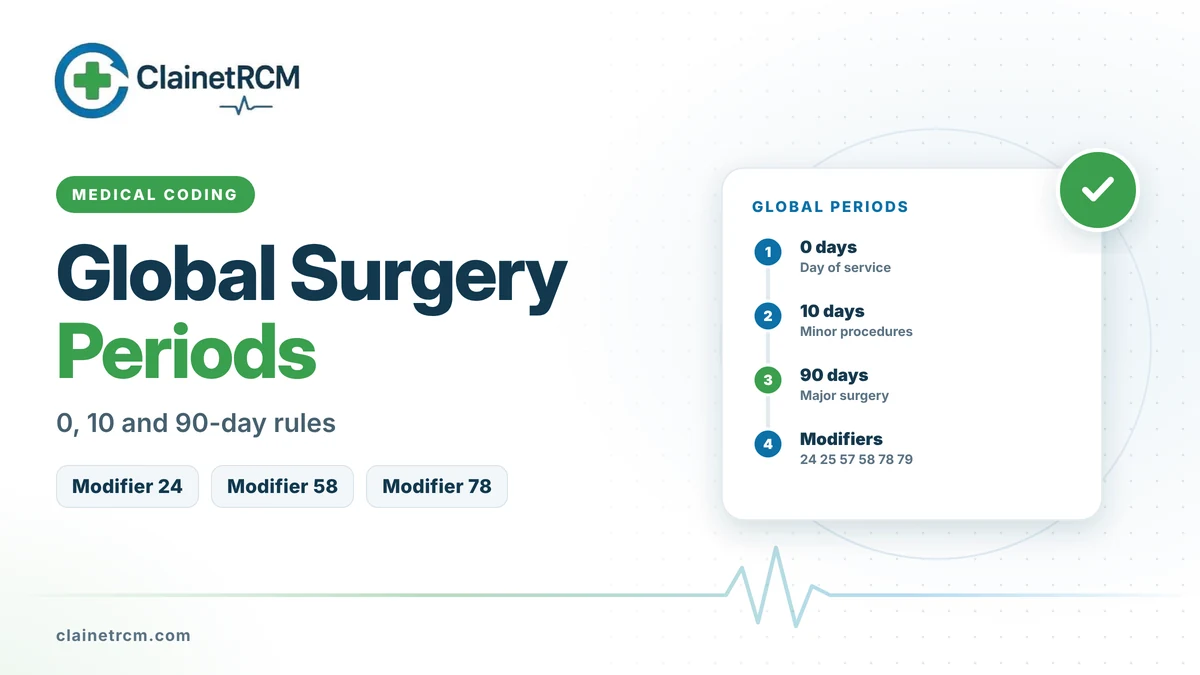
The global surgery period explained: what 0, 10 and 90-day globals include, and how modifiers 24, 25, 57, 58, 78, 79 and 54/55 unlock separate payment.
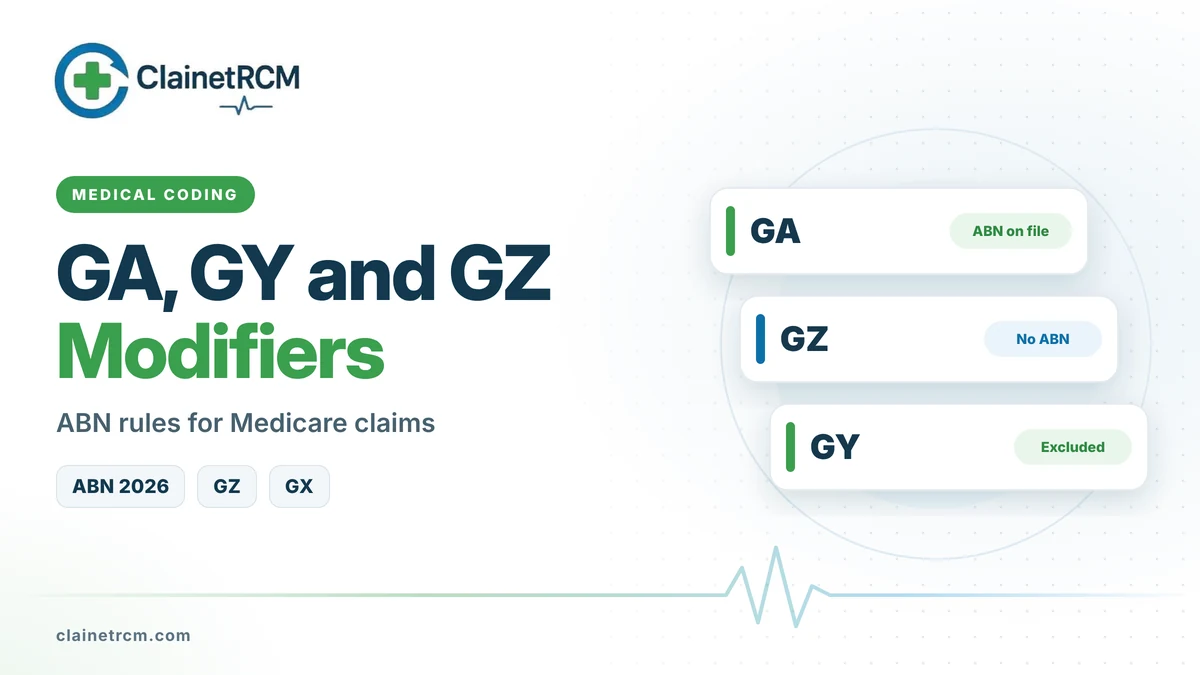
GA GY GZ modifiers explained: when Medicare requires an ABN, how each modifier shifts liability, the new 2026 ABN form, and mistakes that leave you unpaid.
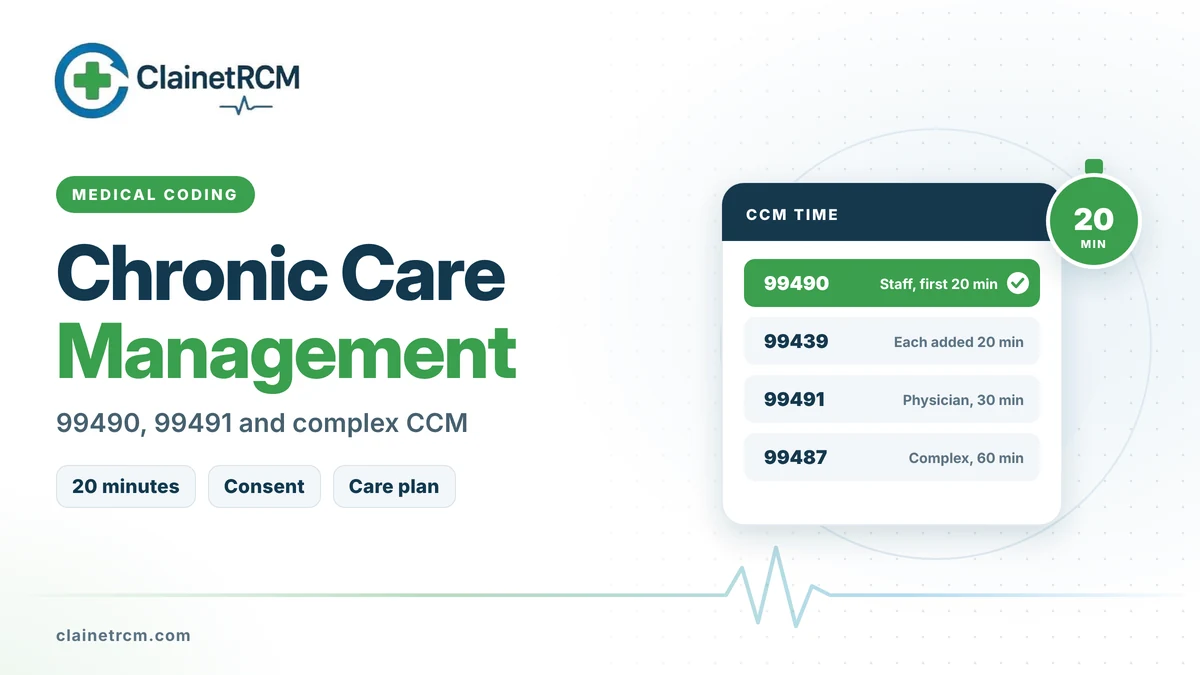
Chronic care management CPT codes explained: 99490, 99439, 99491, 99437, complex CCM 99487 and 99489, PCM, APCM, time rules, consent and billing combinations.
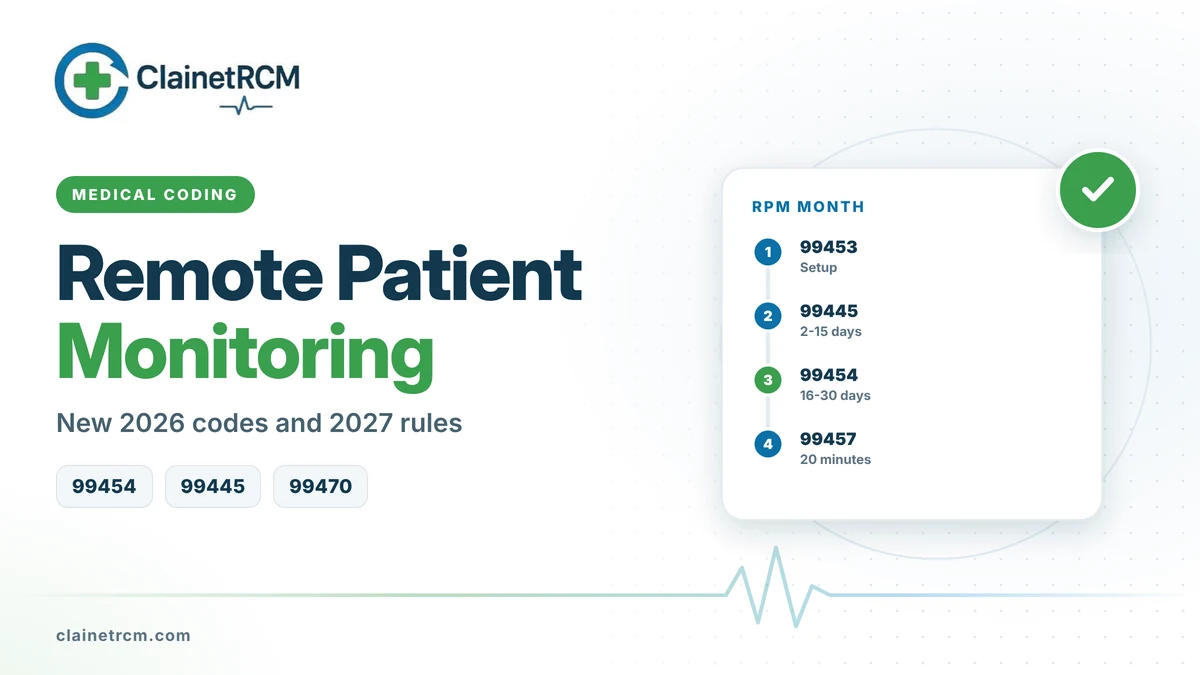
Remote patient monitoring CPT codes explained: 99453, 99454, the new 2026 codes 99445 and 99470, 99457 and 99458, device rules and the 2027 Medicare changes.
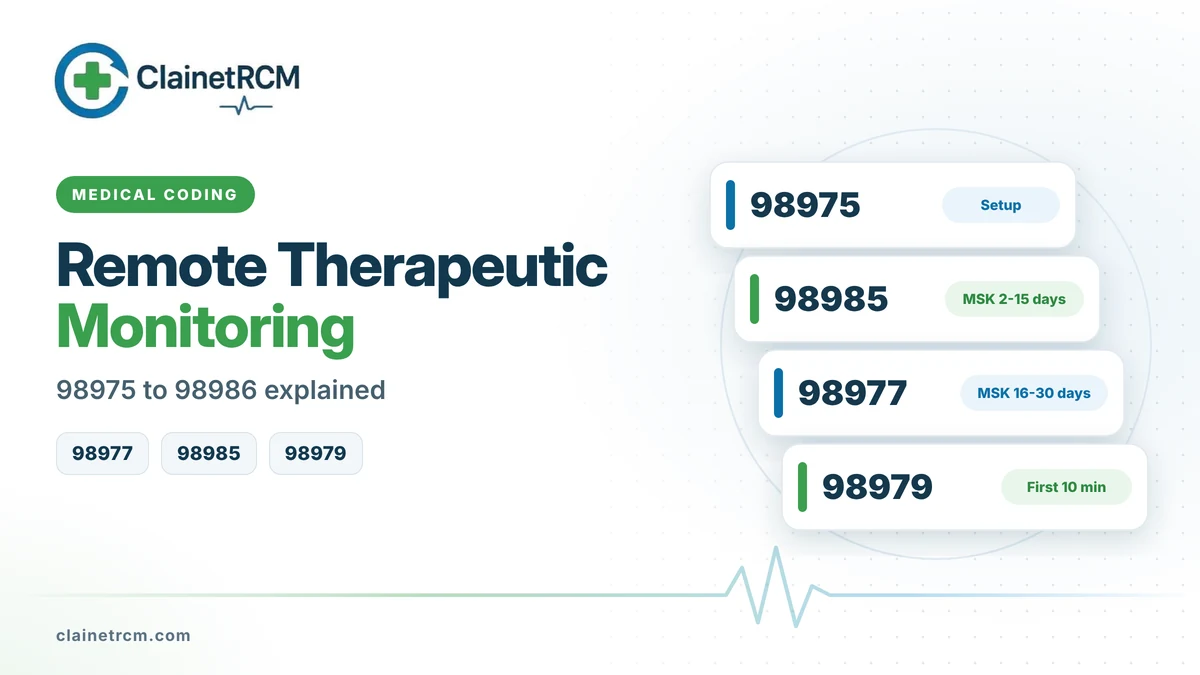
Remote therapeutic monitoring CPT codes explained: 98975 to 98986, the new 2026 short-duration codes, 98979, therapy rules and the 2027 Medicare changes.
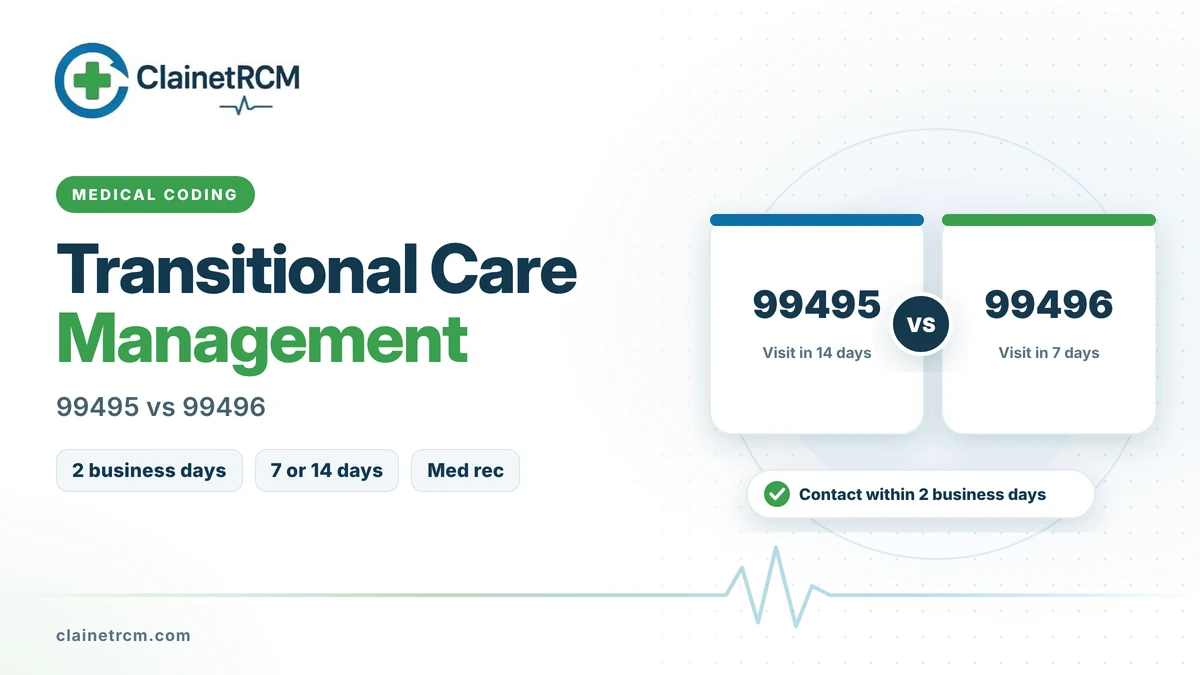
Transitional care management CPT codes 99495 and 99496 explained: the 2-business-day contact, 7 and 14-day visits, medication reconciliation and billing rules.
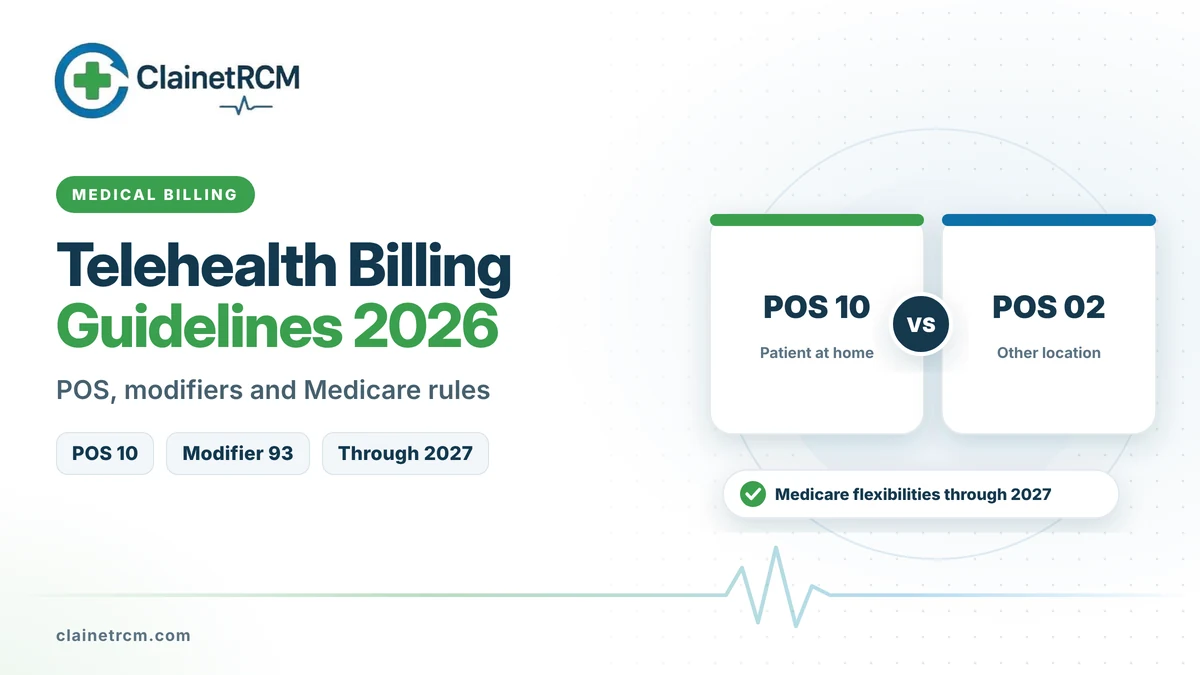
Telehealth billing guidelines for 2026: place of service 02 and 10, modifiers 95, 93 and FQ, Medicare flexibilities through 2027, FQHC rules and payer rules.
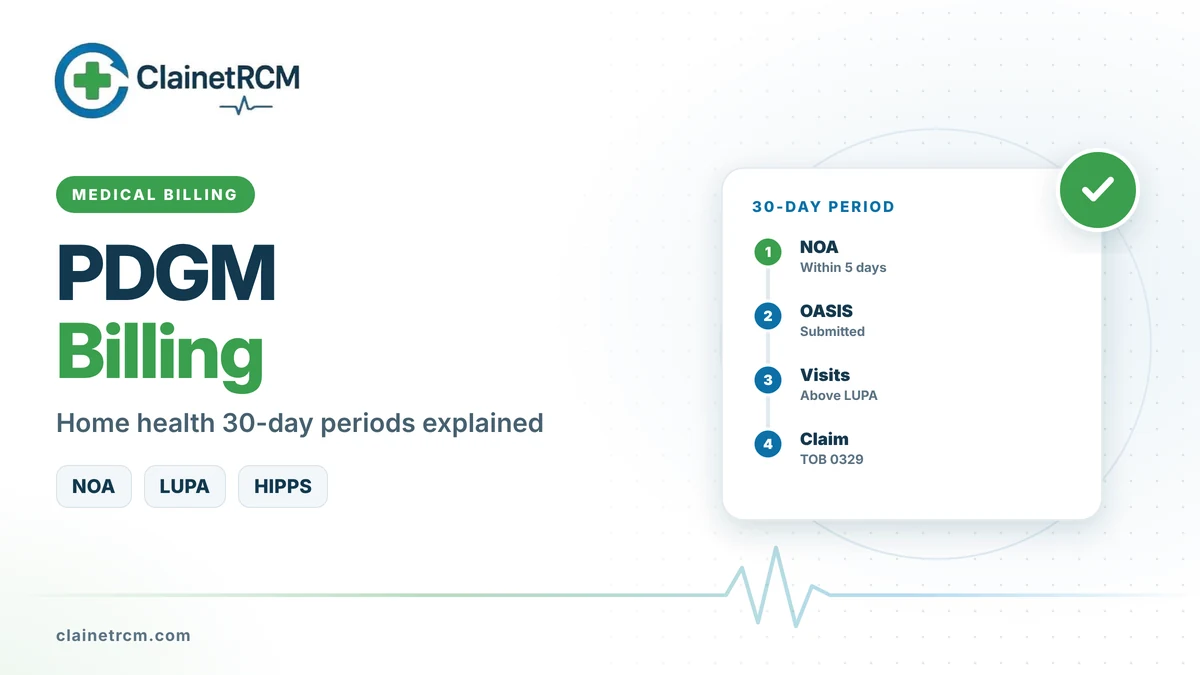
PDGM billing explained for home health: 30-day periods, the 432 case-mix groups, LUPA thresholds, NOA deadlines, HIPPS codes and the 2026 and 2027 rate updates.
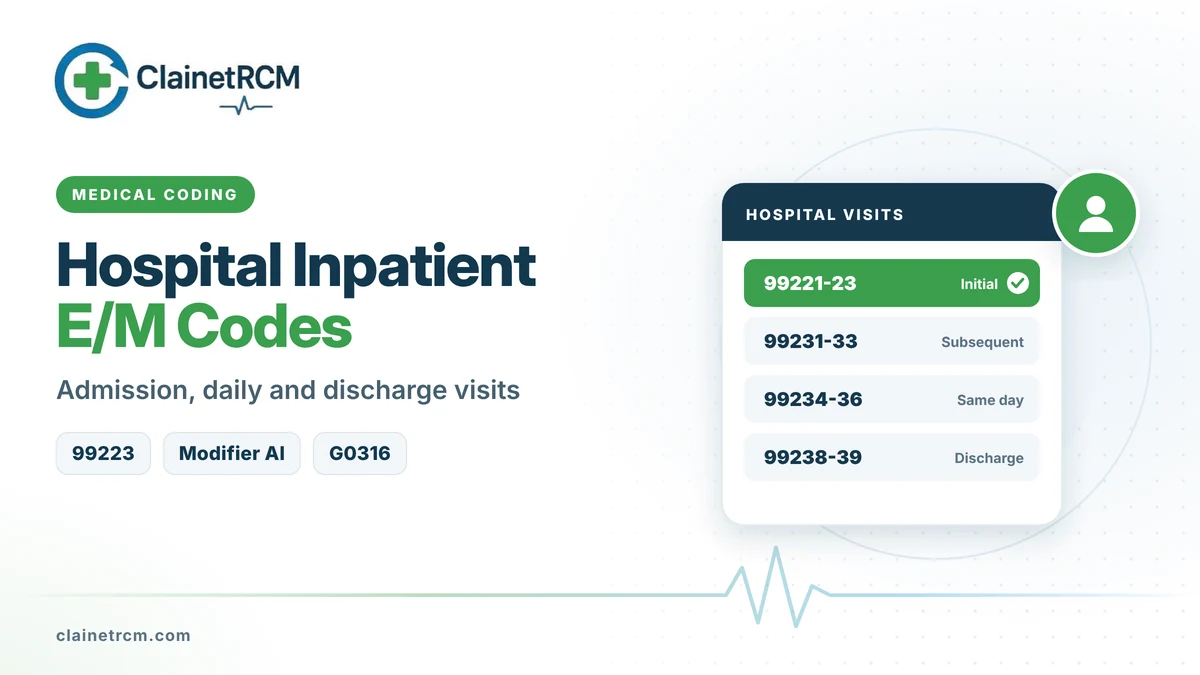
Hospital inpatient E/M codes explained: initial 99221-99223, subsequent 99231-99233, same-day 99234-99236, discharge 99238-99239, time rules and G0316.
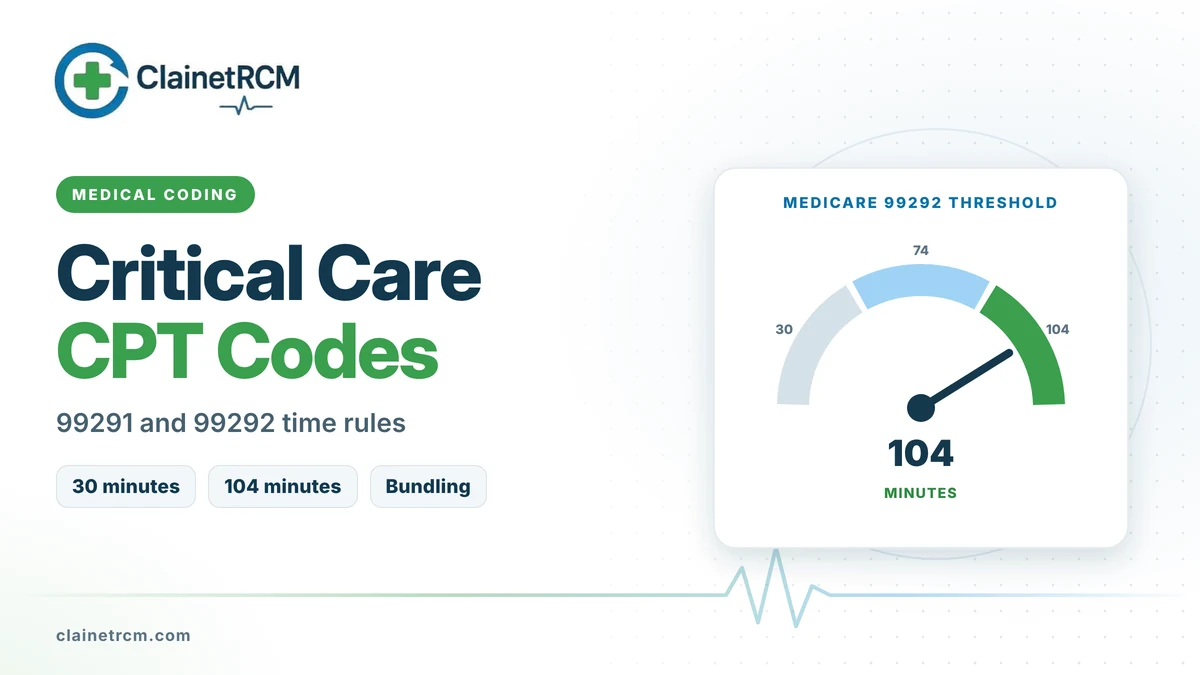
Critical care CPT codes 99291 and 99292 explained: the critical illness definition, CPT vs Medicare time thresholds, bundled services and same-day rules.
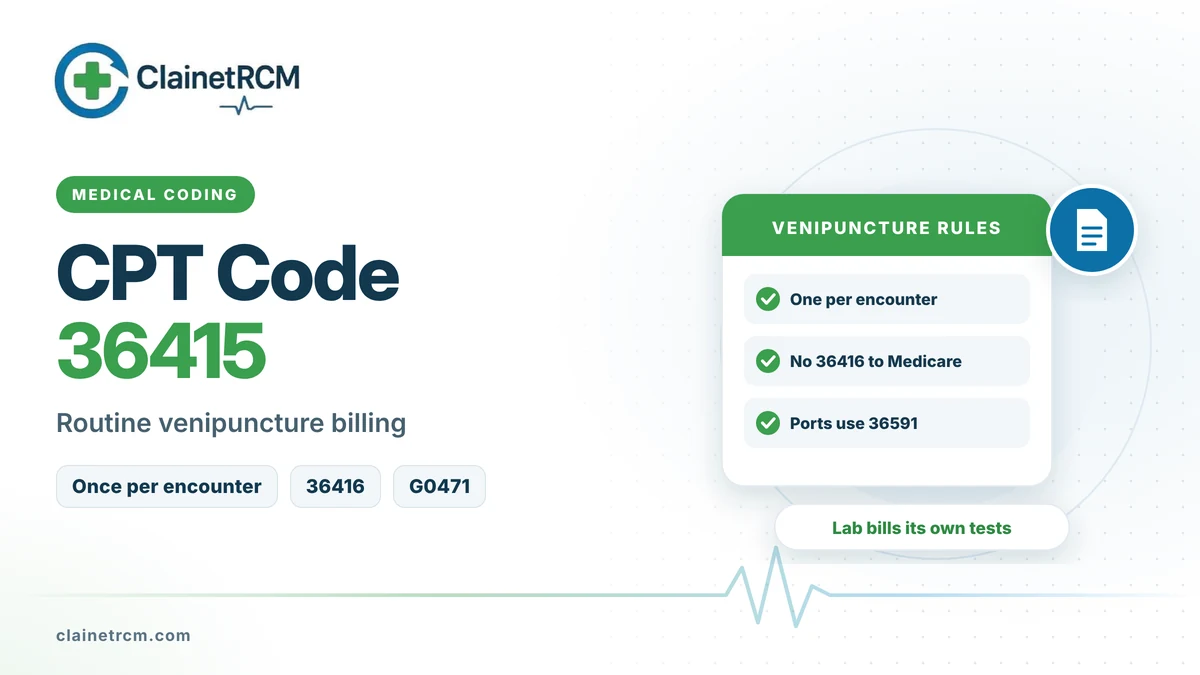
CPT code 36415 covers routine venipuncture. Learn the one-per-encounter rule, 36416 and 36410, Medicare lab rules, specimen handling and common denials.
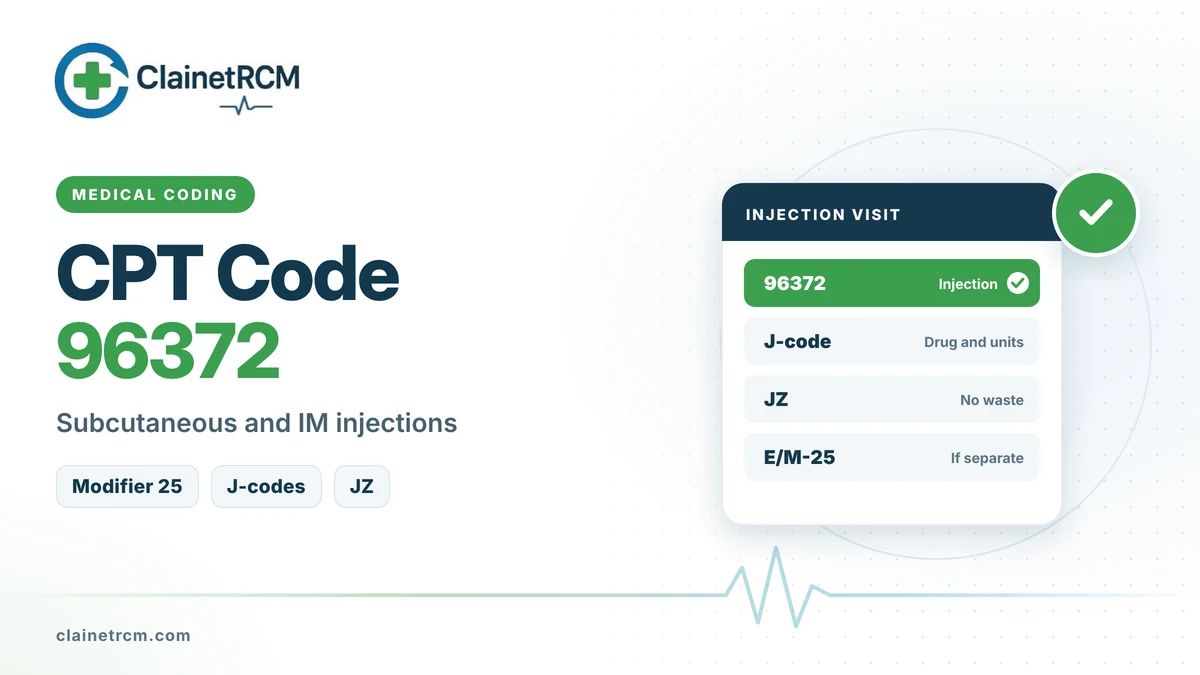
CPT code 96372 covers subcutaneous and intramuscular therapeutic injections. Learn drug coding, E/M and modifier 25, 99211 rules, JZ and common denials.
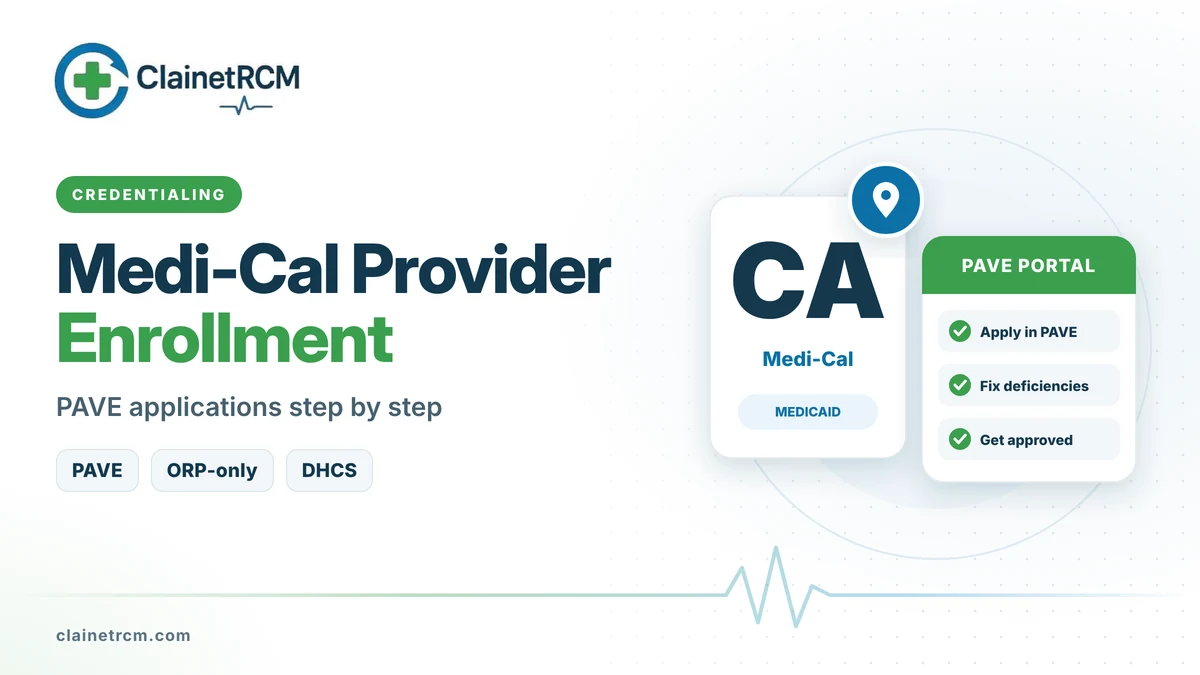
Medi-Cal provider enrollment guide: apply in PAVE, pick the right application type, prepare documents and avoid the deficiencies that delay approval.
Florida Medicaid provider enrollment explained: full vs limited enrollment, Level 2 background screening, SMMC plan credentialing and common delays.
New York Medicaid provider enrollment guide: the Provider Services Portal, OPRA enrollment, ETIN setup for billing and the new risk-based revalidation rules.
Pennsylvania Medicaid provider enrollment: apply through ePEAP, enroll every service location, credential with HealthChoices MCOs and revalidate on time.
Illinois Medicaid provider enrollment through IMPACT: enrollment types, group affiliations, HealthChoice Illinois plan credentialing and revalidation tips.
Ohio Medicaid provider enrollment in the PNM module: OH|ID setup, centralized credentialing, Next Generation plan contracts, OhioRISE and revalidation.
Georgia Medicaid provider enrollment through GAMMIS: application steps, group/billing enrollment, centralized CVO credentialing for CMOs and timelines.
NCTracks provider enrollment guide: the $100 NC fee, state credentialing, Standard Plan and Tailored Plan contracting, OPR Lite and 5-year reverification.
UnitedHealthcare credentialing guide: Onboard Pro steps, CAQH rules, the new CertifyOS process, Community Plan requirements and Optum behavioral health.
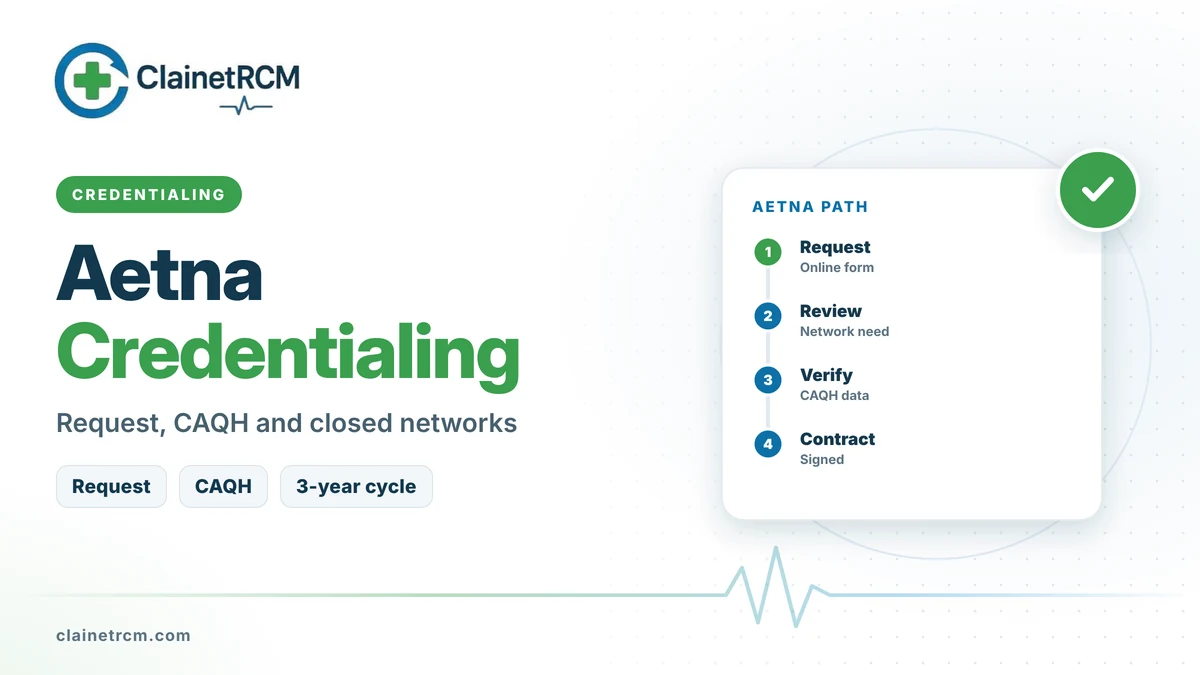
Aetna credentialing guide: submit a request to join, prepare CAQH, track your request, handle a closed network and stay ready for recredentialing.
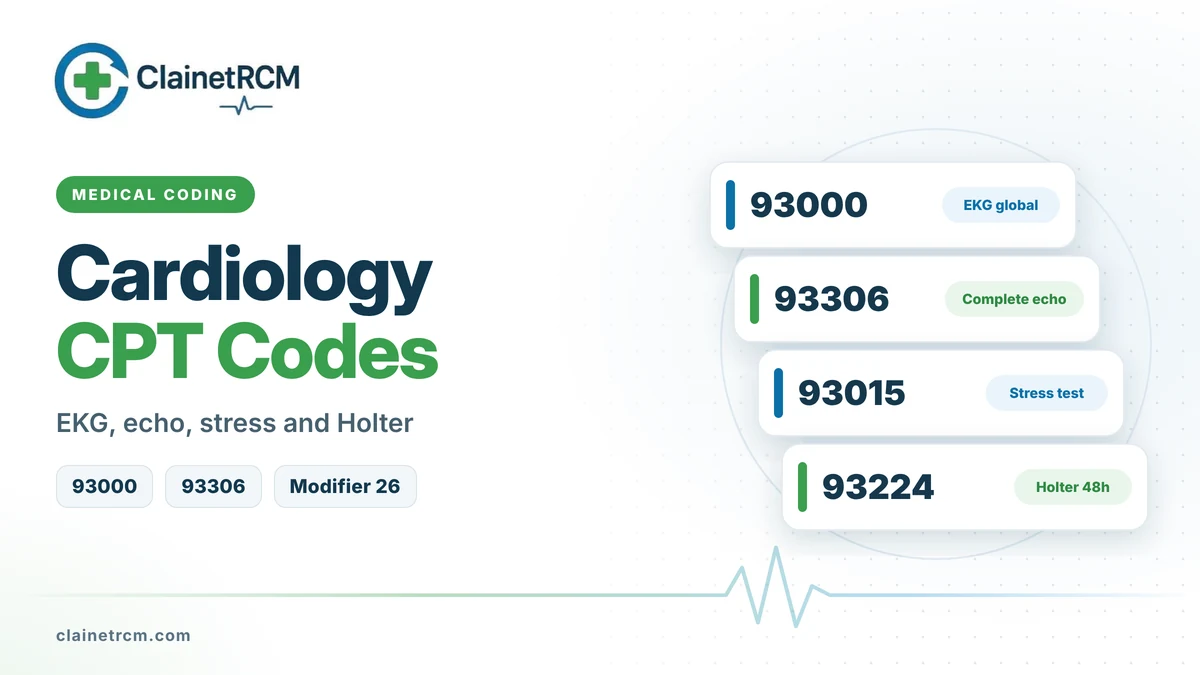
Cardiology CPT codes for EKGs, echocardiograms, stress tests and Holter monitors, plus modifier 26 and TC rules and the 2026 PCI coding changes.
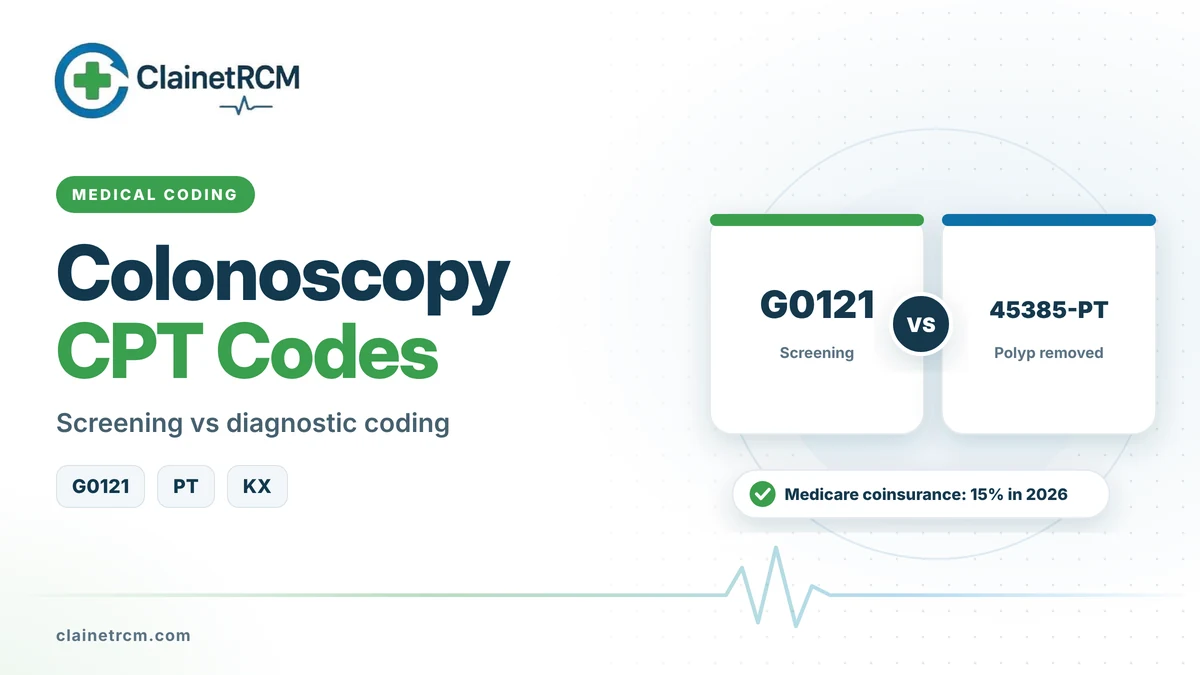
Colonoscopy CPT codes explained: G0105 and G0121, 45378 to 45385, modifiers PT, KX and 33, and what changes when a screening turns diagnostic.
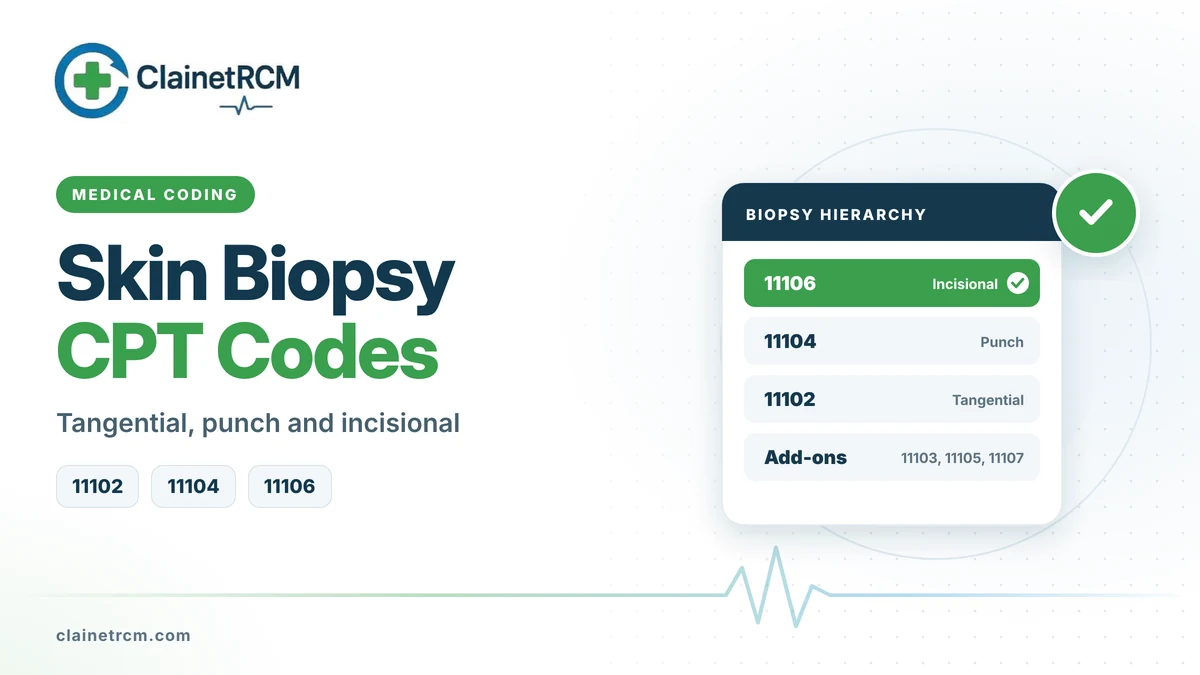
Skin biopsy CPT codes 11102 to 11107: choosing tangential, punch or incisional, add-on rules for multiple lesions, pathology pairing and diagnosis coding.
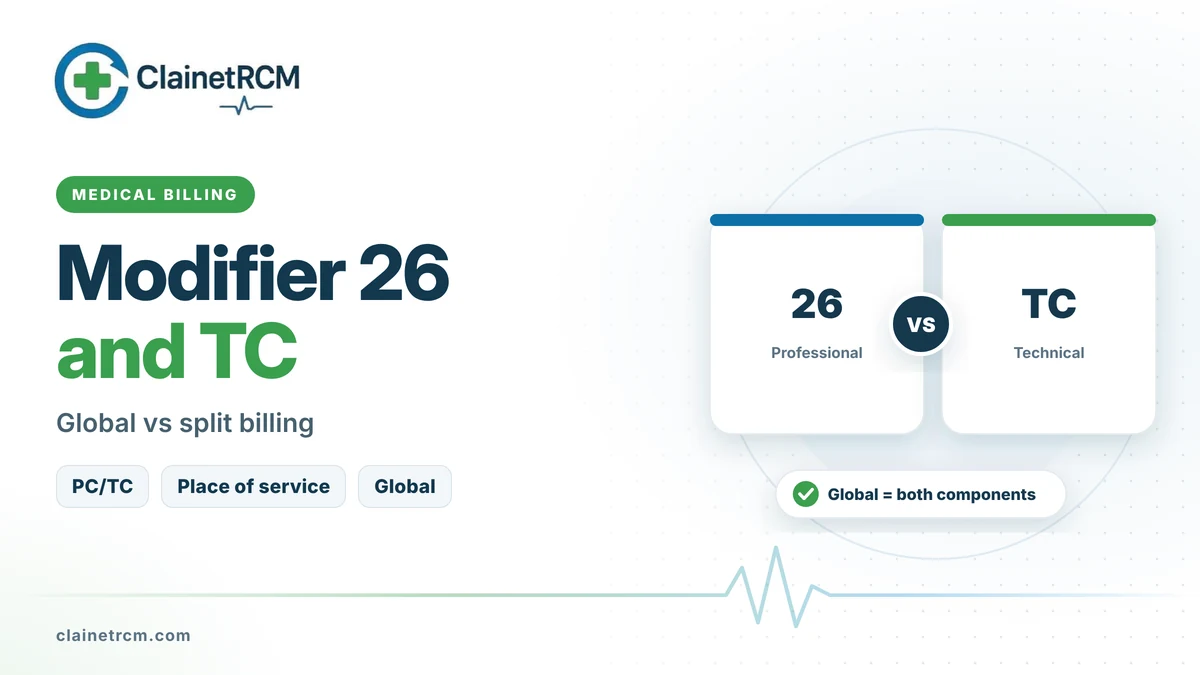
Modifier 26 and TC explained: when to bill globally, how PC/TC indicators work, hospital and office rules, purchased tests and common split-billing denials.
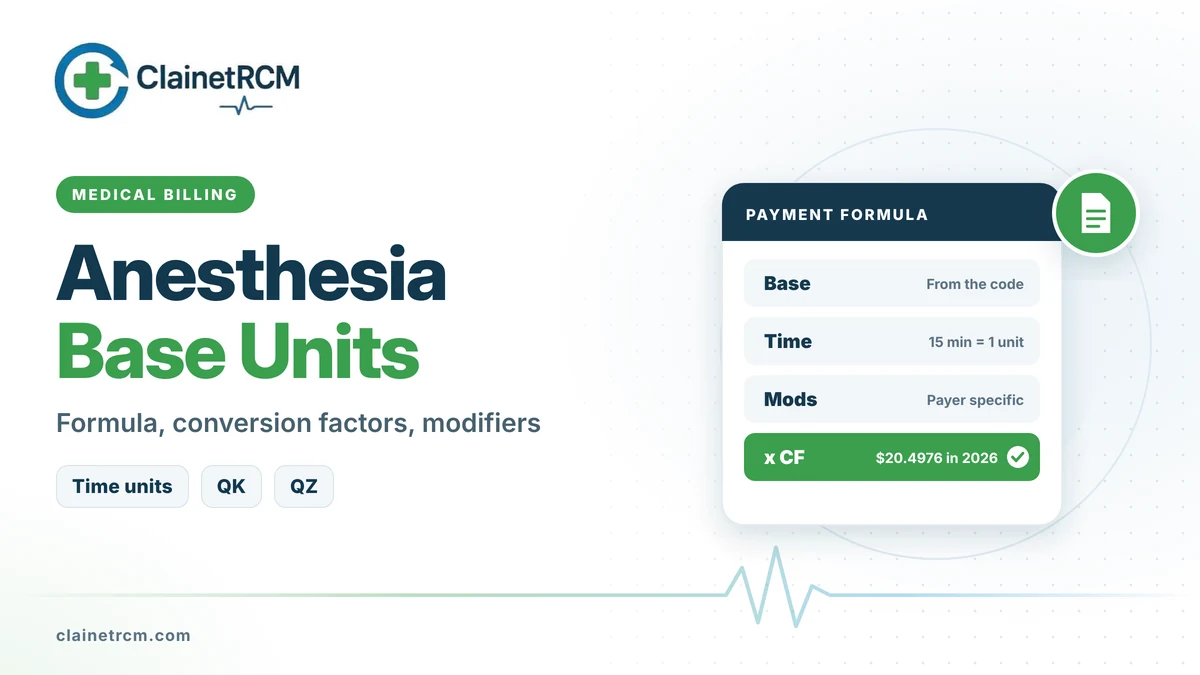
Anesthesia base units explained: the base plus time formula, 2026 and 2027 conversion factors, modifiers AA, QK, QX, QY and QZ, and physical status units.
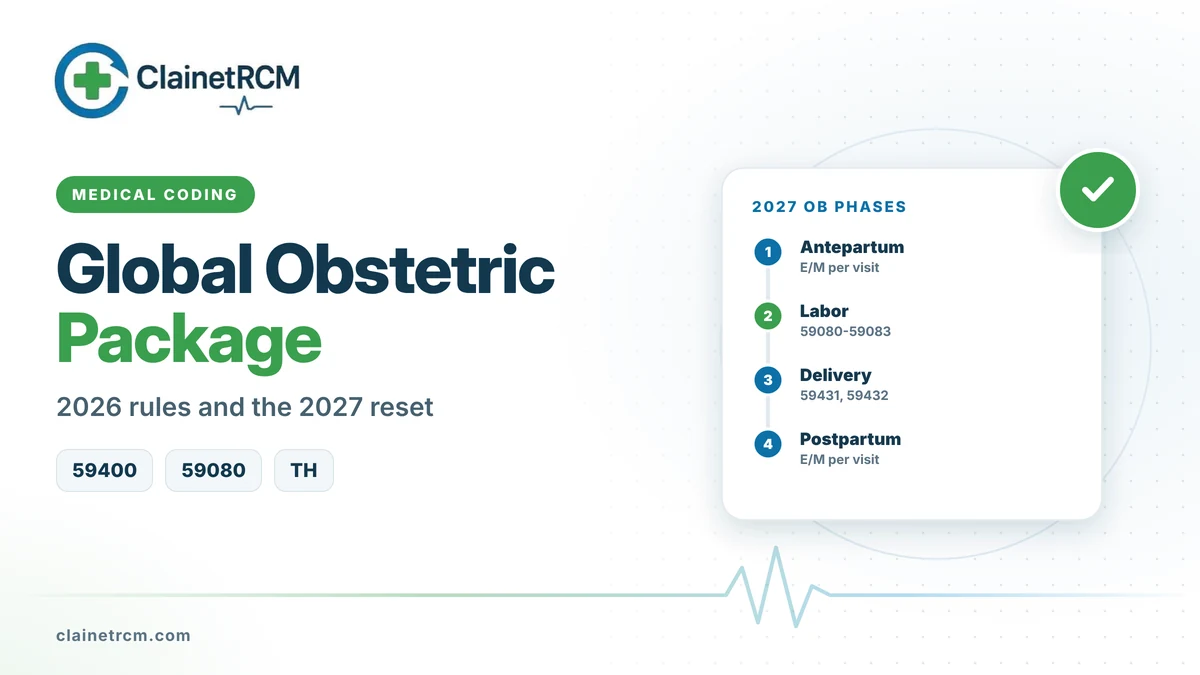
Global obstetric package guide: what 59400 and 59510 include through 2026, partial-care billing, separate services and the 2027 switch to phase-based codes.
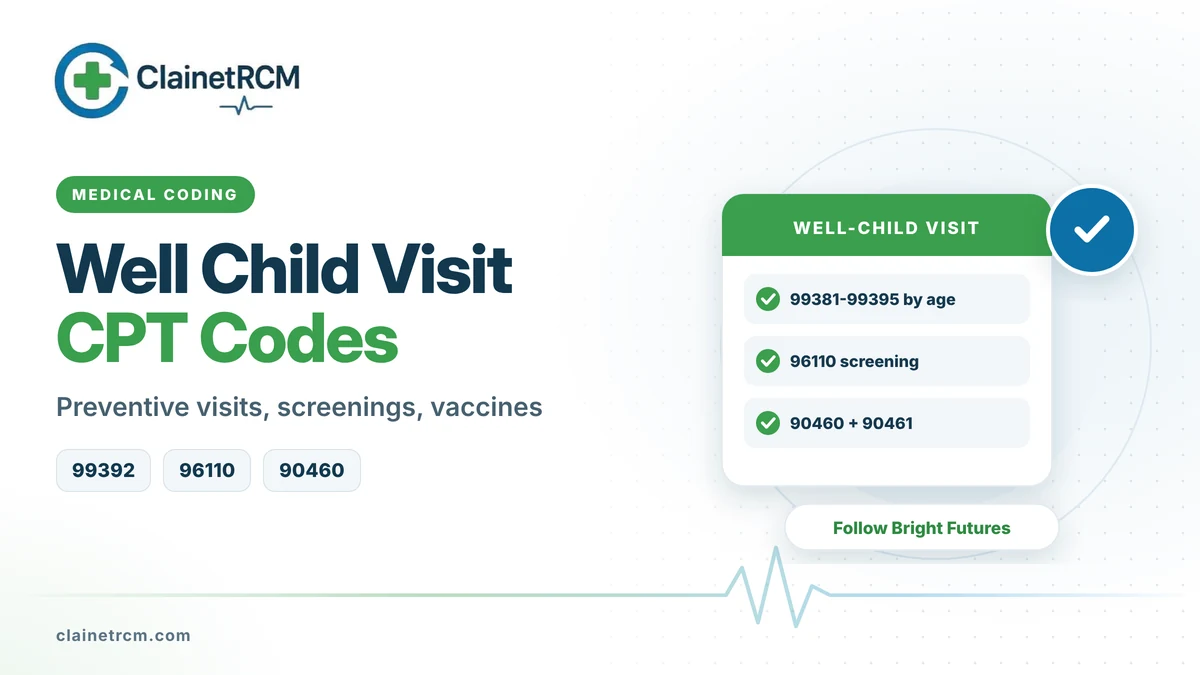
Well child visit CPT codes by age, plus developmental, vision and hearing screening codes, vaccine counseling codes 90460 and 90461, and modifier 25 rules.
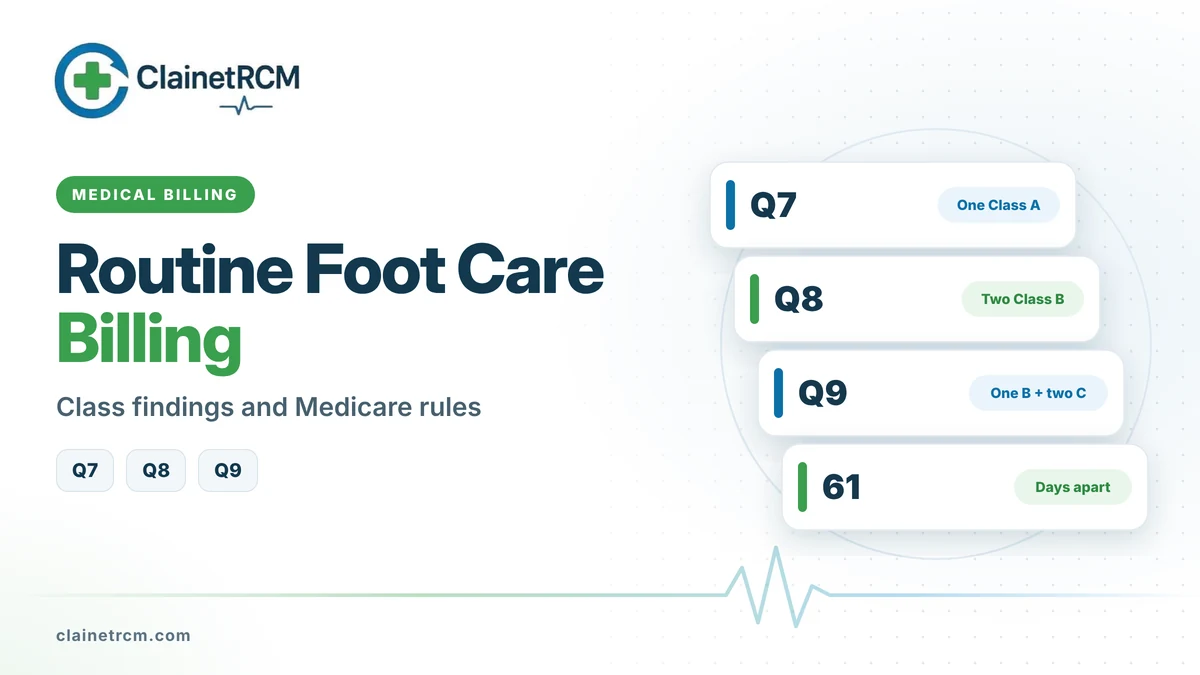
Routine foot care billing guide: Medicare exclusions and exceptions, class findings and Q7, Q8 and Q9 modifiers, nail and callus codes and 61-day frequency.
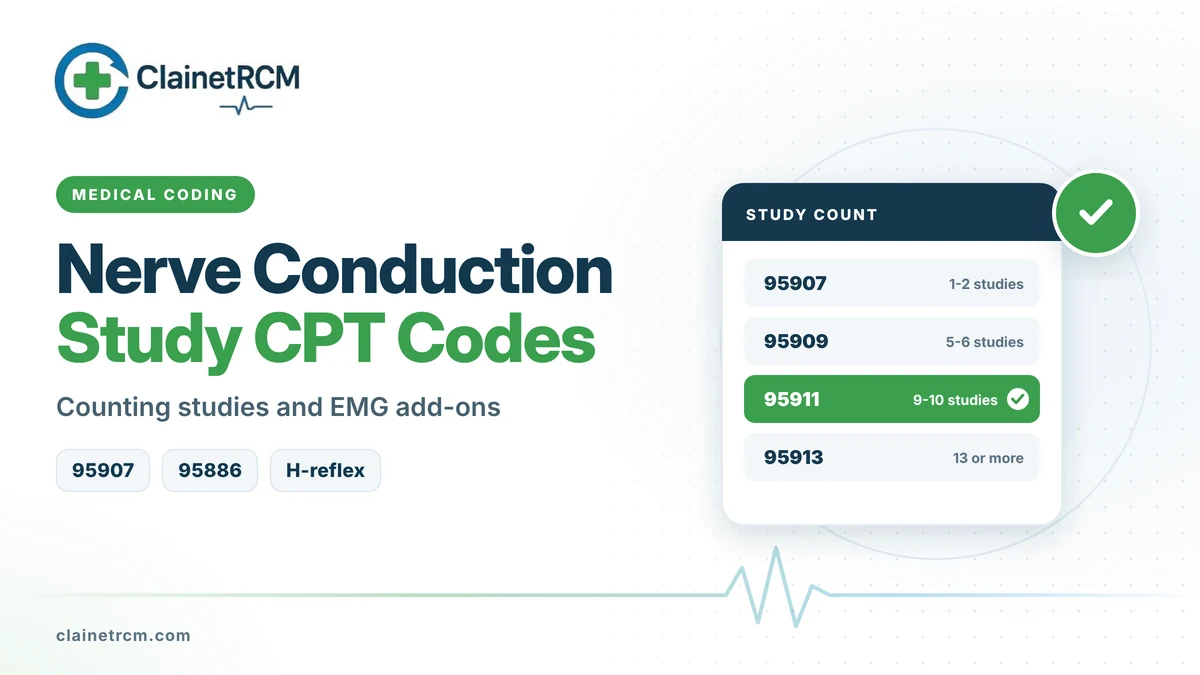
Nerve conduction study CPT codes 95907 to 95913: how to count studies, EMG add-ons 95885 to 95887, maximum study tables and documentation for each nerve.
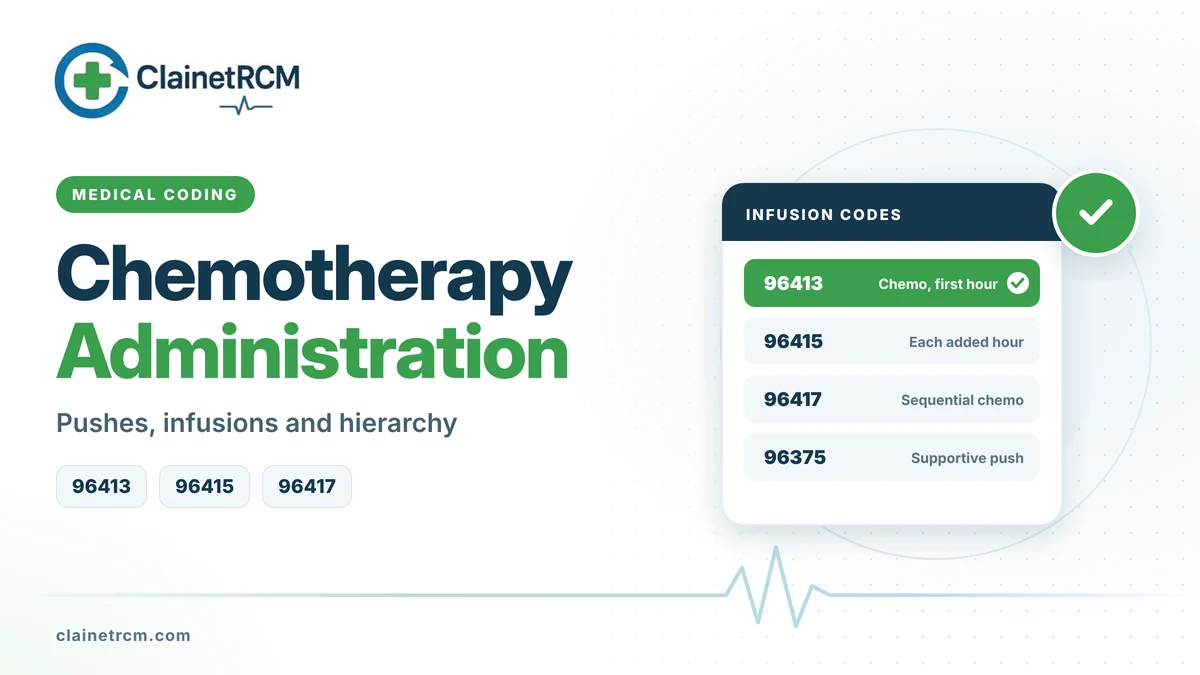
Chemotherapy administration CPT codes explained: injection, push and infusion codes, the initial-service hierarchy, sequential vs concurrent rules and time.
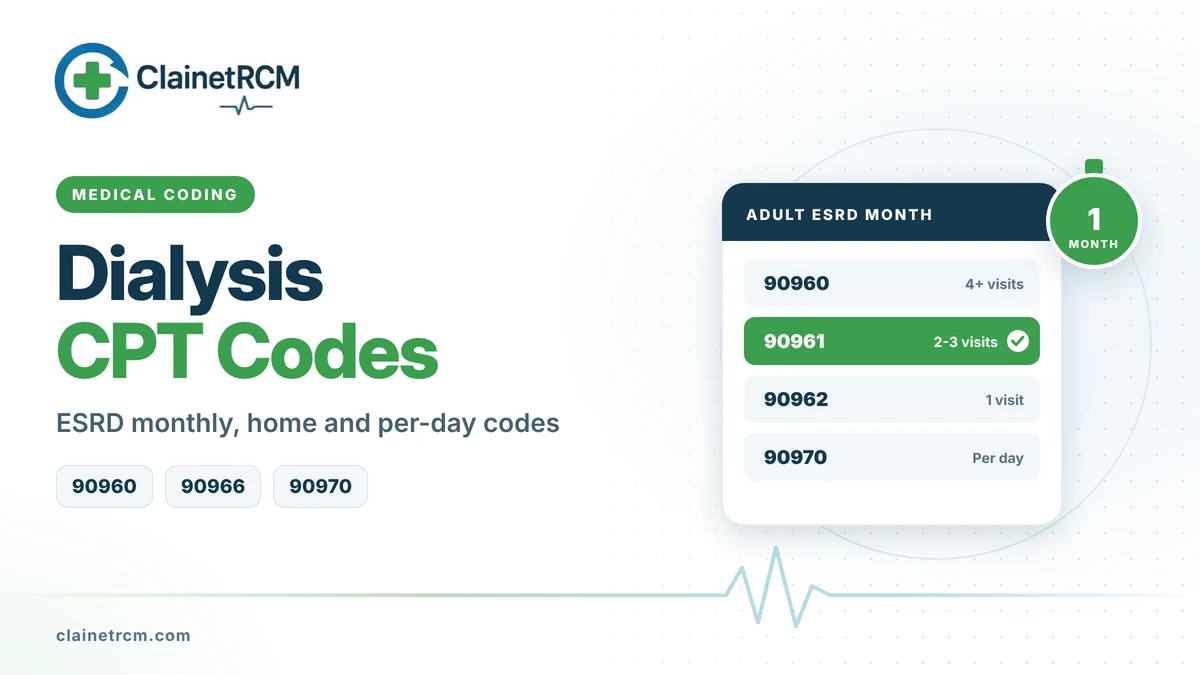
Dialysis CPT codes explained: ESRD monthly codes by age and visits, home dialysis codes, per-day partial-month billing and the in-person access exam.
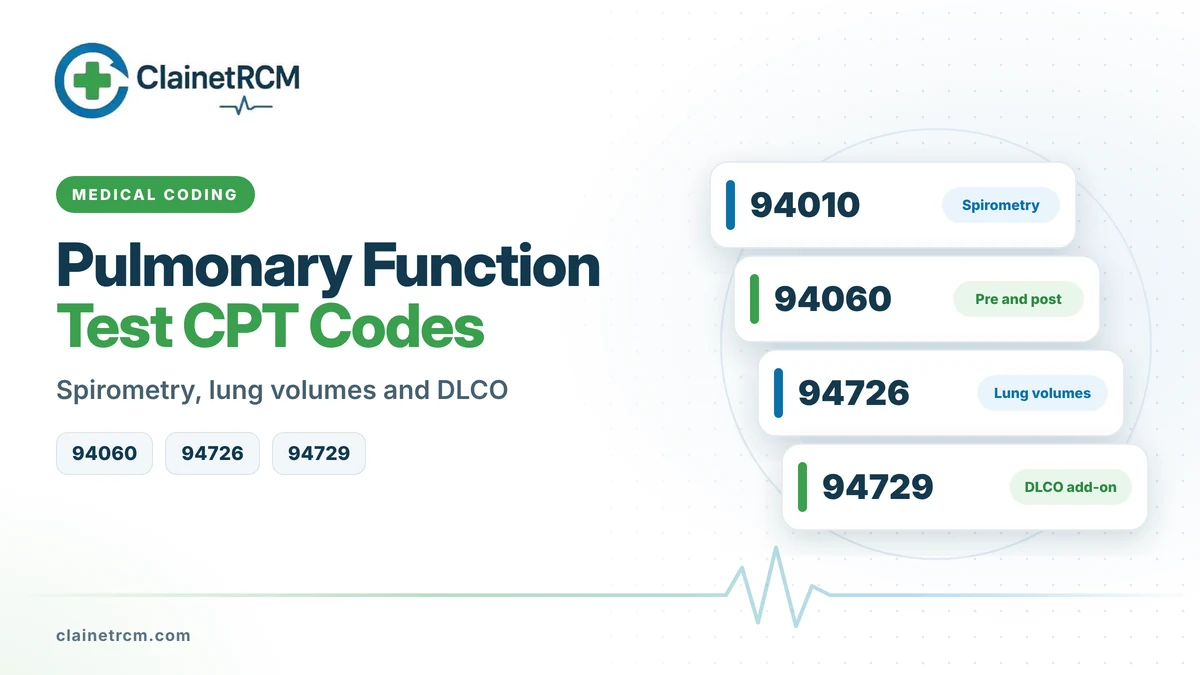
Pulmonary function test CPT codes: spirometry 94010 and 94060, lung volumes, DLCO add-on 94729, exercise tests and the bundling edits that cause denials.
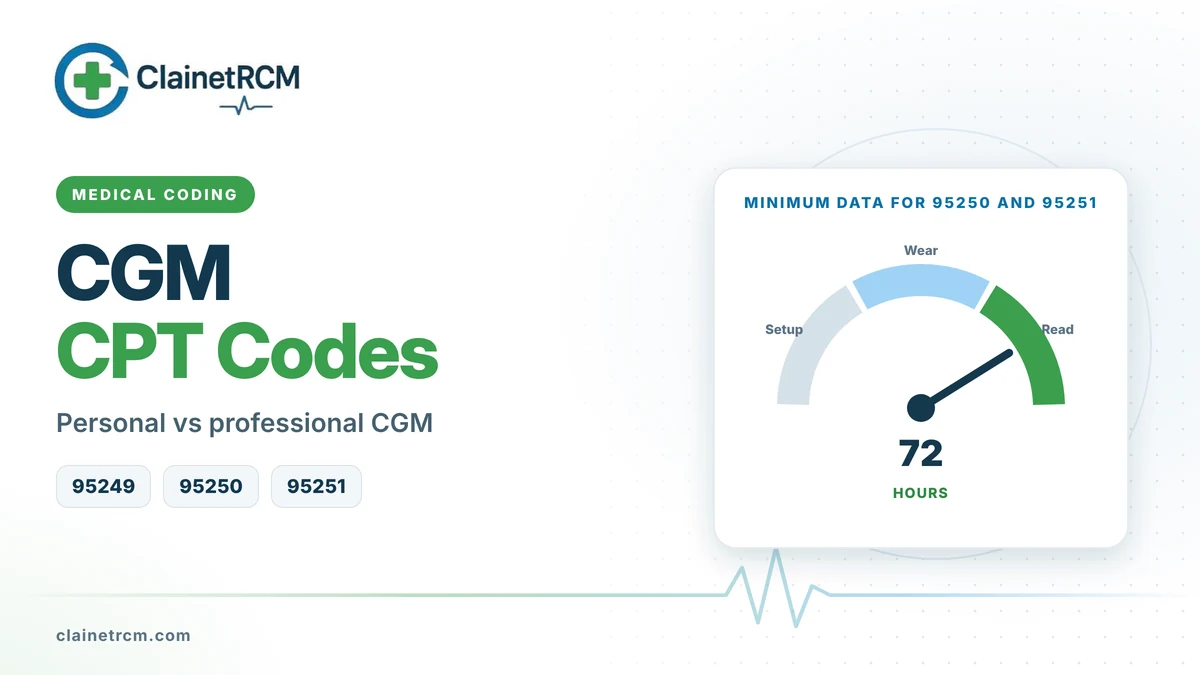
CGM CPT codes 95249, 95250 and 95251: personal vs professional CGM, the 72-hour data rule, interpretation frequency and Medicare coverage requirements.
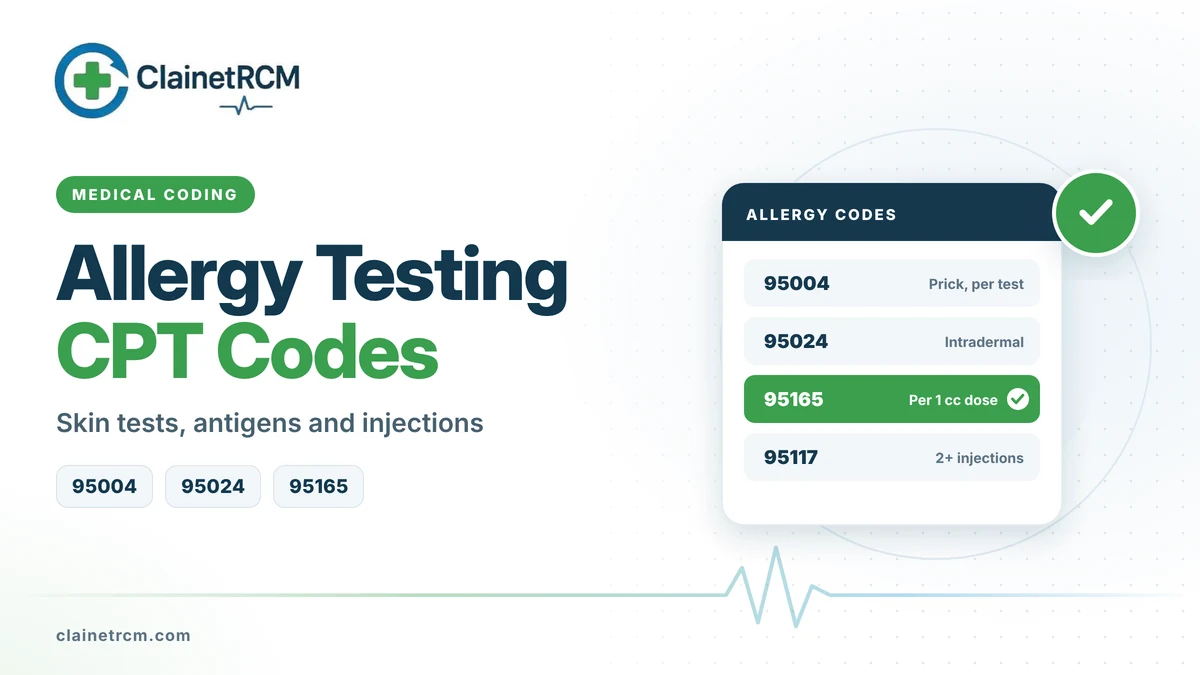
Allergy testing CPT codes explained: percutaneous and intradermal tests by number, patch and challenge tests, 95165 antigen units and immunotherapy injections.
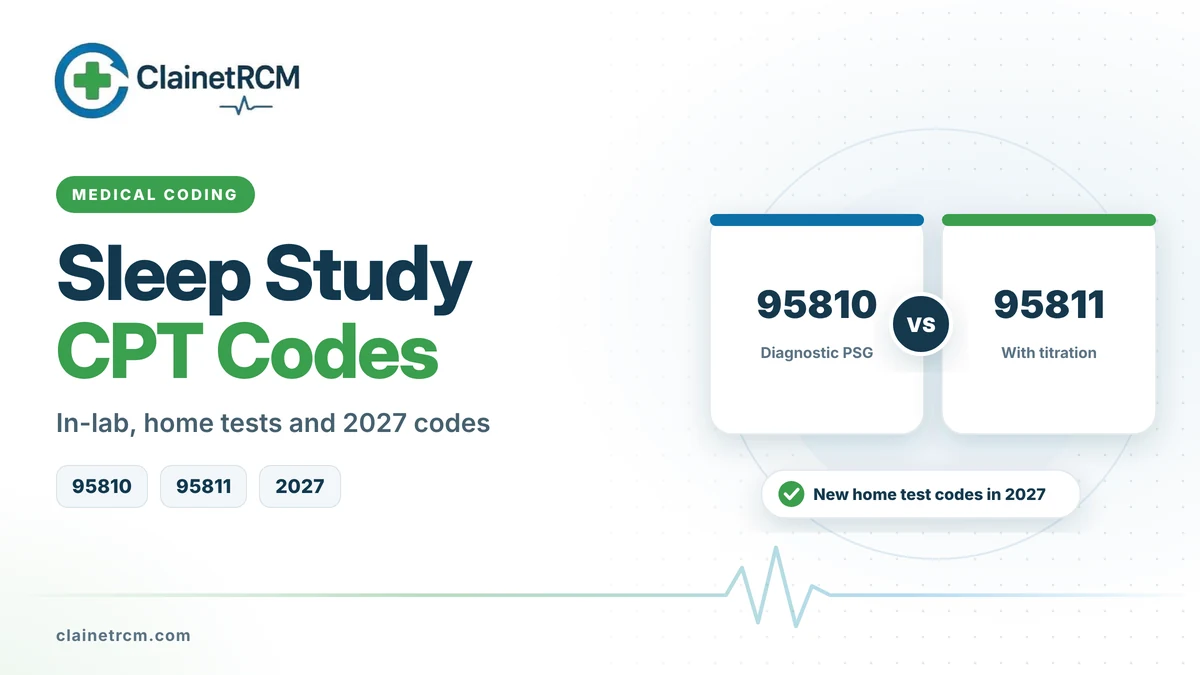
Sleep study CPT codes for in-lab polysomnography and CPAP titration, home sleep apnea tests in 2026, the new 2027 unattended codes and prior authorization tips.
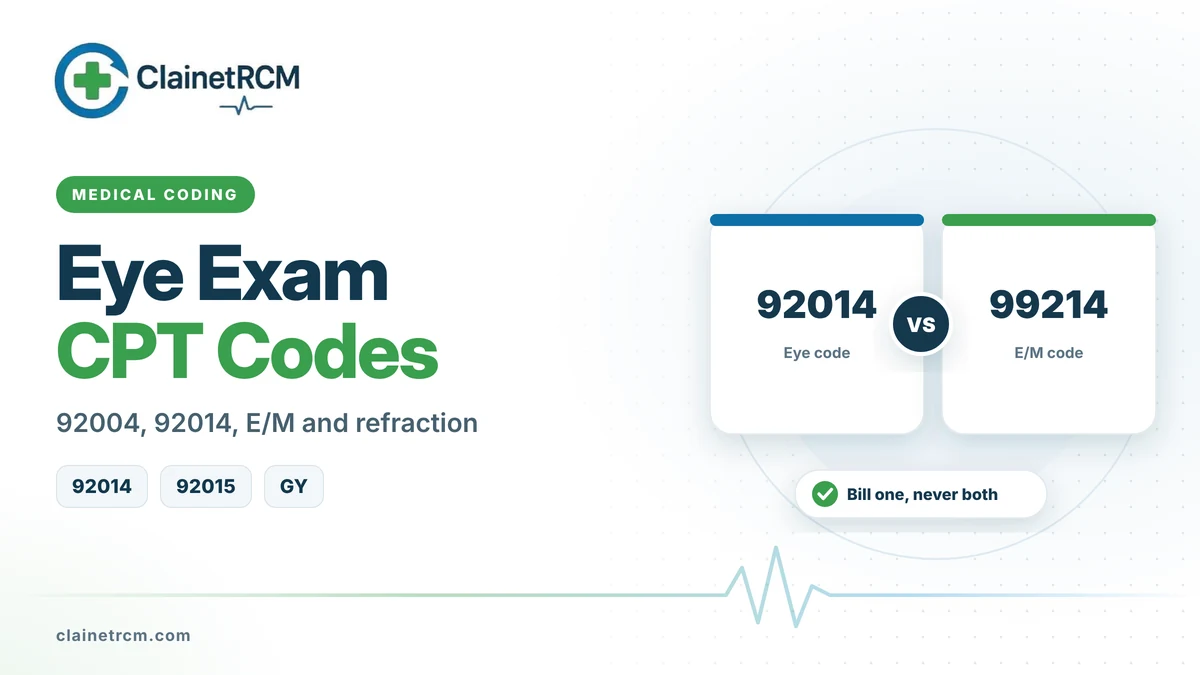
Eye exam CPT codes explained: intermediate vs comprehensive 92002 to 92014, when E/M fits better, refraction 92015 and medical vs routine vision billing.
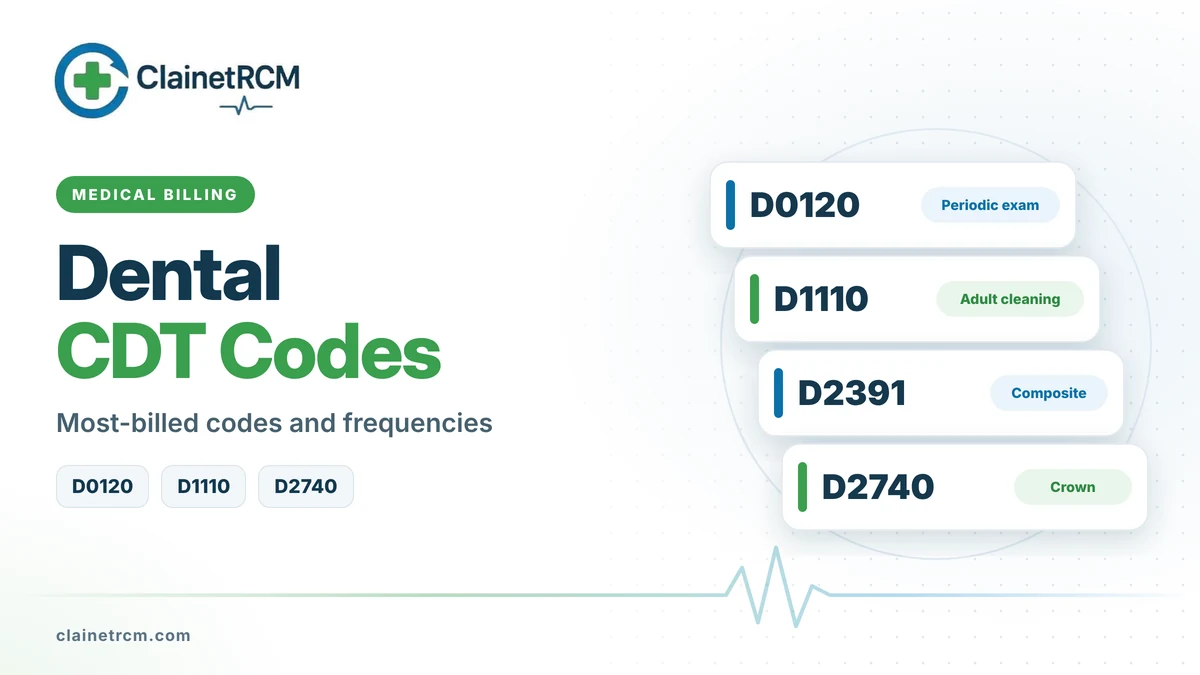
Dental CDT codes practices bill most: exams, X-rays, cleanings, fillings and crowns, plus frequency limits, narratives and the CDT 2026 and 2027 updates.
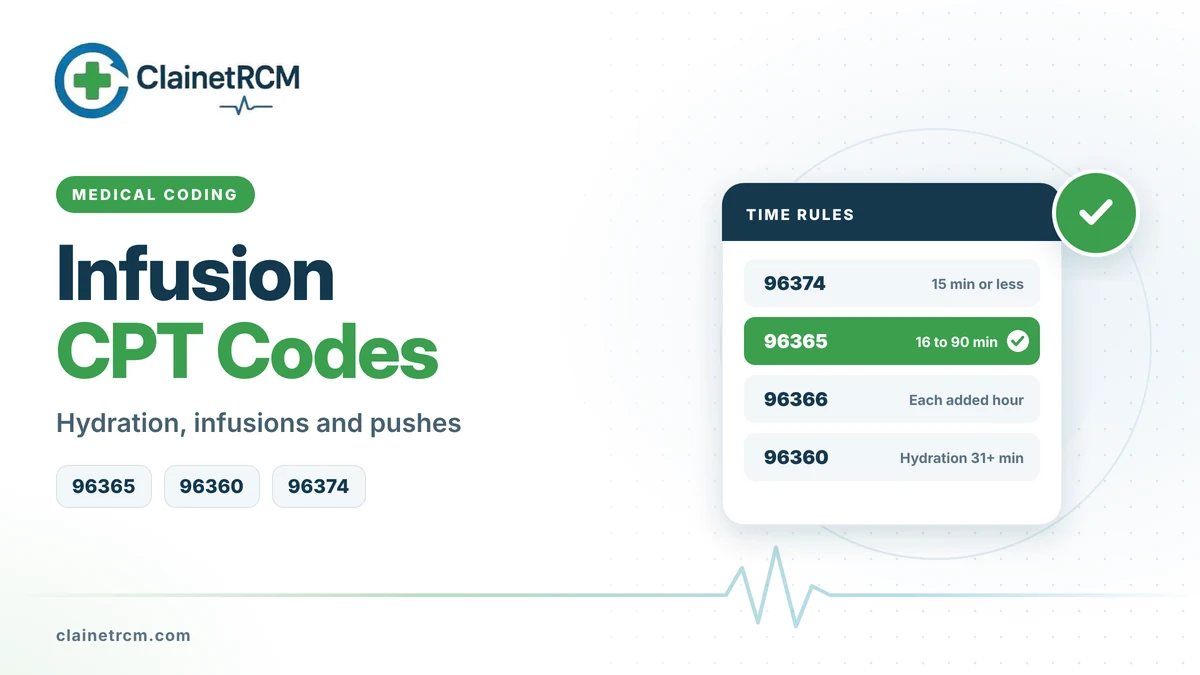
Infusion CPT codes explained: hydration 96360, therapeutic infusions 96365 to 96368, IV pushes 96374 and 96375, time rules and the initial-service hierarchy.
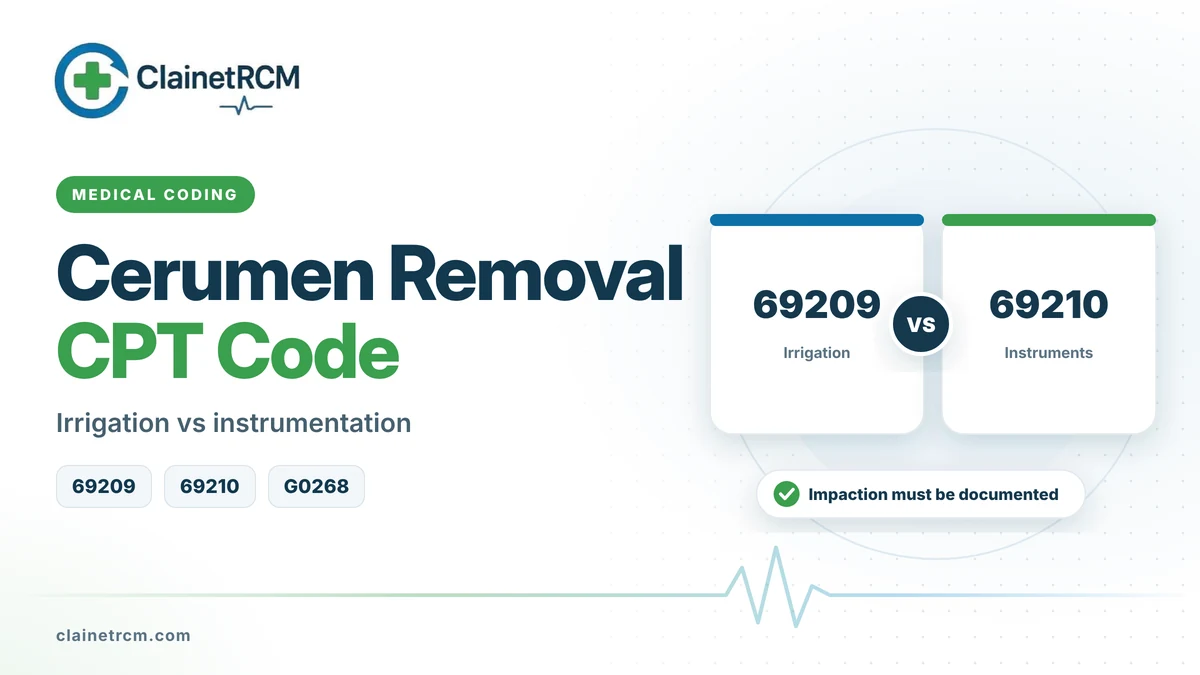
Cerumen removal CPT code guide: irrigation 69209 vs instrumentation 69210, documenting impaction, bilateral rules, G0268 and billing with an E/M visit.
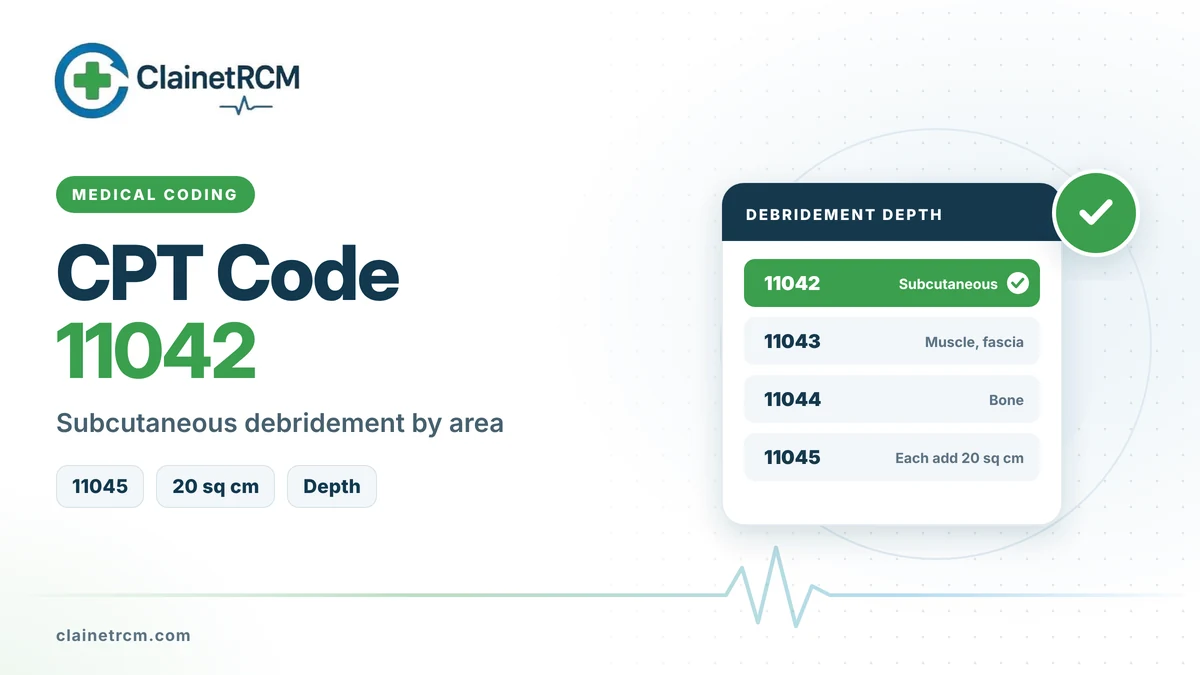
CPT code 11042 for subcutaneous debridement: the 20 sq cm rule, add-on 11045, depth documentation, and selective vs surgical debridement for wound care.
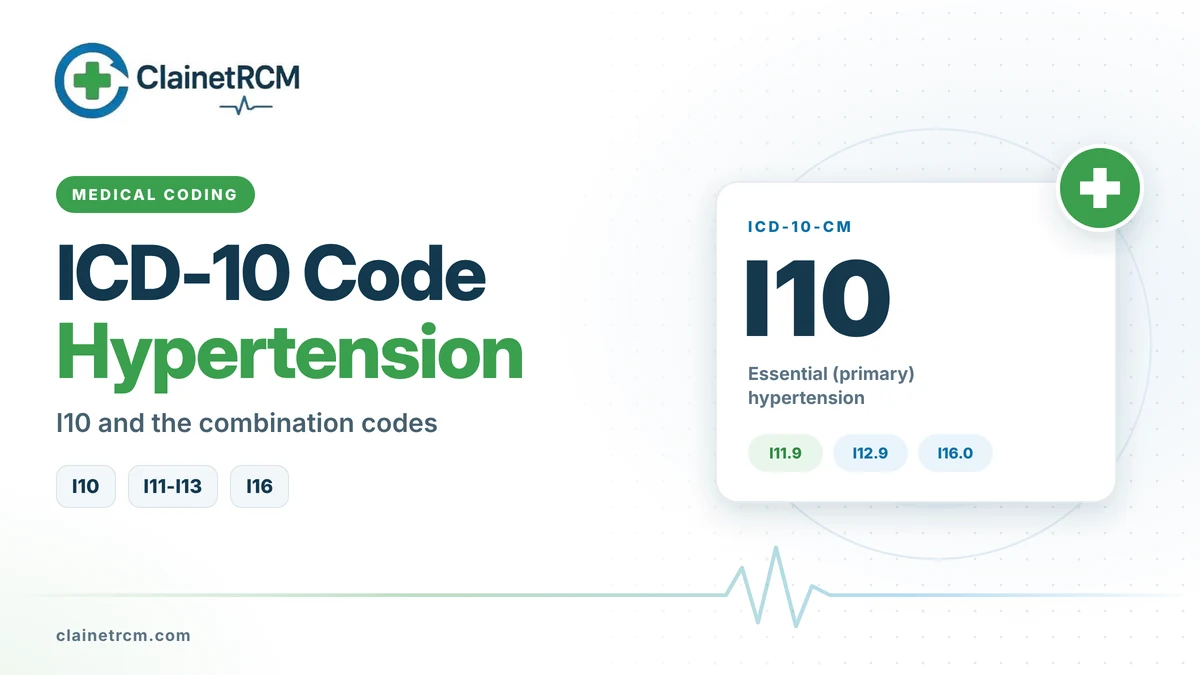
The ICD-10 code for hypertension is I10, but heart disease, CKD and crisis change the code. Learn I11 to I13, I16 urgency and emergency, and I1A.0.
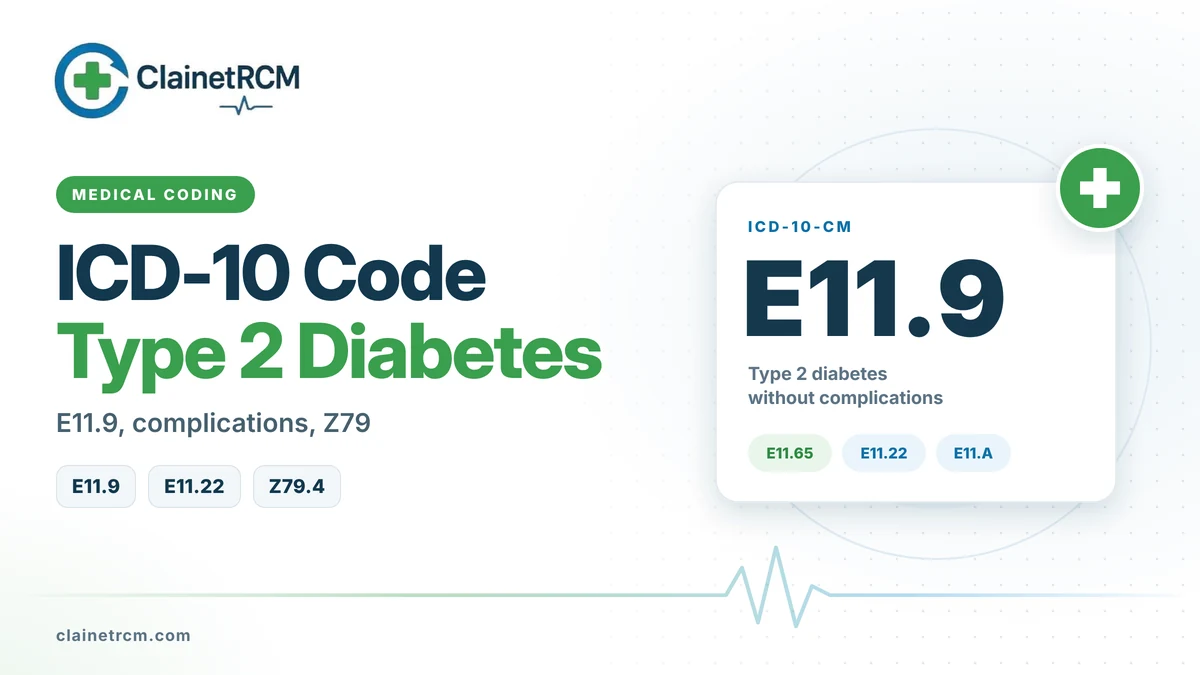
The ICD-10 code for type 2 diabetes is E11.9 without complications. Learn complication codes, E11.A remission, Z79 drug codes and risk adjustment tips.
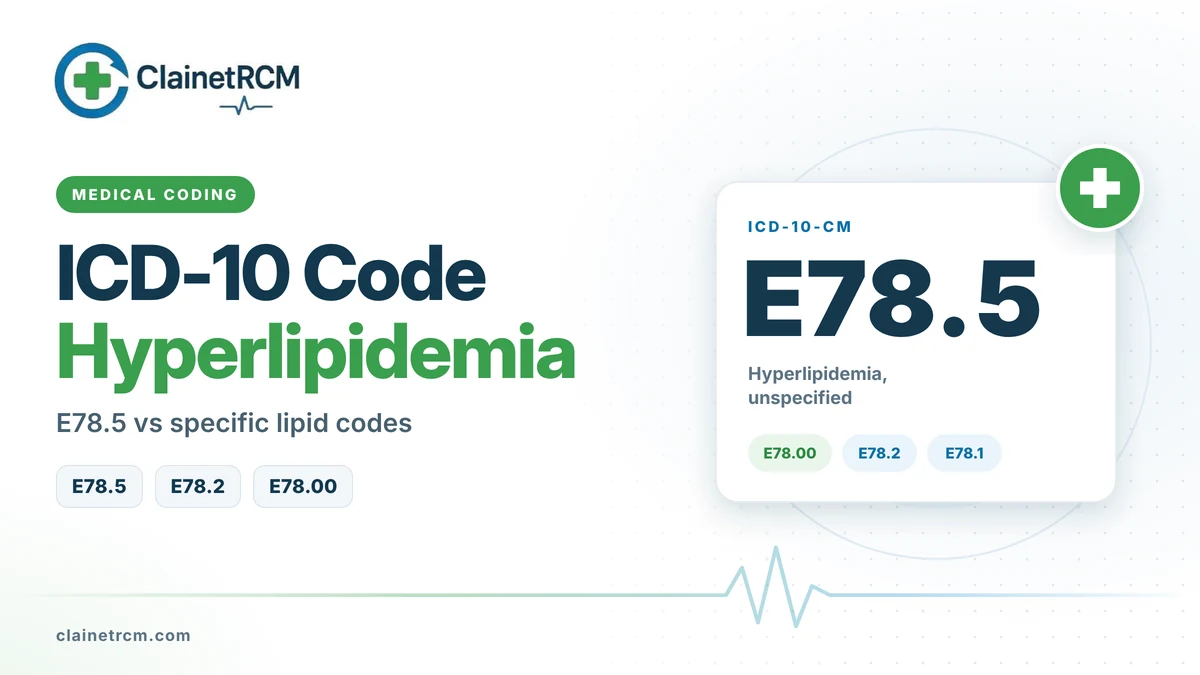
The ICD-10 code for hyperlipidemia is E78.5 when unspecified. Learn when to use E78.00, E78.01, E78.2, E78.1 and E78.49, plus screening and statin coding.
The ICD-10 code for UTI is N39.0 when the site is not specified. Learn cystitis and pyelonephritis codes, organism codes, CAUTI and UTI in pregnancy.
The ICD-10 code for obesity depends on class and cause: E66.811 to E66.813, E66.01 and E66.9, paired with BMI Z68 codes. Plus weight management coverage.
The ICD-10 code for chest pain is R07.9 when unspecified. Learn R07.89, R07.1, R07.2 and R07.81, when symptom codes fit and how to code a confirmed cause.
The ICD-10 code for COPD is J44.9 when unspecified. Learn J44.1 exacerbations vs J44.0 infections, emphysema and asthma overlap and risk adjustment tips.
The ICD-10 code for ADHD depends on presentation: F90.0 inattentive, F90.1 hyperactive, F90.2 combined. Learn adult coding and pairing with 96127.
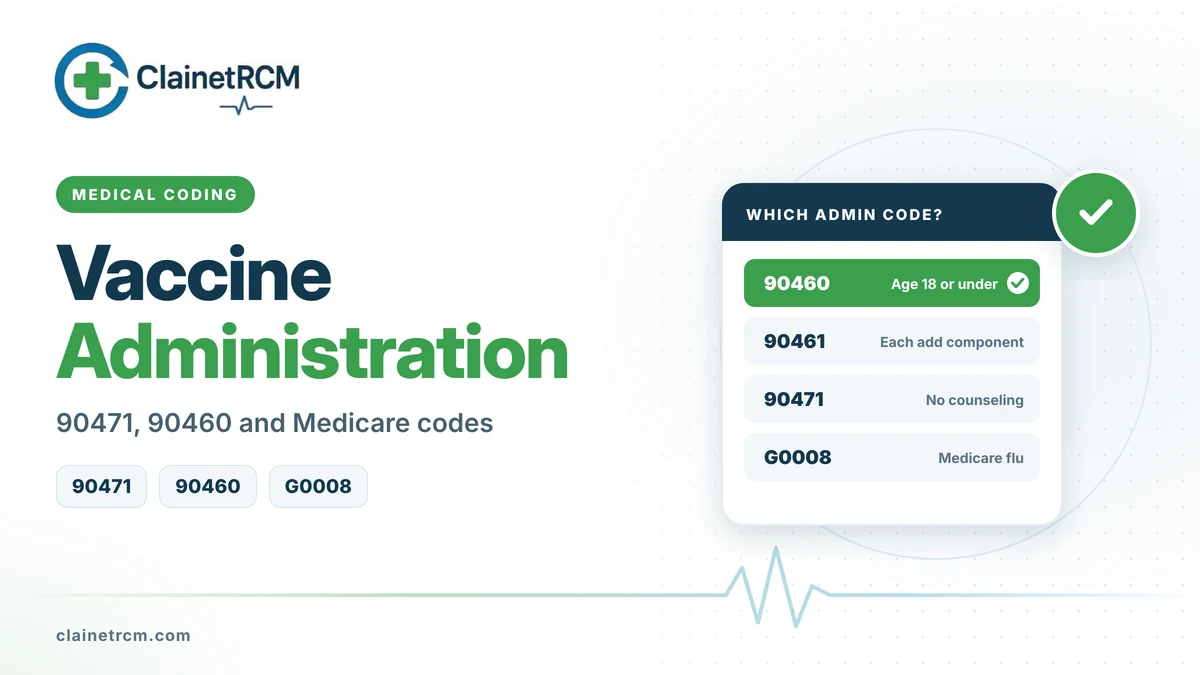
Vaccine administration CPT codes explained: 90471 to 90474, counseling codes 90460 and 90461, Medicare G0008 to G0010 and 90480, and Part B vs Part D.
The JZ modifier attests no drug was discarded from a single-dose container. Learn when JZ and JW are required, how to bill waste and the audit risks.
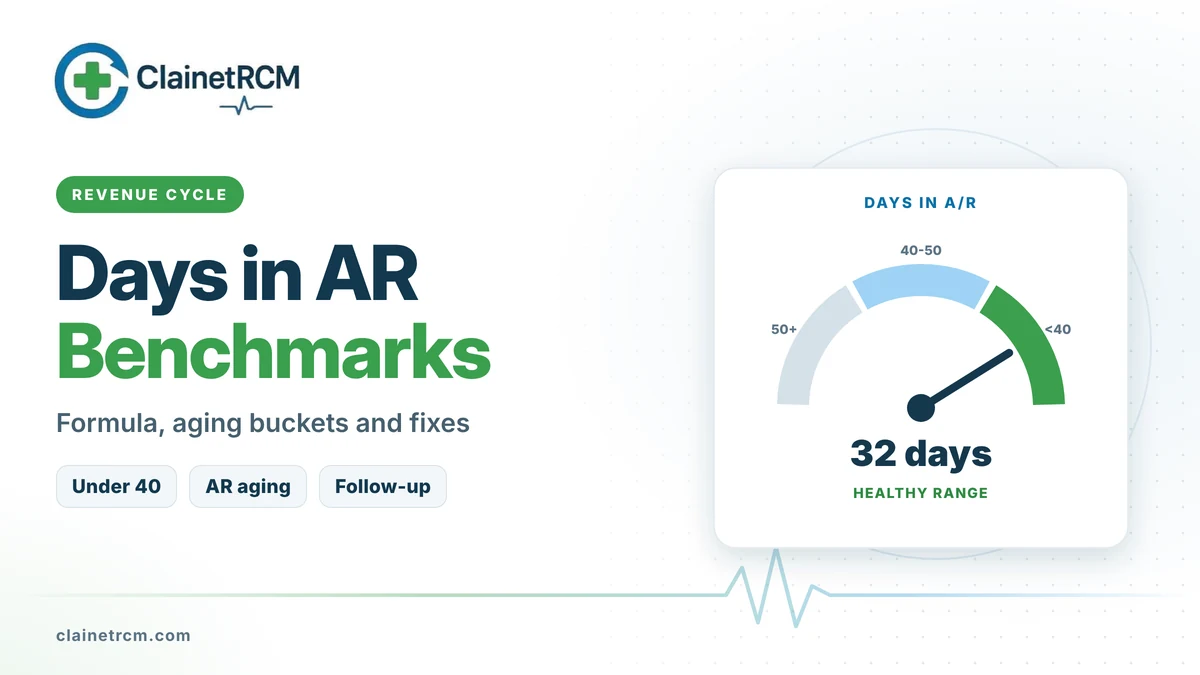
Days in AR shows how fast your practice gets paid. Learn the formula, healthy benchmarks, AR aging buckets and a weekly routine that brings the number down.
Write a medical appeal letter that wins. Use our ready-to-use template, see what payers need to reverse a denial and check the appeal deadlines by level.
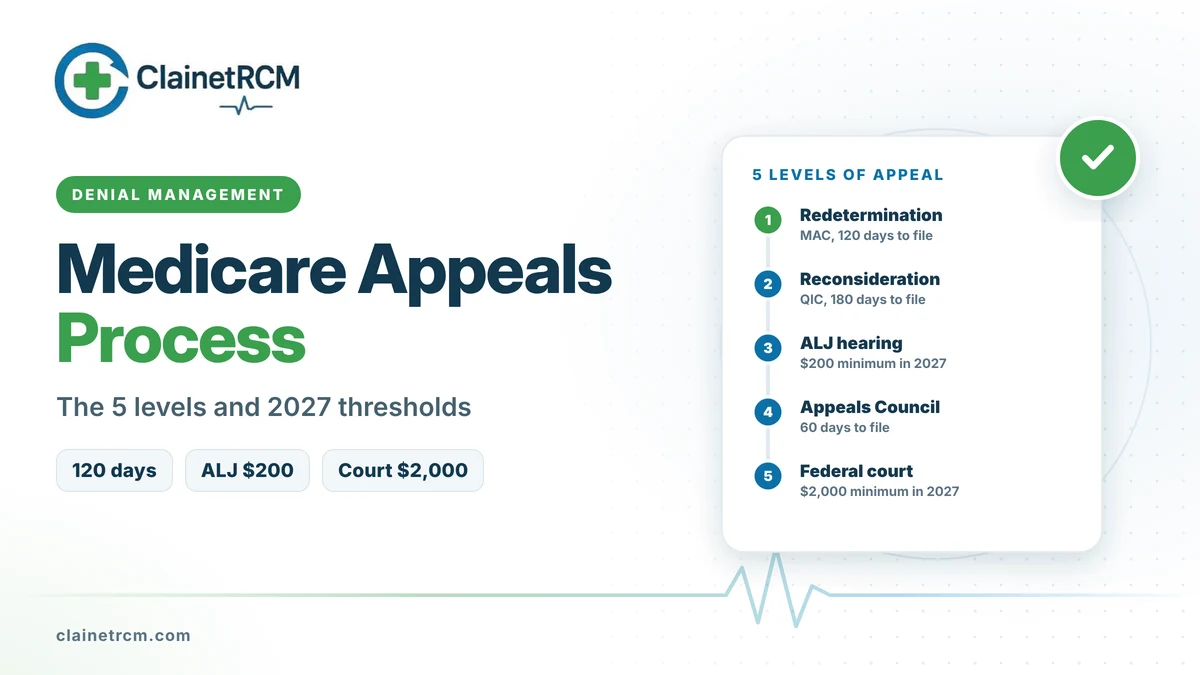
The Medicare appeals process has five levels. See who decides each one, the filing deadlines, decision times and the 2026 and 2027 amount in controversy rules.
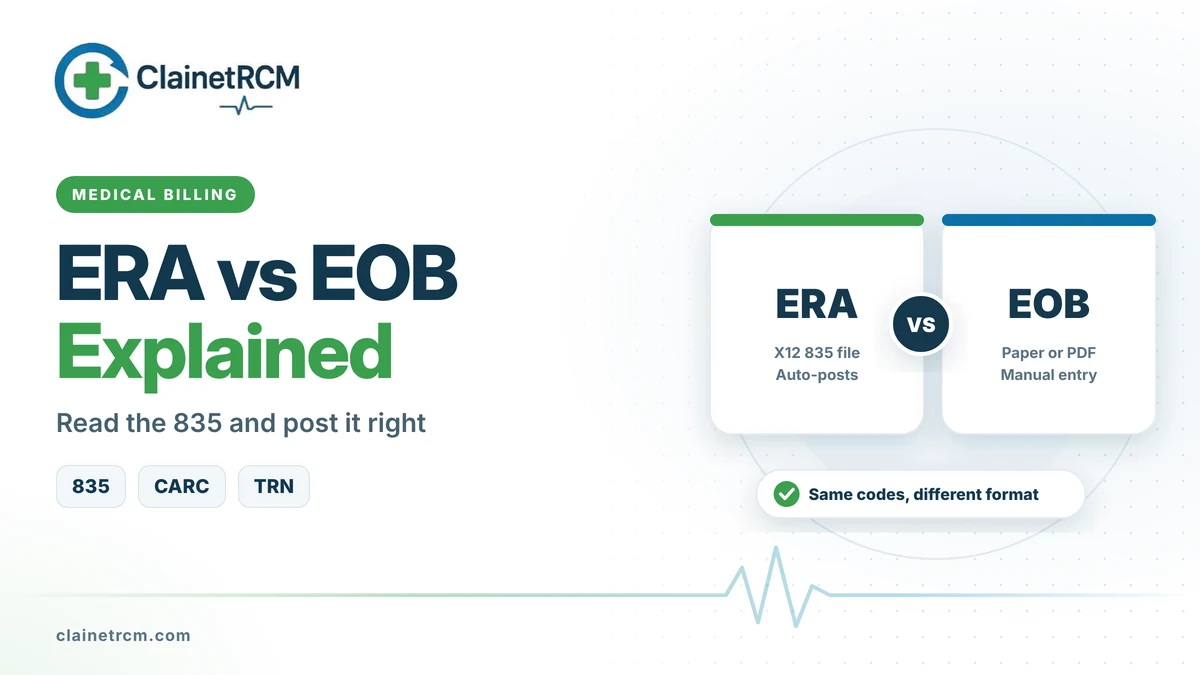
ERA vs EOB explained: what the 835 file shows, how to read group codes, CARCs and RARCs, how EFT reassociation works and tips to auto-post payments cleanly.
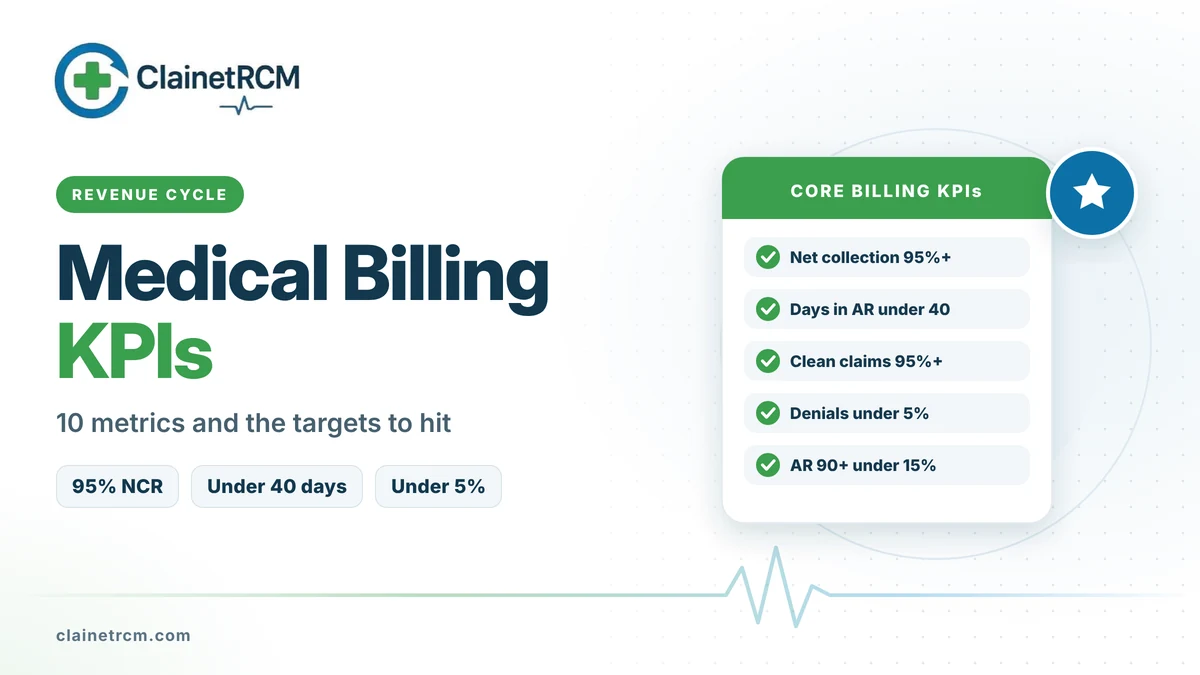
Track the medical billing KPIs that matter: net collection rate, clean claim rate, denial rate, days in AR and more, with formulas and benchmarks to aim for.
BCBS credentialing happens plan by plan. Learn how to find your local Blue plan, apply with CAQH, get contracted and bill out-of-area members through BlueCard.
TRICARE provider enrollment starts with becoming TRICARE-authorized. Compare network and non-network options, the East and West contractors and billing rules.
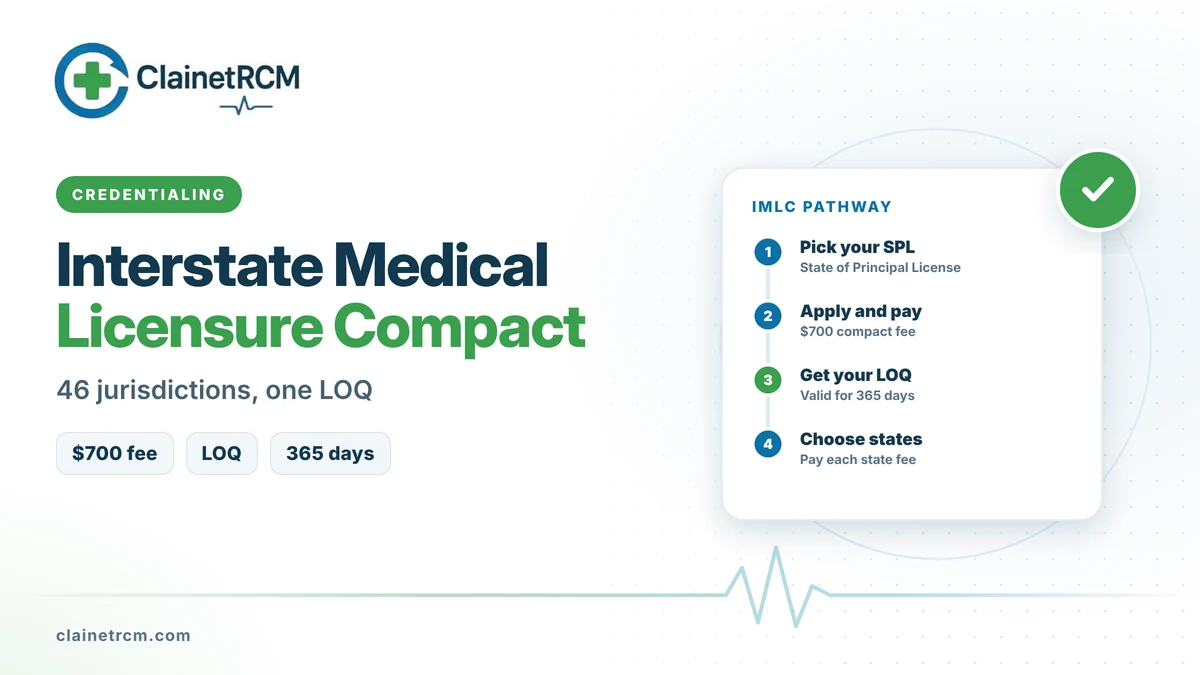
The Interstate Medical Licensure Compact speeds up multi-state licenses. See who qualifies, how the LOQ works, what it costs and which states take part.
A CLIA certificate of waiver lets you run simple waived tests. See who needs one, how to apply with Form CMS-116, the $248 fee and when to use the QW modifier.
DEA registration lets you prescribe controlled substances. Learn how to apply with Form 224, the $888 fee, renewing every three years and state-by-state rules.
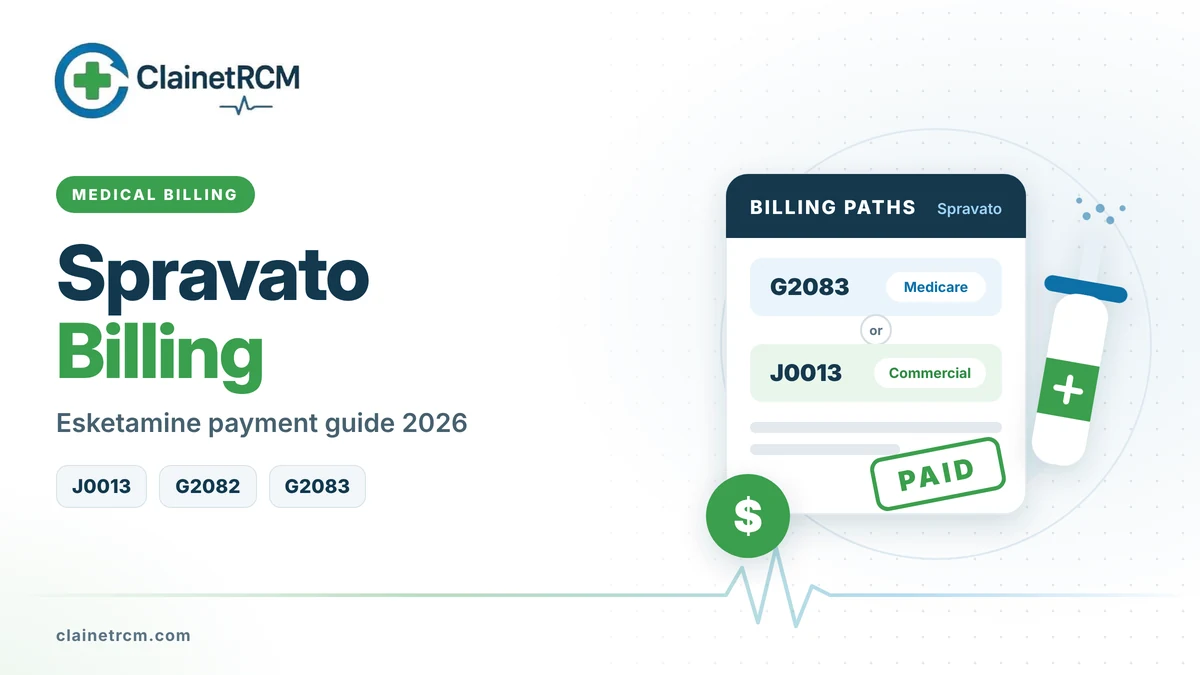
Spravato billing made clear: J0013 vs G2082 and G2083, buy-and-bill vs specialty pharmacy, 2026 Medicare rates, prior auth and the denials to avoid.
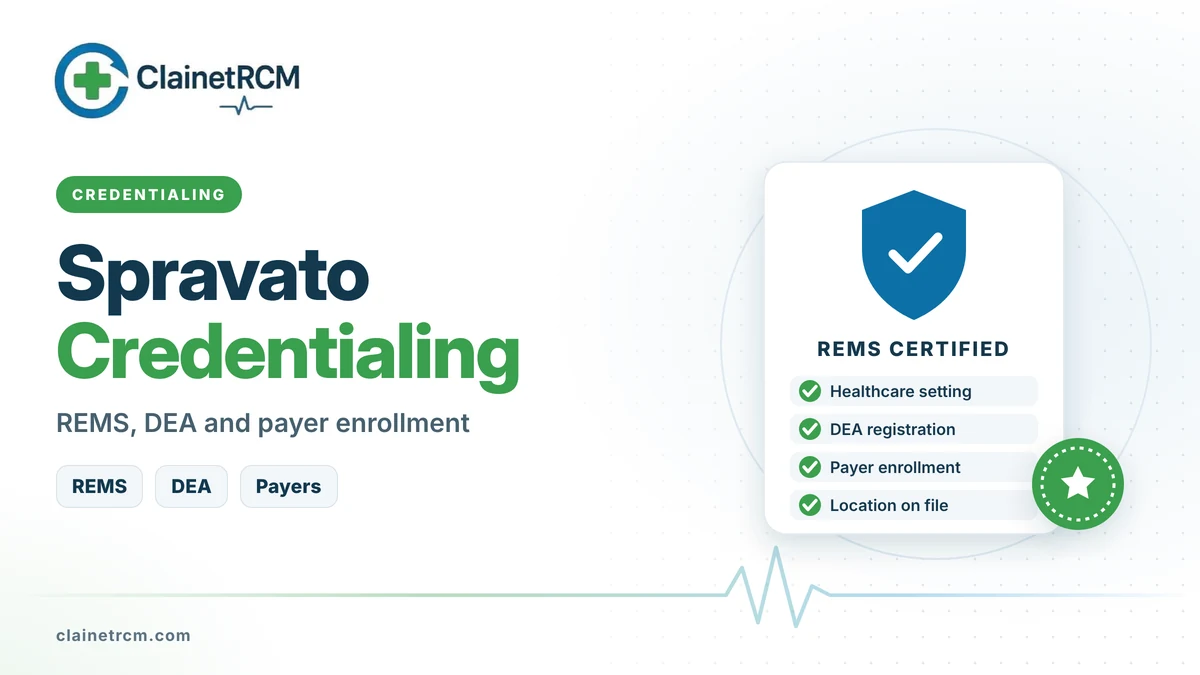
Spravato credentialing step by step: REMS setting certification, DEA registration, payer enrollment and the paperwork that keeps esketamine claims payable.
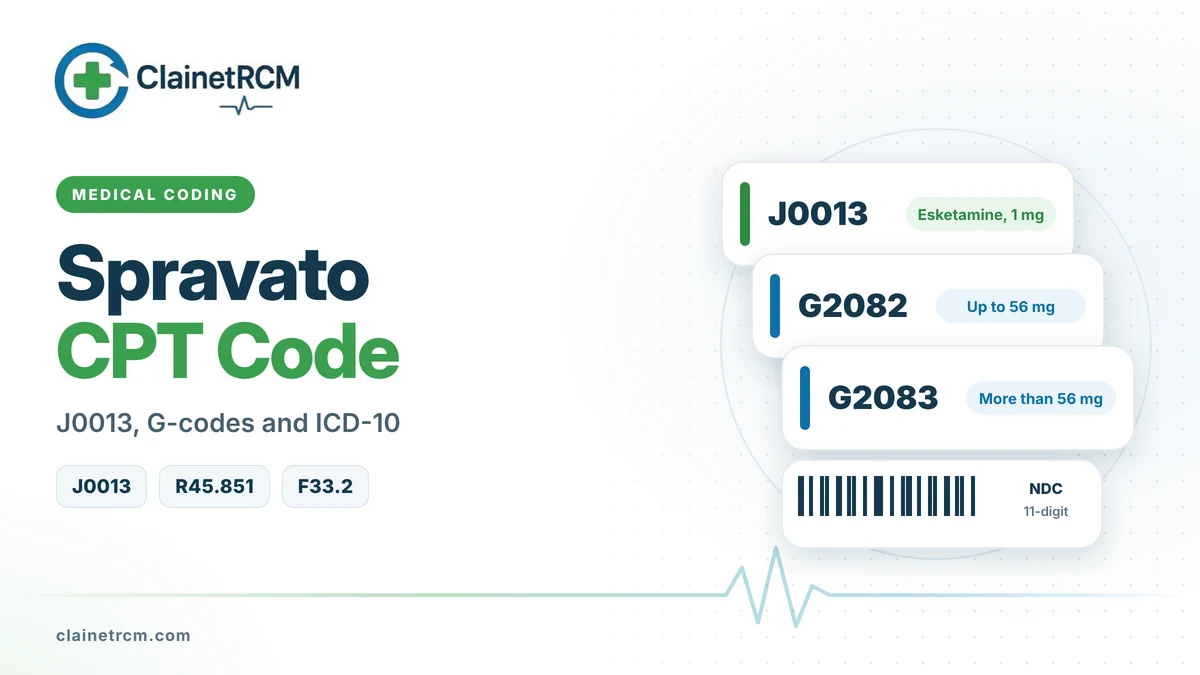
The Spravato CPT code question answered: J0013 replaced S0013 in 2026, G2082 and G2083 for Medicare, NDC units, E/M rules and the ICD-10 codes that fit.
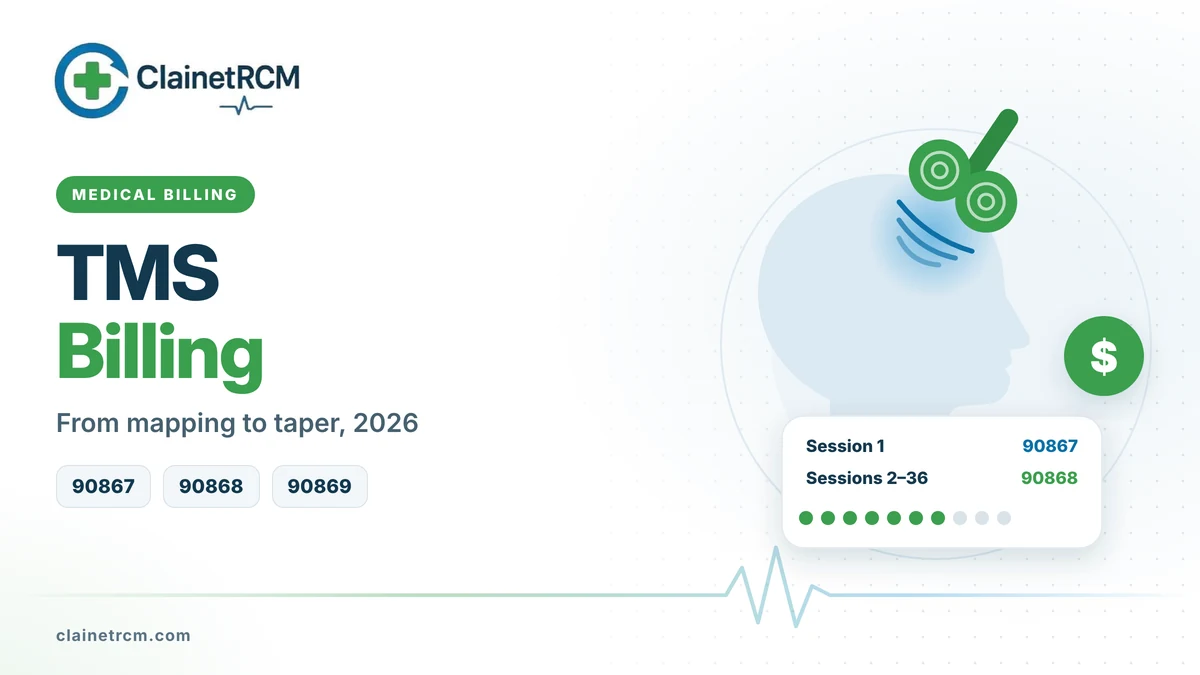
TMS billing explained: how to bill 90867, 90868 and 90869 across a full course, Medicare LCD rules by MAC, prior auth, retreatment and denial fixes for 2026.
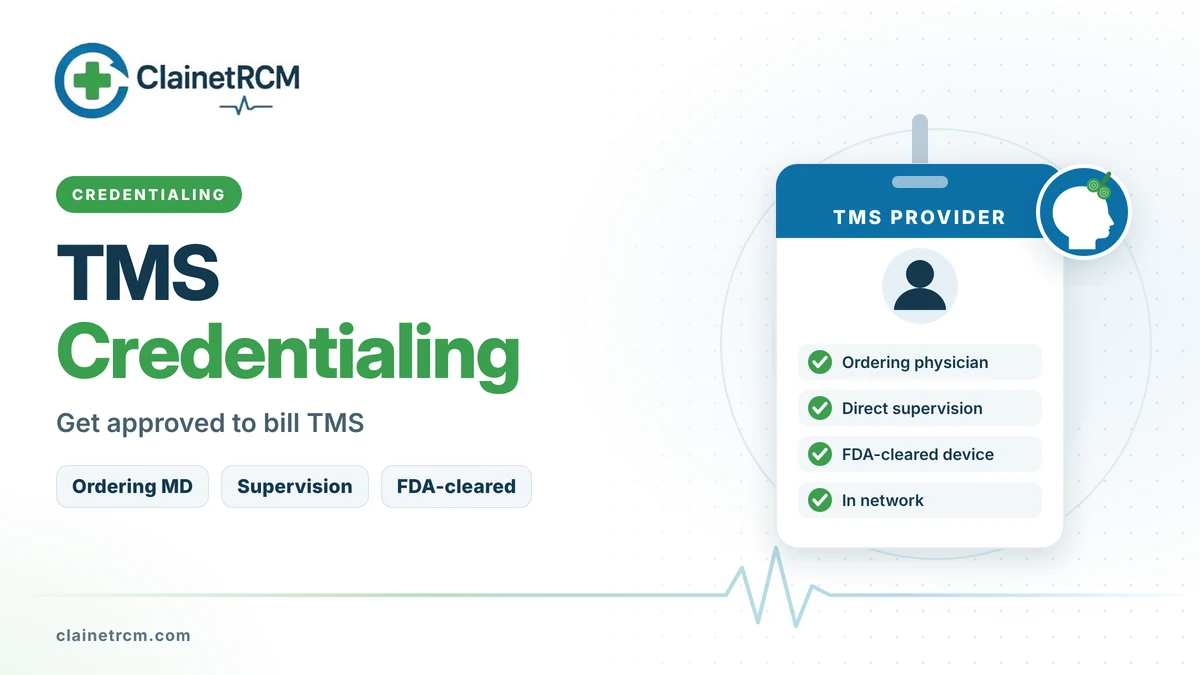
TMS credentialing step by step: who can order and supervise, device and training proof, payer enrollment, Medicare LCD rules and the 2026 payer changes.
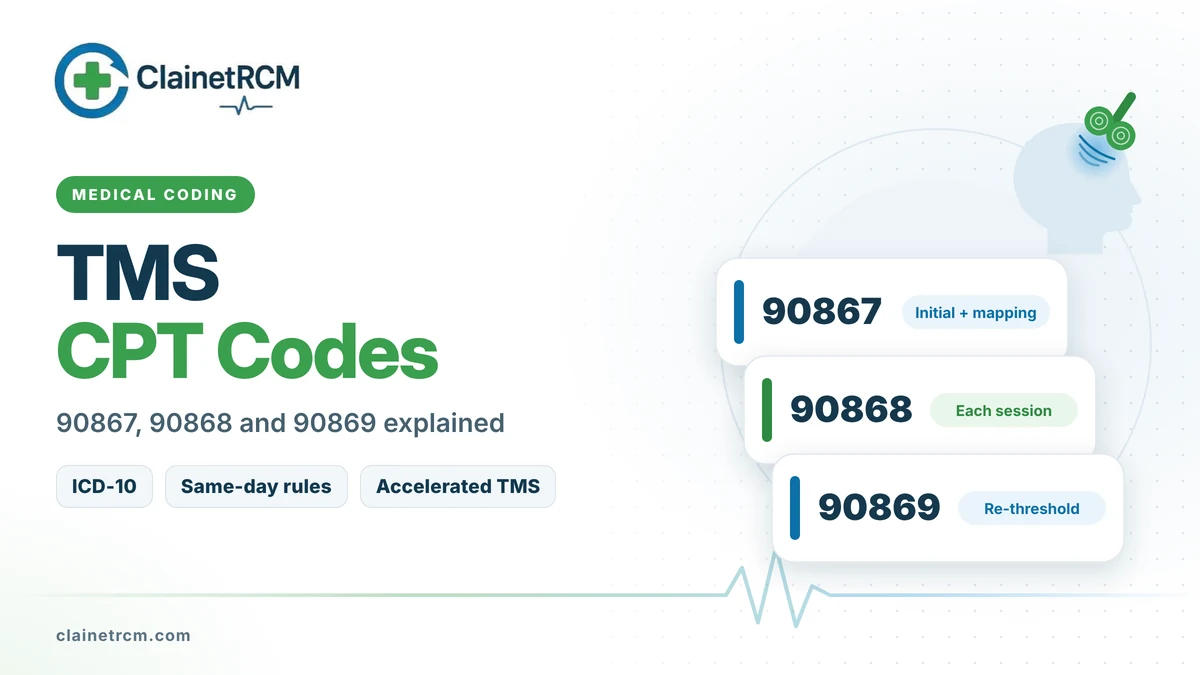
TMS CPT codes 90867, 90868 and 90869 explained, with ICD-10 pairings, same-day rules, deep TMS and OCD coding, SAINT codes and the common errors for 2026.

Surgical clearance ICD 10 codes explained. Learn when to use Z01.810, Z01.811, Z01.812 and Z01.818, how to sequence them, and avoid denials.
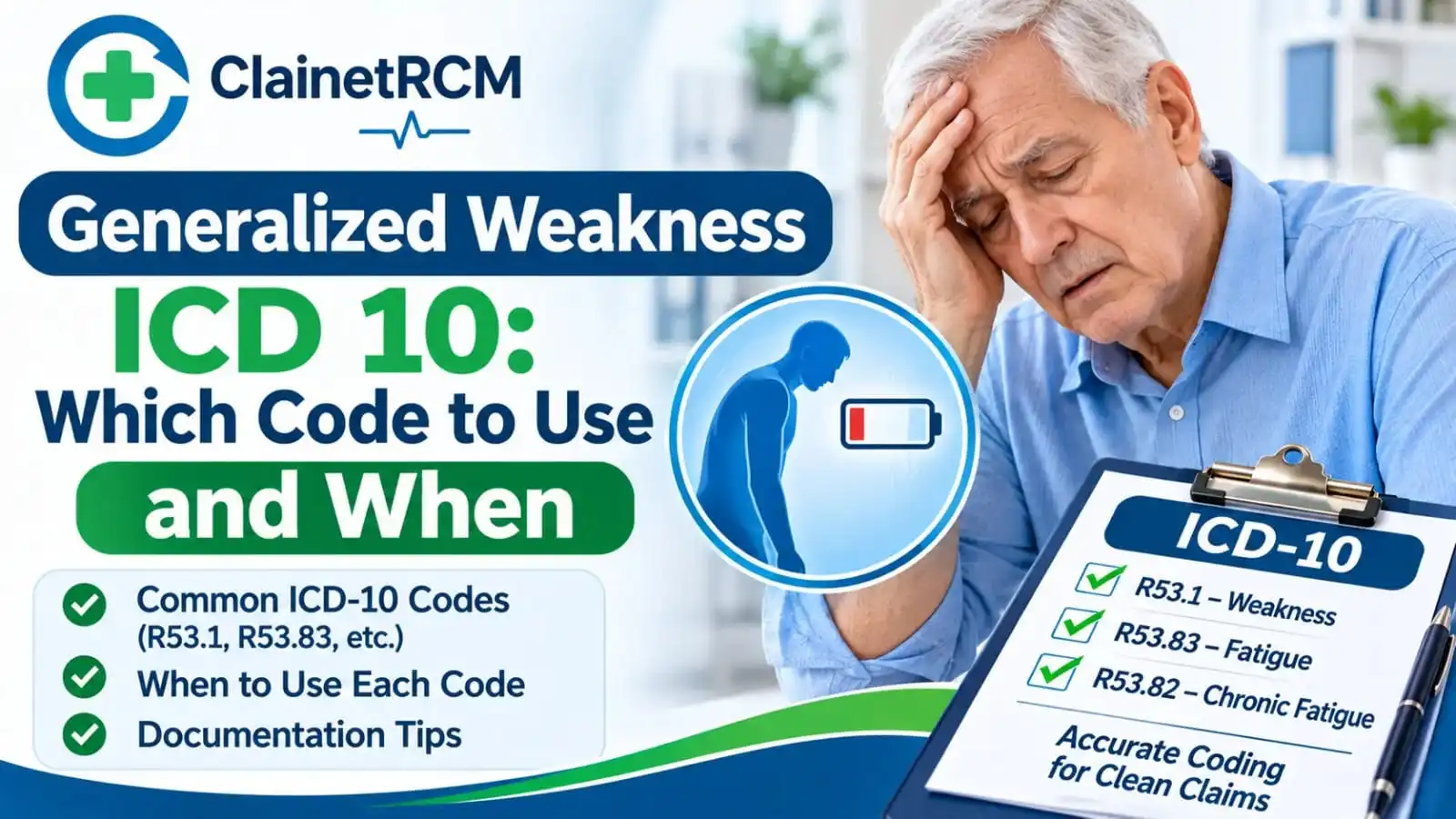
Generalized weakness ICD 10 code is R53.1. Learn when M62.81, R53.81 or R54 fits better, plus documentation tips and denial fixes for FY2027.

Shortness of breath ICD 10 code is R06.02. Learn when to use R06.00, R06.01, R06.09 or a definitive diagnosis, plus FY2027 updates and denial fixes.
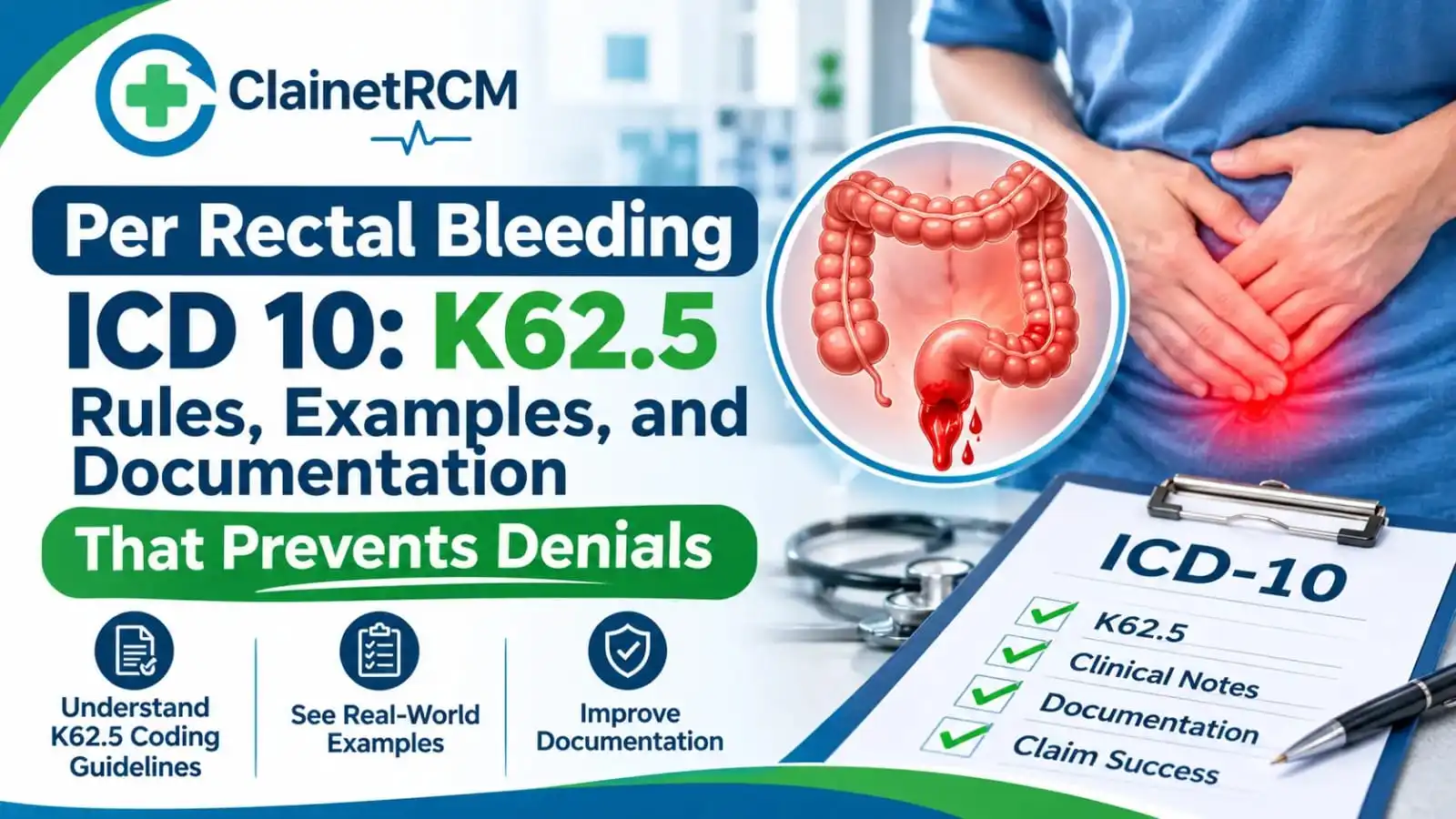
Per rectal bleeding ICD 10 code is K62.5. Learn when to use it, what it excludes, K92.1 vs K62.5, and how to avoid denials. Updated for FY 2027.
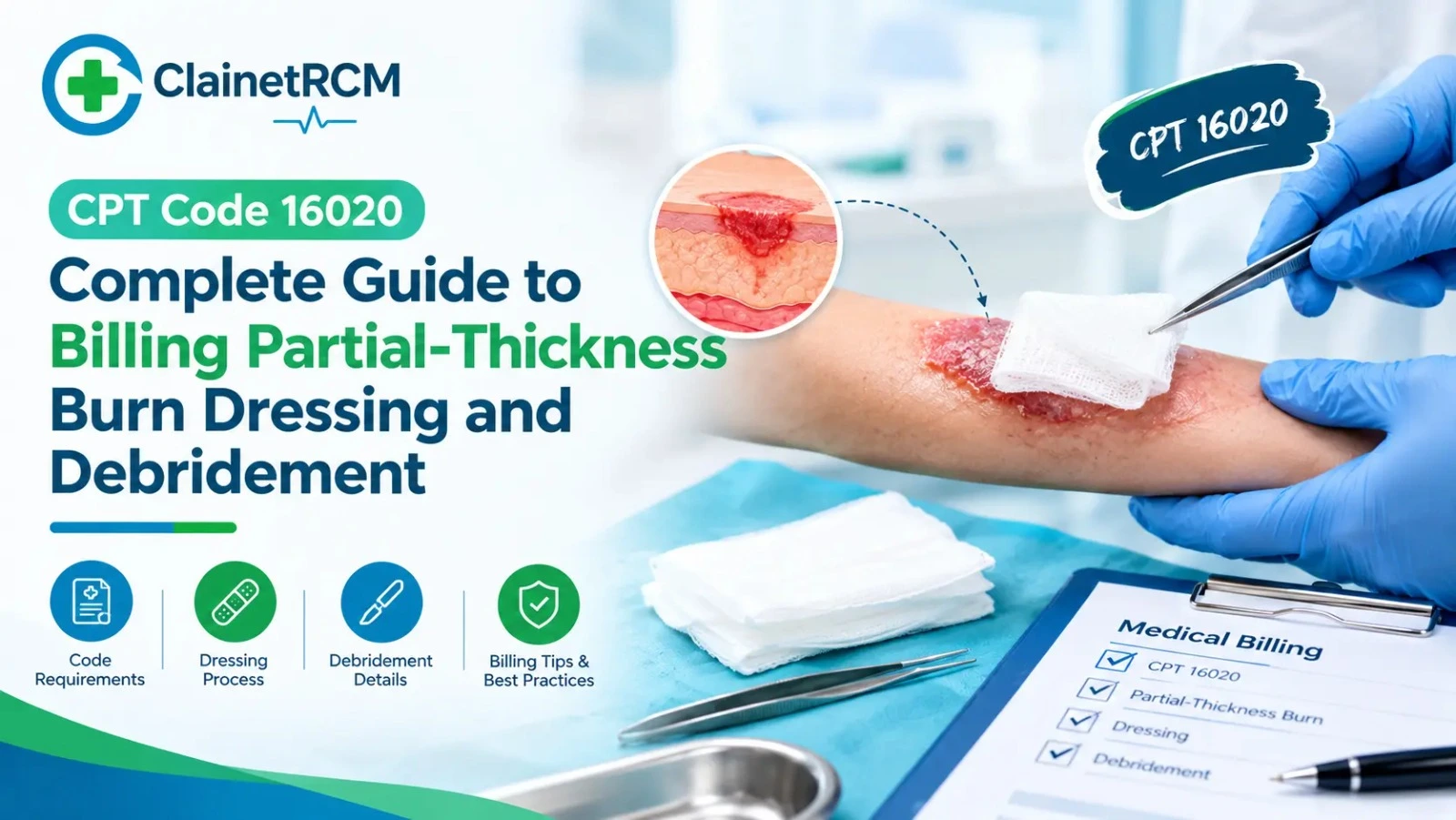
Learn what CPT code 16020 covers, when to bill it, modifier 25 rules, ICD-10 pairing, 2026 Medicare RVUs and the denials that cost practices money.
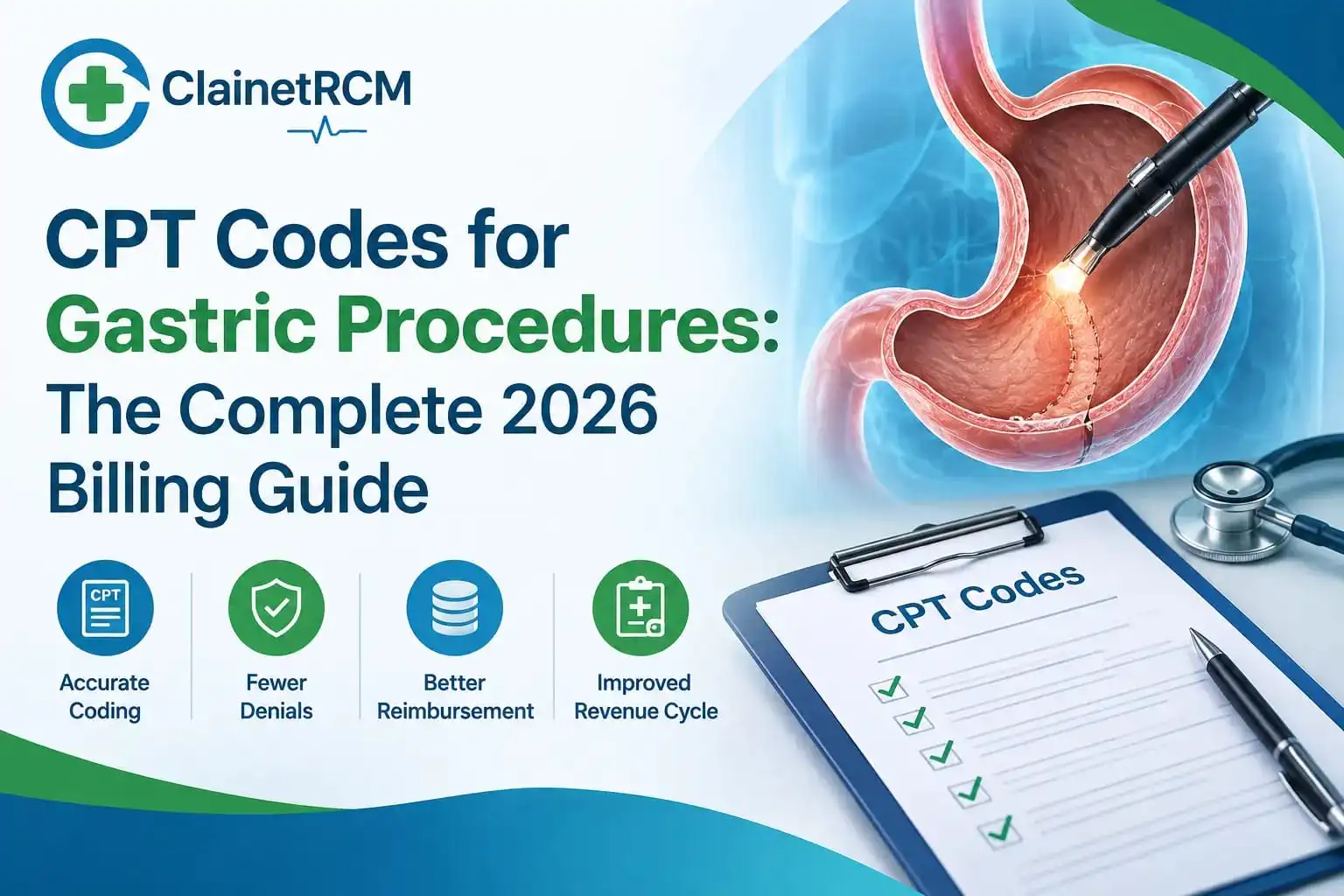
Complete 2026 guide to CPT codes for gastric procedures: EGD, bariatric, gastrectomy, G-tube and gastric emptying codes with billing tips.
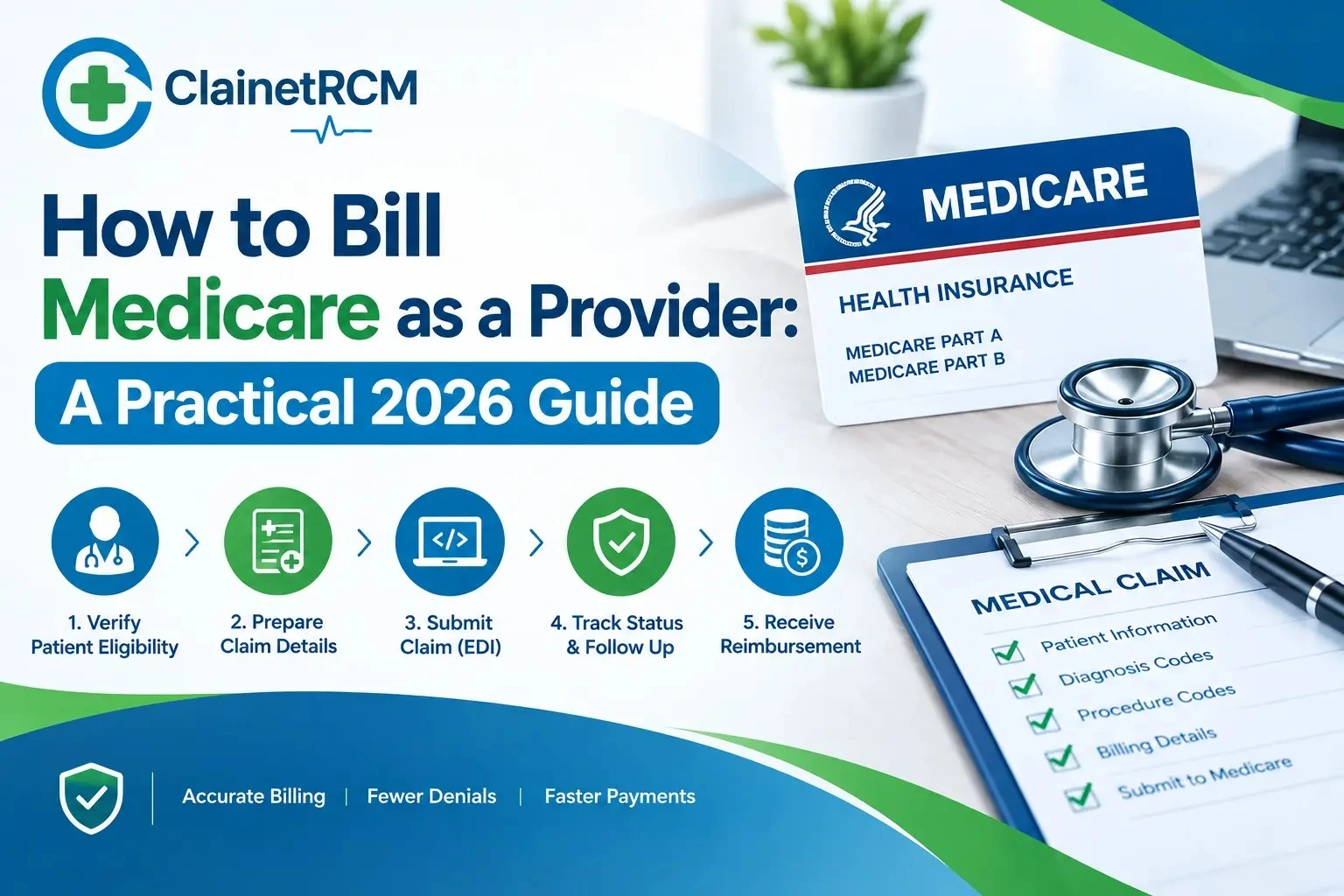
Learn how to bill Medicare as a provider: NPI, PECOS enrollment, claim forms, timely filing, 2026 rates and denial fixes in one practical guide.
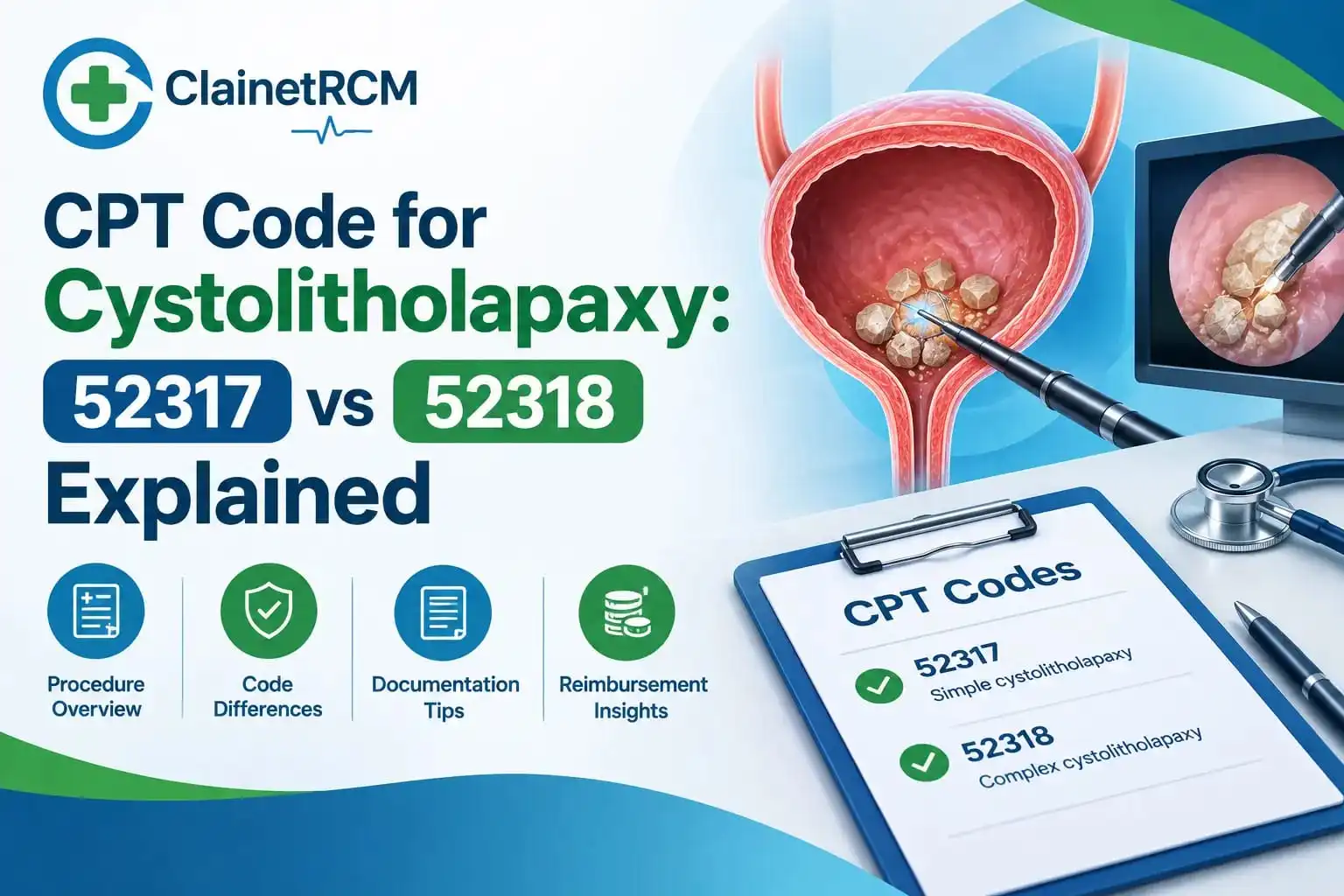
Cystolitholapaxy is billed with CPT 52317 or 52318. Learn size rules, 52310 vs litholapaxy, ICD-10 codes, modifiers, documentation and denial fixes.

Learn which ICD-10-CM codes to use for skin lesions, from R23.8 and L98.9 to D48.5 and C44. Get documentation tips, CPT pairing and denial fixes.

Zoster vaccine CPT code is 90750 for Shingrix. Learn 90471 admin billing, Z23, Medicare Part D rules, 90736 differences and denial fixes.

Specialty medical billing explained: how it works, specialty-by-specialty rules, 2026 Medicare changes, costs, and how to choose the right billing partner.

Learn the medical claims process step by step, from patient registration to payment posting, with denial fixes, timelines, and 2026 benchmarks.
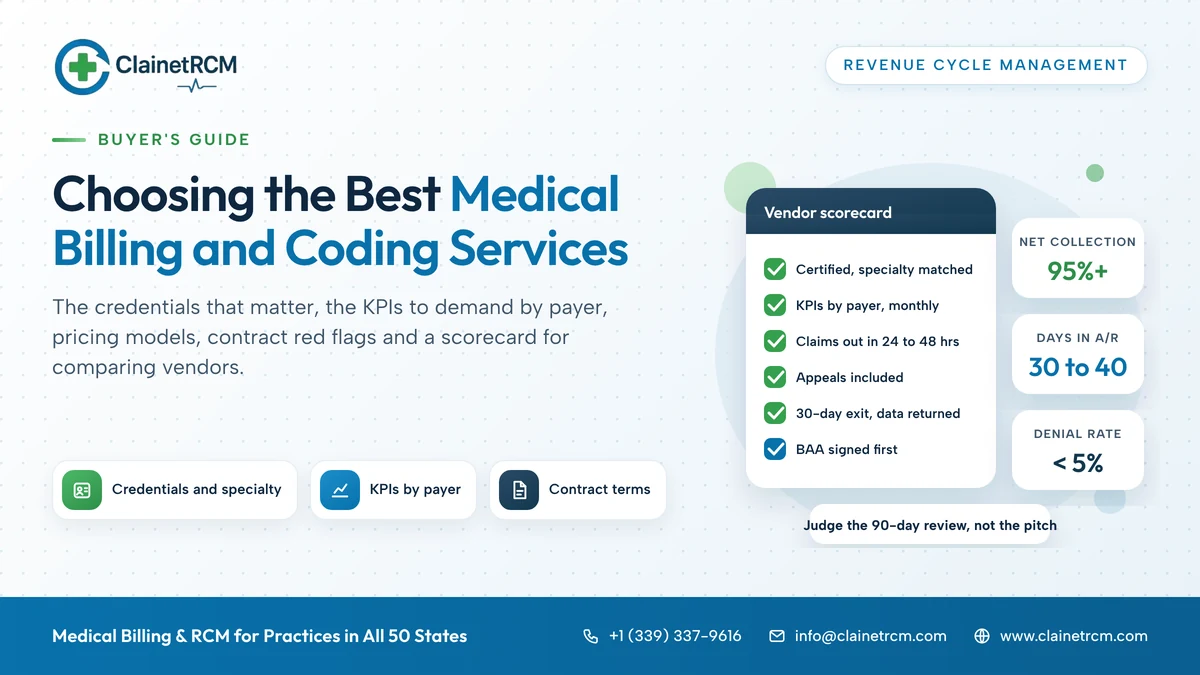
The credentials that matter, the KPIs to demand by payer, pricing models compared, the contract terms that protect you, ten questions for the first call and a scorecard for comparing vendors.
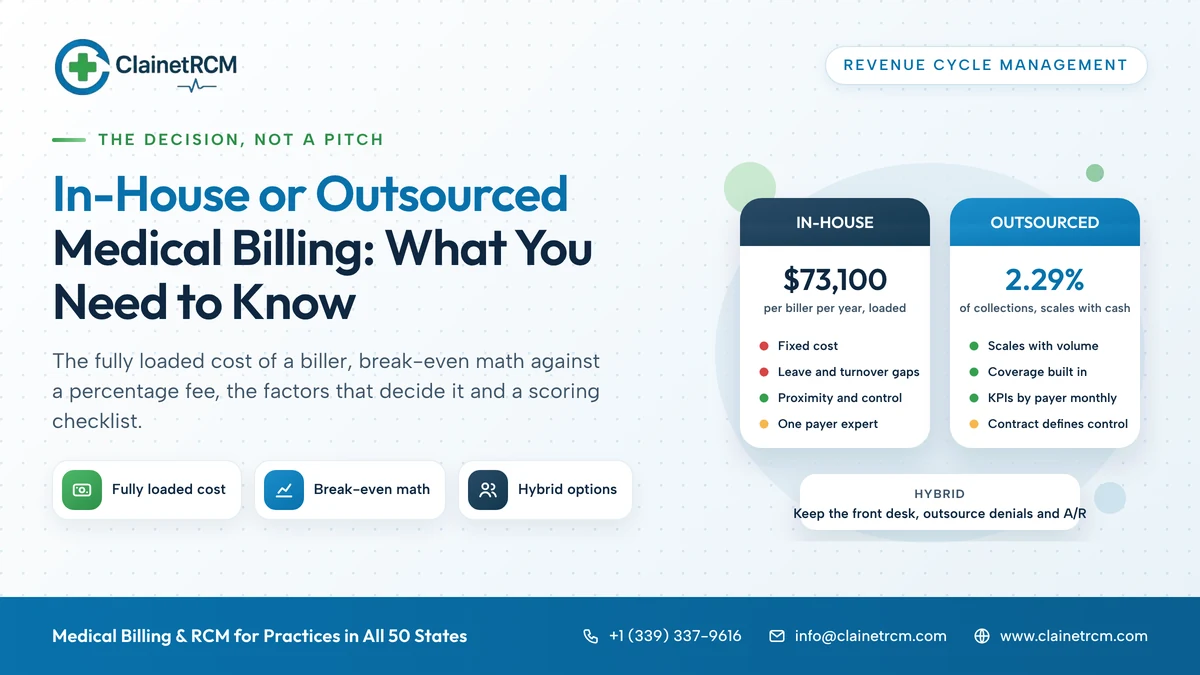
The fully loaded cost of an in-house biller, the break-even math against a percentage fee, the factors that really decide it, hybrid options and a ten-point scoring checklist.
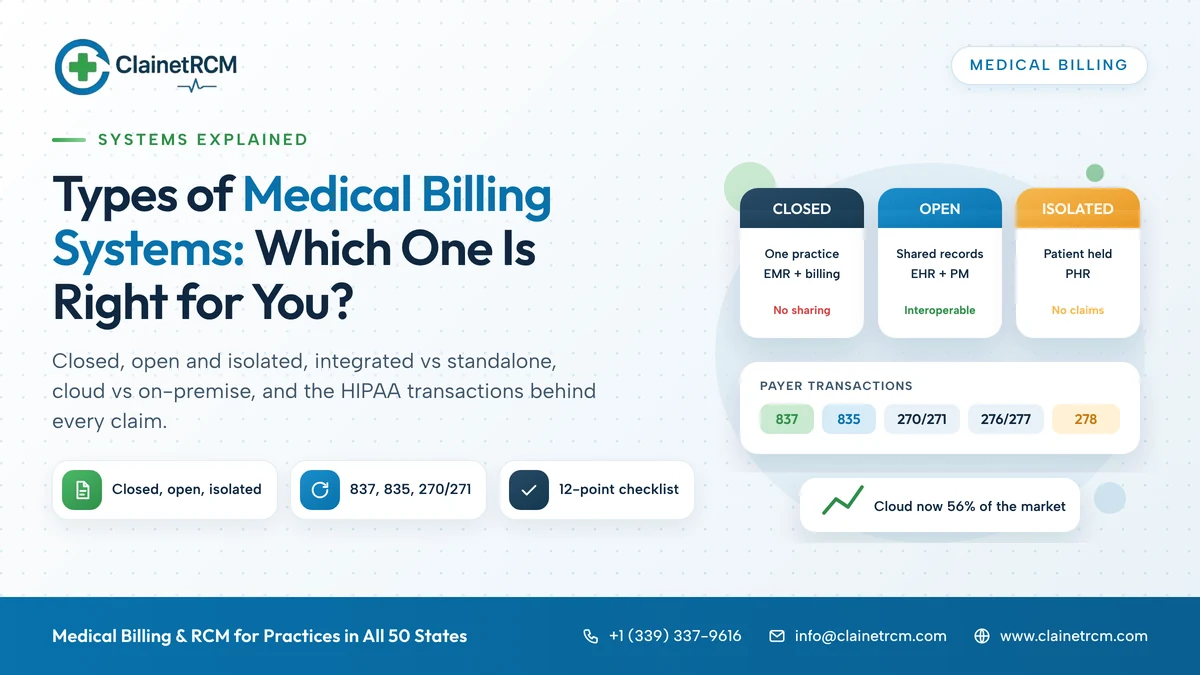
Closed, open and isolated systems compared, integrated vs standalone, cloud vs on-premise, the HIPAA transactions behind every claim, and a 12-point checklist for choosing the right system.
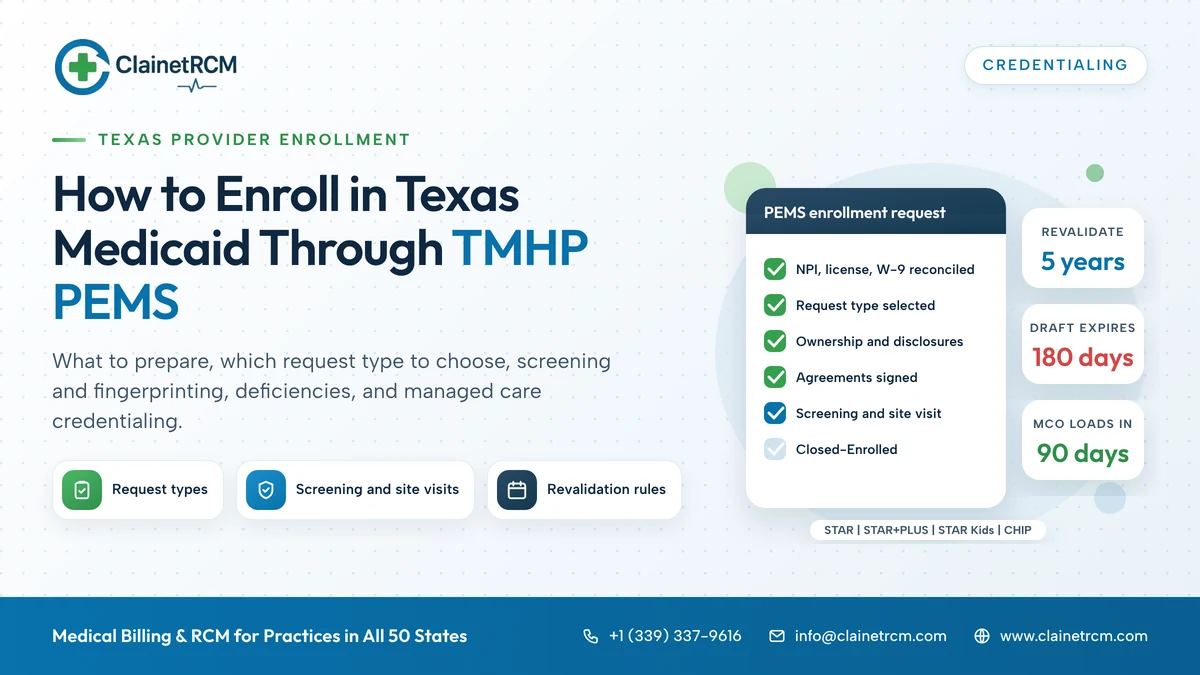
What to prepare, which PEMS request type to choose, how screening, site visits and fingerprinting work, how deficiencies are handled, managed care credentialing through the Texas CVO, and the 2026 changes.
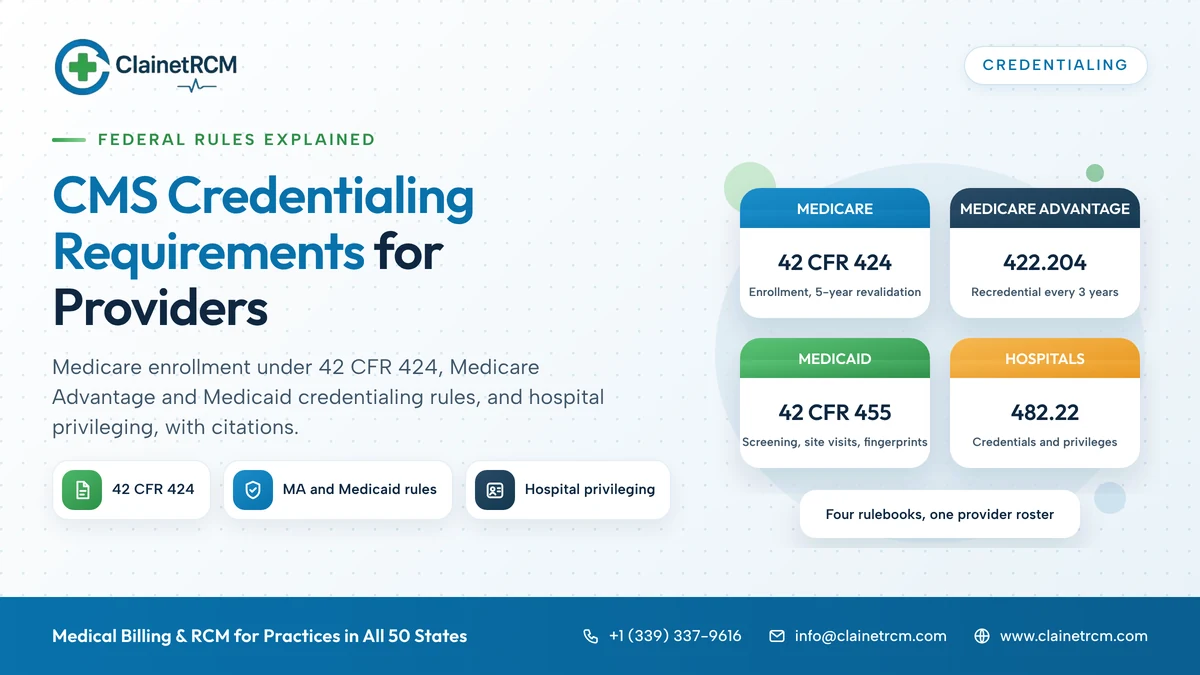
The four federal rulebooks behind enrollment and credentialing, from the CMS-855 and risk-based screening to Medicare Advantage recredentialing, Medicaid database checks and hospital privileging, with citations and a compliance timeline.
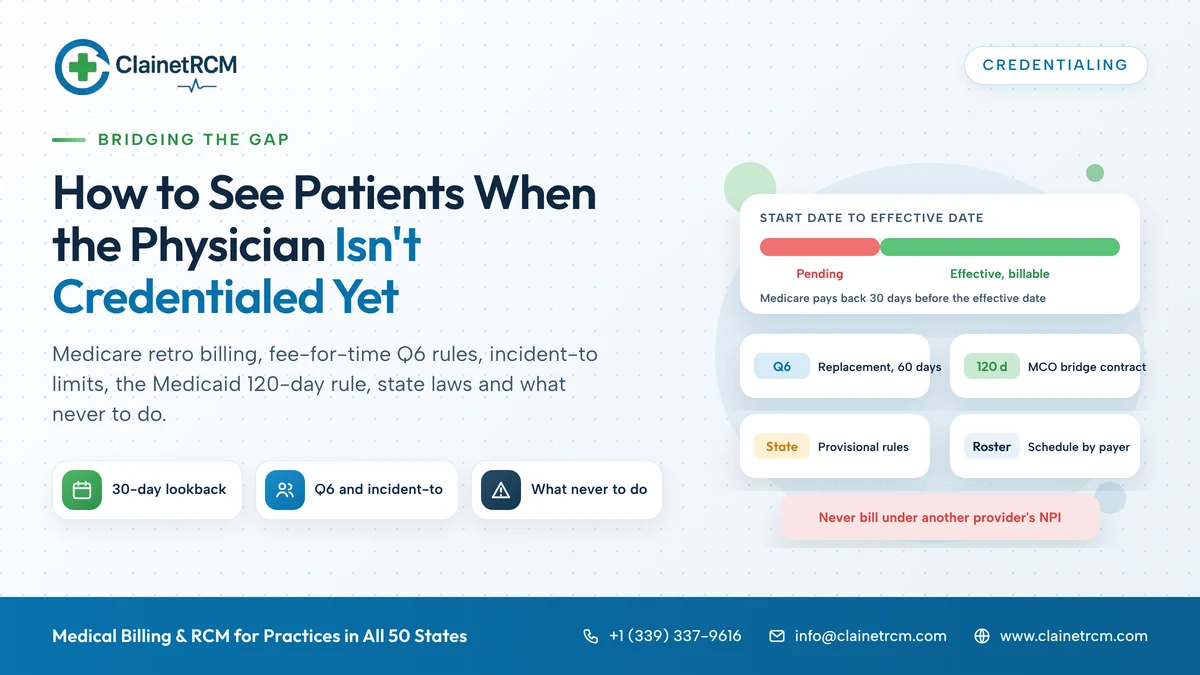
The legitimate bridges for the gap before effective dates: scheduling by payer, Medicare's 30-day lookback, fee-for-time Q6 rules, incident-to limits, the Medicaid 120-day rule, state provisional laws and out-of-network notices, plus the one thing never to do.
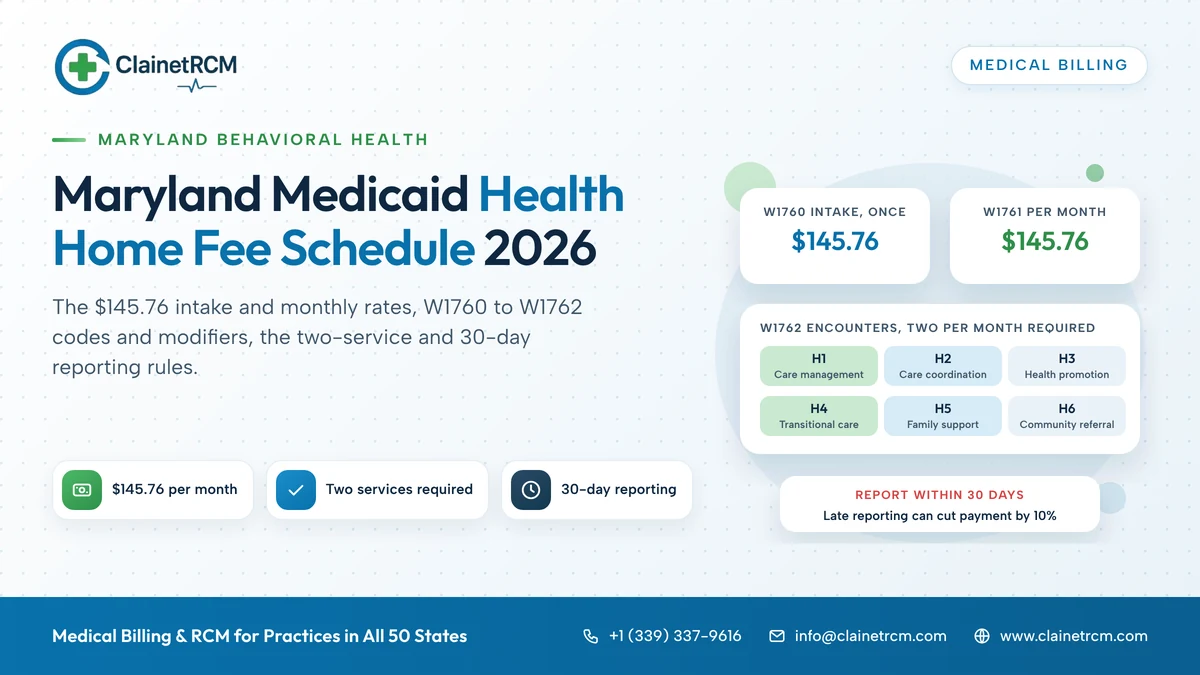
The $145.76 intake and monthly rates, the W1760, W1761 and W1762 codes with H1 to H6 modifiers, the two-service and 30-day reporting rules, the rate history since 2016 and what changed with Carelon.
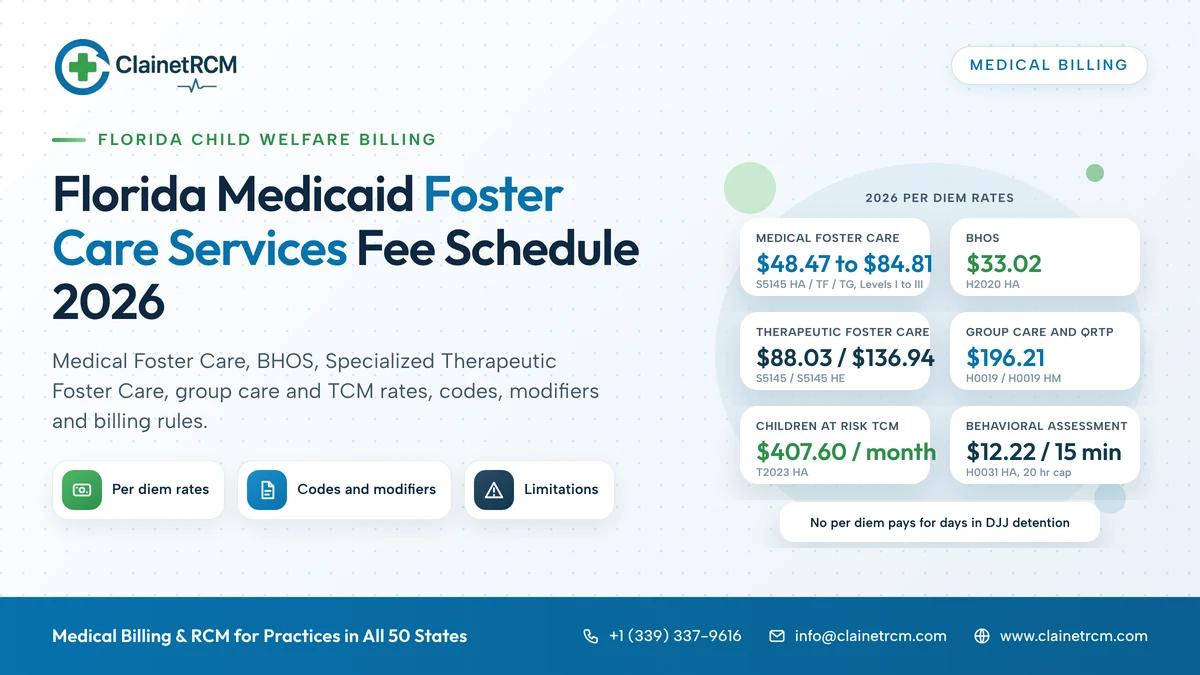
The 2026 per diems and codes for Medical Foster Care ($48.47 to $84.81), BHOS ($33.02), Specialized Therapeutic Foster Care ($88.03 to $136.94), therapeutic group care ($196.21) and targeted case management, with the limitations that decide whether claims pay.
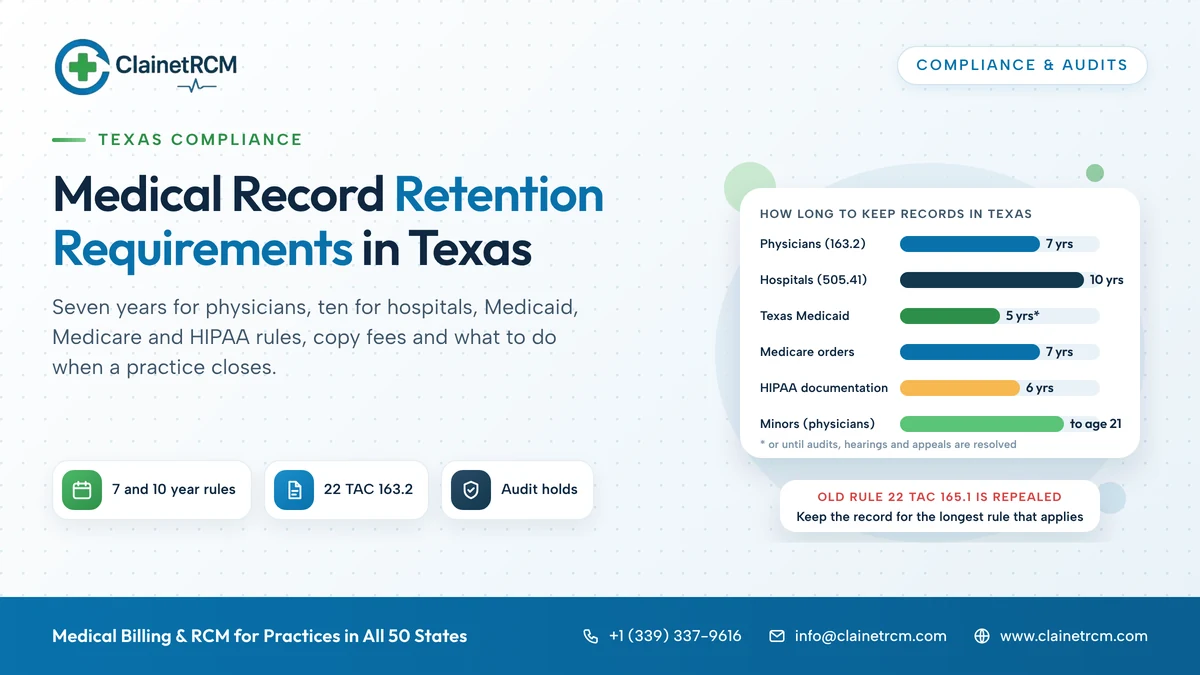
Seven years for physicians under the Medical Board's new Chapter 163, ten for hospitals, Medicaid's five-years-or-until-audits-close rule, Medicare and HIPAA requirements, copy fee maximums, and what to do when a physician leaves or a practice closes.
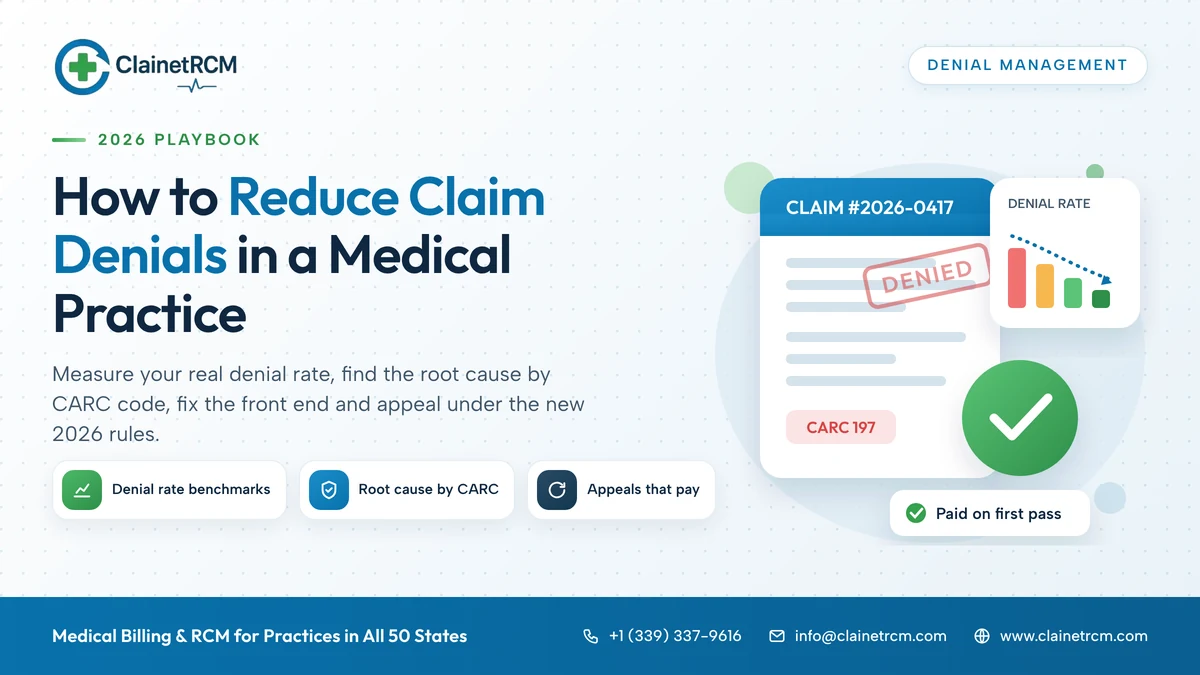
Measure your real denial rate, trace every denial to a root cause by CARC code, fix front-end and credentialing gaps, and use the 2026 prior authorization rules to your advantage.
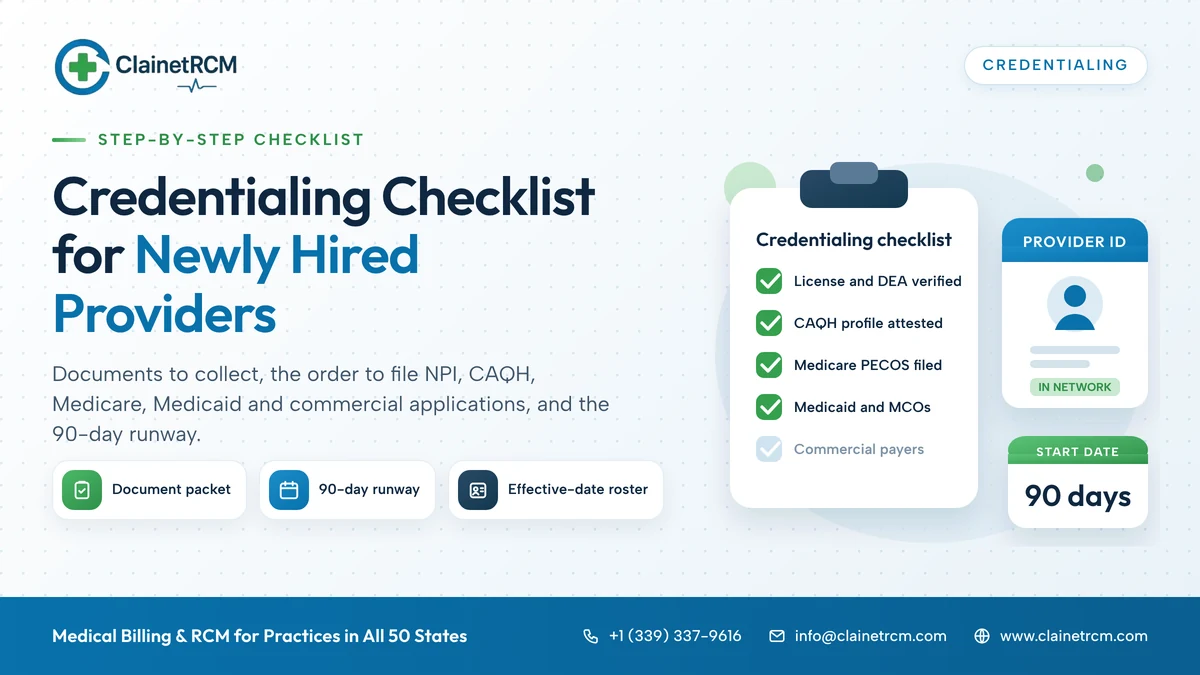
The documents to collect before the offer is final, the order to file NPI, CAQH, Medicare, Medicaid and commercial applications, what the provider can see in the first 30 days, and the maintenance calendar.
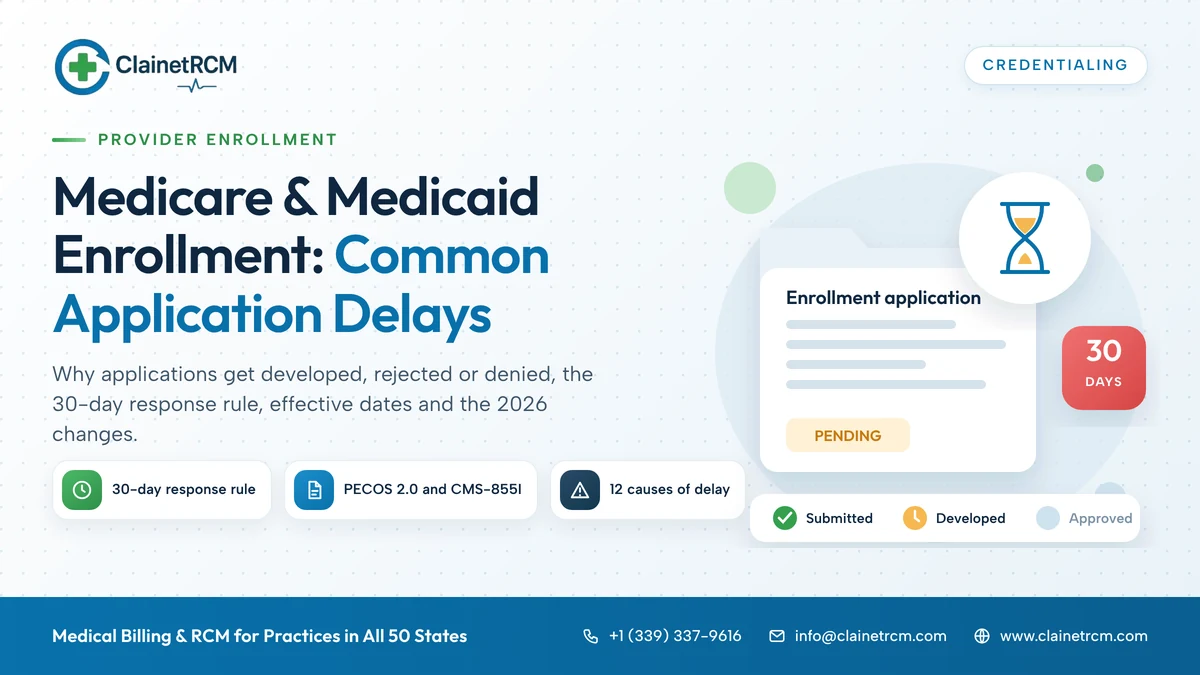
Developed vs rejected vs denied, the 30-day response rule, the 12 causes of stalled applications, the 30-day billing lookback, and the 2026 changes including PECOS 2.0 and the $750 fee.
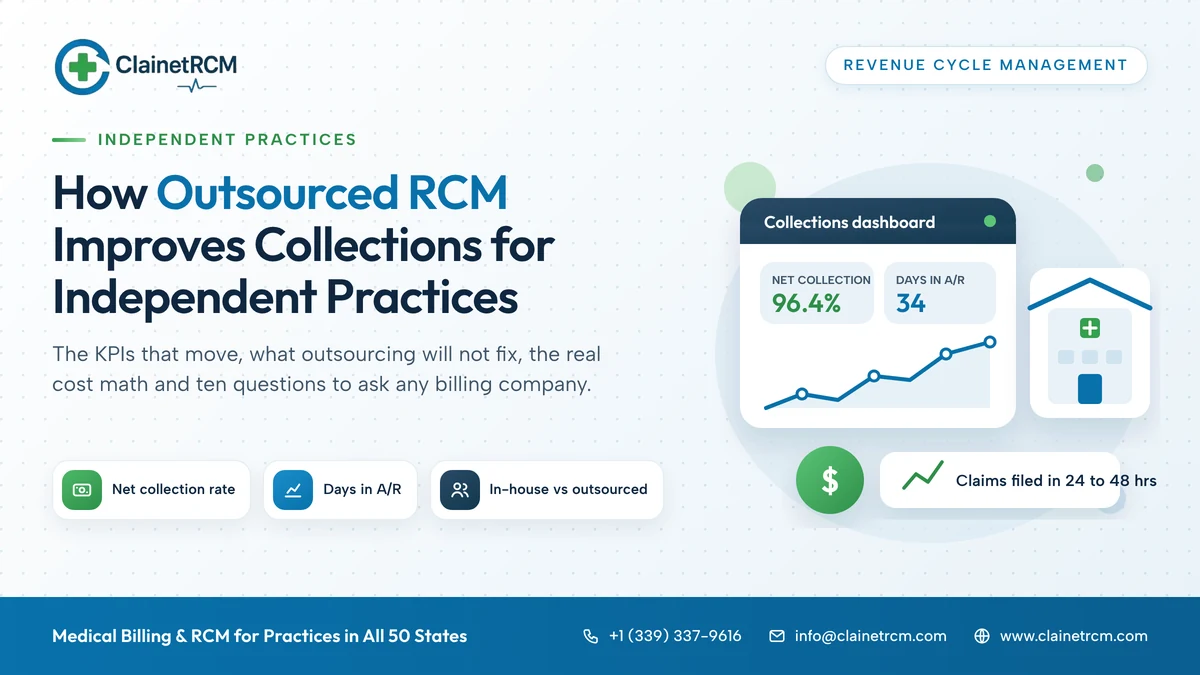
The KPIs that actually move, seven ways outsourcing improves collections, what it will not fix, in-house vs outsourced cost math, and ten questions to ask any billing company before you sign.
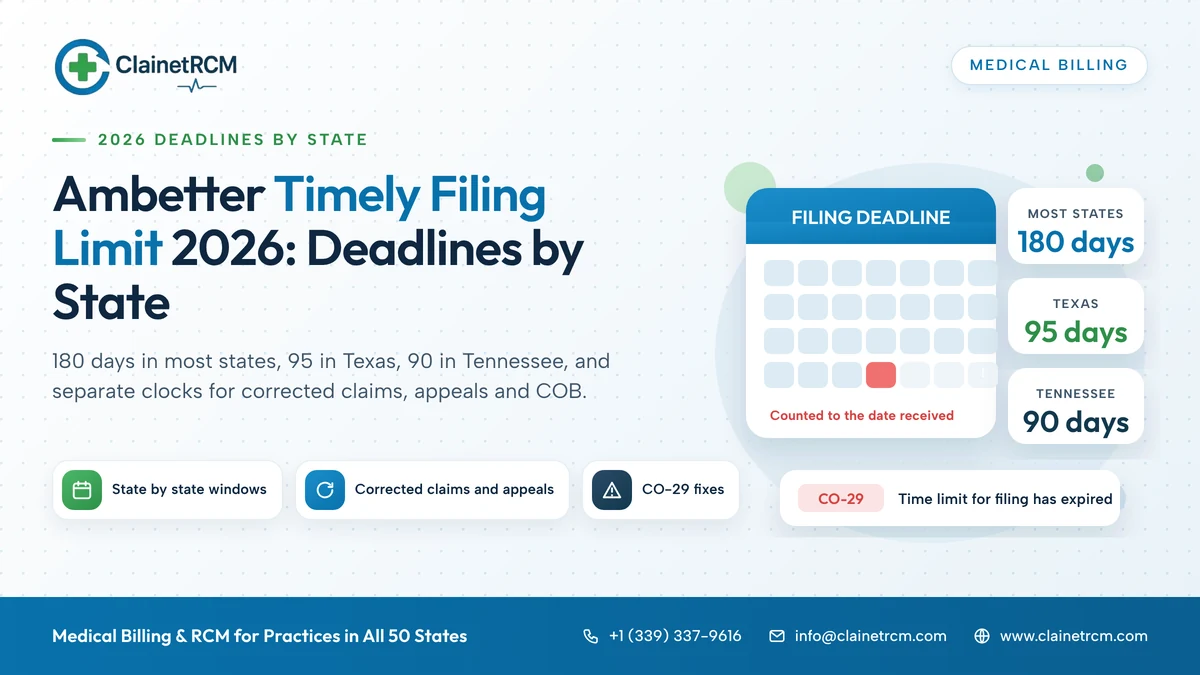
Ambetter timely filing limit is 180 days in most states, but Texas allows 95 and Tennessee 90. See state deadlines, appeals, COB and CO-29 fixes.
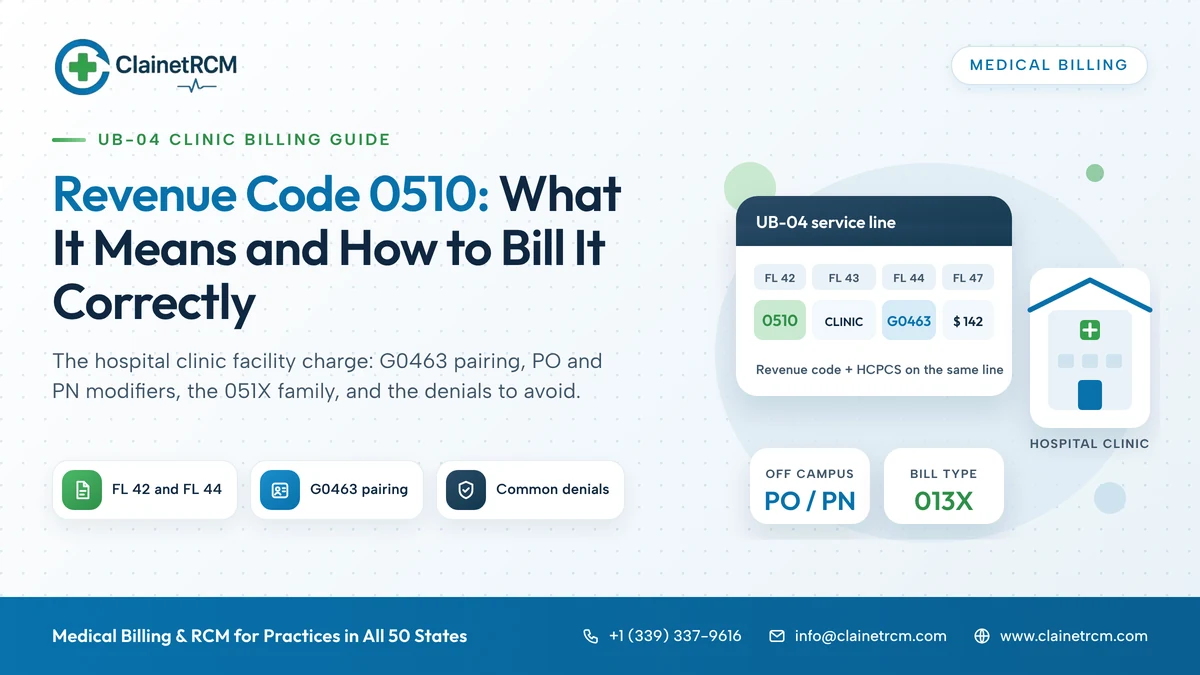
Revenue code 0510 explained for hospital clinic billing: when to use it, G0463 pairing, PO/PN modifiers, 051X codes, denials and fixes.

What makes a claim clean, how it differs from a rejected or denied claim, the clean claim rate formula and 95% benchmark, and a pre-submission checklist.
A rejection is not a denial, but the filing clock keeps running. Rejection vs denial, how to read the 999 and 277CA, and the most common rejection causes.
F91.3 is billable as-is, but the neighboring codes cause the denials. Covers the F91 family, DSM-5-TR criteria and severity specifiers.
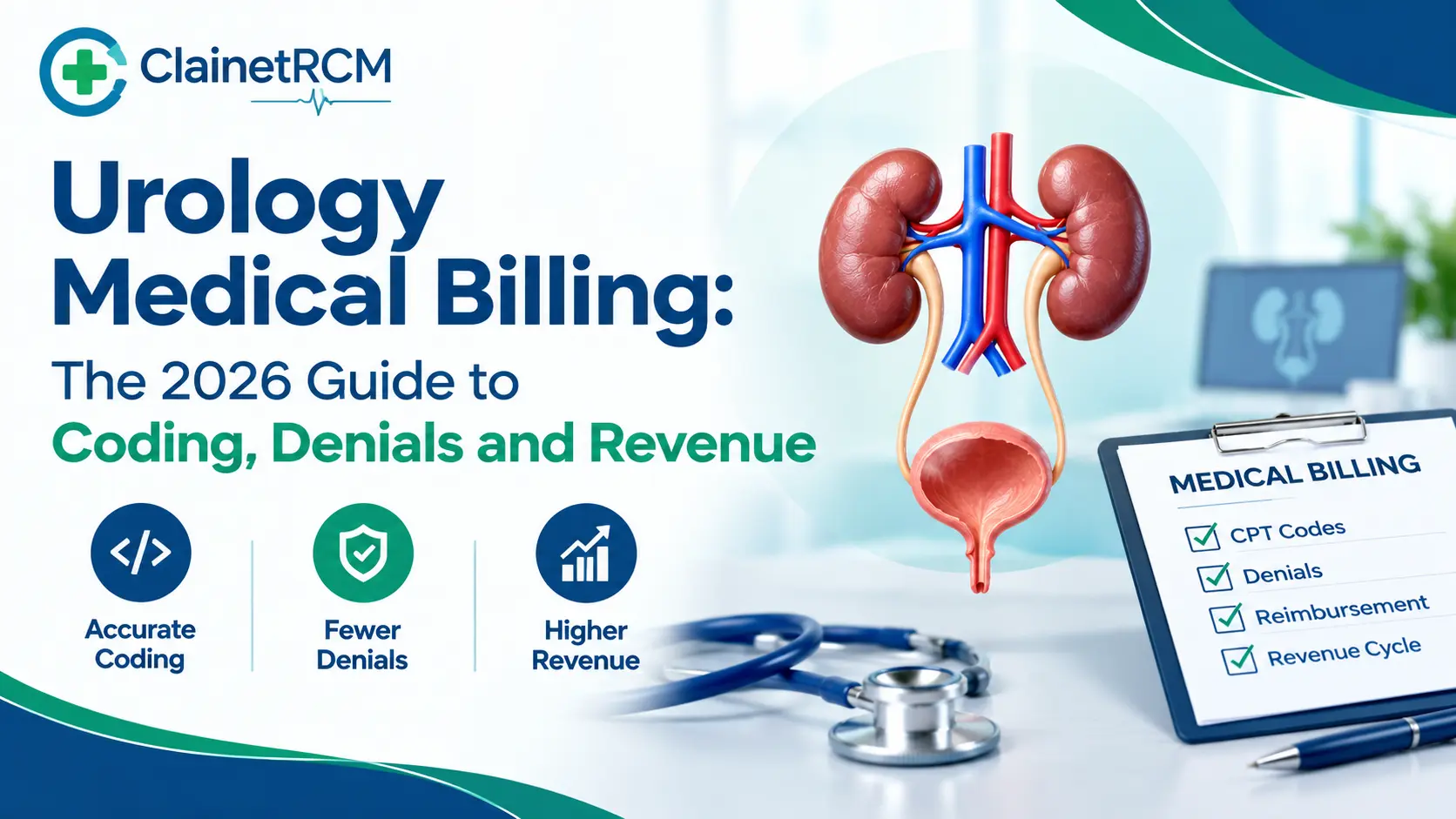
The code families urology bills most, the ICD-10 specificity that wins medical necessity, and the 2026 prostate biopsy overhaul.
The UB-04 code for a complete hospital inpatient stay: how the three digits break down, and when to use 110, 111 or 117.

A payment in the bank is not revenue until it is posted and reconciled. The nine-step posting workflow, with a worked example.
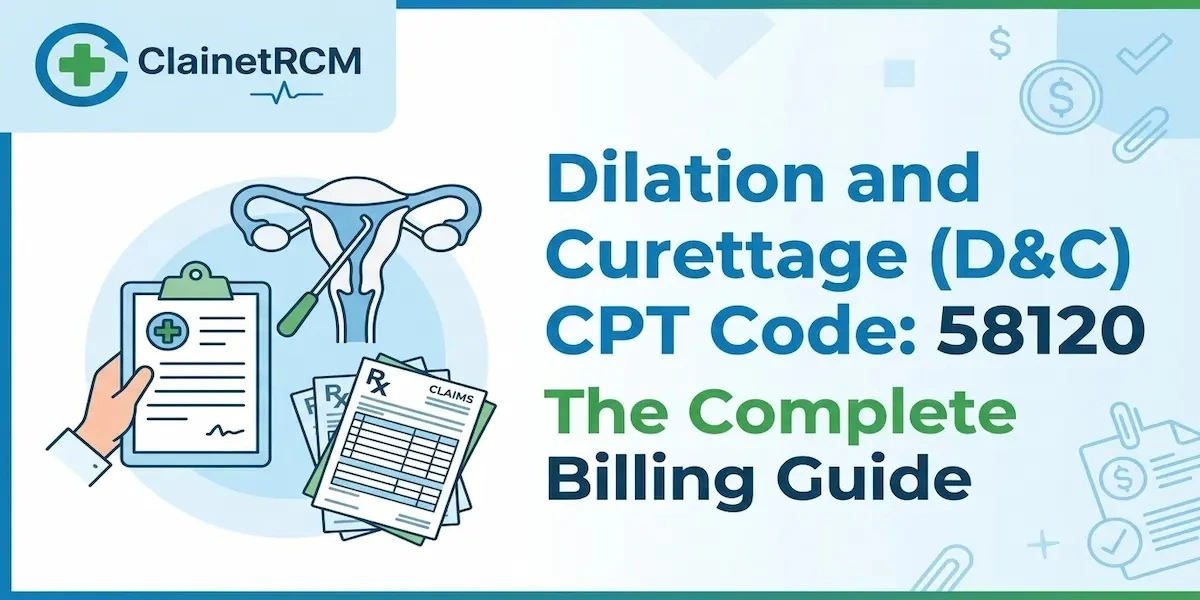
58120 is nonobstetrical only. The obstetric codes for miscarriage (59812, 59820, 59821) and how 58120 compares with 58100.
Struck by turtle, sucked into a jet engine (twice), spacecraft collisions and more codes that really exist in ICD-10.
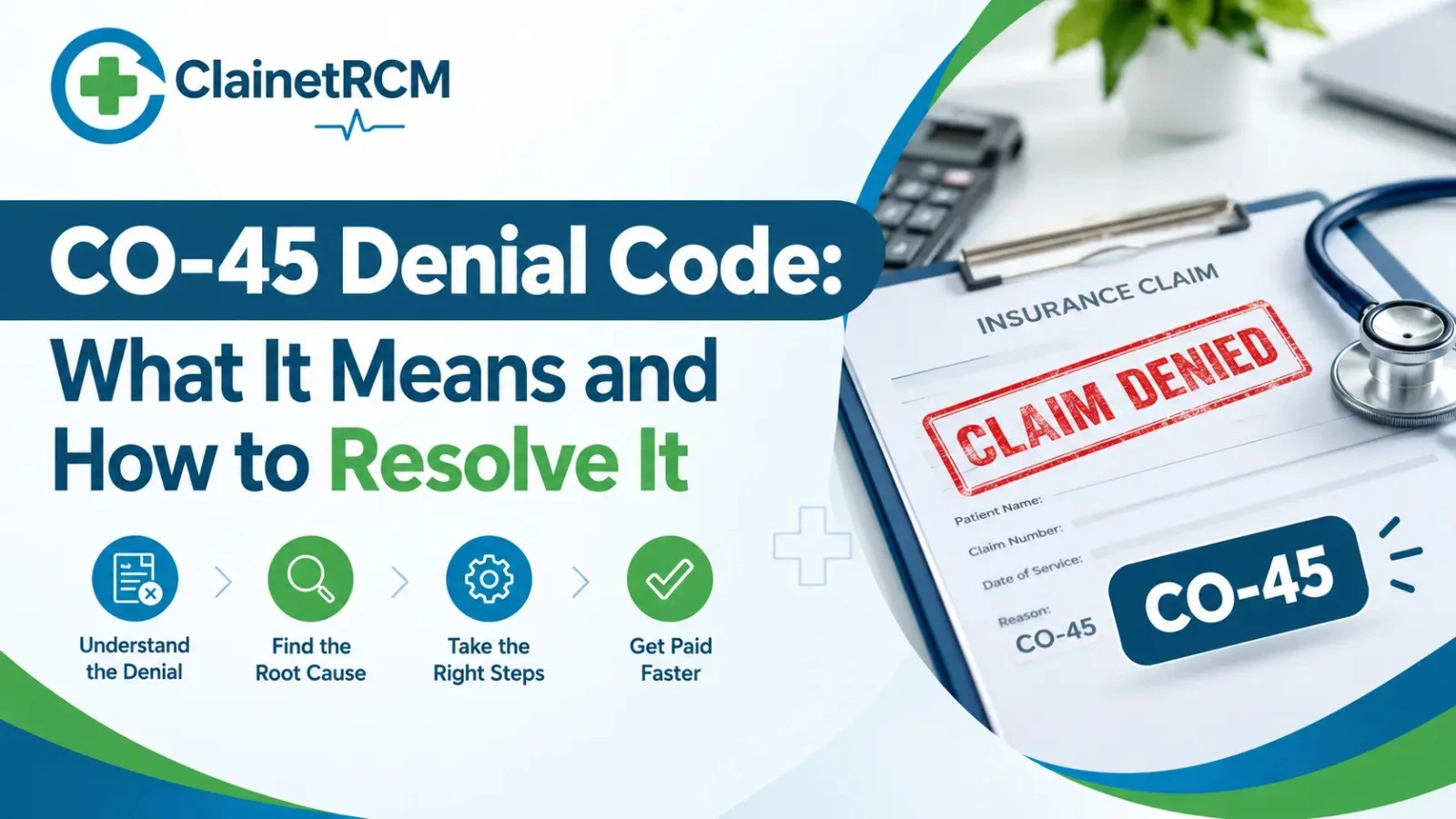
CO-45 is a contractual write-off, not a patient balance. The CO vs PR distinction, explained with a worked EOB example.
0360 bills for the operating room, not the surgeon. The official 036X family and the codes it gets confused with.
Every cystoscopy code from 52000 to 52352 grouped by procedure, and the separate procedure rule behind most denials.
Pharmacy drugs that require detailed coding: inpatient vs outpatient rules and the hemophilia clotting factor exception.
0250 marks the pharmacy department, not the drug. How it pairs with HCPCS and NDC codes across the 025X family.
There is no single tick bite code. How the site-specific S-code pairs with W57.XXXA, body part by body part.

What a superbill is, how it differs from a medical bill and a CMS-1500, and the fields payers expect to see.
Which ICD-10-CM diagnosis codes justify an EGD, when ICD-10-PCS applies, and screening vs diagnostic coding with Z13.810.
Struck by orca, pecked by chicken, bizarre personal appearance: real codes from the 2026 set, and why they exist.
How 58100 differs from 58120 and 58558, the ICD-10 codes that prove medical necessity, and modifiers 25 and 59.
The MDM and total-time pathways, how 99213 compares to 99212, 99214 and 99215, and 2026 RVU values.
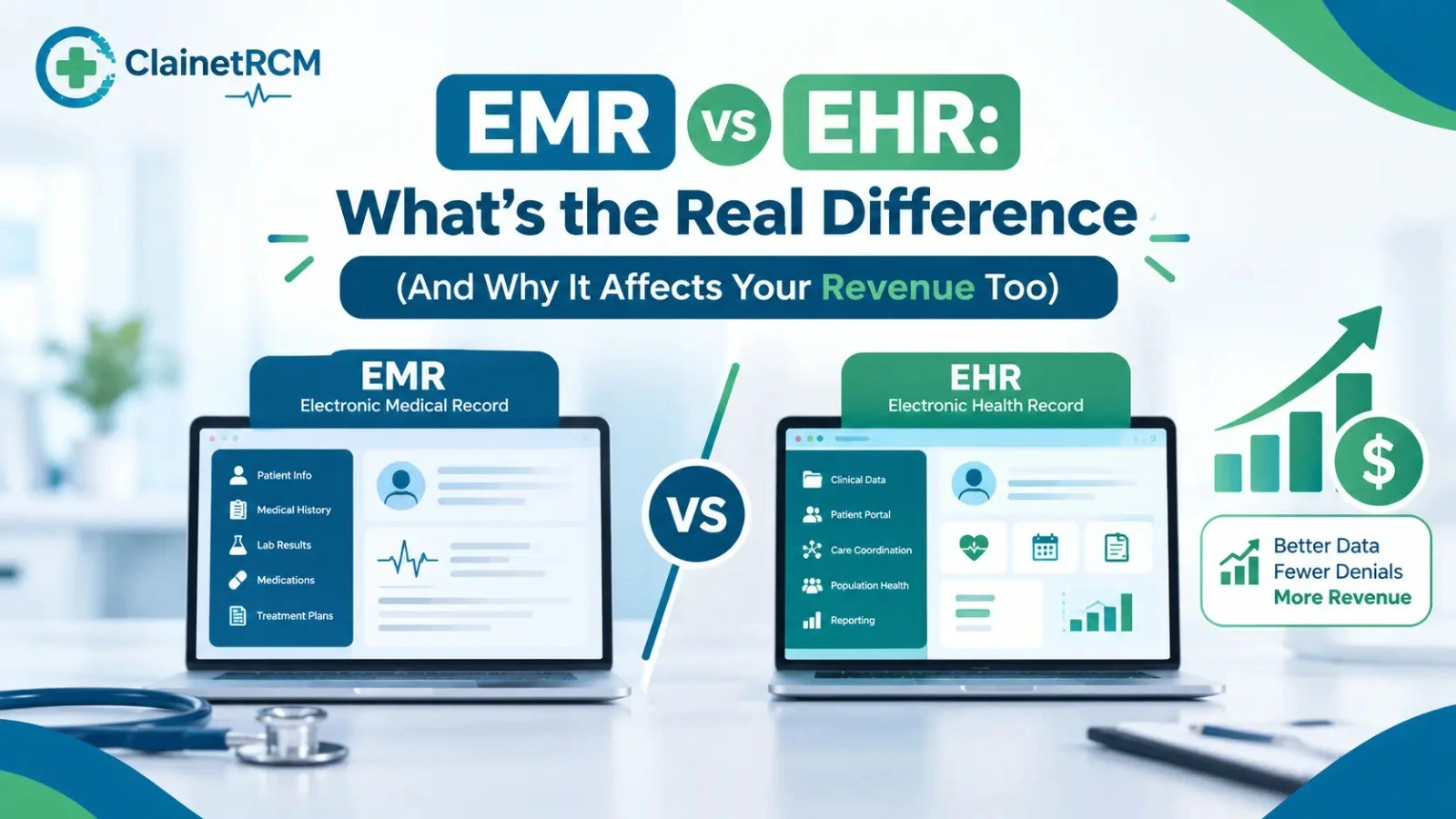
An EMR is a digital chart for one practice. An EHR travels with the patient. See how that one difference shapes your revenue.

Diagnostic cystoscopy billing explained: 2026 Medicare rates, and why the separate procedure rule blocks unbundling.

Every EGD CPT code from 43235 to 43270, with the dilation and biopsy distinctions, modifier rules and NCCI edits.
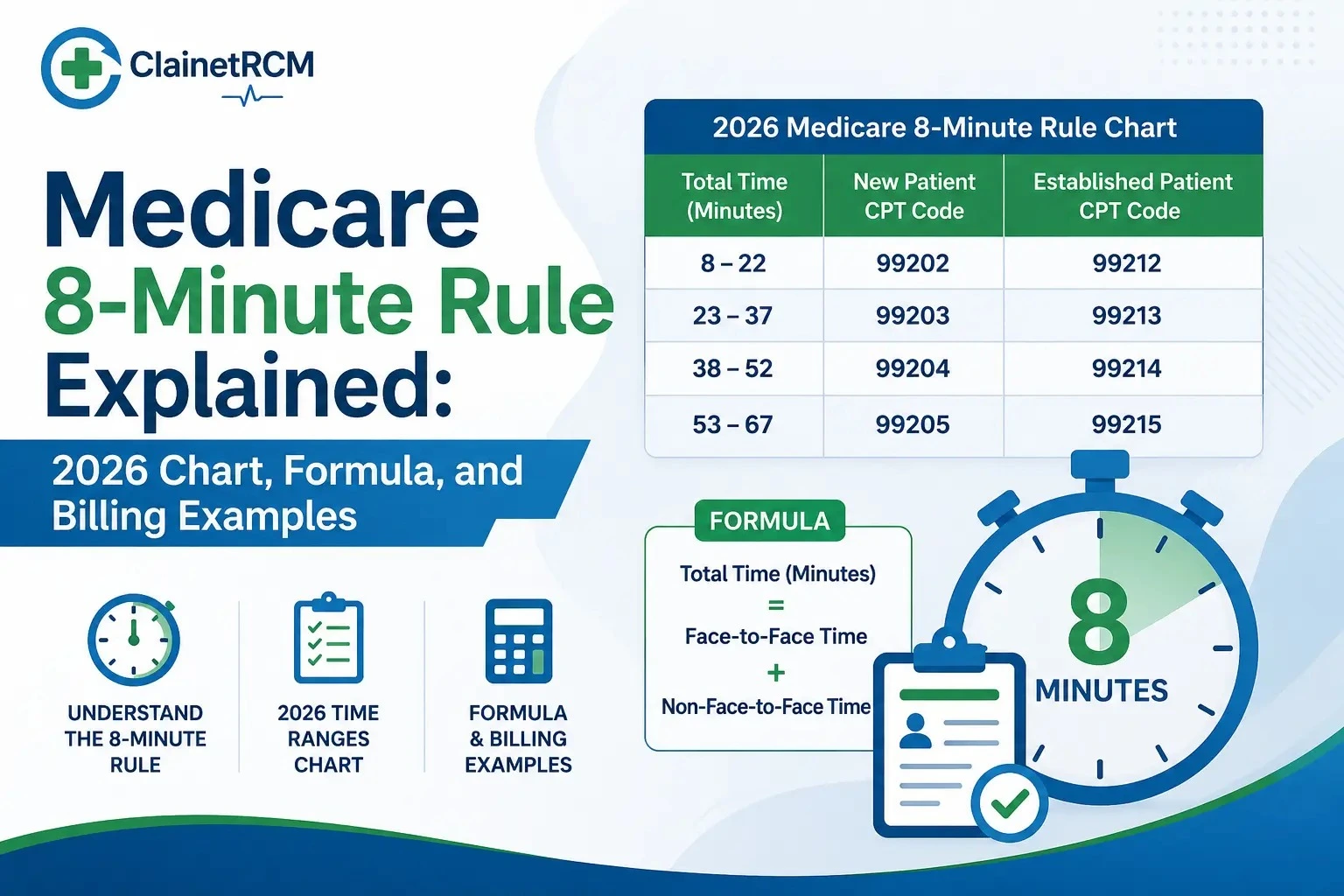
One miscounted minute can cost a therapy practice a billable unit. The 2026 unit chart, the total time formula and examples.

Credentialing decides when providers can see covered patients, submit payable claims and protect cash flow.

J3490 is used for unclassified drugs, but it still requires precise product, dosage, unit and medical-necessity documentation.

Most practices lose 5 to 15% of earned revenue to denied claims, aging AR and unpaid patient balances. Twelve practices that close the gap.
Claim denials tie up revenue you have already earned. The seven most common reasons payers reject claims, and how to fix each one.
No articles match yet. Tell us what you are stuck on and we may write it next.
Tell us what you are stuck on. Our certified coders will look at it, and if it is a pattern in your claims, we will show you what it is costing you.
No setup fee. No long-term contract. Pricing from 2.29% of monthly collections.