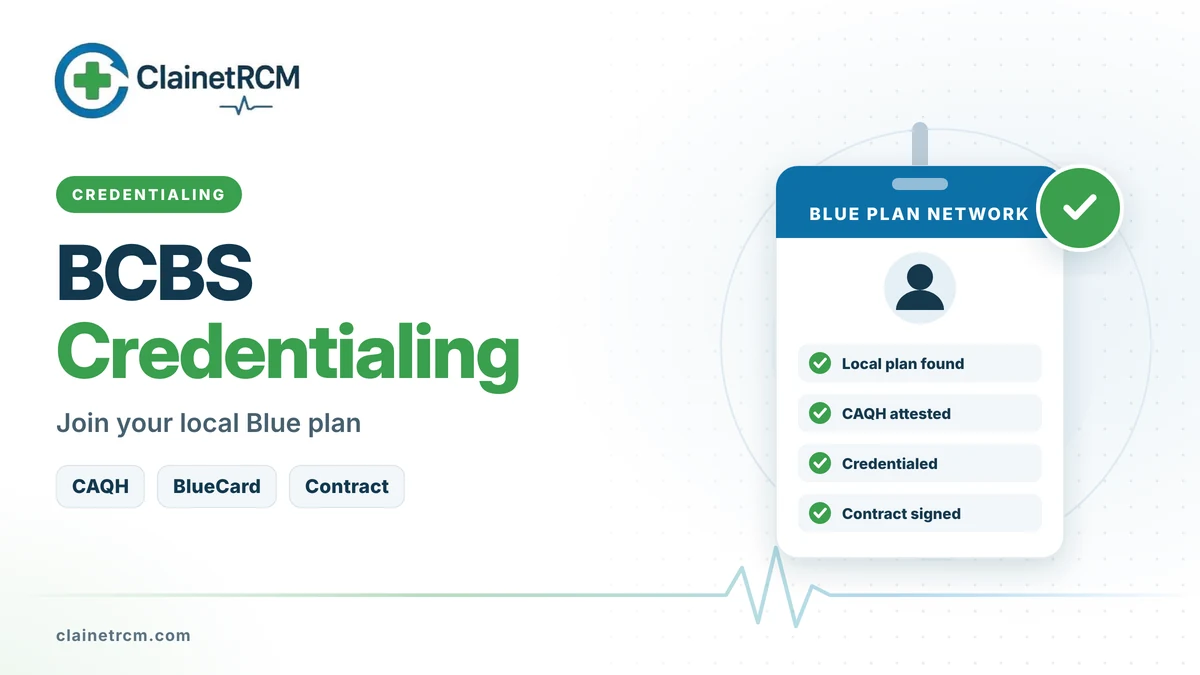
BCBS credentialing is not one national process. The Blue Cross Blue Shield Association is a federation of more than 30 independent, locally operated companies, and each one credentials and contracts providers in its own service area. To join “Blue Cross,” you apply to the Blue company licensed where you practice, meet its credentialing standards and sign its contract. Once you are in, the BlueCard program lets you treat members of other Blue plans and get paid through your local plan.
Quick answer: Identify the Blue plan for your county, complete and attest your CAQH ProView profile and authorize that plan to view it, then submit a participation request through the plan’s provider portal, which for many Blue plans runs through Availity. The plan verifies your license, education, board status, malpractice coverage and sanctions history, then offers a contract. Do not bill as in-network until the plan confirms your effective date. Plan for a process that often takes two to four months.
How BCBS Credentialing Works Plan by Plan
Each Blue company sets its own forms, timelines, fee schedules and network needs. A few examples show how the map looks:
- Anthem Blue Cross and Blue Shield, part of Elevance Health, operates the Blue plans in 14 states.
- Health Care Service Corporation (HCSC) runs the Blue plans in Illinois, Montana, New Mexico, Oklahoma and Texas.
- Florida Blue covers Florida, and Highmark operates in Pennsylvania, Delaware, West Virginia and parts of New York.
- Some states have more than one Blue company, each with its own territory, so confirm which plan covers your practice address.
If you practice in several states, you will usually credential with the local Blue plan in each one.
BCBS Credentialing Step by Step
| Step | What to do | Tip |
|---|---|---|
| 1. Identify your plan | Confirm which Blue company covers your practice location | Check the plan’s provider site for its service area |
| 2. Prepare CAQH | Complete, attest and authorize the plan in CAQH ProView | Re-attest every 120 days so the profile never goes stale |
| 3. Request participation | Submit the plan’s enrollment request online, often through Availity | List every location, the group and individual NPIs and the tax ID |
| 4. Credentialing review | The plan verifies your credentials against primary sources | Answer document requests within a few days |
| 5. Contracting | Review and sign the agreement and fee schedule | Ask which products the contract covers |
| 6. Load and confirm | Get your effective date and check the provider directory | Hold claims or bill as out-of-network until the effective date |
Documents and Data You Need
- Individual and group NPIs and the group tax ID with a signed W-9
- Active state license, DEA registration and any state controlled substance registration
- Board certification, or education and training history if not certified
- Current malpractice certificate of insurance and claims history
- Hospital privileges or a written admitting arrangement, if the plan requires one
- Five-year work history with explanations for gaps
- Practice locations, hours, phone numbers and accessibility details
Most of this already lives in CAQH ProView. When the CAQH profile and the plan application disagree, such as different addresses or practice names, the application stalls.
Group vs Individual Enrollment
Most practices hold a group agreement, and each provider is credentialed and then linked to the group. When you hire a new provider, start BCBS credentialing as soon as the signed offer is in hand, because the provider cannot be billed in-network until linked to the group with an effective date. Facilities such as ambulatory surgery centers and labs go through a separate facility credentialing process.
Products: Commercial, Medicare Advantage, Medicaid and FEP
A Blue plan often runs several networks: commercial PPO and HMO, Medicare Advantage, Medicaid managed care and plans for the Federal Employee Program. Joining one network does not always add you to the others. Ask the plan which products your agreement includes and whether Medicare Advantage or Medicaid require an amendment or separate application. Medicaid networks also require that you be enrolled with the state Medicaid program.
When the Network Is Closed
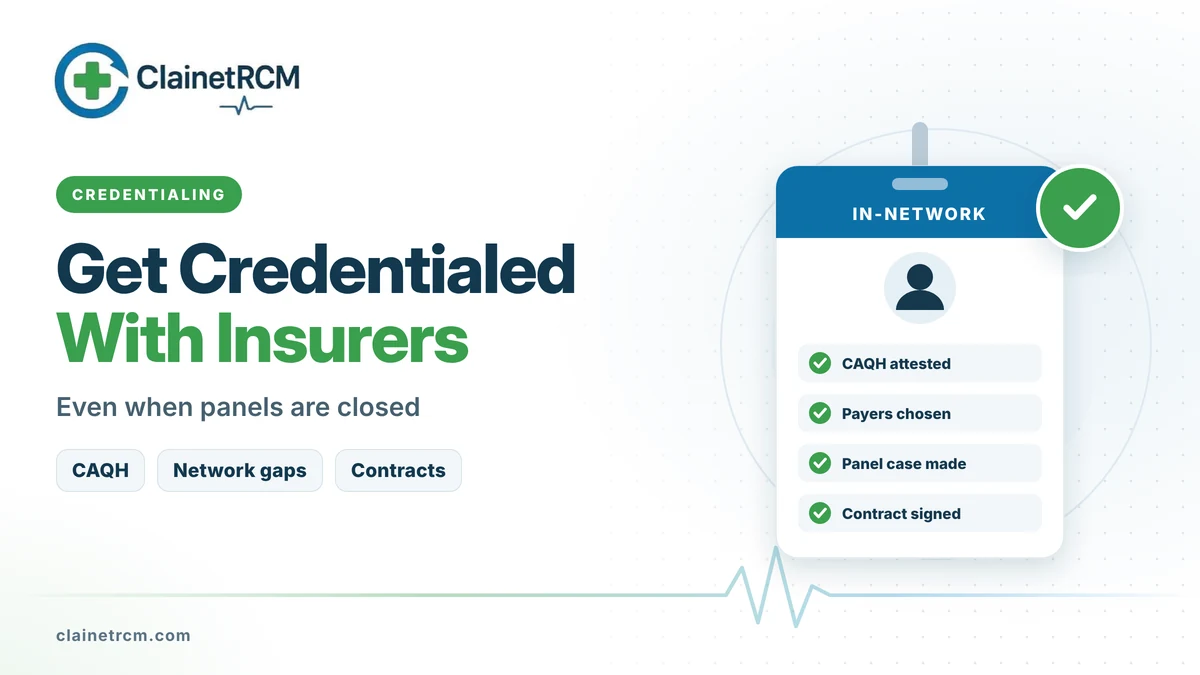
A Blue plan can decline to add providers when it already has enough of your specialty in an area, so you may face a closed network. You can strengthen a request by showing:
- A specialty, service or language the network lacks
- Extended hours, telehealth or same-week appointments
- A location in an underserved or rural area
- Hospital affiliations or referral relationships the plan values
If the plan still declines, ask when the network will be reviewed again and whether a single-case agreement is possible for specific patients.
BlueCard: Treating Out-of-Area Blue Members
The BlueCard program links Blue plans across the country. When a member from another Blue plan visits you:
- Check the prefix. The three characters before the member ID on the card identify the member’s home plan.
- Verify eligibility through your local plan’s portal or the BlueCard eligibility line at 1-800-676-BLUE.
- Submit the claim to your local Blue plan, not the member’s home plan.
- Get paid by your local plan under your local contract terms.
The member’s home plan may still handle prior authorization and medical record requests, so follow the instructions your local plan provides.
Recredentialing and Updates
Blue plans recredential providers on a cycle, commonly every three years under NCQA standards. Keep CAQH attested, renew your license and malpractice coverage on time, and report address, tax ID and ownership changes before they happen. A lapsed document during recredentialing can remove you from the network.
Common Causes of Delay
- CAQH profile not attested or the plan not authorized to view it
- Malpractice certificate or license that expires during review
- Practice name or address that does not match the W-9 or NPPES record
- Missing explanations for gaps in work history
- Applying to the wrong Blue company for the practice location
Frequently Asked Questions
It varies by plan and by how complete your application is. Many practices see two to four months from a complete submission to a signed contract and effective date.
No. You credential with the Blue plan where you practice. The BlueCard program handles members of other Blue plans who visit you. If you practice in several states, you usually credential with each local plan.
Most Blue plans rely on CAQH ProView for credentialing data. Keep your profile complete, attested and authorized for each plan you join.
You can, but you will be out-of-network. Claims are processed under the member’s out-of-network benefits, if any, and most plans do not backdate participation before the effective date.
BlueCard is the national program that lets members of one Blue plan use providers who participate with another Blue plan. You bill your local plan and are paid under your local contract.
Not always. Many Blue plans contract those products separately, so confirm which networks your agreement covers.
Final Thoughts
BCBS credentialing goes smoothly when you apply to the right Blue company with a complete, attested CAQH profile and follow up until you have a signed contract and an effective date. After that, BlueCard turns your local agreement into access to Blue members from across the country. If you would rather hand off the paperwork, our credentialing services manage every step. For a complete list of what to gather first, use our credentialing checklist for new providers.
Get In-Network With Your Blue Plan
We prepare your CAQH profile, submit your Blue plan application, follow up every week and confirm your effective date before you bill.
Start BCBS Credentialing
Written by
ClainetRCM Billing Team
ClainetRCM is a Boston-based revenue cycle management company specializing in medical billing, coding, credentialing and denial management for healthcare providers across all 50 states. Our AAPC and AHIMA certified team works inside your existing EHR, files claims within 24 to 48 hours and reviews every AR bucket on a 14-day cycle.