A newly hired physician, nurse practitioner, physician assistant or therapist cannot bill a payer until that payer has credentialed and enrolled them. If the paperwork starts on the first day of work, the practice carries that provider's salary for two to five months while most of their visits are either unbillable or billed at a loss. If it starts the day the offer letter is signed, the provider is usually effective with Medicare and the largest commercial plans before they see their first patient.
This is the credentialing checklist we use for newly hired providers at ClainetRCM: what to collect before the start date, the order the applications have to go in, what the provider can and cannot see during the gap, and the maintenance schedule that keeps them enrolled afterward. It is written for practice owners, administrators and office managers, not for the credentialing committee at a hospital, although the hospital privileges piece is covered too.
Last updated: October 2026
Key takeaways
- Start credentialing 90 to 120 days before the provider's first day. Medicare individual enrollment typically takes 30 to 45 days, Medicaid and managed care plans 30 to 60 days, and commercial payers 60 to 150 days.
- Medicare lets a new provider bill back only 30 days before the enrollment effective date, and that date is the later of the application filing date or the first date of service. Most commercial plans allow no retroactive billing at all.
- The applications depend on each other. The NPI feeds the CAQH profile, the CAQH profile feeds commercial payers, and the Medicare enrollment has to be complete before the reassignment to your group takes effect.
- A new hire cannot be billed under another provider's name while credentialing is pending. Incident-to billing has strict conditions, and the Q6 substitute-physician modifier is for covering an absent physician, not for onboarding a new one.
- Credentialing does not end at approval. CAQH re-attestation is due every 120 days, NCQA requires recredentialing every 36 months, Medicare revalidation runs on a five-year cycle, and exclusion checks are now a monthly task.
Why New-Provider Credentialing Is a Revenue Event
Every day a hired provider works before their enrollments are effective is a day of care that mostly cannot be billed. The arithmetic is simple. A physician generating $4,000 a day in collectible charges who starts 60 days before Medicare and the top three commercial plans are effective represents well over $100,000 of visits that have to be rescheduled, written off, billed to patients as out of network, or billed improperly. Our analysis of how credentialing impacts practice revenue walks through the full formula.
The federal rules set the outer limits. Under 42 CFR 424.520(d), a physician or non-physician practitioner's Medicare effective date is the later of the date the enrollment application was filed or the date the provider first furnished services at the location. Under 42 CFR 424.521(a), the provider may bill back up to 30 days before that effective date (90 days during a Presidentially declared disaster). Nothing before that window is recoverable. Commercial contracts are usually stricter: the provider is in network from the date the payer loads them, and claims before that are processed as out of network or denied with CARC 242.
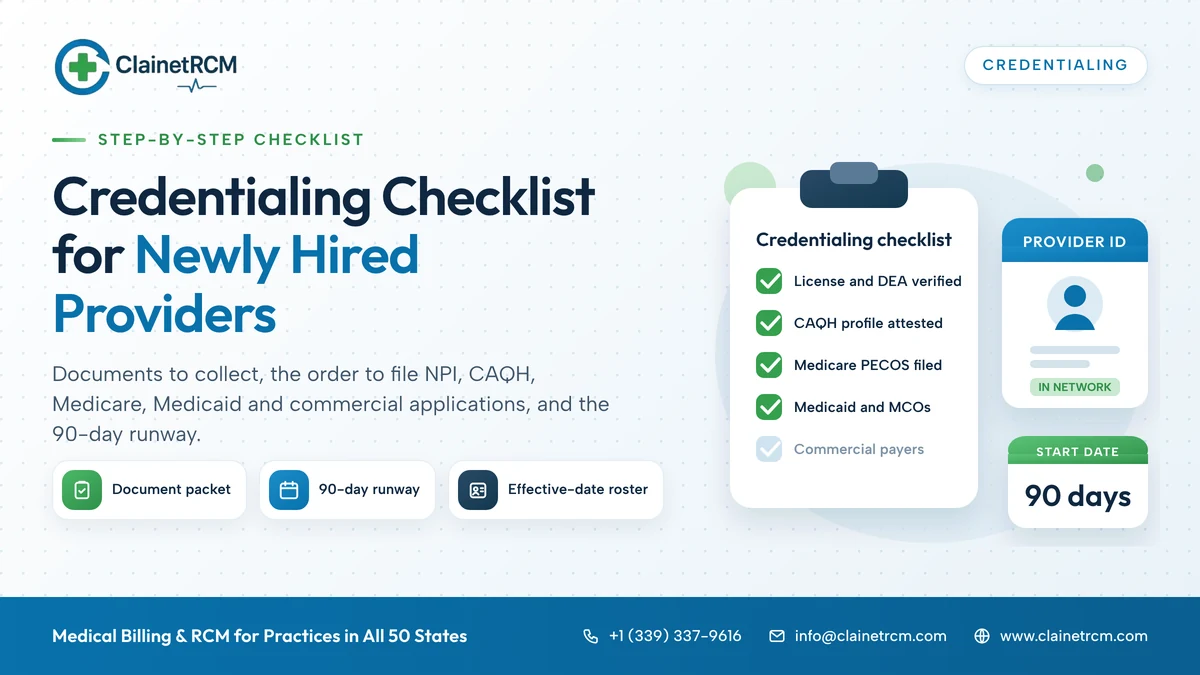
The 90-day rule. Count backward from the start date. If the signed offer, the document packet and the first applications are not in motion 90 days out, the provider will start with at least one major payer still pending. For a provider coming from another state, add the state license, DEA and controlled substance registration lead times on top.
Phase 1: Collect Everything Before the Offer Is Final
Credentialing delays are almost always document delays. A payer that requests one missing item restarts its clock, and many practices wait weeks for a provider to find a certificate they were never told to bring. Put the document request in the offer process itself, with a deadline, and verify each item against the primary source before anything is submitted.
| Document or data point | Why payers need it | Where delays happen |
|---|---|---|
| State license in the practice state, with number and expiration | Required for every application; verified at the licensing board | Provider licensed in another state only; renewal due within 90 days |
| DEA registration (Form 224) and state CDS or CSR registration where required | Prescribing authority; verified with DEA and the state | DEA address still shows the old practice; state CDS never obtained |
| Board certification or eligibility status, with dates | Verified with ABMS, AOA, ANCC, AANP, NCCPA or the specialty board | Lapsed MOC; "board eligible" claimed past the eligibility window |
| Education and training: medical school, residency, fellowship, degree for NPs, PAs and therapists | Primary source verification under NCQA standards | Foreign graduates without ECFMG certificate on file |
| Work history for the past five years, month and year, with no unexplained gaps | Required by NCQA and most payer applications | Gaps longer than six months need a written explanation |
| Malpractice certificate of insurance showing limits and dates | Proof of coverage at the new practice | COI issued to the old employer; tail coverage not documented |
| Malpractice claims history and any settlements | Checked against the NPDB self-query | Undisclosed claims found at verification |
| Hospital privileges, current and past, with status | Supports clinical competence; required for hospital-based billing | Privileges lapsed at a prior facility |
| NPI (Type 1), NPPES login and taxonomy code | Links the individual to every claim and enrollment | Taxonomy does not match the specialty being credentialed |
| CAQH ID and login, with the practice authorized to access it | Most commercial payers pull the application from CAQH | Profile owned by the previous group; attestation expired |
| Government ID, Social Security number, immunization and TB records, BLS/ACLS where required | Identity verification; hospital and payer requirements | Expired BLS card |
| Signed attestation questions: sanctions, exclusions, license actions, criminal history, impairment | Every application asks; answers are verified | Answers that differ between applications |
Run three checks on the provider yourself before you submit anything: the OIG List of Excluded Individuals and Entities, SAM.gov, and your state Medicaid exclusion list. An excluded provider cannot be billed to any federal program, and the practice that bills them is liable. If the provider has anything to disclose, address it in a cover letter rather than letting the payer discover it. Our document collection and verification service handles this packet for every new hire, with primary source verification done before the applications go out.
Phase 2: The 90-Day Runway, in the Right Order
The applications are not independent. Submit them in the wrong order and you will be waiting on one to finish before another can start. This is the sequence that works.
- NPI and NPPES. Confirm the provider has a Type 1 NPI, that the NPPES record shows the correct taxonomy, the practice address and a current contact, and that you have the login. Payers compare application data to NPPES field by field, and mismatches are a top reason Medicare applications get developed. If anything needs updating, do it first; our NPI registration team handles new numbers and corrections.
- CAQH profile. Create or claim the CAQH profile, update every section for the new practice, upload the current documents, authorize the payers you will apply to, and attest. The CAQH profile is the single source most commercial plans pull from, so an incomplete profile stalls every commercial application at once. CAQH profile management keeps it current afterward.
- Medicare enrollment through PECOS. File the CMS-855I for the individual (reassignment of benefits to your group is now part of the 855I; the separate CMS-855R was retired in 2023), the CMS-588 for electronic funds transfer if the group's banking is changing, and the CMS-460 participation agreement if the provider is new to Medicare and will be a participating provider. File this the moment the start date is known, because the filing date sets the earliest possible effective date. Submitting online through PECOS is faster than paper: CMS's 2026 enrollment update cites roughly 15 days of contractor processing for online applications against about 30 for paper, before development requests. Medicare provider enrollment at ClainetRCM typically completes in 30 to 45 days end to end.
- Medicaid and managed care. Enroll the provider with the state Medicaid program first, because federal rules require every network provider of a Medicaid managed care plan to be enrolled with the state (42 CFR 438.602(b)), and providers who only order, refer or prescribe for Medicaid patients must be enrolled too. Then apply to each Medicaid managed care organization, which credentials separately. Plan on 30 to 60 days for Medicaid provider enrollment and the MCOs.
- Commercial payers, largest first. Rank payers by the practice's collections and submit to the top five on the same day the CAQH profile is attested. Most insurance credentialing applications take 60 to 150 days, so the biggest payers need the longest runway. Ask each payer whether the provider will be added to the group's existing contract or needs an individual agreement, and ask for the effective date in writing.
- Medicare Advantage and other products. Being in network with a payer's commercial PPO does not automatically load the provider into its Medicare Advantage or exchange products. Confirm each product line separately.
- Hospital privileges. If the provider will admit, round, deliver or operate, start hospital privileging in parallel. Medical staff offices work on committee calendars, and 60 to 90 days is typical.
- Licensing and registrations for providers moving states. A new state medical license can take months, and the DEA registration must be updated or re-filed for the new state address, with a separate state controlled substance registration where the state requires one. Physicians moving between the 44 member states of the Interstate Medical Licensure Compact can use the compact pathway, which is faster than a full application.
Typical timelines for a newly hired provider
| Enrollment or application | Typical timeline | What controls the clock |
|---|---|---|
| Medicare (PECOS, CMS-855I) | 30 to 45 days | Filing date sets the effective date; development requests must be answered within 30 days |
| State Medicaid and managed care organizations | 30 to 60 days | State screening level; MCO committee schedules |
| Medicare Advantage plans | 30 to 60 days | Separate loading from the commercial product |
| Commercial payers (Aetna, BCBS, Cigna, UnitedHealthcare, Humana) | 60 to 150 days | CAQH completeness; committee cycles; whether the group contract already exists |
| Hospital privileges | 60 to 90 days | Medical staff committee calendar; peer references |
| New state license (direct application) | Several weeks to several months by state | Verification of training and other licenses; compact eligibility shortens it |
| DEA registration (new or address change) | Typically 4 to 6 weeks for a new registration; address changes are faster | State license and CDS must come first where the state requires CDS |
These are the ranges we quote clients, and they assume a complete packet and prompt answers to payer questions. If an application is sitting past these windows, something is usually wrong with the data rather than the queue. Our guide to common Medicare and Medicaid enrollment delays lists the specific causes.
Phase 3: The First 30 Days, and What the Provider Can See
Even with a perfect runway, some payers will still be pending on day one. The practice needs scheduling rules for that period, because the alternative is a stack of unbillable visits or, worse, claims billed in a way that creates compliance risk.
- Keep an effective-date roster. One sheet, one row per payer and product, with the status, the effective date once confirmed, and the earliest date of service you will bill. Give it to the schedulers.
- Schedule by payer. Book Medicare patients from the Medicare effective date (or up to 30 days before it, once approved). Hold patients of still-pending commercial plans for the provider's colleagues, or schedule them after the expected effective date.
- Do not bill under another provider's NPI. Billing a new hire's services under a credentialed colleague's name misrepresents who rendered the service and exposes the practice to overpayment demands and False Claims Act liability.
- Know the incident-to limits. Medicare incident-to billing lets a physician bill certain services performed by auxiliary staff in the office, but only for an established patient with an established plan of care, with the physician providing direct supervision in the office suite. It is not a workaround for a new physician, and most commercial payers do not recognize it at all.
- The Q6 modifier is not for new hires. Medicare's fee-for-time compensation arrangement (the old locum tenens rule) lets a substitute physician bill under an absent physician's NPI for up to 60 continuous days. It covers a physician who has left or is away, not a new provider joining the group. See locum tenens credentialing for how true locum coverage works.
- Out-of-network billing is a decision, not a default. Some commercial plans will pay a pending provider as out of network, but the patient takes the higher cost share and may not be told. Decide this per payer and disclose it to patients if you do it.
Phase 4: Keep the Provider Enrolled
Most credentialing lapses happen a year or more after onboarding, when nobody owns the calendar. Build the maintenance schedule the same day the provider is approved.
| Requirement | Frequency | What happens if it is missed |
|---|---|---|
| CAQH re-attestation | Every 120 days | Payers stop pulling the profile; applications and recredentialing stall |
| Commercial recredentialing | Every 36 months under NCQA standards (some payers every 24) | Network termination and denials with CARC 242 until reinstated |
| Medicare revalidation | Every 5 years (every 3 for DMEPOS suppliers) | Deactivation of billing privileges and a gap no appeal can close |
| Medicaid revalidation | At least every 5 years, by state schedule | Disenrollment from Medicaid and every MCO |
| Reporting changes to Medicare | 30 days for practice location, ownership and adverse actions; 90 days for other changes | Claims denied for a location Medicare does not have on file; possible revocation |
| License, DEA, CDS, board certification and malpractice expirations | Tracked continuously; renewals filed 60 to 90 days early | Payers suspend the provider the day a license lapses |
| Exclusion screening (OIG LEIE, SAM.gov, state Medicaid lists) | Monthly, under current NCQA requirements | Federal program billing by an excluded provider is an overpayment and a penalty exposure |
Two of these changed recently. NCQA's 2025 standards shortened the primary source verification window to 120 days for credentialing accreditation and made monthly exclusion monitoring mandatory, so health plans are now stricter about stale documents than they were two years ago. Our re-credentialing and Medicare revalidation services run this calendar for every provider on the roster, and the NCQA credentialing standards page explains the verification elements in detail.
State Laws That Shorten the Wait
A growing number of states now put a clock on health plans, and a practice that knows the rule can hold the payer to it.
- Texas. Insurance Code 1457.002 requires health plans to offer provisional credentialing to a physician who submits a completed application and is joining a practice as a partner, shareholder or employee of a physician already contracted with the plan. The plan must then complete credentialing within 60 calendar days of granting provisional status.
- California. Health and Safety Code 1374.197 requires plans to verify a mental health or substance use disorder provider's qualifications within 60 days of receiving a completed application, and to confirm receipt and completeness within seven business days.
- Wyoming. For applications submitted on or after July 1, 2025, health carriers must acknowledge receipt within seven days, flag an incomplete application within 30 days and conclude credentialing within 60 calendar days, and must reimburse covered services back to the date the completed application was received once the provider is credentialed and contracted.
Several other states have similar statutes or regulations, and the details differ by provider type and plan type. Check your state's insurance code when you set expectations with a new hire, and cite it in writing when a payer runs past the deadline.
Seven Mistakes That Add 30 Days or More
- Starting on the first day of work. The single biggest cause of the revenue gap. Credentialing belongs in the offer workflow.
- Data that does not match across systems. A middle initial on the license, a maiden name on the DEA, a home address in NPPES. Payers develop or reject applications for mismatches, and a Medicare rejection means starting over.
- Submitting to commercial payers before the CAQH profile is complete and attested. The payer pulls an incomplete profile and the application sits in a "needs information" status nobody is watching.
- Leaving a question blank. Blank is not "no." Every attestation question needs an answer, and a disclosed issue with a cover letter is processed faster than a discovered one.
- Forgetting the group side. A credentialed provider still needs to be linked to the group's tax ID, location and contract with each payer. Group practice credentialing is a separate step with most plans.
- Wrong taxonomy or specialty. A nurse practitioner credentialed under the wrong taxonomy, or a physician under a general code when the payer contract is specialty-specific, gets claims denied even after approval. Nurse practitioner and physician assistant enrollments have their own supervision and collaboration documentation in many states.
- Nobody chasing status. Payers rarely call to say an application is stuck. A weekly status check on every open application, with a named contact at the payer, is where most of the time is saved.
In-House or Outsourced Credentialing for New Hires?
A practice that hires one provider every few years can run this checklist in-house if someone owns it and has the time. The work is not complicated, but it is unforgiving about sequence, detail and follow-up, and it competes with everything else an office manager does. Practices that add providers regularly, operate in more than one state, or have had a provider start before enrollment was complete usually find that a dedicated credentialing team pays for itself with the first avoided gap.
ClainetRCM prices credentialing as a flat fee per provider per payer, separate from billing, with weekly status updates and assigned payer representatives who help move stalled applications. See pricing for how it fits alongside billing, and the provider credentialing page for the full scope.
Hiring a Provider? Start the Clock Today.
Send us the start date and we will build the runway: document packet, NPI and CAQH, Medicare and Medicaid enrollment, commercial payers and hospital privileges, in the right order, with weekly status updates until every effective date is confirmed.
Talk to a Credentialing SpecialistFrequently Asked Questions
Plan on 90 to 120 days from a complete application packet to being in network with the major payers. Medicare individual enrollment through PECOS typically takes 30 to 45 days, state Medicaid and managed care plans 30 to 60 days, Medicare Advantage plans 30 to 60 days, commercial payers 60 to 150 days and hospital privileges 60 to 90 days. A provider moving from another state needs additional time for the state license, DEA and controlled substance registration.
At minimum: state license, DEA and state CDS registration where required, board certification, education and training records, a five-year work history with no unexplained gaps, malpractice certificate of insurance and claims history, hospital privileges, NPI and NPPES login, CAQH ID and login, government ID, immunization and BLS records where required, and signed attestation answers about sanctions, exclusions and license actions. Every item should be verified against the primary source before submission.
They can see patients, but the practice usually cannot bill the payer for those visits until the provider is effective. Medicare allows billing back only 30 days before the enrollment effective date, and most commercial plans allow no retroactive billing. Billing the visits under another provider's NPI is improper. Practices typically schedule patients by payer using an effective-date roster, hold pending payers' patients for credentialed colleagues, or make a disclosed decision to bill some plans out of network.
Under 42 CFR 424.520(d), it is the later of the date the Medicare contractor received the enrollment application that was later approved, or the date the physician first furnished services at the practice location. Under 42 CFR 424.521, the physician may then bill retrospectively for up to 30 days before that date, or 90 days if a Presidentially declared disaster prevented timely enrollment. Filing early is the only way to move the effective date forward.
No. CMS merged the reassignment information into the CMS-855I in 2023 and discontinued the separate CMS-855R. On paper, reassignments are reported in Section 4F of the CMS-855I, signed by both the practitioner and the group's authorized or delegated official. In PECOS, the reassignment is added in the Reassignment topic of the individual's enrollment.
Generally no. Medicare incident-to billing applies to services by auxiliary personnel for established patients under an established plan of care with direct physician supervision, not to a new physician or practitioner managing their own patients. The Q6 modifier covers a substitute physician filling in for an absent physician under a fee-for-time compensation arrangement for up to 60 continuous days; it does not cover a provider who has been hired to join the practice.
NCQA standards require health plans to recredential practitioners every 36 months, and some payers use a 24-month cycle. Medicare revalidation is every five years (three years for DMEPOS suppliers), Medicaid revalidation at least every five years by state schedule, and CAQH requires re-attestation every 120 days. Licenses, DEA and CDS registrations, board certifications and malpractice coverage must stay current throughout, and exclusion lists should be checked monthly.
Usually yes. Enrollment in traditional Medicare through PECOS does not place a provider in a Medicare Advantage plan's network. Each MA plan credentials and contracts separately, often through the same application the payer uses for its commercial products, and a provider loaded into a payer's commercial PPO is not automatically loaded into its MA or exchange products. Confirm each product line and ask for the effective date in writing.
The Bottom Line
Credentialing a newly hired provider is a sequence, not a form. Collect the packet before the offer is final, file Medicare the day the start date is known, let the CAQH profile drive the commercial applications, keep an effective-date roster the schedulers actually use, and put the maintenance calendar in place the day the first approval arrives. Do that and the provider's first month produces revenue instead of write-offs.
If you have a provider starting in the next 90 days and any of these steps have not begun, that is the one to start today.

Written by
ClainetRCM Billing Team
ClainetRCM is a Boston-based revenue cycle management company specializing in medical billing, coding, credentialing and denial management for healthcare providers across all 50 states. Our AAPC and AHIMA certified team works inside your existing EHR, files claims within 24 to 48 hours and reviews every AR bucket on a 14-day cycle.