Medicare receives about 19,000 new provider enrollments a month, and most of them are approved without drama. The ones that stall share a pattern: the application said one thing, a federal or state database said another, and the contractor sent a request for more information that nobody answered in time. The result is a rejected application, a lost effective date and weeks of unbillable visits.
This guide explains how Medicare and Medicaid enrollment actually moves, the difference between a developed, returned, rejected and denied application, the twelve causes of enrollment delays we see most often, the 2026 changes that affect every new application, and what to do when yours is stuck. It is written for practice owners, administrators and the people who fill in the CMS-855 forms.
Last updated: October 2026
Key takeaways
- CMS's 2026 provider enrollment update cites roughly 15 days of contractor processing for online PECOS applications and about 30 days for paper, before any development requests. Most delays come from data mismatches, missing documents and unanswered requests, not from the queue.
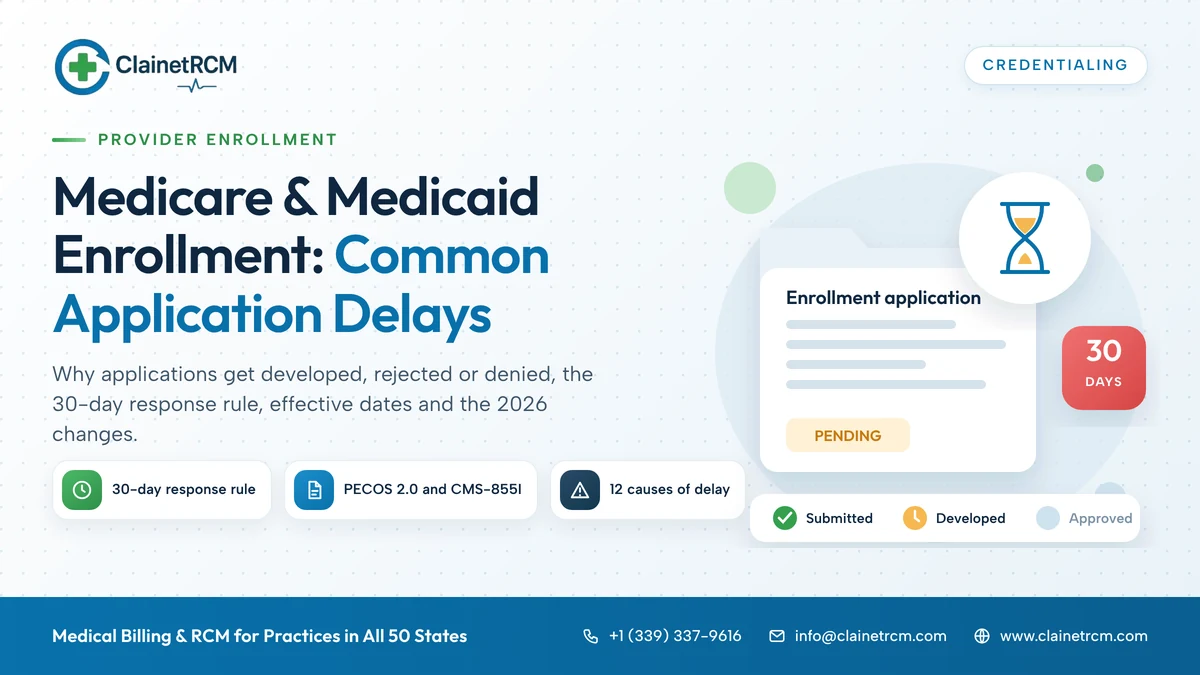
- If a contractor asks for missing information, you have 30 calendar days to supply it. Miss that window and the application is rejected under 42 CFR 424.525, with no appeal rights, and you start over with a new filing date.
- The Medicare effective date for a physician or practitioner is the later of the filing date or the first date of service, and you can bill back only 30 days before it. Every rejection moves the effective date, which means lost revenue that cannot be recovered.
- Medicaid adds a second layer: a provider must be enrolled with the state agency before any Medicaid managed care plan can treat them as a network provider, and each plan credentials separately.
- The CY 2026 application fee is $750 for institutional providers. Individual physicians and non-physician practitioners filing the CMS-855I do not pay it.
How Medicare and Medicaid Enrollment Actually Moves
Understanding the steps makes the delays easier to diagnose, because each cause of delay lives at a specific step.
Medicare
- You submit the application, either online through PECOS or on paper: CMS-855I for an individual physician or practitioner (including reassignment of benefits to a group, since the separate CMS-855R was retired in 2023), CMS-855B for a group or clinic, CMS-855A for institutional providers, CMS-855S for DMEPOS suppliers, and CMS-855O for providers who only order, certify or refer. The CMS-588 covers electronic funds transfer and the CMS-460 is the participation agreement.
- The Medicare Administrative Contractor screens it. The MAC compares every field to NPPES, IRS records, state licensing boards, the OIG exclusion list and prior Medicare history, and applies the screening level set by 42 CFR 424.518: limited, moderate or high. Moderate and high risk bring an unannounced site visit; high risk adds fingerprint-based background checks for owners of 5 percent or more.
- The MAC develops the application if anything is missing or inconsistent. You receive a request for information and have 30 calendar days to respond.
- The MAC approves, rejects or denies. Approval triggers a letter with the effective date. The MAC then updates the claims processing system, which CMS says takes one to two more days. You are not actually able to bill until that update is done.
- Certified providers wait longer. Hospitals, home health agencies, hospices and other certified providers also need a state survey or accreditation review before CMS approval, which CMS describes as three to nine months of state review plus about 30 days at CMS.
Medicaid
- Enroll with the state Medicaid agency first. Federal rules require every network provider of a Medicaid managed care plan to be enrolled with the state (42 CFR 438.602(b)), and providers who only order, refer or prescribe for Medicaid patients must be enrolled too (42 CFR 455.410(b)). States apply the same limited, moderate and high screening levels as Medicare and may rely on Medicare's screening when the provider is already enrolled there.
- Then apply to each managed care organization. Each MCO credentials and contracts separately, often through CAQH, and will not load a provider the state has not enrolled.
- Revalidate on the state's schedule. States must revalidate enrolled providers at least every five years (42 CFR 455.414), and many run shorter cycles for higher-risk provider types.
Developed, Returned, Rejected, Denied: They Are Not the Same
Providers often describe any bad news as "denied." The distinction matters, because each status has a different remedy and a different effect on your effective date.
| Status | What it means | Effect on your effective date | What you can do |
|---|---|---|---|
| Developed | The contractor needs more information or a corrected document | None, if you respond within 30 days | Send exactly what was requested, to the contact named, and confirm receipt |
| Returned | The application could not be processed at all: wrong form, no signature, wrong contractor | Lost. The application is treated as never received | Fix the defect and submit a new application |
| Rejected | Incomplete information was not supplied within 30 days, or the application was unsigned, undated, carried a copied or stamped signature, or was signed more than 120 days before receipt (42 CFR 424.525) | Lost. A new application sets a new filing date | No appeal rights. Submit a complete new application with all supporting documents |
| Denied | CMS decided the provider does not meet requirements (42 CFR 424.530): licensure, exclusion, felony, false information, unpaid overpayment, failed site visit and similar | No enrollment | Request reconsideration within 60 days; a corrective action plan is available only for some noncompliance findings |
| Revoked | Existing billing privileges terminated (42 CFR 424.535), with a re-enrollment bar of one to ten years | Privileges end on the revocation date | Reconsideration within 60 days; a corrective action plan is allowed only for noncompliance revocations under 424.535(a)(1), and only once |
| Deactivated | Billing privileges stopped, usually for non-billing or a missed revalidation (42 CFR 424.540); not a sanction | Reactivation creates a gap in billing privileges | Submit a reactivation or a new full application, depending on the reason |
The practical lesson: a development request is an opportunity, a rejection is a restart, and a denial is a dispute. Treat each accordingly.
The 12 Most Common Causes of Enrollment Delays
These are the causes behind most of the stalled applications that reach our Medicare provider enrollment team. The fix for almost all of them happens before submission.
1. Legal business name or tax ID does not match IRS records
The legal business name on a CMS-855B or 855A must match the IRS exactly, as shown on the CP-575 notice or a 147C letter, including punctuation and suffixes such as LLC or PLLC. "Main Street Family Care" and "Main Street Family Care, PLLC" are different names to the MAC. Order a 147C letter from the IRS before you file if you cannot find the CP-575. New entities should settle this during business registration, before the first enrollment is drafted.
2. The application disagrees with NPPES
Name, practice address, taxonomy and the Type 1 or Type 2 NPI are all compared to the NPPES record. A provider who moved, married or changed specialty and never updated NPPES will be developed on the mismatch. Update NPPES first, wait for it to post, then file. Our NPI registration team cleans these records before applications go out.
3. Signature problems
Under 42 CFR 424.525, an application can be rejected if it is unsigned or undated, carries a copied or stamped signature, or was signed more than 120 days before the contractor received it. The signer also has to be the right person: the practitioner for the individual sections, and an authorized or delegated official on file for the organization. Reassignments on the CMS-855I need both signatures.
4. Missing supporting documents
The usual gaps are the CMS-588 EFT form without a voided check or bank letter, missing state license copies, the CP-575 or 147C, business licenses or certifications the state requires, and documentation of any adverse legal history that was disclosed. Build a document index for each form type and attach everything on the first submission.
5. Practice location problems
Medicare needs a physical location where patients are seen, with the correct address format. P.O. boxes, commercial mail drops and unlisted suites cause development, and a moderate or high risk application can fail an unannounced site visit if the location is not open and operational during business hours with signage and posted hours. Report every practice location, and report location changes within 30 days under 42 CFR 424.516.
6. Unanswered development requests
This is the most expensive cause, because it converts a fixable application into a rejection. Development letters go to the correspondence address and the contact person on the application, who is often an office manager who has since left or a provider who does not open mail. Put one named person on every application, check PECOS status weekly and calendar the 30-day deadline the day a request arrives.
7. Reassignment and group linkage out of sequence
A new physician cannot reassign benefits to a group that is not yet enrolled, and a group cannot bill for a physician whose individual enrollment is pending. File the group enrollment first for a new practice, then the individual enrollments with reassignment. Groups adding providers should confirm the group linkage is in PECOS for each payer location. Critical access hospitals should note that since January 1, 2026, CMS denies Method II professional claims when the reassignment is not in PECOS.
8. Application fee errors
Institutional providers filing the CMS-855A, CMS-855B (other than physician and practitioner organizations) or CMS-855S must pay the application fee, which is $750 for calendar year 2026, or submit a hardship exception request that CMS decides within 60 days. An unpaid or incorrectly paid fee holds the application. Individual physicians and non-physician practitioners filing the CMS-855I do not pay a fee, and neither do individual practitioners enrolling in Medicaid or CHIP.
9. Screening requirements for moderate and high risk providers
Newly enrolling home health agencies, DMEPOS suppliers, hospices and skilled nursing facilities, among others, face site visits and fingerprint-based background checks for every owner with a 5 percent or greater interest. Owners get 30 days to be fingerprinted. Add this to the timeline for home health and hospice or DMEPOS supplier enrollment, and check for moratoria: CMS imposed a six-month moratorium on new DME supplier enrollments beginning February 27, 2026, with applications filed after that date denied.
10. Undisclosed adverse legal history
Every application asks about felony convictions, license suspensions or revocations, exclusions, Medicare or Medicaid overpayments and payment suspensions. An undisclosed item that the contractor finds in its own databases leads to denial for providing false or misleading information, which is far harder to recover from than a disclosed item with documentation. Answer every question and attach the records.
11. Medicaid-specific sequencing
Applying to a Medicaid managed care plan before the state enrollment is complete, skipping ordering-referring-prescribing enrollment for providers who never bill Medicaid directly, missing a state revalidation, or failing a state site visit will all stall Medicaid participation. States also increasingly apply high-risk screening to newly enrolling skilled nursing facilities and hospices. Our Medicaid provider enrollment service manages the state portal and the MCO applications together, in the right order.
12. Status problems from the provider's past
A provider who opted out of Medicare is locked out for the two-year opt-out period unless they cancel within the first 90 days. A provider deactivated for non-billing must reactivate before claims will pay. A provider with an unpaid overpayment or an active re-enrollment bar from a prior revocation will be denied. Check PECOS history before you accept a start date.
Delays That Happen After Approval
Approval is not the end of the process. Three timing rules catch practices after the letter arrives.
- The effective date and the 30-day lookback. Under 42 CFR 424.520(d), a physician or practitioner's effective date is the later of the filing date of the approved application or the first date of service at the location. Under 42 CFR 424.521(a), services may be billed retrospectively for up to 30 days before that date, or 90 days when a Presidentially declared disaster prevented timely enrollment. Visits before the lookback window are not billable to Medicare.
- The claims system update. CMS says the MAC updates the claims processing system one to two days after approval. Claims submitted before that update reject or deny for provider eligibility; hold them for a few days rather than resubmitting.
- Deactivation for non-billing. Medicare can deactivate billing privileges when a provider submits no claims for six consecutive months under 42 CFR 424.540. CMS has applied the six-month standard to hospices since March 2024 and to home health agencies since January 2026, while other Part B and individual providers are currently deactivated after 13 consecutive months without claims. A provider who joins your group but keeps an old, idle enrollment can be caught by this.
Revalidation is the other post-approval trap. Medicare revalidation is due every five years (every three for DMEPOS suppliers), due dates are posted in the PECOS revalidation lookup six to seven months in advance, and the MAC mails a notice about 90 days before. Missing it deactivates billing privileges and creates a gap that no appeal can close. Medicare revalidation tracking exists for exactly this reason, and we cover the revenue side in how credentialing impacts practice revenue.
What Changed in 2025 and 2026
| Change | What it means for your application |
|---|---|
| PECOS 2.0 launched (late 2025) | Sequential sections with real-time validation against CMS records, a status dashboard, revalidation pre-populated with existing data, and role-based access for authorized and delegated officials. Validation catches NPPES mismatches at entry, so fix NPPES before you start |
| CY 2026 application fee: $750 | Up from $730 in 2025. Applies to institutional providers; not to physicians or non-physician practitioners filing the CMS-855I |
| CMS-855R retired; reassignment on the CMS-855I | Since late 2023, paper reassignments are reported in Section 4F of the CMS-855I with both signatures. Old forms are returned |
| Form revisions scheduled for 2026 | CMS has signaled revised CMS-855B (tentatively April 2026), CMS-855S (spring 2026) and CMS-855I (fall 2026) forms. Confirm you are using the current version before mailing a paper application |
| DME supplier moratorium | A six-month moratorium on new DMEPOS supplier enrollments began February 27, 2026, extendable; applications after that date are denied |
| Critical access hospital Method II claims | Since January 1, 2026, professional claims are denied when the practitioner's reassignment to the CAH is not in PECOS |
| Medicaid provider screening under H.R. 1 (2025) | Section 71105 requires states to check enrolled providers against the Social Security Death Master File quarterly rather than only at enrollment, effective January 1, 2028. Expect more frequent state data matches |
How to Keep an Enrollment Application Moving
- Reconcile the data before you file. NPPES, IRS, state license, CAQH and the application should agree on every name, address, NPI, taxonomy and date. This one step prevents most development requests.
- File online. PECOS applications are processed in roughly half the time of paper, and PECOS 2.0 validates fields as you enter them.
- File early. Because the filing date sets the earliest effective date, submit the moment the start date is known, even if a few documents are still coming. Our credentialing checklist for newly hired providers lays out the 90-day runway.
- Attach everything the first time. Use a document index for each form type and include the CMS-588 with bank verification, licenses, IRS documents and any adverse-history records.
- Name one owner. One person's name, phone and email on every application, with a shared inbox so nothing dies when staff change.
- Check status weekly in PECOS and the state Medicaid portal, and calendar every development deadline on the day it arrives.
- Escalate with the right contact. Each MAC has a provider enrollment line and a process for status inquiries once the normal processing window has passed. Use it, and keep a log of dates and reference numbers.
- Hold claims until the claims system is updated, then release them in a batch with dates of service inside the lookback window.
If Your Application Was Rejected or Denied
Rejected: there is no appeal. Fix the defect, assemble the complete packet and submit a new application immediately, because the new filing date is now your earliest possible effective date. Review the rejection letter line by line; most list every deficiency.
Denied: you may request reconsideration within 60 days of the notice, with documentation addressing each reason. A corrective action plan is available only for specific noncompliance findings, and a provider gets one opportunity to use it. A denial for false or misleading information, exclusion or a felony is a legal matter, not a paperwork one, and warrants counsel.
Deactivated: submit the reactivation (or a new full application if the deactivation was for a missed revalidation) and expect a gap in billing privileges from the deactivation date to the reactivation effective date. Claims in that gap are generally not payable.
Whatever the status, do not resubmit the same application unchanged. The second review will find the same problem, and you will have spent another month learning that.
When to Hand Enrollment to a Specialist
A single physician joining an established group with clean records can usually be enrolled in-house if someone owns the calendar. Enrollment becomes a specialist's job when the practice is new, when it adds providers regularly or across several states, when institutional or DMEPOS enrollments with fees and site visits are involved, or when an application has already been rejected once. The cost of a second rejection is measured in weeks of unbillable care, not in staff hours.
ClainetRCM files Medicare, Medicaid and managed care enrollments for practices in all 50 states, with assigned payer representatives who help move stalled applications and weekly status reporting until the effective date is confirmed. Enrollment is priced as a flat fee per provider per payer, separate from billing; see pricing and the provider credentialing page for scope. If a provider is already seeing patients while enrollment is pending, our guide to reducing claim denials covers how provider-eligibility denials (CARC B7, 170 and 242) should be handled in the meantime.
Is an Enrollment Application Stuck?
Send us the application details and we will tell you where it is, why it stalled and what it will take to get it approved. Medicare, Medicaid, managed care and commercial payers, in all 50 states, with weekly status updates.
Talk to an Enrollment SpecialistFrequently Asked Questions
CMS's 2026 provider enrollment update cites roughly 15 days of contractor processing for online PECOS applications and about 30 days for paper, before any development requests. In practice, a complete individual enrollment with reassignment typically takes 30 to 45 days end to end, including the one to two days the contractor needs to update the claims system after approval. Certified providers such as hospitals and home health agencies also need a state survey or accreditation review, which CMS describes as three to nine months.
Under 42 CFR 424.525, a contractor may reject an application when requested information is not supplied within 30 calendar days, when the application is unsigned or undated, when it carries a copied or stamped signature, or when it was signed more than 120 days before the contractor received it. Rejections carry no appeal rights; you must submit a new, complete application, and the new filing date becomes your earliest possible effective date.
A rejection means the application could not be processed because it was incomplete or defective; it has no appeal rights and you start over. A denial means CMS reviewed the application and decided the provider does not meet enrollment requirements under 42 CFR 424.530, for reasons such as licensure, exclusion, felony convictions or false information. Denials can be appealed through reconsideration within 60 days of the notice.
Under 42 CFR 424.521(a), a physician or non-physician practitioner may bill for services furnished up to 30 days before the enrollment effective date, or up to 90 days when a Presidentially declared disaster prevented timely enrollment. The effective date itself is the later of the application filing date or the first date of service at the location, which is why filing early matters.
No. The CY 2026 application fee of $750 applies to institutional providers filing the CMS-855A, CMS-855B (other than physician and non-physician practitioner organizations) or CMS-855S, and to comparable Medicaid-only and CHIP-only institutional providers. Individual physicians and non-physician practitioners filing the CMS-855I do not pay it, and neither do individual practitioners enrolling in Medicaid or CHIP.
The most common reason is that the provider is not yet enrolled with the state Medicaid agency. Federal rules (42 CFR 438.602(b)) require every network provider of a Medicaid managed care plan to be enrolled with the state, so plans will not load a provider until that enrollment is complete. Other frequent causes are an incomplete CAQH profile, a state site visit or screening step still pending, a missed state revalidation, and name or address data that differs between the state portal and NPPES.
Medicare requires revalidation every five years for most providers and every three years for DMEPOS suppliers (42 CFR 424.515). Due dates are posted in the PECOS revalidation lookup about six to seven months in advance and the contractor sends a notice roughly 90 days before. States must revalidate Medicaid providers at least every five years (42 CFR 455.414), and many use shorter cycles. Missing a revalidation deactivates billing privileges and creates a gap in payable claims.
PECOS 2.0, launched in late 2025, replaced the older interface with a sequential application that validates each section against CMS records in real time, a dashboard that shows each application's status, revalidations pre-populated with existing enrollment data, and role-based access for authorized and delegated officials. Because the system checks data against NPPES as you enter it, mismatches should be corrected in NPPES before starting an application.
The Bottom Line
Medicare and Medicaid enrollment delays are rarely about slow contractors. They are about data that does not match, documents that are missing, requests that go unanswered and applications filed in the wrong order. Reconcile the records before you file, use PECOS, respond to development requests inside 30 days, enroll with the state before the managed care plans, and track revalidation and deactivation rules after approval.
If you have an application that has been pending longer than the normal windows above, find out which status it is actually in this week. The remedy for a developed application and a rejected one are completely different, and only one of them has a deadline you can still meet.

Written by
ClainetRCM Billing Team
ClainetRCM is a Boston-based revenue cycle management company specializing in medical billing, coding, credentialing and denial management for healthcare providers across all 50 states. Our AAPC and AHIMA certified team works inside your existing EHR, files claims within 24 to 48 hours and reviews every AR bucket on a 14-day cycle.