Knowing how to get credentialed with insurance companies is the difference between a practice that fills its schedule in month two and one that is still waiting on contracts in month six. Each payer has its own application, timeline and network rules, and some will tell you their panel is closed. This guide walks through the process step by step, including what to do when the answer is “not right now.”
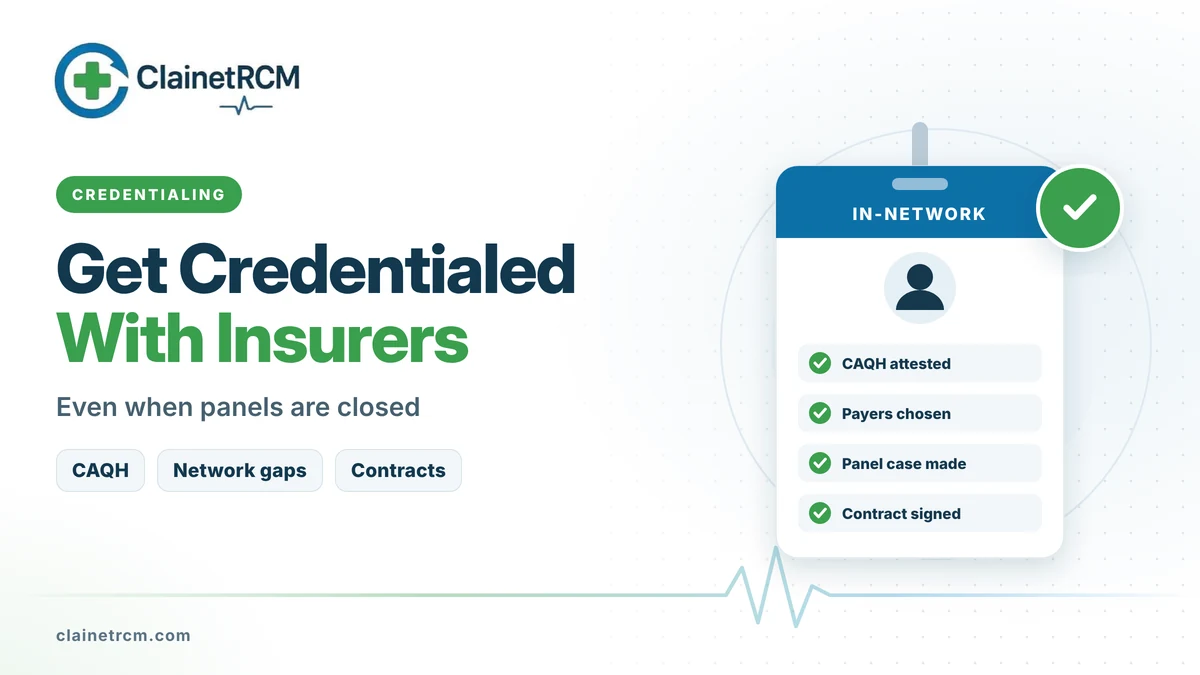
Quick answer: Set up the basics (NPIs, TIN, licenses, malpractice coverage), build and attest your CAQH profile, enroll in Medicare and Medicaid first if you plan to see those patients, then choose commercial payers based on your local patient mix. Submit each payer’s application or letter of interest, follow up weekly, review the contract and fee schedule, and confirm your effective date before scheduling patients. If a payer says its network is a closed panel, respond with a network adequacy case backed by data.
How to Get Credentialed With Insurance Companies: Step by Step
- Set up your identity and entity. Get a Type 1 NPI for each provider and a Type 2 NPI if you bill as a group or corporation, register the TIN and confirm the legal business name matches IRS records.
- Secure licenses and coverage. Active state license, DEA and state controlled substance registrations if you prescribe, board certification where applicable, and professional liability insurance at the limits payers require.
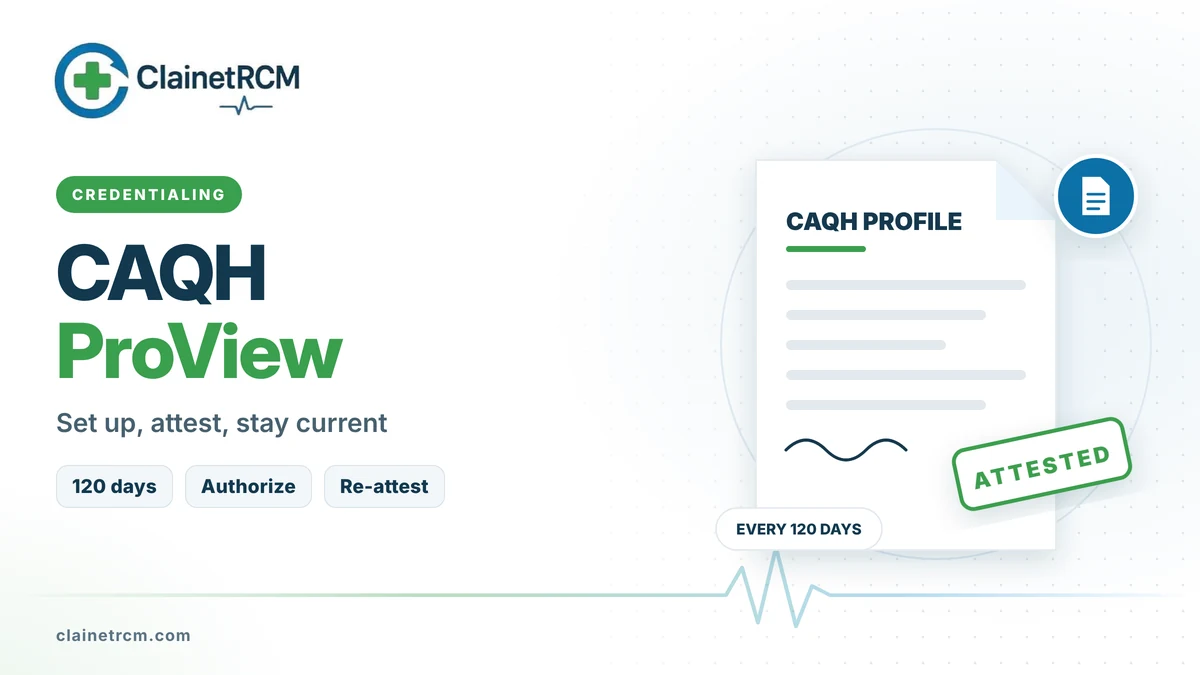
- Build your CAQH profile. Complete every section, upload documents, authorize payers and attest. Most commercial and Medicare Advantage plans pull data from it.
- Enroll in government programs first. Medicare enrollment through PECOS and state Medicaid enrollment come first because many plans check them, and Medicaid managed care plans require state enrollment before they contract.
- Pick your payer list. Ask your referral sources and front desk which plans local patients carry. Start with the five to eight payers that cover most of your market.
- Submit applications. Some payers use an online request form, some ask for a letter of interest, and some use a delegated group’s roster. Keep a record of every submission date and reference number.
- Follow up weekly. Log every call, name and promised date. Escalate files that have been silent for 30 days.
- Review and sign the contract. Check the fee schedule, timely filing limits, termination terms and effective date before you sign.
- Confirm loading and test. Ask for the provider ID and effective date in writing, update your billing system and send a few test claims before booking a full schedule.
Which Payers to Start With
| Payer type | Why it matters | Notes |
|---|---|---|
| Medicare | Often the largest single payer for adult practices | Enroll in PECOS; usually the fastest approval |
| Medicare Advantage plans | A large share of Medicare patients | Separate credentialing for each plan, usually through CAQH |
| State Medicaid | Required before Medicaid managed care | State portal; requirements vary by provider type |
| Medicaid managed care plans | Most Medicaid patients in many states | Credential with each plan after the state ID is issued |
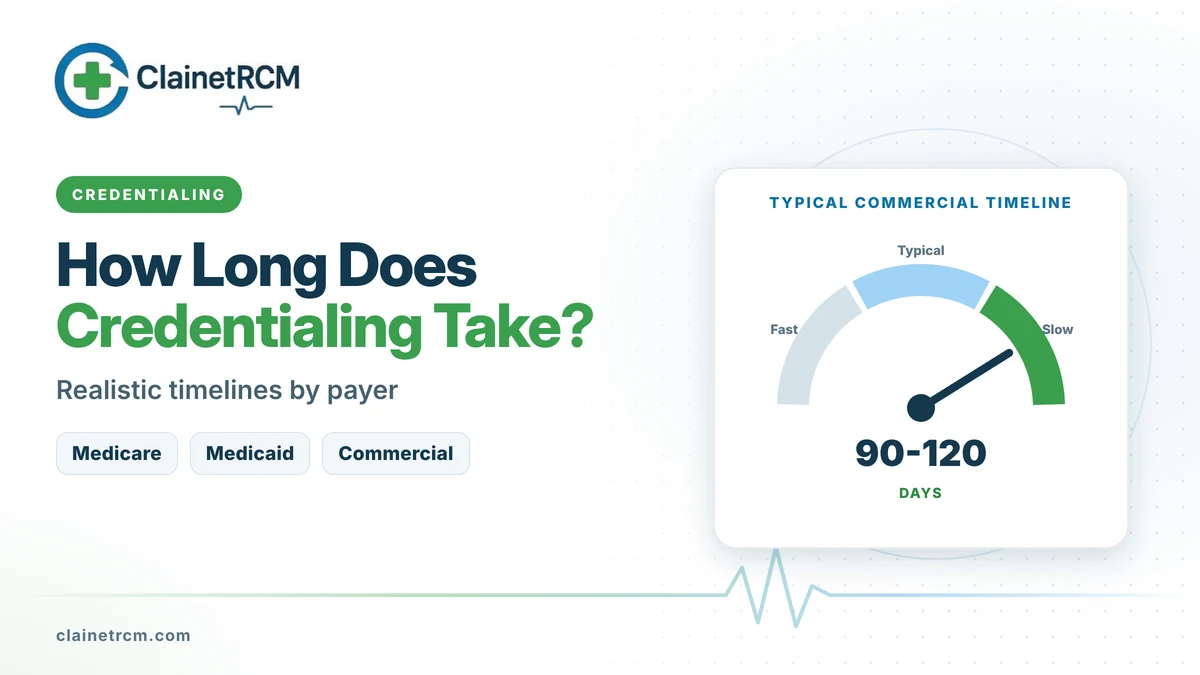
| Major commercial payers | Employer and marketplace patients | Typically 90 to 120 days; may have closed panels |
| Behavioral health carve-outs and EAPs | Often manage mental health benefits | Separate networks from the medical plan |
What a Closed Panel Means
A closed panel means the payer believes it already has enough providers of your type in your area to meet its network adequacy standards. It is a business decision, not a judgment about your qualifications, and it is often negotiable. Panels close and reopen, and a well-documented request can change the answer.
How to Reopen a Closed Panel
- Make a network adequacy case. Show the payer what its members cannot get today: long waits for new-patient appointments, long travel distances, or no in-network provider offering a specific service such as child psychiatry, TMS, Spravato treatment or a needed language.
- Bring evidence. Letters from referring physicians, hospital case managers or employers, and counts of members you have had to turn away, carry real weight.
- Highlight what is unique. Evening or weekend hours, telehealth availability, subspecialty training, board certification or languages spoken.
- Ask for a reconsideration in writing. Address it to provider network management, not general customer service, and request a specific decision date.
- Join a contracted group. A group or IPA that is already in-network may be able to add you through delegated credentialing and its provider roster, which can be much faster.
- Use single case agreements. For an individual patient who needs your services and has no in-network alternative, a single case agreement lets the payer pay you for that patient’s care.
- Reapply on a schedule. If the answer is still no, ask when the network will be reviewed and reapply then, often every six to twelve months.
- Know your regulator. Medicare Advantage plans must meet CMS time-and-distance standards, and many states enforce network adequacy for commercial plans. A documented access gap can be raised with the state insurance department.
Common Reasons Applications Are Denied or Delayed
- An incomplete or expired CAQH profile
- Missing malpractice coverage at the payer’s required limits
- An address, TIN or NPI that does not match other records
- No hospital admitting privileges or arrangement, when the payer requires one
- Unexplained gaps in work history
- Closed network for the specialty and county
Contract Terms to Review Before You Sign
- Fee schedule. Ask for rates on your top 20 codes, not just a percentage of Medicare.
- Timely filing limits. Some contracts allow as little as 90 days to submit claims.
- Effective date. Commercial payers rarely pay retroactively, so the effective date decides which visits are billable.
- Termination and amendment terms. How either side can exit, and how the payer can change rates.
- Credentialing and recredentialing obligations. What you must report and when.
Frequently Asked Questions
Commonly 90 to 120 days for commercial payers, faster for Medicare and variable for Medicaid. Our guide on how long credentialing takes breaks it down by payer.
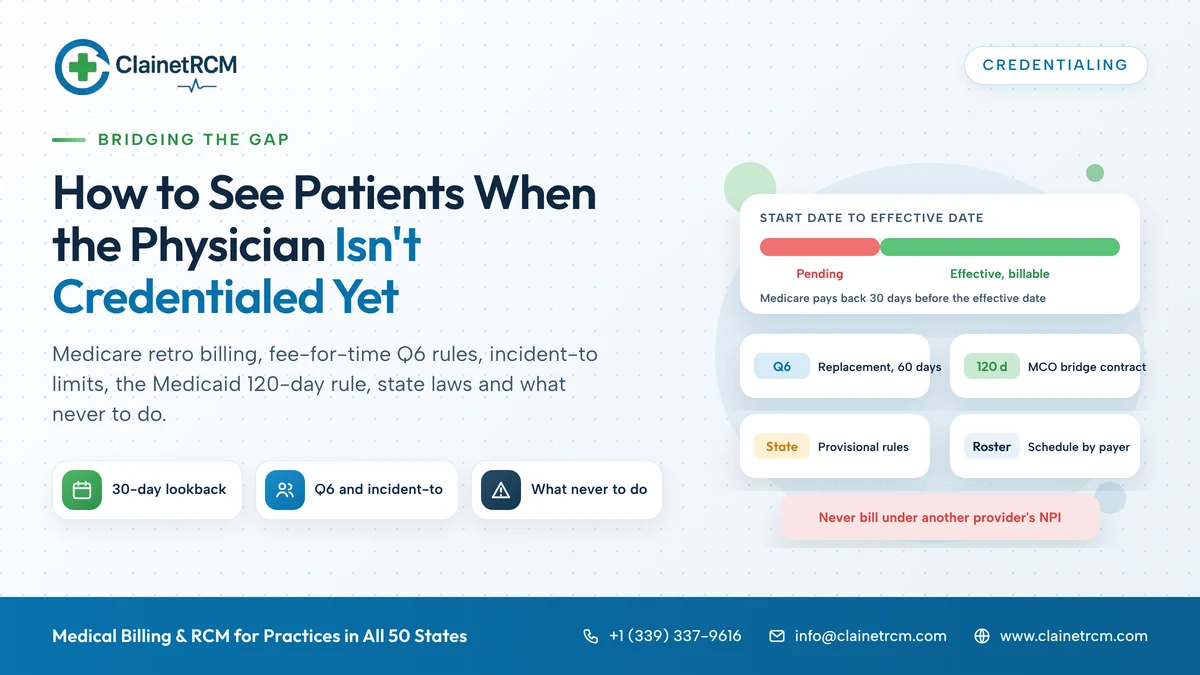
You can, but the visits may not be paid at in-network rates or at all. Read our guide on seeing patients before credentialing before you schedule.
A payer’s statement that its network already has enough providers of your type in your area. It can often be reversed with a strong network adequacy argument or by joining a contracted group.
For most commercial and Medicare Advantage plans, yes. See our CAQH ProView guide for setup and attestation tips.
A one-time agreement in which a payer agrees to pay an out-of-network provider for a specific patient’s care, usually because no in-network provider can meet the patient’s needs.
If you are adding several providers or payers, a credentialing service usually pays for itself through faster approvals and fewer denied claims.
Final Thoughts
Learning how to get credentialed with insurance companies is mostly about preparation and persistence: complete data, the right payer list, weekly follow-up and a documented case for every closed panel. Our credentialing services team handles every step, from CAQH to contract review. New practices should also work through our credentialing checklist for new providers.
Get In-Network With the Payers Your Patients Use
We build your payer strategy, submit complete applications, make the case to closed panels and review contracts before you sign.
Start My Credentialing
Written by
ClainetRCM Billing Team
ClainetRCM is a Boston-based revenue cycle management company specializing in medical billing, coding, credentialing and denial management for healthcare providers across all 50 states. Our AAPC and AHIMA certified team works inside your existing EHR, files claims within 24 to 48 hours and reviews every AR bucket on a 14-day cycle.