How long does credentialing take? It is the first question every new provider and practice manager asks, and the honest answer is “longer than you want.” Credentialing and payer enrollment run on each payer’s schedule, not yours, and a single missing document can add weeks. The good news is that the timeline is predictable once you know the stages, and much of the delay is preventable.
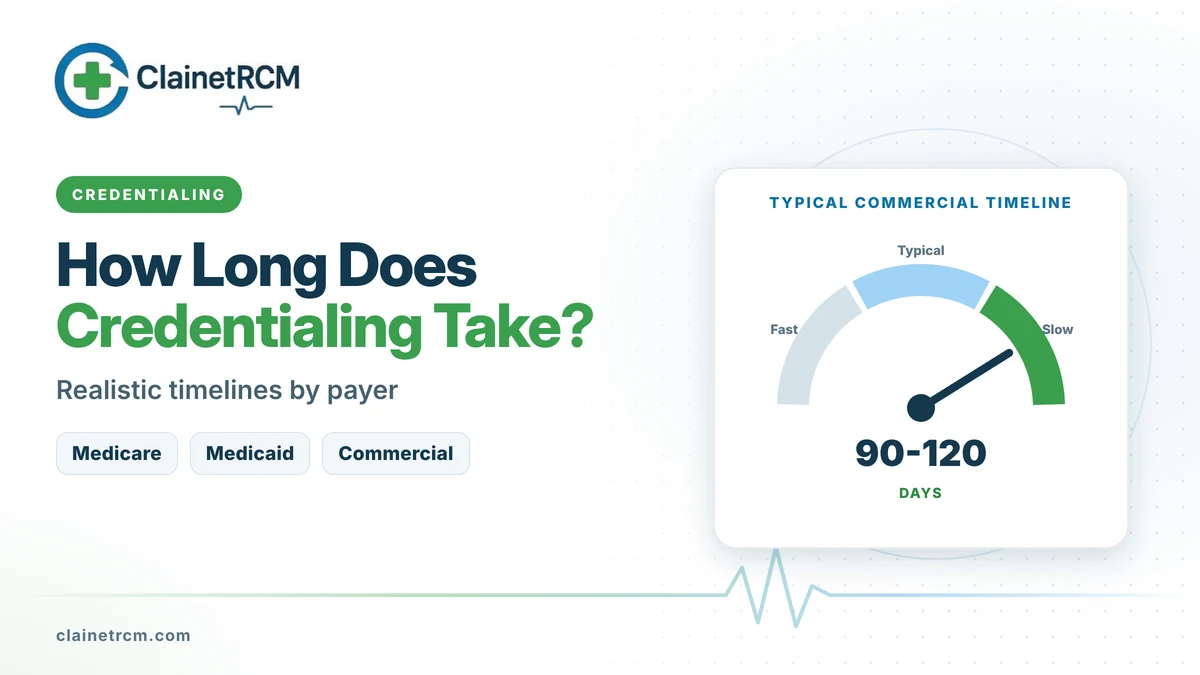
Quick answer: Plan for 90 to 120 days for most commercial payers from a complete application to an active contract, and longer for busy or closed networks. Medicare enrollment through PECOS is usually faster: Noridian quotes 15 to 50 calendar days for a clean web application without a site visit. State Medicaid enrollment often takes one to three months, and Medicaid managed care plans add their own credentialing after that. Start at least 120 days before a new provider’s first day.
How Long Does Credentialing Take by Payer?
| Payer type | Typical range | What drives the timeline |
|---|---|---|
| Original Medicare (PECOS) | About 15 to 50 days for clean web applications; longer with development or a site visit | MAC workload, development requests, application type |
| Medicare Advantage plans | Often 60 to 120 days | Plan credentialing committee, CAQH completeness, Medicare enrollment first |
| State Medicaid (fee-for-service) | Often 30 to 90 days, varies widely by state | State portal, provider risk level, fingerprinting or site visits for some provider types |
| Medicaid managed care plans | Often 60 to 120 days after the state Medicaid ID | Plan credentialing plus contracting |
| Commercial payers | Commonly 90 to 120 days, sometimes 150 or more | Network status, committee schedules, contract negotiation |
| Hospital privileges | Often 60 to 120 days | Medical staff office review and board approval |
These are typical ranges, not guarantees. The Medicare range comes from Noridian’s published review times; the others reflect what credentialing teams commonly see. Your experience will vary by state, specialty and payer.
The Stages of Credentialing and How Long Each Takes
- Preparation (1 to 2 weeks). Gathering licenses, certifications, malpractice coverage, work history, NPIs and group information. Missing items here cause most later delays.
- Applications and CAQH (1 to 2 weeks). Completing payer applications, building or updating the CAQH profile and authorizing payers to view it.
- Primary source verification (2 to 6 weeks). The payer or its credentialing verification organization confirms licenses, education, board certification, DEA registration, malpractice history and sanctions directly with the source.
- Credentialing committee (2 to 6 weeks). Many plans approve providers at committee meetings that happen monthly. Miss one meeting and you wait for the next.
- Contracting and loading (2 to 6 weeks). The contract is issued, signed and countersigned, and the provider is loaded into the payer’s claims system with an effective date.
The last stage surprises people. Credentialing approval is not the same as being in-network. Claims only pay once the contract is executed and the provider is loaded.
What Slows Credentialing Down
- Incomplete or expired CAQH profiles. An attestation older than 120 days or an expired malpractice certificate stops verification.
- Unexplained work history gaps. Most payers ask for an explanation of any gap of six months or more.
- Data mismatches. Different addresses, names or TINs across CAQH, NPPES, PECOS and the application.
- Slow responses. Payers send follow-up requests by email or fax; each day without an answer is a day added.
- Closed panels. If a payer’s network is full for your specialty or area, the application may be denied or parked. Our guide on how to get credentialed with insurance companies covers how to respond.
- Medicaid prerequisites. Medicaid managed care plans require the provider to be enrolled with the state Medicaid program first, so the state step must finish before the plan step starts.
Planning Revenue Around Credentialing
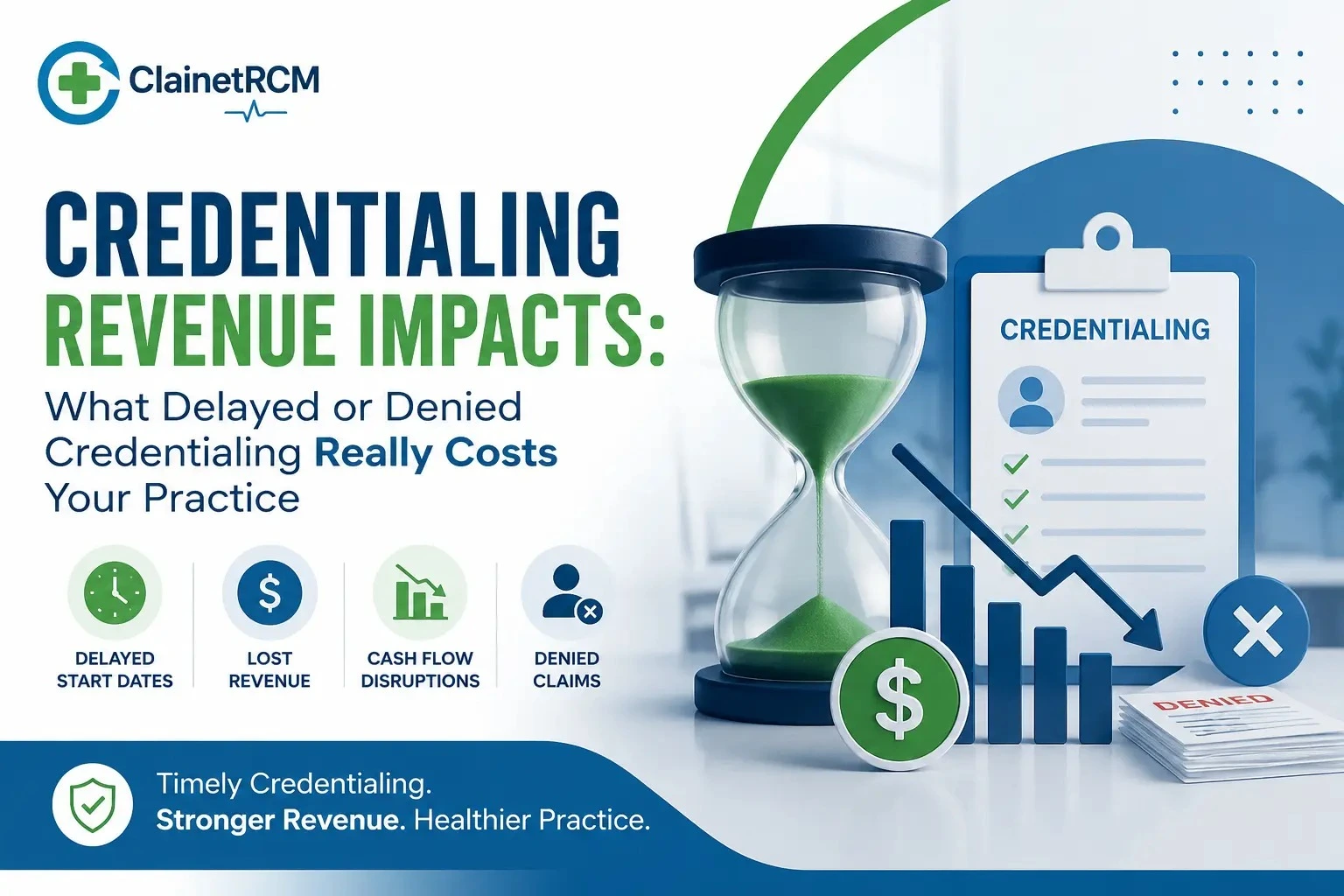
Credentialing delays are a cash flow problem as much as an administrative one. A few habits keep revenue moving:
- Start 120 days out. Earlier for commercial payers known to be slow in your market.
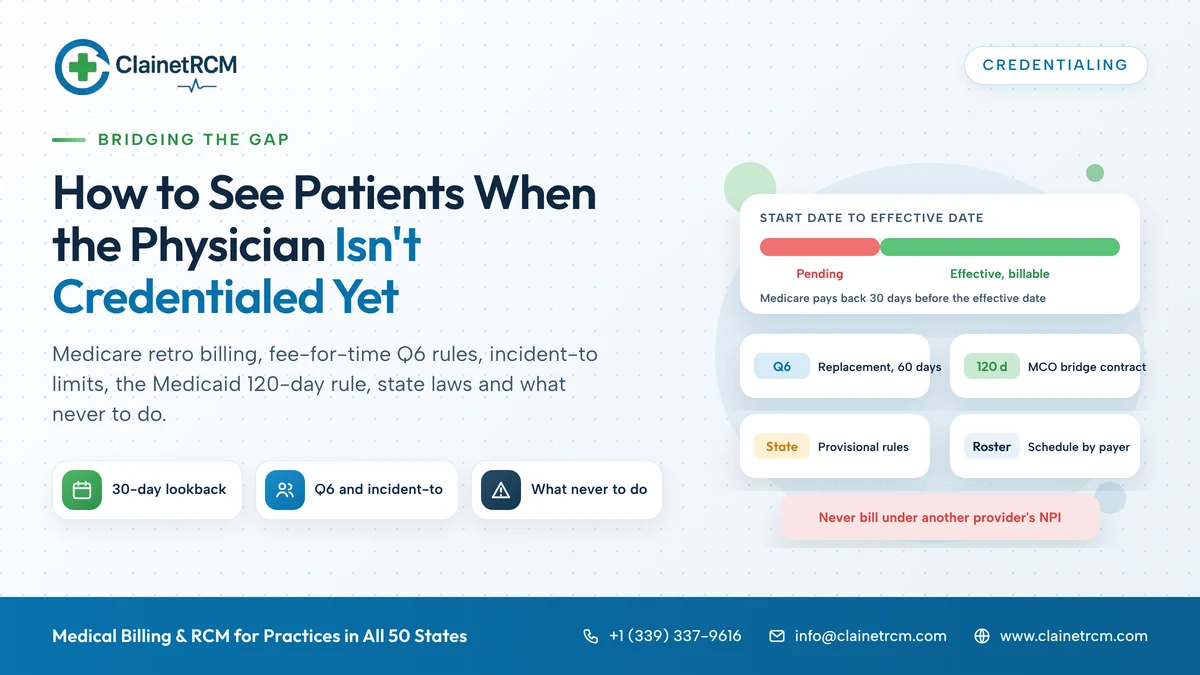
- Submit Medicare early. Medicare lets physicians and practitioners bill retroactively for up to 30 days before the filing date in most cases, so a prompt PECOS submission protects early visits. Commercial payers rarely offer that, which makes the effective date in each contract worth confirming.
- Schedule by payer status. Book a new provider’s early patients with payers that are already active, and keep a live list for the front desk.
- Follow up on a schedule. Check every pending application weekly and escalate anything silent for 30 days.
- Know the risks of seeing patients early. Our guide on seeing patients before credentialing explains the options and their limits.
Example: A New Provider Starting July 1
A psychiatrist joining a group on July 1 should have the credentialing file assembled by late February and applications submitted by March 1. Medicare (PECOS) and the state Medicaid program go first, because Medicaid plans depend on the state ID. Commercial and Medicare Advantage applications go out the same week once the CAQH profile is complete and attested. With weekly follow-up, most payers should be active by the start date, and the few that are not have a documented status and escalation plan.
Recredentialing Takes Time Too
Credentialing is not a one-time project. Under NCQA standards, health plans recredential practitioners at least every 36 months, and Medicare revalidation comes around every five years. Recredentialing is usually faster than initial credentialing, but a missed request can still end a contract, so track every cycle.
Frequently Asked Questions
Rarely by request, but you can avoid most delays by submitting complete applications, keeping CAQH current and answering follow-up questions the same day. Some states require plans to decide within a set number of days.
Not as an in-network provider. Claims for a provider who is not yet credentialed are usually denied or processed as out of network. Medicare’s limited retroactive billing is the main exception.
Commercial plans verify everything with primary sources, review files at scheduled committee meetings and then contract and load the provider, and each step has its own queue.
It is the date from which the payer will pay claims for that provider. Confirm it in writing, because it may be the committee approval date, the contract date or a date the payer assigns.
Usually not, because the payer already has the provider’s file. The risk is missing the request, which can end the contract.
Final Thoughts
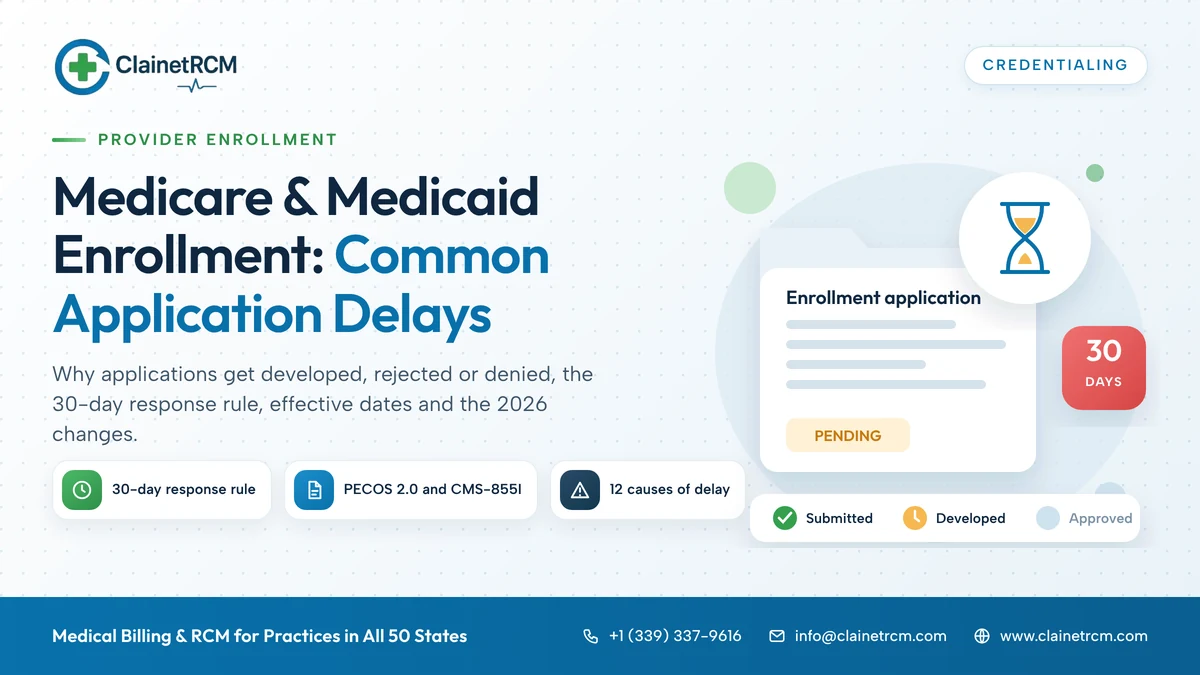
How long does credentialing take? Usually about three to four months for commercial payers, less for Medicare and somewhere in between for Medicaid, with every missing item adding time. Start early, keep data consistent and follow up relentlessly. If an application is already stuck, read our guide to Medicare and Medicaid enrollment delays and our breakdown of how credentialing affects revenue, or let our credentialing services team manage the whole process.
Shorten Your Credentialing Timeline
We submit complete applications, follow up with every payer weekly and escalate stalled files, so new providers start billing sooner.
Start Credentialing Now
Written by
ClainetRCM Billing Team
ClainetRCM is a Boston-based revenue cycle management company specializing in medical billing, coding, credentialing and denial management for healthcare providers across all 50 states. Our AAPC and AHIMA certified team works inside your existing EHR, files claims within 24 to 48 hours and reviews every AR bucket on a 14-day cycle.