The new physician starts Monday. Medicare was filed three weeks ago, two of the commercial plans are "in committee," and the schedule is already full. Every practice manager has faced this moment, and the question is always the same: how do we see patients when the physician isn't credentialed yet, without giving the visits away or billing them in a way that comes back as an overpayment demand?
There are legitimate options, and they are narrower than most practices assume. This guide walks through each one: what Medicare allows, what the fee-for-time (locum tenens) and incident-to rules actually cover, how Medicaid managed care and state provisional credentialing laws help, when out-of-network billing is permitted and how patients must be told, and the one approach that turns a cash-flow problem into a False Claims Act problem.
Last updated: October 2026
Key takeaways
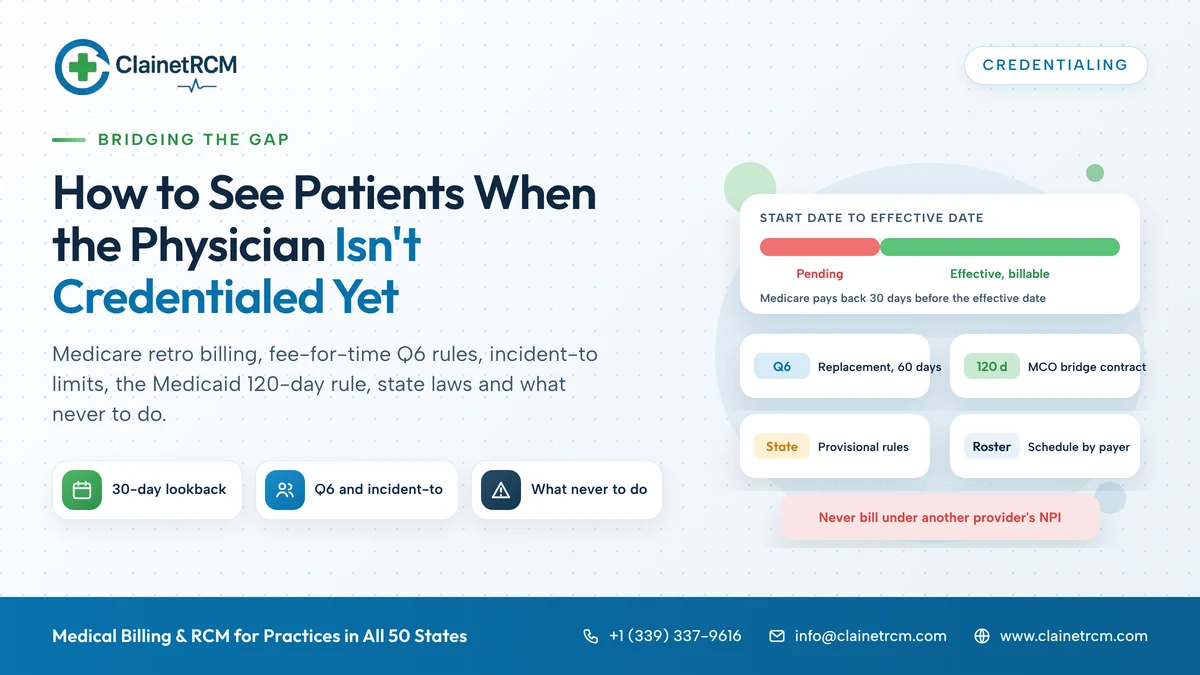
- Medicare pays back only 30 days before the enrollment effective date, and the effective date is the later of the filing date or the first date of service. Filing early is the single most valuable move.
- Fee-for-time compensation (the old locum tenens rule, modifier Q6) covers a substitute for an absent physician or, for up to 60 continuous days, a replacement for a physician who has left the group. It does not cover a new permanent hire beyond that window.
- Incident-to billing applies to auxiliary staff treating established patients under an established plan of care with direct supervision in the office. It cannot be used to bill a new physician's own visits under a colleague's name.
- Medicaid managed care plans may contract with a provider for up to 120 days while state enrollment is pending, and several states (Texas, California, Wyoming and others) require plans to treat qualifying new physicians as participating while credentialing runs.
- Billing a new provider's services under another provider's NPI is a false claim. CityMD paid $6.6 million in 2018 for exactly that.
Why the Gap Exists
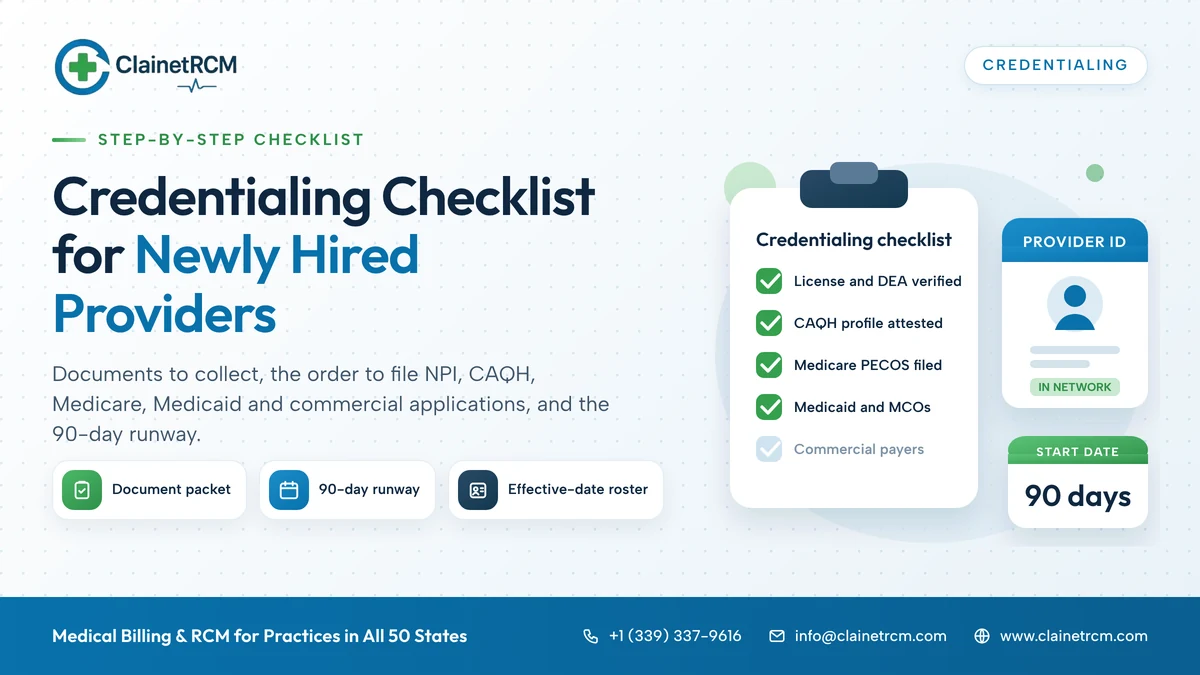
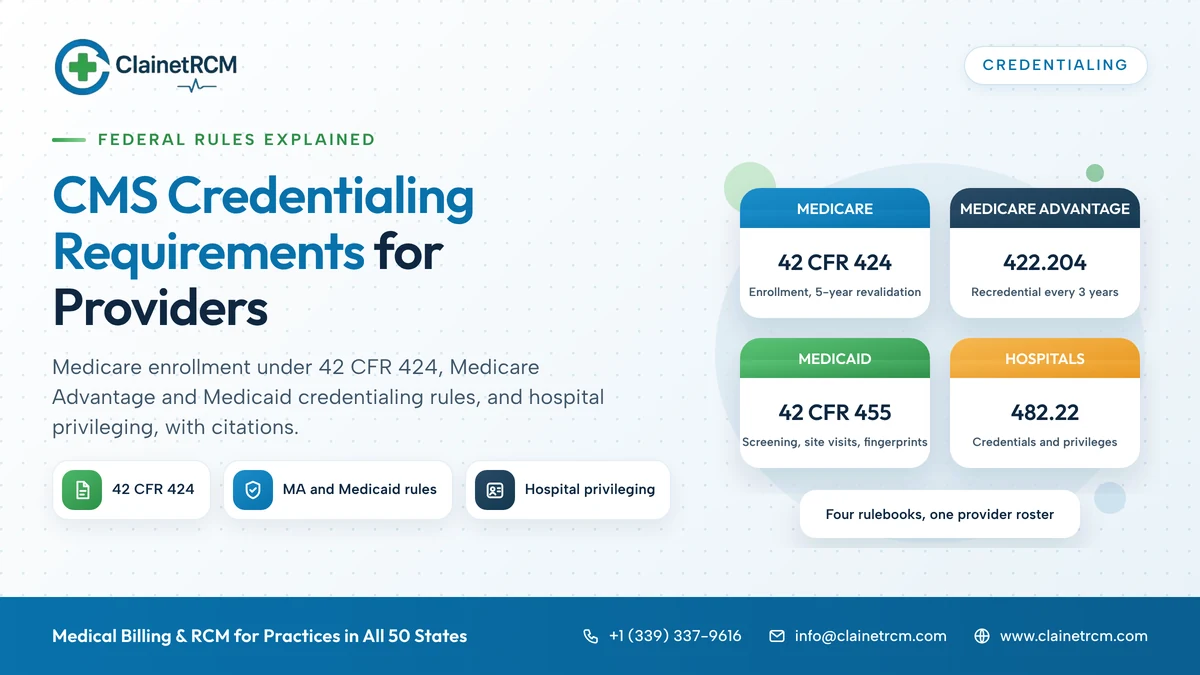
Credentialing and enrollment are sequential and slow: Medicare enrollment typically takes 30 to 45 days, Medicaid and managed care plans 30 to 60 days, commercial payers 60 to 150 days and hospital privileges 60 to 90 days. A provider hired with a four-week notice period arrives before most of those clocks have run. The revenue at stake is large; our analysis of how credentialing impacts practice revenue puts numbers on it, and the credentialing checklist for newly hired providers explains how to shrink the gap with a 90-day runway. This article is about what to do with the gap that remains.
The Options at a Glance
| Option | Who it applies to | What it allows | Limits |
|---|---|---|---|
| Schedule by payer | Every practice | See patients whose payers have approved the provider; hold the rest for credentialed colleagues | Requires an effective-date roster and disciplined scheduling |
| Medicare retrospective billing | Physicians and practitioners | Bill up to 30 days before the Medicare effective date (90 in a declared disaster) | Only after approval; the effective date is the later of filing date or first service date |
| Fee-for-time compensation (Q6) | A substitute physician for an absent or departed physician | Bill under the absent physician's NPI for up to 60 continuous days | Not for a new permanent hire where no physician is absent or has left |
| Reciprocal billing (Q5) | Physicians covering for each other occasionally | Bill under the regular physician's NPI for occasional coverage | Same 60-day limit; the regular physician must be unavailable |
| Incident-to | Auxiliary staff and NPPs under a supervising physician | Bill certain office services under the supervising physician for established patients with an established plan of care | Direct supervision, office setting, no new patients or new problems; not for a new physician's own visits |
| Medicaid MCO pending-enrollment contracts | Providers with state enrollment filed | Plan may contract for up to 120 days while the state enrolls the provider | Plan must terminate if enrollment fails or 120 days pass |
| State provisional credentialing laws | Varies by state and provider type | Plan must treat the applicant as participating, or finish credentialing within a set number of days | Conditions apply; plans may recoup if credentialing fails |
| Out-of-network with notice | Commercial patients, by payer | Bill as non-participating | Patient cost share rises; No Surprises Act notice and consent rules apply in some settings; many plans pay little or nothing |
Option 1: Schedule by Payer With an Effective-Date Roster
This is the foundation everything else sits on. Keep one sheet per provider listing each payer and product, the application status, the confirmed effective date and the earliest date of service you will bill. Give it to the schedulers, and book the new provider's template by payer: Medicare patients from the Medicare effective date, Blue Cross patients from the Blue Cross date, and so on. Patients of still-pending payers are scheduled with credentialed colleagues or booked after the expected effective date.
It is not glamorous, but it is the only option that costs nothing and creates no compliance exposure. Practices that use it well also tell patients at scheduling that the new provider is "being added to your plan" and offer the choice of waiting or seeing a colleague.
Option 2: File Medicare Early and Use the 30-Day Lookback
Under 42 CFR 424.520(d), a physician or non-physician practitioner's Medicare effective date is the later of the date the Medicare contractor received the application that was later approved or the date the provider first furnished services at the location. Under 42 CFR 424.521(a), once approved, the provider may bill retrospectively for services furnished up to 30 days before that effective date, or 90 days if a Presidentially declared disaster prevented timely enrollment.
Two consequences follow. File the CMS-855I the day the start date is known, because nothing moves the effective date earlier than the filing date. And hold Medicare claims for the new provider rather than discarding them: once approval arrives, dates of service inside the lookback window are payable. Our Medicare provider enrollment team files online through PECOS, which CMS processes faster than paper, and tracks the claims hold until the effective date is confirmed.
Option 3: Fee-for-Time Compensation (Locum Tenens) and Reciprocal Billing
Medicare's fee-for-time compensation arrangement, formerly called locum tenens, lets a practice bill under a regular physician's NPI for services furnished by a substitute physician when the regular physician is unavailable. The conditions, from the Medicare Claims Processing Manual, chapter 1, section 30.2.11:
- The regular physician is unavailable to provide the services.
- The patient arranged or sought to receive the services from the regular physician.
- The substitute is paid on a per diem or similar fee-for-time basis.
- The substitute does not provide services over a continuous period of longer than 60 continuous days (with an exception for a regular physician called to active duty).
- Claims carry modifier Q6, and the practice keeps a record of each service with the substitute's NPI for the Medicare contractor.
The nuance that matters for a new hire: the manual treats a physician who has left the group as a "regular physician" for this purpose, so a group that hires a replacement may bill the replacement's services under the departed physician's NPI with Q6 for up to 60 days. That is a legitimate bridge when a departure and a replacement line up. What the rule does not cover is a newly hired physician joining a group where nobody has left or is absent, or any arrangement that runs past 60 continuous days. Reciprocal billing (modifier Q5) works the same way for occasional coverage between physicians, with the same 60-day limit. Since 2017, physical therapists in health professional shortage areas, medically underserved areas and rural areas may use both arrangements for outpatient therapy. See locum tenens credentialing for how true locum coverage is set up.
Option 4: Incident-To, and Why It Does Not Cover a New Physician
Incident-to billing lets a physician bill Medicare for services furnished by auxiliary personnel, including nurse practitioners and physician assistants, as an integral but incidental part of the physician's own professional service. The Medicare Benefit Policy Manual, chapter 15, section 60, sets the conditions: the service is commonly furnished in physician offices, is part of the physician's plan of care for an established patient, and is furnished under the physician's direct supervision, meaning the physician is present in the office suite and immediately available. It does not apply to new patients or to new problems for established patients, and it does not apply in hospital or facility settings.
That makes incident-to a limited bridge for a nurse practitioner or physician assistant awaiting their own enrollment: established patients, existing plans of care, physician in the suite, office setting only, and many commercial payers do not recognize it at all. It is not a bridge for a physician. A physician's own evaluation and management visits are not "incidental" to another physician's service, so billing a new physician's visits under a colleague's NPI as incident-to misrepresents who rendered the care.
Option 5: Medicaid Managed Care and the 120-Day Rule
Under 42 CFR 438.602(b), a state must screen and enroll every network provider of its Medicaid managed care plans, but a plan "may execute network provider agreements pending the outcome" of that enrollment for up to 120 days. The plan must terminate the agreement if the state cannot enroll the provider or the 120 days pass without enrollment. In practice, this means a plan can load a new provider while the state application is still processing, if the plan chooses to and its own credentialing is complete. File the state enrollment first, start the plan applications the day it is submitted, and ask each plan whether it will contract pending state approval. State-specific rules on retroactive Medicaid billing vary and should be confirmed with the state program; see Medicaid provider enrollment for how we handle it by state.
Option 6: State Provisional and Expedited Credentialing Laws
A growing number of states require commercial plans to shorten or bridge the gap. Three examples with the statute text behind them:
- Texas. Insurance Code chapter 1452, subchapter C, applies to a physician who joins an established medical group that already contracts with the plan. Once the physician, licensed and in good standing with the Texas Medical Board, submits all required credentialing documentation, the plan "shall treat the applicant physician as if the physician were a participating provider" for payment and patient cost sharing, although the plan may leave the physician out of its directory. If the physician later fails credentialing, the plan may recover the difference between in-network and out-of-network payment from the physician or the group. Parallel subchapters cover podiatrists and therapeutic optometrists.
- California. Health and Safety Code 1374.197 requires plans to verify a mental health or substance use disorder provider's qualifications within 60 days of a completed application and to confirm receipt and completeness within seven business days.
- Wyoming. For applications submitted on or after July 1, 2025, carriers must acknowledge receipt within seven days, flag incomplete applications within 30 days, conclude credentialing within 60 calendar days, and reimburse covered services back to the date the completed application was received once the provider is credentialed and contracted.
Several other states have similar provisions, and the details differ by provider type and plan type. Check your state's insurance code when a new provider is hired, cite it in writing when a plan runs past the deadline, and ask each plan whether it offers a retroactive effective date to the application date, which some do on request.
Option 7: Billing Out of Network, With the Right Notices
Some commercial plans will process a pending provider's claims as out of network. Whether that helps depends on the plan: PPO products may pay a reduced allowed amount with higher patient cost sharing; HMO and narrow-network products often pay nothing. Before using this route, decide it payer by payer, estimate the patient's cost in advance, and disclose it at scheduling.
In hospital and ambulatory surgery center settings, the No Surprises Act adds rules. Under 45 CFR 149.420, a non-participating provider furnishing non-emergency services at a participating facility may balance bill only with the patient's informed consent, delivered on the standard notice at least 72 hours before the service (or at scheduling if booked within 72 hours, and no later than three hours before a same-day service), with a good-faith estimate and a statement that consent is optional. Notice and consent are not permitted at all for ancillary services such as anesthesiology, pathology, radiology, emergency medicine, neonatology, assistant surgeons, hospitalists and intensivists, for diagnostic services, where no participating provider is available at the facility, or for unforeseen urgent needs. Get the compliance review before the first claim, not after the first complaint.
The One Thing Never to Do
Do not bill a new provider's services under another provider's NPI. It misrepresents who rendered the service, and payers treat it as a false claim regardless of intent. In 2018, CityMD paid $6,606,251 to settle allegations that it billed Medicare for services by uncredentialed physicians using the NPIs of credentialed physicians, among other conduct. Overpayment demands, exclusion and personal liability for the signing physician are all on the table. If a visit cannot be billed correctly, hold it, reschedule it or absorb it; never relabel it.
The same rule applies to "supervision" labels that do not meet the incident-to conditions, to backdating effective dates, and to billing hospital services before privileges are granted. A practice's medical billing process should block claims for any rendering provider without a confirmed effective date for that payer, which is one of the first edits we build for new clients.
A 30-Day Plan for a Provider Starting Before Credentialing Is Done
- Today: confirm Medicare and the state Medicaid enrollment are filed. If not, file now; the filing date is the earliest effective date you will ever get.
- This week: build the effective-date roster and give it to scheduling. Identify which plans the provider is already effective with, which are pending, and which have provisional credentialing rules in your state.
- This week: decide, payer by payer, whether pending plans will be held, seen by colleagues, bridged by a 120-day Medicaid MCO contract or a state provisional rule, or billed out of network with disclosure.
- If a physician has left: set up fee-for-time billing with Q6 for up to 60 days under the departed physician's NPI, with the required records.
- For NPs and PAs: schedule established patients under existing plans of care with a supervising physician in the suite, where incident-to applies and the payer recognizes it.
- Weekly: check every application's status, answer every payer request inside its window, and update the roster. Our guide to Medicare and Medicaid enrollment delays covers what to do when an application stalls.
- On approval: release held Medicare claims inside the 30-day lookback, confirm plan effective dates in writing, and open the full schedule.
A Provider Starting Before the Paperwork Is Done?
ClainetRCM files Medicare and Medicaid the day the start date is known, runs every commercial application in parallel, builds the effective-date roster and holds and releases claims inside the lookback windows, so the first month produces revenue without compliance risk.
Talk to a Credentialing SpecialistFrequently Asked Questions
Yes, the physician can see patients; the question is whether the visits can be billed. Medicare pays only from the enrollment effective date, with a 30-day lookback once approved. Commercial plans pay in network only from their own effective dates unless a state provisional credentialing law or a plan policy bridges the gap. Practices manage this by scheduling by payer with an effective-date roster, holding Medicare claims for the lookback, and reserving pending payers' patients for credentialed colleagues.
No. Billing services under the NPI of a provider who did not render them misrepresents the claim and is treated as a false claim by Medicare, Medicaid and commercial payers. In 2018 CityMD paid $6.6 million to settle allegations that included billing Medicare for uncredentialed physicians' services under credentialed physicians' NPIs. The only exceptions are the fee-for-time (Q6) and reciprocal (Q5) arrangements for an absent or departed physician, within their 60-day limits.
Only in one situation. Medicare's fee-for-time compensation arrangement treats a physician who has left the group as a regular physician, so a group may bill a replacement's services under the departed physician's NPI with modifier Q6 for up to 60 continuous days. It does not cover a new physician joining a group where nobody has left or is absent, and it never extends beyond 60 continuous days except when the regular physician is called to active duty.
Within narrow limits. Medicare incident-to billing allows a supervising physician to bill for services an NP or PA furnishes to established patients under an established plan of care, in the office, with the physician present in the suite and immediately available. It does not cover new patients, new problems or facility settings, and many commercial payers do not recognize incident-to at all. It is not a substitute for enrolling the NP or PA.
Under 42 CFR 424.521(a), up to 30 days before the enrollment effective date, or 90 days when a Presidentially declared disaster prevented timely enrollment. The effective date itself is the later of the application filing date or the first date of service at the location (42 CFR 424.520(d)), so filing early is what makes the lookback useful.
Federal rules allow it for a limited period. Under 42 CFR 438.602(b), a Medicaid managed care plan may execute a network provider agreement while the state's enrollment process is pending for up to 120 days, but must terminate it if the state cannot enroll the provider or the 120 days expire. Whether a particular plan does so is its own policy, so ask each plan and file the state enrollment first.
Several. Texas Insurance Code chapter 1452 requires plans to treat a physician joining an established contracted group as participating once the credentialing documentation is submitted. California Health and Safety Code 1374.197 requires plans to verify mental health and substance use disorder providers within 60 days. Wyoming requires carriers to conclude credentialing within 60 calendar days and pay back to the date a completed application was received, for applications filed on or after July 1, 2025. Other states have similar laws; check your state's insurance code.
Sometimes, and it should be a payer-by-payer decision made before the visit. PPO products may pay a reduced out-of-network amount with higher patient cost sharing; HMO and narrow-network products often pay nothing. In hospital and ambulatory surgery center settings, the No Surprises Act requires written notice and consent at least 72 hours in advance for non-emergency services by non-participating providers, and prohibits balance billing entirely for ancillary and emergency services. Disclose the cost to the patient at scheduling.
The Bottom Line
When a physician isn't credentialed yet, the practice has real options: schedule by payer, file Medicare early and use the 30-day lookback, bridge a departure with fee-for-time billing for up to 60 days, use incident-to for NPs and PAs within its narrow conditions, lean on the Medicaid 120-day rule and state provisional credentialing laws, and bill out of network only with disclosure and the right notices. What it does not have is a shortcut. Billing under another provider's name turns a temporary cash-flow gap into a permanent compliance problem, and the only cure for the gap itself is starting credentialing the day the offer is signed.

Written by
ClainetRCM Billing Team
ClainetRCM is a Boston-based revenue cycle management company specializing in medical billing, coding, credentialing and denial management for healthcare providers across all 50 states. Our AAPC and AHIMA certified team works inside your existing EHR, files claims within 24 to 48 hours and reviews every AR bucket on a 14-day cycle.