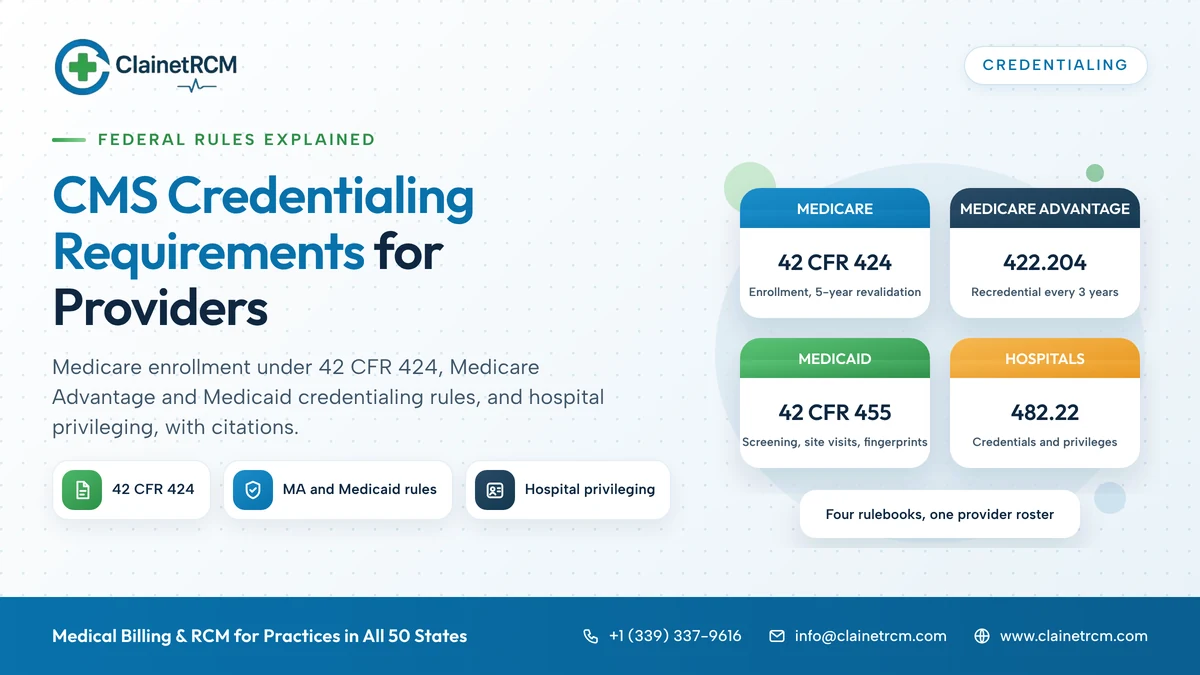
"CMS credentialing requirements" is a phrase that covers four different rulebooks. Medicare itself does not credential providers; it enrolls them, through PECOS and the CMS-855 forms, under 42 CFR part 424. Medicare Advantage plans credential their networks under 42 CFR 422.204. State Medicaid programs screen and enroll providers under 42 CFR part 455, and their managed care plans credential under 42 CFR 438.214. Hospitals credential and privilege their medical staffs under the Conditions of Participation at 42 CFR 482.12 and 482.22.
A provider who bills Medicare, sees Medicare Advantage and Medicaid patients and holds hospital privileges is subject to all four at once. This guide lays out what each one requires, where they overlap, the timelines and the ongoing obligations that catch practices after the first approval, with the regulatory citations so your compliance officer can check them.
Last updated: October 2026
Key takeaways
- Medicare enrollment (42 CFR 424 subpart P) requires a complete and truthful CMS-855 application, an NPI, electronic funds transfer, an operational practice location, risk-based screening, revalidation every five years (three for DMEPOS) and reporting of changes within 30 or 90 days.
- Medicare Advantage plans (42 CFR 422.204) must verify licensure from primary sources, check disciplinary status and Medicare eligibility, conduct site visits as appropriate, recredential at least every three years and screen against the CMS preclusion list.
- Medicaid (42 CFR 455) requires state screening by risk level with site visits, fingerprinting for high-risk owners and monthly exclusion database checks, revalidation at least every five years, and state enrollment of every managed care network provider (42 CFR 438.602(b)).
- Hospitals (42 CFR 482.12 and 482.22) must examine credentials through the medical staff, grant privileges on individual character, competence, training, experience and judgment, and may rely on a distant-site hospital's credentialing for telemedicine.
- The obligations continue after approval: revalidation, change reporting, deactivation after six consecutive claim-free months, and recredentialing cycles that run independently for every plan.
Enrollment vs Credentialing: Four Rulebooks, One Provider
| Program | Regulation | What it is called | Who makes the decision | Cycle |
|---|---|---|---|---|
| Medicare fee-for-service | 42 CFR 424 subpart P | Enrollment | Medicare Administrative Contractor for CMS | Revalidation every 5 years; DMEPOS every 3 |
| Medicare Advantage | 42 CFR 422.204 | Credentialing | Each MA organization | Recredentialing at least every 3 years |
| Medicaid fee-for-service | 42 CFR 455 subparts B and E | Screening and enrollment | State Medicaid agency | Revalidation at least every 5 years |
| Medicaid managed care | 42 CFR 438.214 and 438.602 | Credentialing (plus state enrollment) | Each plan, under a uniform state policy | Set by state policy; typically every 3 years |
| Hospitals | 42 CFR 482.12(a) and 482.22 | Credentialing and privileging | Governing body on medical staff recommendation | Periodic reappraisal; typically every 2 years |
The distinction matters because the remedies differ. A Medicare enrollment rejection has no appeal and restarts the effective date; a Medicare Advantage credentialing denial has the plan's appeal process; a hospital privileging denial triggers fair hearing rights under the medical staff bylaws. Our provider credentialing team runs all four tracks together because a gap in any one of them produces the same thing: claims that cannot be paid.
Medicare Enrollment Requirements (42 CFR 424 Subpart P)
The application
Under 42 CFR 424.510, a provider or supplier must submit enrollment information on the applicable application (CMS-855I for physicians and practitioners, including reassignment of benefits to a group since the separate CMS-855R was retired in 2023; CMS-855B for groups and clinics; CMS-855A for institutional providers; CMS-855S for DMEPOS suppliers; CMS-855O for those who only order, certify or refer), and the application must be "complete, accurate, and truthful." The provider must have an NPI, agree to receive payment by electronic funds transfer on the CMS-588, and be operational at the practice location before billing privileges are granted. Online submission through PECOS is faster than paper and is the route to use for every application that allows it; our PECOS enrollment page explains the setup.
Screening by risk level
42 CFR 424.518 assigns every provider type a categorical risk level. Limited risk (physicians, non-physician practitioners, groups, hospitals, ASCs, FQHCs, RHCs and others) means license verification across states and database checks before and after enrollment. Moderate risk (ambulance suppliers, independent laboratories, IDTFs, portable x-ray and others) adds an on-site visit. High risk (prospective home health agencies, DMEPOS suppliers, hospices, skilled nursing facilities and certain others) adds fingerprint-based national background checks for every owner with a 5 percent or greater interest, due with the application or within 30 days of a contractor request. CMS also elevates a provider to high risk after a payment suspension in the prior ten years, an exclusion, or a prior revocation.
Fees, effective dates and retrospective billing
- The application fee (42 CFR 424.514) applies to institutional providers filing the CMS-855A, CMS-855B (other than physician and practitioner organizations) or CMS-855S at initial enrollment, revalidation and new locations. It is $750 for calendar year 2026, up from $730 in 2025, and is adjusted by the consumer price index each year. Physicians and non-physician practitioners filing the CMS-855I do not pay it.
- Under 42 CFR 424.520(d), a physician or practitioner's effective date is the later of the filing date of the application that is later approved or the date services were first furnished at the location.
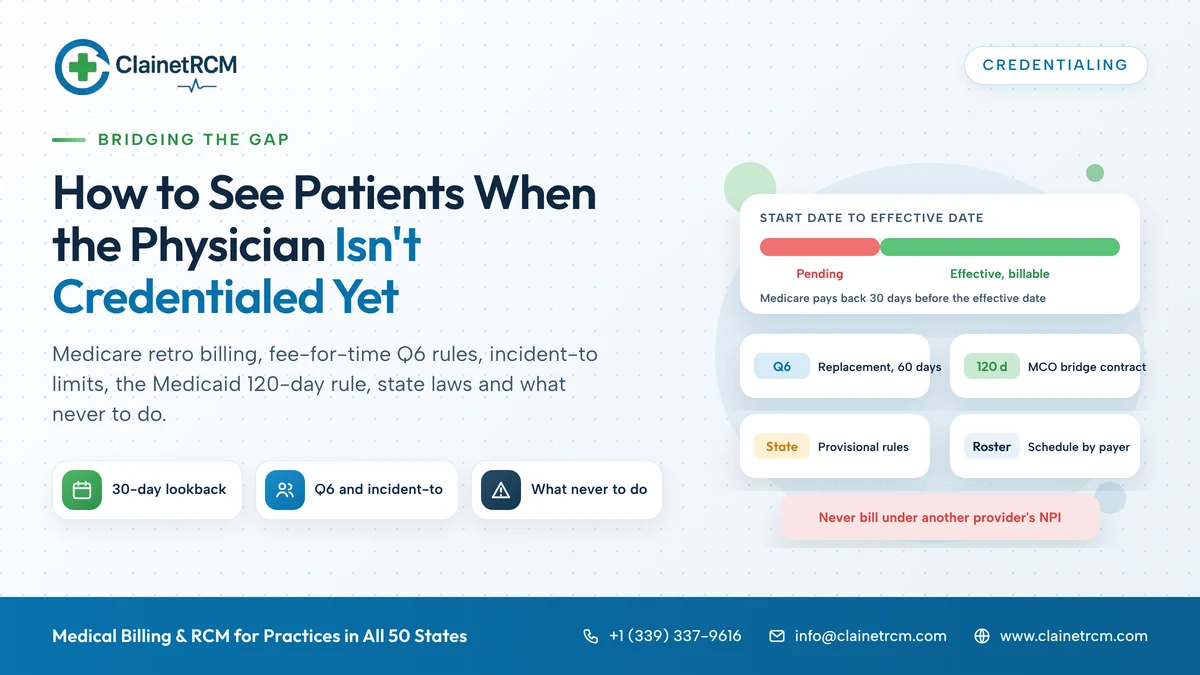
- Under 42 CFR 424.521(a), services may be billed retrospectively for up to 30 days before that effective date, or 90 days when a Presidentially declared disaster prevented timely enrollment.
Ongoing obligations
| Obligation | Rule | Consequence of missing it |
|---|---|---|
| Revalidation | 42 CFR 424.515: resubmit and recertify every 5 years (DMEPOS every 3); respond within 60 days of a revalidation notice; CMS may revalidate off cycle | Deactivation and a gap in billing privileges |
| Reporting changes | 42 CFR 424.516(d): physicians, practitioners and their organizations report ownership changes, adverse legal actions and practice location changes within 30 days; all other changes within 90 days | Claims denied for unreported locations; possible revocation |
| Keeping documentation | 42 CFR 424.516(f): providers and the physicians who order, certify, refer or prescribe must keep the related documentation for 7 years from the date of service and produce it on request | Overpayment recovery; revocation for failure to provide access |
| Staying active | 42 CFR 424.540(a): billing privileges may be deactivated after 6 consecutive calendar months without a Medicare claim, for failing to report changes, or for failing to furnish requested information within 90 days | No payment for services furnished while deactivated; reactivation may require a full new application |
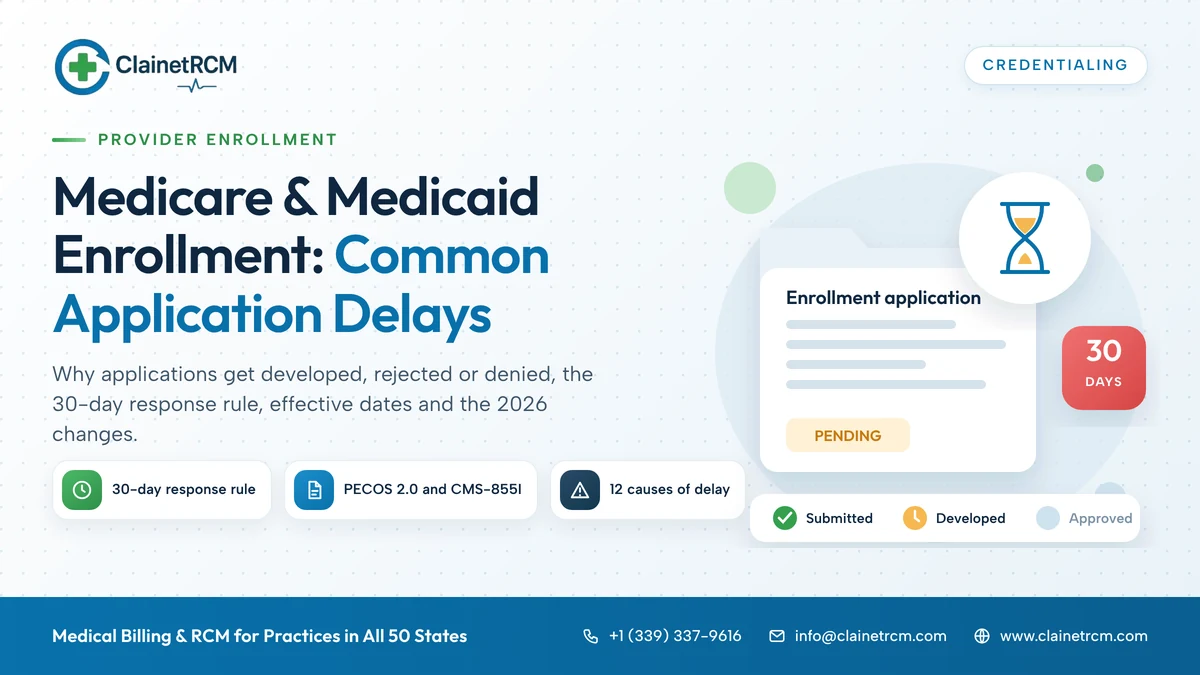
Enrollment problems rarely come from the rules themselves; they come from data that does not match across NPPES, the IRS and the application, and from development requests that go unanswered within the 30-day window. Our guide to Medicare and Medicaid enrollment delays covers the statuses and remedies, and our Medicare provider enrollment service manages the filings.
Medicare Advantage Credentialing (42 CFR 422.204)
An MA organization must have written policies and procedures for selecting and evaluating providers and must follow a documented process. For physicians and other health care professionals, 42 CFR 422.204(b)(2) requires the initial credentialing process to include:
- A written application, signed and dated, with the applicant's attestation that the application and supporting information are correct and complete.
- Verification of licensure or certification from primary sources.
- A check of disciplinary status.
- Confirmation of eligibility for payment under Medicare, including a documented process for complying with the CMS preclusion list under 42 CFR 422.222.
- Site visits, as appropriate.
Recredentialing must occur at least every three years, must update the initial information and must consider performance indicators such as quality improvement, utilization management, grievances and appeals, and enrollee satisfaction data, again with an attestation. The organization must also have a process for consulting with its contracted professionals on the criteria. For non-physician providers such as facilities, the plan must determine that the provider is licensed to operate in the state and is accredited or meets the plan's own standards. The regulation does not name NCQA, but the elements track NCQA's credentialing standards closely, and most MA plans are NCQA accredited, which is why providers see the same application and the same 120-day verification windows across plans. Being enrolled in traditional Medicare does not load a provider into an MA network; each plan credentials separately, and our Medicare Advantage credentialing page explains the process.
Medicaid Screening, Enrollment and Managed Care Credentialing
State screening and enrollment (42 CFR 455 subpart E)
| Requirement | Regulation | What it means for a provider |
|---|---|---|
| Ordering, referring and prescribing enrollment | 455.410(b) | Any physician or professional who orders, refers or prescribes for Medicaid patients must be enrolled, even without billing |
| License verification | 455.412 | The state confirms the license has not expired and carries no current limitations |
| Revalidation | 455.414 | At least every 5 years, regardless of provider type |
| Risk levels | 455.450 | Limited, moderate and high, mirroring Medicare; the highest applicable level governs |
| Site visits | 455.432 | Pre- and post-enrollment site visits for moderate and high risk providers; unannounced visits allowed |
| Fingerprinting | 455.434 | High-risk providers and their 5 percent owners, within 30 days of request |
| Database checks | 455.436 | Social Security Death Master File, NPPES, the OIG exclusion list and the federal exclusion system (EPLS, now SAM.gov), with exclusion lists checked at least monthly |
| Termination | 455.416 | Denial or termination where a 5 percent owner refuses screening or has a program-related conviction in the prior 10 years |
| Application fee | 455.460 | Institutional providers pay the same fee as Medicare ($750 in 2026) unless already paid to Medicare or another state; individual practitioners are exempt |
Managed care (42 CFR 438.214 and 438.602)
Every state must establish a uniform credentialing and recredentialing policy that its Medicaid managed care plans follow for acute, primary, behavioral health, substance use disorder and long-term services and supports providers. Plans may not employ or contract with excluded providers and must terminate providers terminated from Medicare, Medicaid or CHIP. Separately, 42 CFR 438.602(b) requires the state to screen and enroll every network provider of a managed care plan; a plan may sign a network agreement while state enrollment is pending for up to 120 days, but must terminate it if the state cannot enroll the provider or the 120 days expire. Many states run the plan-side verification through a centralized credentialing verification organization, Texas being one example, which is described in our guide to enrolling in Texas Medicaid through TMHP PEMS. For state-by-state enrollment, see Medicaid provider enrollment.
Hospital Credentialing and Privileging (42 CFR 482.12 and 482.22)
Hospitals that participate in Medicare must meet the Conditions of Participation, and two of them govern who may practice there.
- Governing body (482.12(a)). The governing body determines, in accordance with state law, which categories of practitioners are eligible for medical staff membership; appoints members after considering medical staff recommendations; approves medical staff bylaws; holds the medical staff accountable for quality of care; and must ensure that the criteria for selection are individual character, competence, training, experience and judgment. Membership or privileges may not be granted solely on board certification, fellowship or society membership.
- Medical staff (482.22). The medical staff must periodically appraise its members, examine the credentials of candidates and make recommendations to the governing body. The bylaws must state the qualifications for appointment, set the criteria for determining the privileges to be granted and describe the procedure for applying them. A history and physical must be completed no more than 30 days before or 24 hours after admission.
- Telemedicine credentialing by proxy (482.22(a)(3) and (4)). The governing body may rely on the credentialing and privileging decisions of a distant-site hospital or telemedicine entity under a written agreement, provided the distant-site hospital participates in Medicare, supplies a current list of the practitioner's privileges, the practitioner is licensed in the state where the patient is located, and the originating hospital reviews the practitioner's performance and shares adverse events and complaints.
Most hospitals and health systems also follow accreditor standards (The Joint Commission, DNV, and others) that add primary source verification, ongoing and focused professional practice evaluation, and reappointment cycles of up to two years. Because privileging decisions are made by committees that meet on calendars, 60 to 90 days is typical, and the work should start when the provider's start date is known. Our hospital privileging service prepares and tracks the applications.
Putting It Together: A Compliance Timeline
| When | Medicare | Medicare Advantage and commercial plans | Medicaid and MCOs | Hospital |
|---|---|---|---|---|
| 90 to 120 days before start | File CMS-855I or 855B in PECOS (filing date sets the effective date) | Complete CAQH; submit to the largest plans first | File state enrollment; start MCO applications as soon as it is submitted | Submit privileging application |
| Before first patient | Confirm approval and claims-system update | Confirm effective dates and products in writing | Confirm state and plan effective dates | Confirm privileges granted |
| Ongoing | Report changes in 30 or 90 days; keep ordering documentation 7 years; avoid 6 claim-free months | Recredential at least every 3 years; keep CAQH attested every 120 days | Revalidate at least every 5 years; monthly exclusion checks | Reappointment on the bylaws cycle; OPPE and FPPE |
| Every 5 years | Revalidate (3 for DMEPOS) | Revalidate |
The single most useful control is one roster that lists every provider, every program and plan, the effective date, the revalidation or recredentialing due date and the owner of the task. Our credentialing checklist for newly hired providers builds that roster from the first day, and how credentialing impacts practice revenue shows what each missed date costs.
Recent Changes to Know
- The CY 2026 Medicare, Medicaid and CHIP application fee for institutional providers is $750.
- CMS implemented a temporary nationwide enrollment moratorium on new home health agencies and hospices on May 13, 2026, for six months with possible extensions; initial applications and non-exempt changes of ownership are denied while it runs.
- PECOS 2.0 replaced the older enrollment interface in late 2025, with real-time validation against CMS records and a status dashboard.
- Reassignment of benefits is reported on the CMS-855I; the separate CMS-855R was discontinued in 2023.
- The deactivation standard for non-billing is six consecutive calendar months under 42 CFR 424.540, as amended through December 2025.
Four Rulebooks, One Roster, Zero Gaps
ClainetRCM manages Medicare enrollment, Medicare Advantage and commercial credentialing, state Medicaid and managed care enrollment and hospital privileging from one roster, with every effective date and revalidation tracked and weekly status updates. Flat fee per provider per payer.
Talk to a Credentialing SpecialistFrequently Asked Questions
Not in the way health plans do. Medicare enrolls providers through PECOS and the CMS-855 applications under 42 CFR 424 subpart P, verifying licensure, identity, ownership and practice locations and screening by risk level. Credentialing, meaning primary source verification of education, training, work history and malpractice history by a committee, is done by Medicare Advantage plans, Medicaid managed care plans, commercial payers and hospitals under their own rules.
A complete, accurate and truthful CMS-855 application, an NPI, agreement to electronic funds transfer on the CMS-588, an operational practice location, screening at the limited, moderate or high risk level (with site visits and fingerprinting for the higher levels), the application fee for institutional providers ($750 in 2026), revalidation every five years (three for DMEPOS), and reporting of ownership, adverse action and location changes within 30 days and other changes within 90 days.
At least every three years under 42 CFR 422.204(b)(2). Recredentialing must update the information verified at initial credentialing and consider performance indicators such as quality improvement, utilization management, grievances and appeals, and enrollee satisfaction data, with a new attestation from the provider.
Under 42 CFR 455 subpart E, states must verify licenses, assign each provider a limited, moderate or high risk level, conduct site visits for moderate and high risk providers, fingerprint high-risk providers and their 5 percent owners, check the Death Master File, NPPES and exclusion databases (with exclusion lists checked at least monthly), collect the application fee from institutional providers, enroll all ordering, referring and prescribing providers, and revalidate every provider at least every five years.
Under 42 CFR 482.12(a) and 482.22, the governing body decides which practitioner categories are eligible, appoints medical staff members on the medical staff's recommendation and must base selection on individual character, competence, training, experience and judgment, never solely on board certification or society membership. The medical staff must examine candidates' credentials, periodically appraise members, and maintain bylaws that set qualifications and the criteria and procedure for granting privileges.
Yes. Under 42 CFR 482.22(a)(3) and (4), a hospital's governing body may rely on the credentialing and privileging decisions of a distant-site hospital or telemedicine entity under a written agreement, provided the distant-site hospital participates in Medicare, provides a current list of the practitioner's privileges, the practitioner holds a license in the state where the patient is located, and the originating hospital reviews the practitioner's performance and shares adverse events and complaints with the distant site.
Under 42 CFR 424.540(a), CMS may deactivate billing privileges after six consecutive calendar months without a Medicare claim. Services furnished while deactivated are not payable, and reactivation requires recertifying the enrollment information and may require a complete new application. Providers who join a group but keep an idle solo enrollment, or who only occasionally see Medicare patients, should watch this rule.
Enrollment is a program registering a provider so claims can be paid: Medicare through PECOS, Medicaid through the state agency. Credentialing is a plan or hospital verifying a provider's qualifications, usually through primary source verification and a committee decision, before admitting them to a network or medical staff. A provider typically needs both: for example, Texas Medicaid enrollment through PEMS and then credentialing with each STAR or CHIP plan.
The Bottom Line
CMS credentialing requirements are really four sets of rules: Medicare enrollment under 42 CFR 424, Medicare Advantage credentialing under 422.204, Medicaid screening and managed care credentialing under parts 455 and 438, and hospital privileging under the Conditions of Participation. Each has its own application, verification standard and cycle, and a provider who bills all of them is subject to all of them. Keep the data consistent, file early, answer every request inside its window and track every date on one roster, and the rules become a schedule rather than a risk.

Written by
ClainetRCM Billing Team
ClainetRCM is a Boston-based revenue cycle management company specializing in medical billing, coding, credentialing and denial management for healthcare providers across all 50 states. Our AAPC and AHIMA certified team works inside your existing EHR, files claims within 24 to 48 hours and reviews every AR bucket on a 14-day cycle.