Texas Medicaid enrollment runs through one door: the Provider Enrollment and Management System, or PEMS, operated by the Texas Medicaid & Healthcare Partnership (TMHP) for the Texas Health and Human Services Commission. Whether you are a physician joining a group in Houston, a new therapy practice in Austin, or a home health agency in Dallas, every enrollment, revalidation, re-enrollment and record change goes through PEMS.
This guide explains how to enroll in Texas Medicaid through TMHP PEMS step by step: what to prepare, which request type to choose, how screening, site visits and fingerprinting work, how deficiencies are handled, what happens after approval with managed care plans, and the 2026 changes that affect every Texas provider. It is written for practice owners, administrators and credentialing staff.
Last updated: October 2026
Key takeaways
- PEMS is the only way to enroll, revalidate or update a record with Texas Medicaid, CHIP, the CSHCN Services Program, Healthy Texas Women and Texas long-term care programs. The provider administrator account you create is the key to everything that follows.
- Pick the right request type. New Enrollment, Existing Enrollment, Revalidation, Reenrollment and Maintenance are processed differently, and the wrong choice is a common cause of delay.
- Applications are screened by risk level. Moderate and high risk providers get site visits, and high risk providers and their 5 percent owners submit fingerprints. Institutional providers pay the federal application fee ($750 in 2026) unless it was already paid to Medicare or another state.
- A draft left untouched for 180 calendar days expires. Revalidation can be submitted up to 180 days early, and a request that reaches Closed-Enrolled within the 45-day grace period avoids a gap.
- Texas Medicaid enrollment is step one. Each managed care plan (STAR, STAR+PLUS, STAR Kids, STAR Health, CHIP) credentials separately through the state's centralized verification organization and must finish within 90 days of a complete application.
What PEMS Is and Who Uses It
PEMS replaced the older Provider Enrollment Portal and paper applications with a single electronic application that validates data as you enter it and, in TMHP's words, "provides immediate feedback on your application so that you can address issues before submitting." It is used to enroll, re-enroll and revalidate with Texas Medicaid and the programs that ride on Medicaid enrollment: CHIP, the Children with Special Health Care Needs (CSHCN) Services Program, Healthy Texas Women (HTW), Kidney Health Care, the Medical Transportation Program, and long-term services and supports contracts with HHSC.
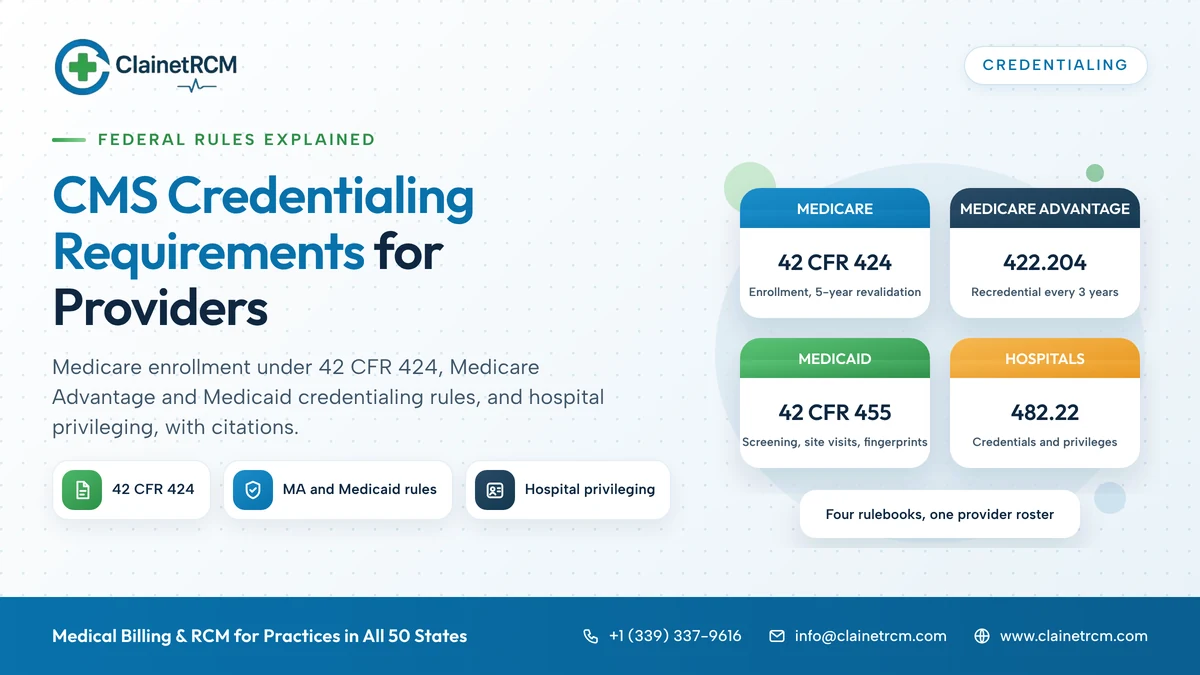
Two facts shape how you should approach it. First, Texas Medicaid is a fee-for-service enrollment with the state, but most Texas Medicaid members are in managed care, so enrollment with TMHP is the prerequisite for the plan contracts that actually pay most claims. Second, PEMS enforces the federal screening rules in 42 CFR part 455 (risk levels, site visits, fingerprinting, database checks), so the application is as much a screening as a registration.
Before You Start: What to Have Ready
Most PEMS delays are data delays. Gather and reconcile these before you open the application.
| Item | Why PEMS needs it | Common problem |
|---|---|---|
| NPI (Type 1 for individuals, Type 2 for organizations) or an Atypical Provider Identifier (API) for non-healthcare providers such as transportation | The enrollment record is keyed to the NPI or API | Taxonomy or address in NPPES does not match the application |
| Texas license or certification, current and not expiring within 30 days | Verified with the licensing board | Texas Medicaid will not enroll a provider whose license expires within 30 days of the application |
| IRS documentation (CP-575 or 147C) and a signed W-9 | Legal name and tax ID must match IRS records exactly | Trade name entered where the legal name belongs; missing suffix such as PLLC |
| Practice location details and hours | Site visits for moderate and high risk providers happen at the listed locations | A location that is not open or has no signage during business hours |
| Ownership and control disclosures for every 5 percent owner, managing employee and agent, with dates of birth and Social Security numbers | Required by 42 CFR 455.104; drives fingerprinting for high risk providers | Owners omitted; entity owners not traced to individuals |
| Disclosures of criminal convictions, exclusions, sanctions and prior terminations | Required by 42 CFR 455.106; checked against OIG, SAM and state lists | Undisclosed history discovered during screening |
| Medicare enrollment details, if enrolled | Medicare screening can satisfy the Texas site visit when name, NPI, SSN or TIN and address match | Mismatched addresses between PECOS and PEMS |
| Bank letter or voided check for electronic funds transfer | Payment setup | Account name differs from the legal name on the W-9 |
| CLIA certificate, DEA registration, accreditation or program-specific certifications where applicable | Program eligibility | Expired or missing |
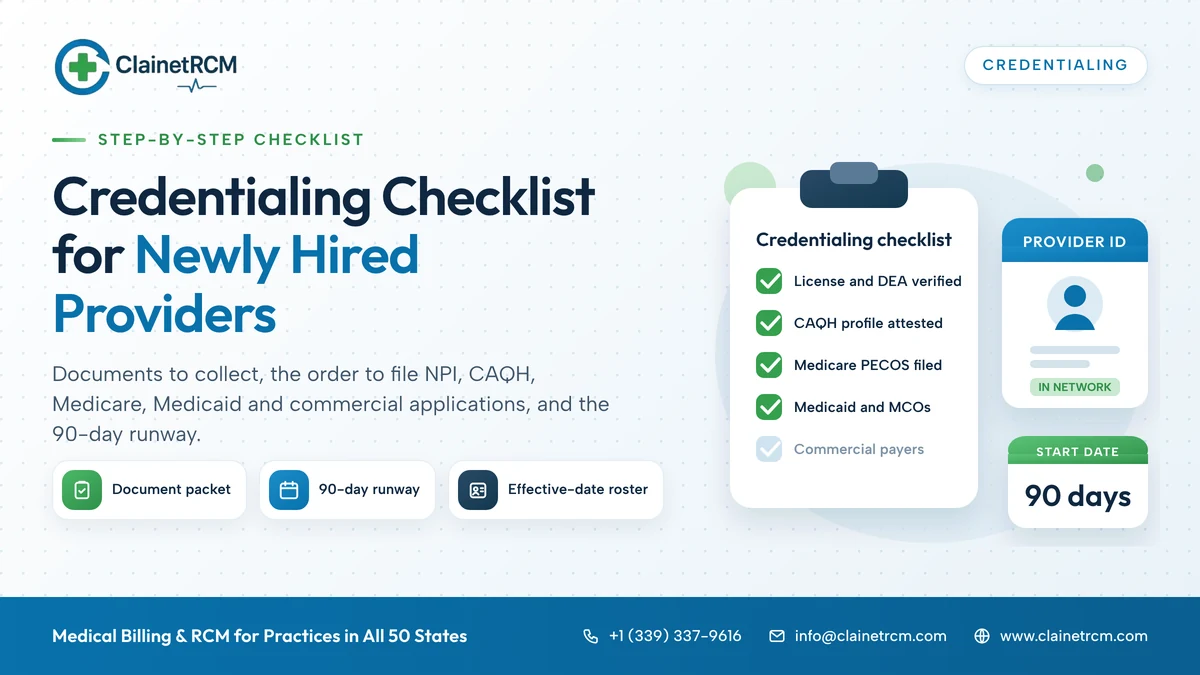
If the practice is new, settle the entity, EIN and NPI registrations first; every later step depends on them. Providers who also serve Medicare patients should enroll in Medicare before or alongside Texas Medicaid, because PECOS data can reduce the Texas screening burden and because Medicare enrollment is itself a 30 to 45 day process. Our credentialing checklist for newly hired providers covers the full sequence.
How to Enroll in Texas Medicaid Through PEMS, Step by Step
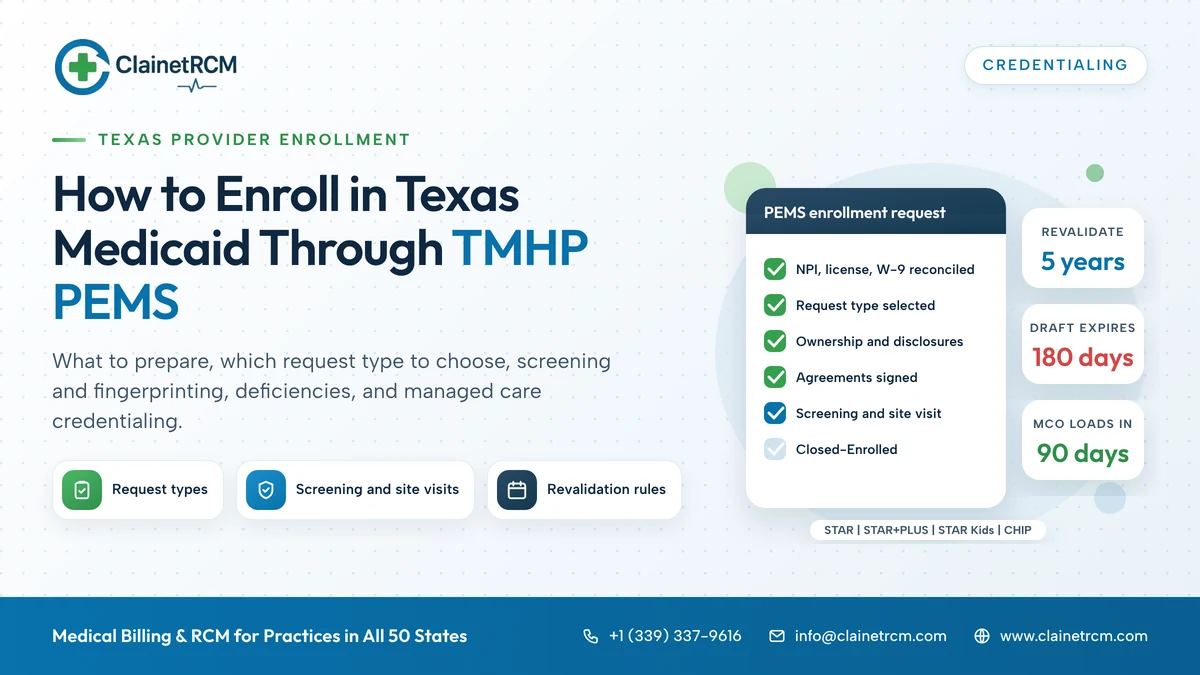
- Create the TMHP account and a provider administrator. The provider administrator owns the PEMS record, receives TMHP's notices and can delegate access to staff or a credentialing vendor. Keep this account tied to a role, not a person who might leave. TMHP has moved provider logins to a new identity platform with multifactor authentication in 2026, so register the login before you need it.
- Choose the request type. New Enrollment is for an NPI or API never enrolled in Texas Medicaid, or after a change of ownership. Existing Enrollment adds a practice location or program to an enrolled NPI. Revalidation renews an existing enrollment. Reenrollment applies after disenrollment, termination or exclusion and is screened like a new application. Maintenance updates demographics, locations, ownership or banking on an active record. If the type you expect is missing, a draft or in-progress request may already exist.
- Select the NPI or API, the provider type and the programs. Choose Medicaid plus any of CHIP, CSHCN, HTW or LTSS that apply. Program selection determines which agreements and attestations PEMS will require.
- Complete every section. Identifying information, practice locations, ownership and control, disclosures, licenses and certifications, Medicare information, and EFT. PEMS validates fields as you go; fix every flag before moving on, because the system will not let you submit with system deficiencies outstanding.
- Upload the attachments the application requests for your provider type and programs.
- Sign the agreements. The HHSC Medicaid provider agreement and program-specific agreements are signed electronically by the provider or the authorized representative. Unsigned or incorrectly signed agreements are a routine reason for a request to be returned.
- Pay the application fee if you are an institutional provider. Federal rules (42 CFR 455.460) require states to collect the fee from institutional providers before executing a provider agreement unless the provider already paid it to Medicare or another state's Medicaid or CHIP program. The CY 2026 amount is $750. Individual physicians and non-physician practitioners do not pay it.
- Submit and track the request on the Requests page in PEMS. A Provider Enrollment Specialist reviews it, and the final status for an approved enrollment is Closed-Enrolled.
Drafts expire. A PEMS request left in draft status for 180 calendar days is set to Expired and cannot be submitted; TMHP emails the provider administrator 30 days before that happens. Start the application when you can finish it.
Screening, Site Visits and Fingerprinting
Every Texas Medicaid applicant is screened according to a categorical risk level: limited, moderate or high, mirroring the Medicare levels in 42 CFR 424.518. TMHP's ACA screening requirements, revised in December 2025, spell out what each level adds.
- Limited risk (physicians, most practitioners, groups): license verification, database checks and federal and state requirement verification.
- Moderate risk (for example ambulance, independent labs, physical therapy groups, hospice revalidations): everything above plus a site visit at each practice location listed on the application.
- High risk (newly enrolling home health agencies, DMEPOS suppliers, hospices and skilled nursing facilities, and providers with prior exclusions, suspensions or revocations): everything above plus fingerprint-based criminal background checks for the provider and every person with a direct or indirect ownership or control interest of 5 percent or more.
Three practical points. A Medicare-enrolled provider's Medicare site visit can satisfy the Texas requirement when the name, NPI, Social Security number or tax ID, address and owner details match exactly, which is a strong argument for reconciling PECOS and PEMS before you file. If TMHP cannot reach you to schedule a site visit, it will conduct an unannounced one, so the location must be open and operational during business hours. And screening applies not only at initial enrollment but at revalidation, re-enrollment and some updates to the record.
Deficiencies: How They Work and How to Avoid Them
After submission, the Provider Enrollment Specialist either approves the request, routes it for additional review (a site visit or HHSC approval), or returns it with deficiencies. TMHP's instruction is plain: "If any deficiencies are identified within the application, Provider Enrollment will request the required corrections." Deficiencies arrive as tasks in PEMS and by notice to the provider administrator, and each has a response window; miss it and the request can be closed, which means starting over.
The causes we see most often in Texas applications:
- Legal name, tax ID or address that does not match the IRS, NPPES or the license.
- Taxonomy codes in NPPES that do not match the provider type and program selected in PEMS.
- Ownership and control disclosures that stop at an entity instead of tracing to the individuals behind it.
- A license or certification expiring within 30 days, or already expired.
- Agreements signed by someone who is not the authorized representative on file, or not signed at all.
- Missing attachments for the specific provider type, such as accreditation or CLIA.
- Medicare information omitted when the provider is enrolled in Medicare, which forfeits the site-visit match.
- The wrong request type, such as a New Enrollment filed for an NPI that already has a record.
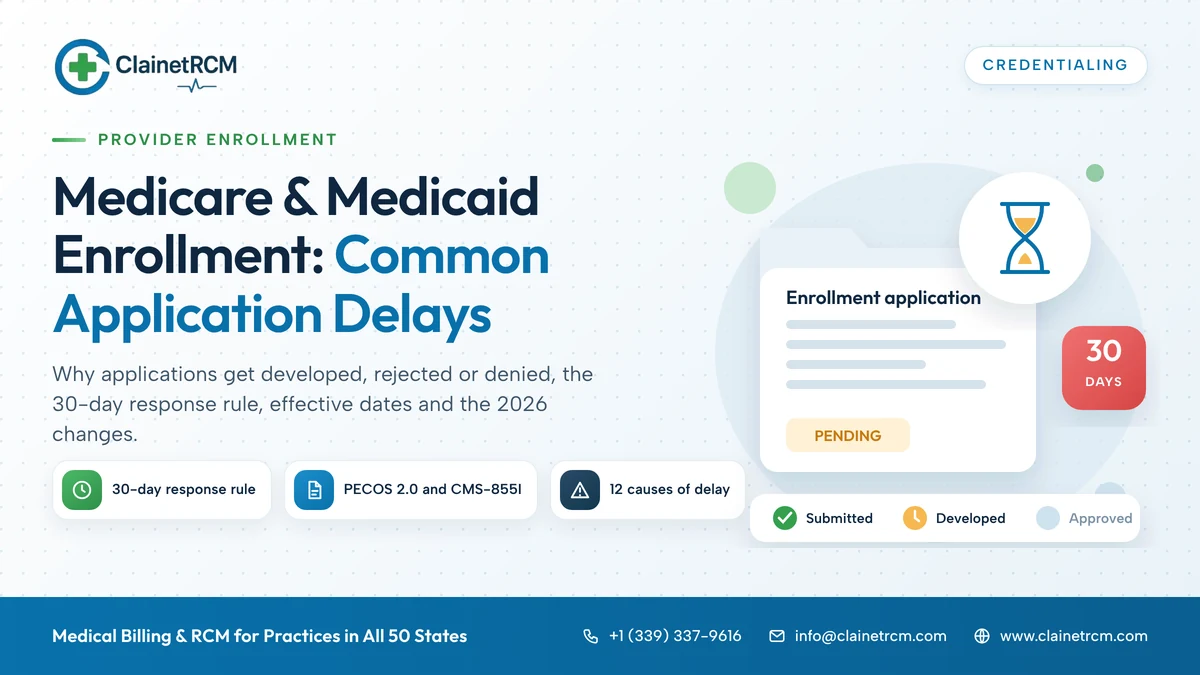
Texas does not publish a guaranteed processing time, and the clock depends on completeness and screening. In our experience, Texas Medicaid enrollment for a complete, limited-risk application typically completes in 30 to 60 days, with managed care plan credentialing running alongside. Applications that bounce on deficiencies take far longer, which is why the preparation table above matters more than any trick inside the system. If an application has stalled, our guide to Medicare and Medicaid enrollment delays walks through the statuses and remedies.
After Approval: Managed Care Credentialing
Approval in PEMS makes you a Texas Medicaid provider and lets you bill fee-for-service claims through TMHP. Most members, though, are enrolled in managed care, so the next step is contracting with the plans in your service area: STAR (children, pregnant women and low-income families), STAR+PLUS (adults with disabilities and those 65 and older), STAR Kids (children with disabilities), STAR Health (children in foster care) and CHIP.
Texas centralizes the verification work. Medicaid managed care organizations use the Texas Association of Health Plans' contracted credentialing verification organization, Verisys, so a provider completes the Texas Standardized Credentialing Application once (through CAQH or directly) and the CVO performs primary source verification for every plan. Each plan's committee then makes its own decision. The published standards: the plan must complete credentialing and load the provider as in-network no later than 90 days after receipt of a complete application, re-credentialing happens every three years, and the CVO notifies providers at least 180 days before the re-credentialing due date.
Federal rules add a useful backstop. Under 42 CFR 438.602(b), a Medicaid managed care plan may execute a network provider agreement while state enrollment is still pending for up to 120 days, but must terminate it if the state cannot enroll the provider or the 120 days run out. In practice, file PEMS first and start the plan applications as soon as the PEMS request is submitted, not approved. Plans also check the effective dates, so a provider who sees STAR members before the plan loads them is paid as out of network at best.
Keeping the Enrollment Active
| Requirement | Rule in PEMS | If you miss it |
|---|---|---|
| Revalidation | Most providers have a five-year enrollment period; some have one or two years. The date appears in PEMS and on the Provider Welcome letter. Submit up to 180 days early | Disenrollment from all Texas state health care programs; claims and prior authorization requests denied; a full Reenrollment is required |
| 45-day grace period | A revalidation submitted before the due date that reaches Closed-Enrolled within 45 days after the due date is treated as complete with no gap | A gap in enrollment and unpayable dates of service |
| Maintenance requests | Changes to demographics, locations, ownership, banking or licenses must be submitted as Maintenance before the revalidation date | Claims denied for a location or provider the state does not have on file; screening issues at revalidation |
| Healthy Texas Women attestation | HTW providers recertify in PEMS each year; the program year 2027 window runs November 1 to December 31, 2026 | HTW claims denied; a new certification creates a new effective date and a possible coverage gap |
| Claims activity | TMHP treats 24 months without claims as grounds for disenrollment, after which Reenrollment is required | Loss of billing privileges for the dormant NPI |
In 2026 TMHP introduced automatic 60-day extensions for revalidations that are in flight (submitted but not yet approved) when the due date falls on or after June 16, 2026; the extension posts in PEMS on the original due date, and a draft does not count as in flight. Providers with no submitted request the day before the due date are still disenrolled. Revalidation tracking for Medicare and Medicaid together is the only reliable way to keep a multi-provider group out of that trap.
What Changed in 2025 and 2026
- TMHP revised its ACA screening requirements document in December 2025, restating the risk levels, site visit rules, the Medicare site-visit match and fingerprinting for 5 percent owners.
- The CY 2026 federal application fee for institutional providers rose to $750, from $730 in 2025.
- Revalidation due dates in flight on or after June 16, 2026 receive an automatic 60-day extension.
- TMHP rolled out a new login process with multifactor registration for provider accounts during 2026; check TMHP's news page for your transition release and register early.
- Healthy Texas Women recertification for program year 2027 runs November 1 through December 31, 2026, inside PEMS.
- Doulas and community health workers became eligible to enroll in Texas Medicaid from December 1, 2024, adding new provider types to PEMS.
When to Hand PEMS to a Specialist
A single physician joining an enrolled group with clean records can complete PEMS in-house if someone owns the account and the calendar. The work gets harder with multiple locations, institutional provider types with fees and fingerprinting, a change of ownership, a prior disenrollment, or a group adding providers every quarter. ClainetRCM files and tracks Texas Medicaid enrollments, managed care credentialing through the CVO and the plan contracts that follow, alongside Medicare and commercial enrollment, with weekly status updates until every effective date is confirmed. See our Texas medical billing and credentialing page for the payers and programs we work with, and Texas medical licensing if a provider is still waiting on the board.
Enrolling in Texas Medicaid? Start PEMS the Right Way.
ClainetRCM prepares the packet, reconciles NPPES, IRS and license data, files the PEMS request, answers deficiencies inside the window and runs the STAR, STAR+PLUS, STAR Kids and CHIP plan credentialing in parallel. Flat fee per provider per payer.
Talk to a Texas Enrollment SpecialistFrequently Asked Questions
PEMS is the Provider Enrollment and Management System, the online application operated by the Texas Medicaid & Healthcare Partnership for the Texas Health and Human Services Commission. Providers use it to enroll, re-enroll, revalidate and update their records with Texas Medicaid, CHIP, the CSHCN Services Program, Healthy Texas Women and Texas long-term services and supports programs. It validates data as you enter it and replaced the older Provider Enrollment Portal and paper applications.
Texas does not publish a guaranteed processing time. A complete, limited-risk application (most physicians and practitioner groups) typically completes in about 30 to 60 days in our experience, with managed care plan credentialing running alongside. Moderate and high risk providers add site visits and fingerprinting, and any application returned with deficiencies takes longer. Managed care plans must complete credentialing within 90 days of a complete application.
Individual physicians and non-physician practitioners do not. Institutional providers (for example home health agencies, DME suppliers, facilities) pay the federal application fee, which is $750 for calendar year 2026, unless they already paid it to Medicare or to another state's Medicaid or CHIP program. Federal rules at 42 CFR 455.460 require the state to collect the fee before executing the provider agreement.
New Enrollment is for an NPI or API that has never been enrolled in Texas Medicaid, or after a change of ownership. Revalidation renews an active enrollment before the end of its enrollment period, usually five years. Reenrollment is required after a provider has been disenrolled, terminated or excluded, including for a missed revalidation, and is screened like a new application. Maintenance updates information on an active record, and Existing Enrollment adds a location or program.
If a revalidation request was submitted before the due date and reaches Closed-Enrolled within the 45-day grace period, there is no gap. Otherwise the provider is disenrolled from all Texas state health care programs, claims and prior authorization requests are denied, and a full Reenrollment is required. In 2026 TMHP added automatic 60-day extensions for revalidations that are already submitted and in flight when the due date falls on or after June 16, 2026.
No. PEMS enrollment makes you a Texas Medicaid provider and is the prerequisite, but each managed care organization credentials and contracts separately. Texas Medicaid plans use a centralized credentialing verification organization (Verisys, contracted by the Texas Association of Health Plans), so you complete the Texas Standardized Credentialing Application once, and each plan then makes its own decision within 90 days of a complete application.
Site visits apply to moderate and high risk provider types, such as ambulance companies, independent labs, home health agencies, DME suppliers and hospices, and are conducted at the practice locations listed on the application. A Medicare-enrolled provider's Medicare site visit can satisfy the Texas requirement when the name, NPI, tax identifiers, address and ownership details match exactly. If TMHP cannot reach you to schedule, it will conduct an unannounced visit.
All high-risk providers and every person with a direct or indirect ownership or control interest of 5 percent or more in a high-risk provider must submit fingerprints for a criminal background check at enrollment, revalidation, re-enrollment and certain updates. Newly enrolling home health agencies, DMEPOS suppliers, hospices and skilled nursing facilities are high risk, as are providers with prior payment suspensions, exclusions or revocations.
The Bottom Line
Enrolling in Texas Medicaid through TMHP PEMS is a sequence: reconcile your NPI, IRS and license data, create the provider administrator account, choose the right request type, complete every section and signature, clear screening, answer deficiencies inside the window, and then credential with each managed care plan. Keep the revalidation date on a calendar from the day the welcome letter arrives, and the enrollment stays active. Treat it as a one-time form and it will cost you a gap in billing privileges sooner or later.

Written by
ClainetRCM Billing Team
ClainetRCM is a Boston-based revenue cycle management company specializing in medical billing, coding, credentialing and denial management for healthcare providers across all 50 states. Our AAPC and AHIMA certified team works inside your existing EHR, files claims within 24 to 48 hours and reviews every AR bucket on a 14-day cycle.