Medicare revalidation is the periodic renewal of your Medicare enrollment. Every enrolled physician, practitioner, group, facility and supplier must confirm that its enrollment record is still accurate on a cycle CMS sets. Missing the deadline is not a paperwork nuisance. It can deactivate your billing privileges and leave a stretch of services Medicare will never pay for.
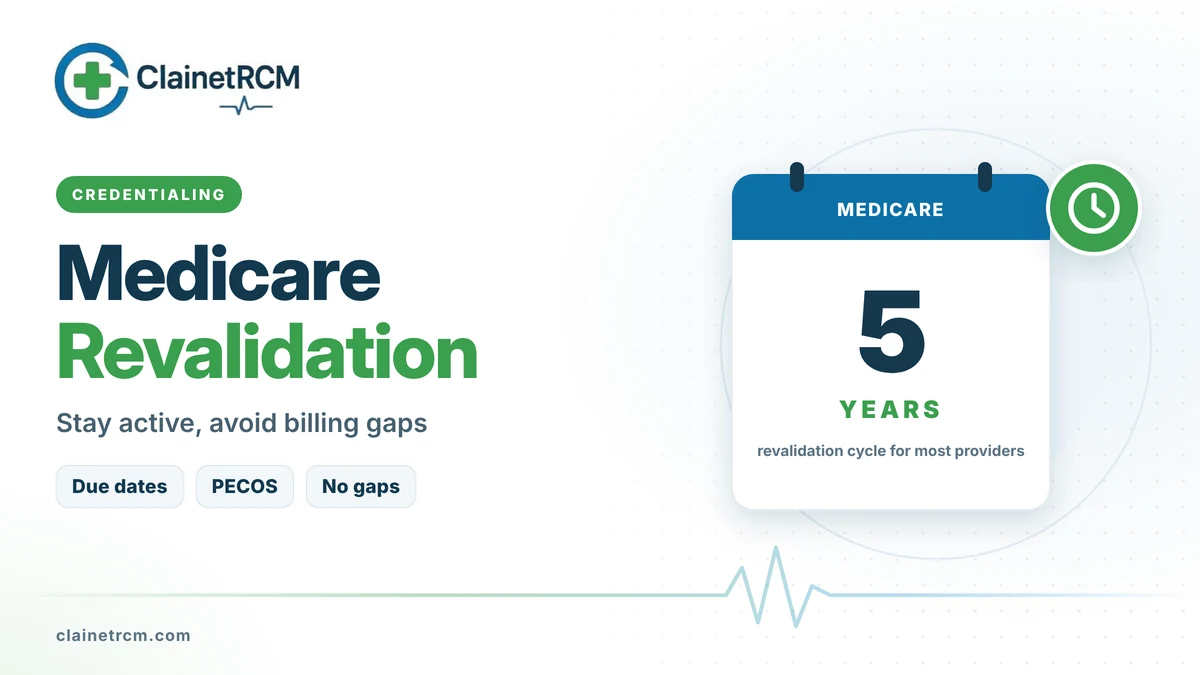
Quick answer: Most providers and suppliers revalidate every five years; DMEPOS suppliers revalidate every three years. CMS posts due dates on the Medicare Revalidation List up to seven months in advance, and your MAC sends a notice about three to four months before the due date. Submit through PECOS within that seven-month window, because earlier, unsolicited revalidation applications are returned. If you miss the due date or ignore a development request, Medicare can hold your payments and deactivate your billing privileges, and it will not pay for services furnished while you were deactivated.
How Medicare Revalidation Works
Federal rules (42 CFR 424.515) require every enrolled provider and supplier to resubmit and recertify the accuracy of its enrollment information. CMS assigns each enrollment a revalidation due date, set at the end of a month, and that date generally carries forward from cycle to cycle. CMS can also request an off-cycle revalidation at any time.
Revalidation is a full review, not a quick confirmation. You verify every section of the enrollment record: practice locations, reassignments, ownership and managing control, licensure, adverse legal history and banking information. Institutional providers pay the application fee with each revalidation ($750 for 2026). Physicians, non-physician practitioners and their group practices do not.
The Revalidation Timeline
| When | What happens |
|---|---|
| Up to 7 months before the due date | The due date appears on the Medicare Revalidation List |
| About 3 to 4 months before | Your MAC sends a revalidation notice by email or mail |
| Within 3 months, even without a notice | Submit your revalidation anyway |
| Due date | The MAC must receive a complete application |
| After the due date | Payments can be held and billing privileges deactivated |
How to Find Your Revalidation Due Date
- Search the Medicare Revalidation List. CMS publishes it on data.cms.gov. Search by NPI, name or organization. Groups can also see the practitioners who reassign benefits to them.
- Read “TBD” correctly. A due date of TBD means CMS has not set one yet. Do not revalidate unless your MAC asks you to; an unsolicited revalidation is returned.
- Keep your email current. MACs send notices to the email and mailing addresses on your enrollment. A former office manager’s inbox is a common place for a notice to disappear.
- Do not rely on the notice alone. CMS is clear that you are responsible for your due date whether or not a notice arrives.
How to Revalidate in PECOS, Step by Step
- Confirm the due date on the Medicare Revalidation List.
- Check PECOS access. Make sure the Authorized Official and any surrogates still have working access, especially if staff have changed.
- Choose revalidation, not a change of information. A change application updates the record but does not satisfy the revalidation requirement.
- Review every section. Update practice locations, reassignments, specialties, ownership, licenses and EFT information.
- Upload documents and e-sign. The practitioner signs an individual revalidation; the authorized or delegated official signs for an organization.
- Pay the fee if you are an institutional provider.
- Answer any development request within 30 days. A late response can lead to rejection and, after the due date passes, deactivation.
- File the approval letter and note when the next cycle begins.
Groups and Reassigned Practitioners
Groups and individual practitioners have separate due dates. A group’s revalidation does not revalidate the individual enrollment of each provider who reassigns benefits to it, and an individual’s revalidation does not cover the group. In a practice with many providers, keep every NPI’s due date in one tracker and review it monthly. A single lapsed practitioner enrollment can stop payment on that provider’s claims even when the group is in good standing.
What Happens If You Miss the Deadline
- Payment hold. Medicare can hold reimbursement while the revalidation is outstanding.
- Deactivation. If the application is not received by the due date, or requested information arrives late, the MAC can deactivate billing privileges.
- Reactivation takes a new application. You keep your original PTAN, but you must submit a new, complete enrollment application. The reactivation date is based on when the MAC receives it.
- The gap is unpaid. Medicare does not reimburse services furnished during the deactivation period. HHS appeals decisions have repeatedly upheld these gaps, including a 2025 case in which a cardiology practice lost nearly seven months of Medicare billing.
Deactivation is not the same as revocation, which is a penalty that bars re-enrollment for a period. But the lost revenue from a gap in billing privileges can be just as painful.
Common Revalidation Mistakes
- Submitting more than seven months early, so the application is returned.
- Filing a change of information instead of a revalidation.
- Forgetting to list current reassignments or deleting active ones by mistake.
- Letting PECOS surrogate access lapse when staff leave.
- Missing the development request because it went to an old email address.
- Assuming the group’s revalidation covered every provider.
Frequently Asked Questions
Every five years for most providers and suppliers, and every three years for DMEPOS suppliers. CMS can also request an off-cycle revalidation.
Only within the window. CMS posts due dates up to seven months ahead and returns revalidation applications submitted before then unless your MAC asked for them.
Institutional providers pay the annual application fee, $750 for 2026. Physicians, non-physician practitioners and their group practices pay nothing.
CMS has not assigned a due date yet. Do not submit a revalidation until a date is posted or your MAC sends you a request.
No. Services furnished during the deactivation period are not reimbursed, even after billing privileges are reactivated.
Medicare Advantage plans run their own recredentialing cycles, commonly every three years. That is separate from Medicare revalidation, so track both.
Final Thoughts
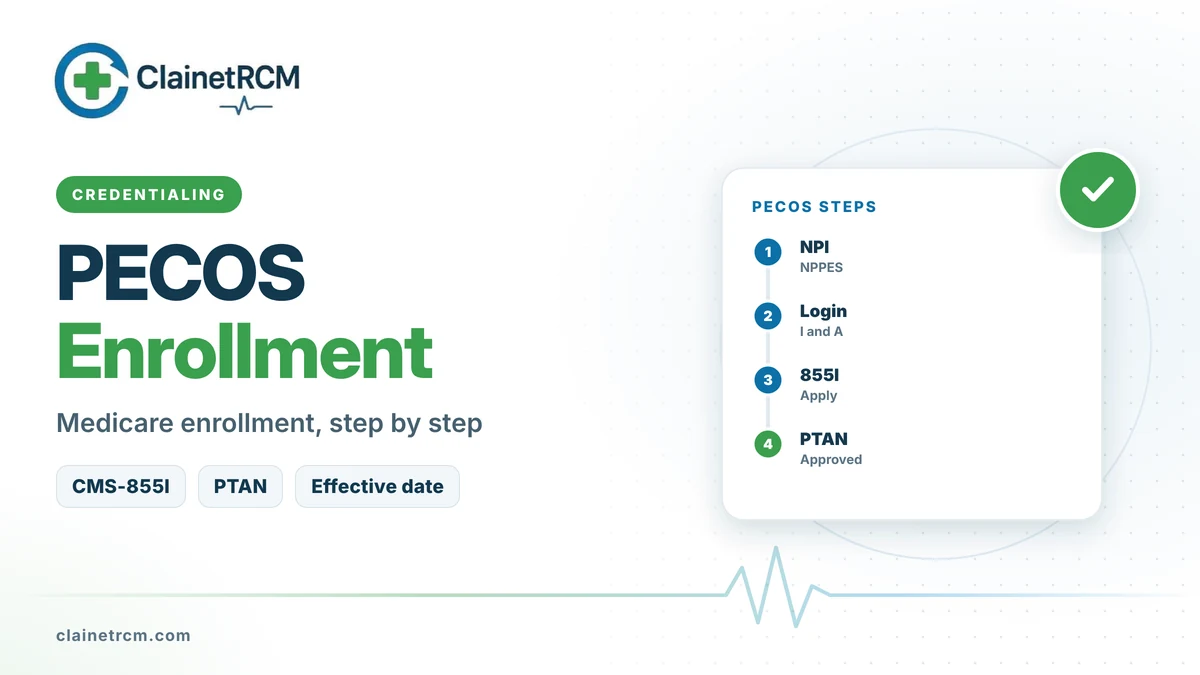
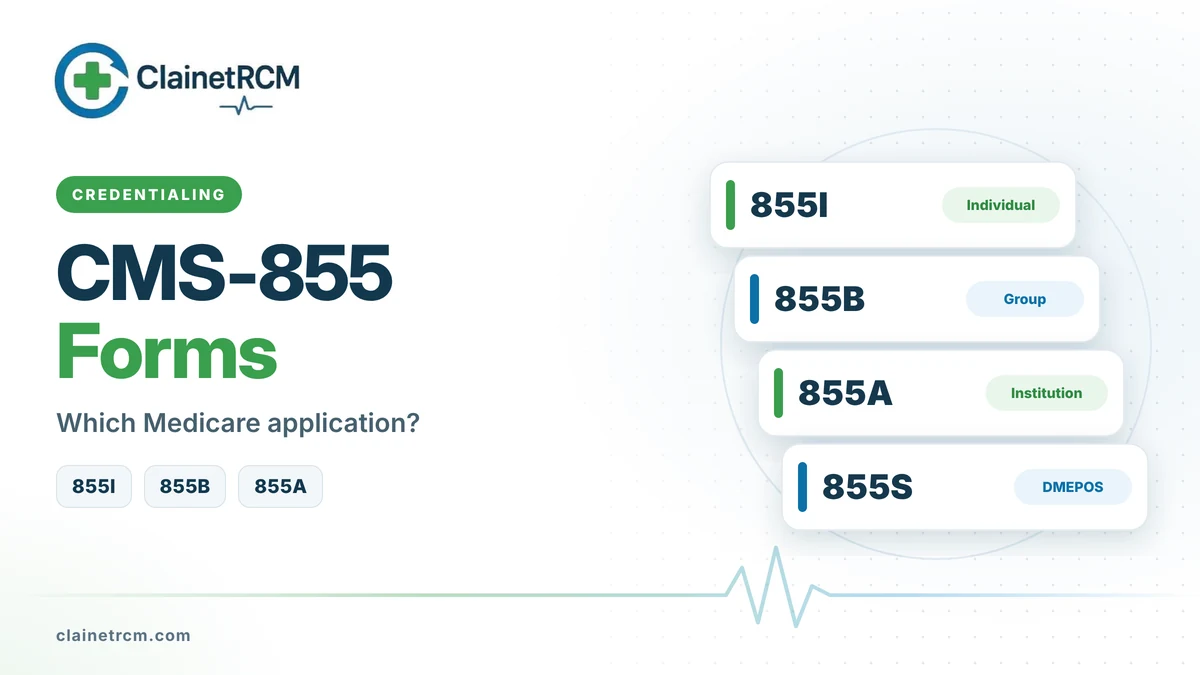
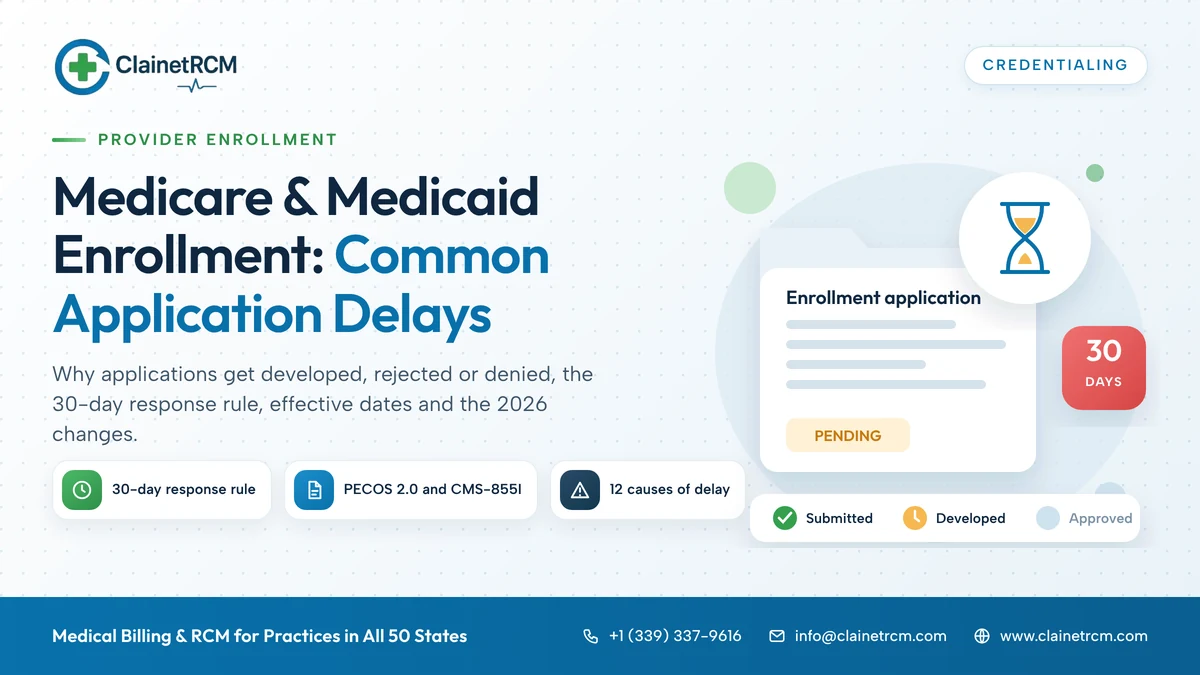
Medicare revalidation is easy to forget because it comes around only once every few years, which is exactly why it causes so many surprise deactivations. Track every due date, keep contact information current and respond quickly to your MAC. If you are already dealing with a delayed file, our guide to Medicare and Medicaid enrollment delays can help, and our credentialing services team can take revalidations off your plate entirely. For the forms themselves, see our CMS-855 forms guide and our PECOS enrollment walkthrough.
Never Miss a Revalidation Due Date
We track every provider’s Medicare due date, file revalidations in PECOS on time and answer MAC requests so billing privileges stay active.
Protect My Enrollment
Written by
ClainetRCM Billing Team
ClainetRCM is a Boston-based revenue cycle management company specializing in medical billing, coding, credentialing and denial management for healthcare providers across all 50 states. Our AAPC and AHIMA certified team works inside your existing EHR, files claims within 24 to 48 hours and reviews every AR bucket on a 14-day cycle.