
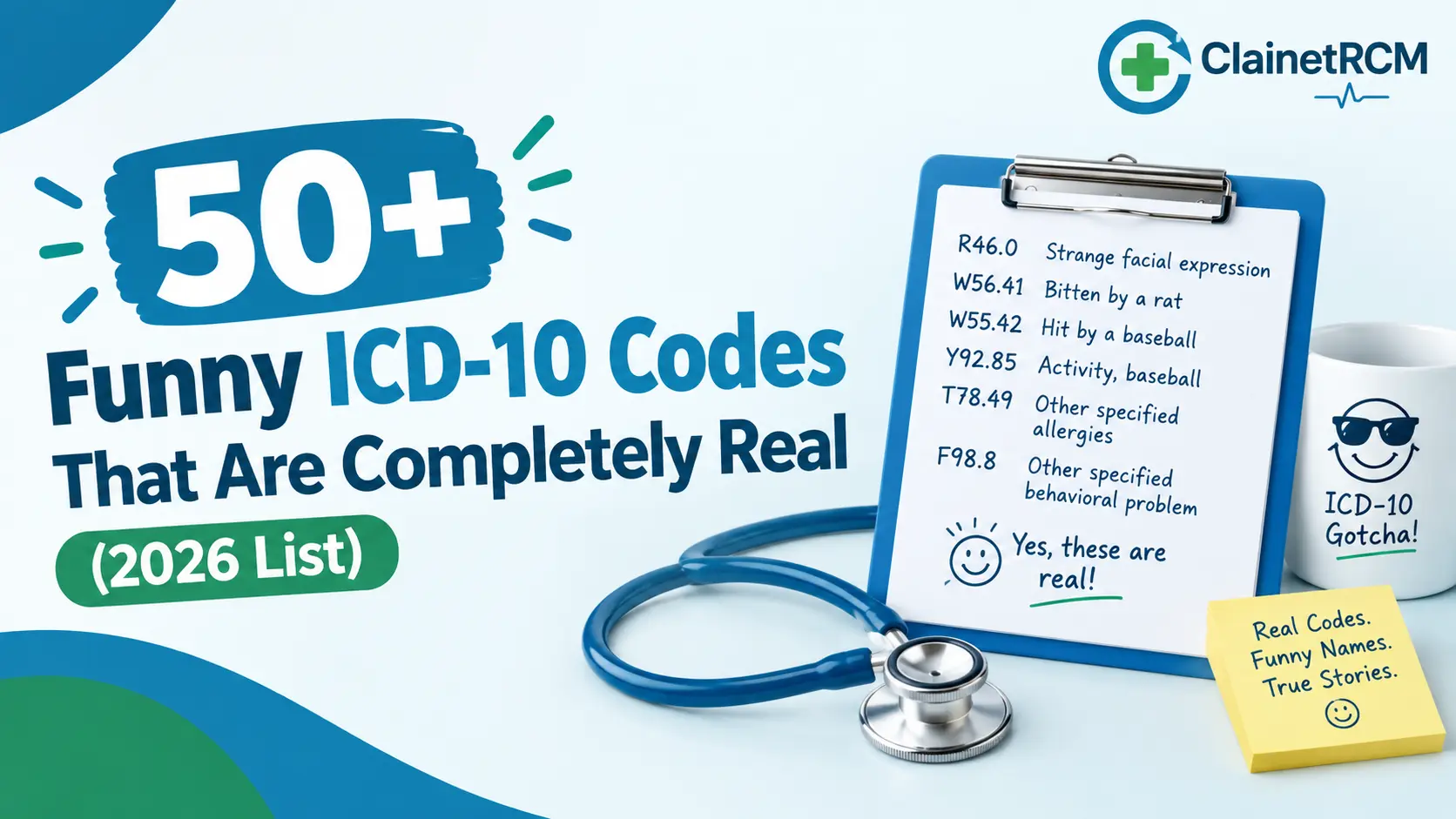
A patient gets struck by a duck. Another one is bitten by a sea lion. Someone else shows up with a documented case of "bizarre personal appearance." None of this is a joke, and none of it is fiction. Every one of these situations has an official ICD-10-CM code sitting inside the same coding system your practice uses to bill for a broken wrist or a routine physical.
ICD-10-CM currently holds more than 70,000 codes, and buried inside that number is a small, delightful pocket of entries that read like they were written for a comedy sketch. They were not. They exist because the coding system was built to capture every possible cause of injury and every possible circumstance of care, no matter how rare or how strange it sounds on paper.
This list rounds up the funniest, weirdest, and most talked about codes still active in the 2026 code set, organized so you can actually find what you're looking for instead of scrolling through a wall of random codes. Along the way, we'll explain why these codes exist, what they teach us about documentation, and where practices actually lose money when they treat coding specificity as a joke instead of a revenue issue.
Why Does ICD-10 Even Have Codes This Specific?
Short answer: because insurers, public health agencies, and researchers all need to know not just what happened to a patient, but how it happened.
ICD-10-CM replaced the older, much smaller ICD-9 system back in October 2015. ICD-9 had roughly 14,000 codes. ICD-10-CM launched with around 68,000, and it has grown every year since through annual updates from the Centers for Medicare & Medicaid Services (CMS) and the National Center for Health Statistics.
That massive jump in detail is intentional. A single vague code like "injury from animal" isn't useful for tracking public health trends, calculating risk, or processing a clean insurance claim. So the system splits injuries by the specific animal involved, whether the patient was bitten, struck, or otherwise in contact, and even where the encounter happened. That level of granularity is exactly what produces headlines like "struck by duck" while also making sure a hospital gets reimbursed correctly for treating an actual duck-related injury.
Most of these codes also carry a seventh character that tells the payer what stage of care this is:
- A stands for initial encounter, meaning active treatment is happening now.
- D stands for subsequent encounter, meaning the patient is back for follow-up care on the same injury.
- S stands for sequela, meaning the visit is for a complication that showed up after the original injury healed.
So when you see "V97.33XD," the D does not mean the patient got sucked into a jet engine twice. It means this is a follow-up visit related to that original, very unfortunate incident.
The Funniest Animal Encounter Codes
Animal-related codes make up the biggest and most famous share of the "funny ICD-10 codes" list, mostly because the system separates almost every possible interaction (bitten, struck, pecked, or "other contact") for almost every possible animal.
| Code | Description |
|---|---|
| W56.22XA | Struck by orca, initial encounter |
| W56.21XA | Bitten by orca, initial encounter |
| W59.22XA | Struck by turtle, initial encounter |
| W59.21XA | Bitten by turtle, initial encounter |
| W61.33XA | Pecked by chicken, initial encounter |
| W61.62XA | Struck by duck, initial encounter |
| W61.61XA | Bitten by duck, initial encounter |
| W55.21XA | Bitten by cow, initial encounter |
| W55.29XA | Other contact with cow, initial encounter |
| W56.11XA | Bitten by sea lion, initial encounter |
| W61.12XA | Struck by macaw, initial encounter |
| W54.1XA | Bitten by dog, initial encounter |
| W53.11XA | Rat bite, initial encounter |
The orca codes usually get the most attention online, and there's actually a small illustrated book dedicated to them called "Struck by an Orca." But the real-world use case is straightforward: marine biologists, aquarium staff, and zoo workers occasionally do get hurt by the animals they work with, and CMS needs a way to code that encounter accurately for both treatment records and workers' compensation claims.
Places, Activities, and Everyday Mishaps
Not every strange code involves an animal. A big chunk of the ICD-10-CM external cause codes (the Y92 series) exist purely to document where an injury happened, which produces some genuinely funny combinations when the location is unexpected.
| Code | Description |
|---|---|
| Y92.253 | Opera house as the place of occurrence of the external cause |
| Y92.250 | Art gallery as the place of occurrence of the external cause |
| Y92.241 | Library as the place of occurrence of the external cause |
| Y92.72 | Chicken coop as the place of occurrence of the external cause |
| Y92.017 | Garden or yard in single-family (private) house as the place of occurrence |
| V97.33XD | Sucked into jet engine, subsequent encounter |
| V91.07XA | Burn due to water-skis on fire, initial encounter |
| V95.43XA | Spacecraft collision injuring occupant, initial encounter |
| Y93.D9 | Activities involving arts and handicrafts |
| Y93.K3 | Activities involving grooming and shearing an animal |
| R14.3 | Flatulence |
| R46.1 | Bizarre personal appearance |
A quick correction worth making here, since a few other roundups get this one wrong: R46.1 (bizarre personal appearance) is not an animal-bite code and has nothing to do with clowns or vampires. It's a legitimate symptom code under the "symptoms and signs involving appearance and behavior" section, used when a patient's appearance is clinically noted as unusual and no definitive diagnosis has been established yet. It's meant to be used carefully and temporarily, not as a punchline in the chart.
The jet engine code deserves its own mention too, because it's the single most shared "funny ICD-10 code" on the internet. V97.33XD only applies to a subsequent encounter, meaning the patient survived being sucked into a jet engine once and is now being seen again for related follow-up care. The initial encounter version, V97.33XA, is just as real.
Codes for the Everyday Human Experience
A smaller, quieter category of codes covers social and behavioral situations that show up constantly in real patient histories, even though they sound almost too relatable to be official medical terminology.
- Z56.4 – Discord with boss, employer, fellow employees, or workmates. Used when workplace conflict is documented as a factor affecting a patient's health.
- Z63.1 – Problems in relationship with in-laws. A real code, used the way you'd expect.
- Z73.3 – Stress, not elsewhere classified.
- Z72.0 – Tobacco use, used far more often than any code on this list.
These aren't jokes buried in the system. They're part of the "Z codes," a section built specifically to capture social, environmental, and lifestyle factors that affect a patient's care, even when there's no injury or disease attached to them.
What's New and a Little Bit Funny in the FY2026 Update
CMS refreshes ICD-10-CM every October 1, and the FY2026 update (effective October 1, 2025) added 614 new codes while revising 38 and retiring 28. Most of the additions are serious clinical updates: more specificity for pelvic and abdominal pain, new codes for inflammatory breast cancer, and expanded options for reporting social determinants of health.
Two additions from this cycle are worth a mention here purely for the "you have got to be kidding" factor:
- R11.16 – Cannabis hyperemesis syndrome, a new code for the cycle of severe nausea and vomiting seen in long-term, heavy cannabis users. It's a real and increasingly documented clinical condition, but the name alone tends to get a reaction in the coding department.
- B88.01 – Infestation by Demodex mites, a microscopic parasite that lives in human hair follicles and is more common than most patients would like to know.
Neither of these is "funny" in the same lighthearted way as struck by orca, but they're a good reminder that the code set is a living document. Every October, new entries get added, some quietly clinical and some destined for the next internet listicle.
The Real Lesson Behind the Joke: Specificity Pays Your Claims
Here's the part most "funny ICD-10 codes" articles skip entirely, and it's the part that actually matters if you're running a practice.
Every code on this list is billable and specific for a reason. Payers reject claims that use vague, unspecified, or category-level codes when a more specific one is available. "W61.62 – Struck by duck" on its own is not billable. The system requires the seventh character, the encounter type, and the correct laterality where it applies, because that's the level of documentation insurance carriers expect before they release payment.
This is the exact same rule that governs every non-comedy code your practice uses every day. A vague diabetes code without the correct manifestation, an unspecified fracture code missing laterality, or a symptom code used past the point where a definitive diagnosis exists can all trigger the same kind of denial as submitting "struck by duck" without its full seventh character. Coders get trained to laugh at the orca code and then walk straight into the same specificity trap on a routine claim.
A few patterns we see constantly during denial management reviews:
- Providers document the mechanism of injury verbally but the coder never captures the seventh character correctly, leading to an automatic rejection.
- Symptom codes like R46.1 get left on a claim long after a definitive diagnosis was reached, which payers flag as incomplete coding.
- Encounter type gets mismatched, with a subsequent encounter billed as an initial visit, which throws off both reimbursement and the patient's treatment history.
None of these mistakes are funny when they show up as a stack of unpaid claims at the end of the month. This is also exactly why medical coding services built around certified coders and regular payer-rule audits exist in the first place: someone on your team needs to be tracking these seventh characters and code updates as closely as the internet tracks the orca one.
How to Avoid Becoming Your Own Funny Code Story
You don't need to memorize all 70,000-plus codes to keep your claims clean. You need a documentation habit and a coding process that catches specificity gaps before the claim ever reaches a payer.
- Document the full clinical picture, not just the diagnosis. Mechanism of injury, encounter stage, and location of occurrence all affect which code is correct.
- Update your code libraries every October 1. The FY2026 changes alone added 614 new codes and retired 28. Billing on a deleted code is one of the fastest ways to see an automatic denial.
- Audit denials for patterns, not just totals. If the same category of code keeps getting kicked back, that's a training gap, not bad luck. Our guide on preventing claim denials walks through how to spot those patterns before they cost you a full billing cycle.
- Keep coding and billing accountable to the same standard. Coding accuracy only pays off if the medical billing side of the process submits it correctly and follows up on every rejection.
If your practice has ever lost a claim over something as small as a missing seventh character, you already understand why "funny" codes and "revenue-critical" codes are, underneath the joke, the exact same thing.
Stop Losing Revenue to Coding Details
Struck by orca or missed by one digit, a denied claim costs your practice the same either way.
ClaiNet RCM's certified coding and billing team catches specificity errors, seventh-character mismatches, and outdated codes before they ever reach a payer, so your reimbursements stay on schedule.
Talk to our RCM team todayFrequently Asked Questions
Are funny ICD-10 codes actually real and billable?
Yes. Every code listed in this article, including struck by orca and bizarre personal appearance, is a real, active entry in the ICD-10-CM code set maintained by CMS and the National Center for Health Statistics. Most are fully billable when the correct seventh character is included.
What is considered the strangest ICD-10 code?
There's no official ranking, but V97.33XD (sucked into jet engine, subsequent encounter) is the most widely shared, since it implies the patient survived the initial incident and needed follow-up care. W56.22XA (struck by orca, initial encounter) is a close second in most online lists.
Why does ICD-10 have codes for such unusual situations?
ICD-10-CM was designed to capture the exact cause, circumstance, and location of every injury or condition, not just the general category. That level of detail supports accurate insurance reimbursement, public health tracking, and research, even when the specific scenario is rare.
How many codes are in the ICD-10-CM system for 2026?
The FY2026 update, effective October 1, 2025, added 614 new codes, revised 38, and retired 28, bringing the active total to well over 70,000 codes across the full ICD-10-CM code set.
Can using the wrong or an outdated ICD-10 code cause a claim denial?
Yes. Payers routinely reject claims that use unspecified codes when a more specific one exists, use a retired code past its effective date, or mismatch the seventh character for encounter type. This applies equally to unusual codes and everyday ones like fracture or diabetes codes.
Where can I look up the current, official list of ICD-10-CM codes?
The full, official code set is published by the CDC's National Center for Health Statistics and mirrored by CMS. Third-party lookup tools like ICD10Data.com are useful for quick reference, but claims should always be coded against the current fiscal year's official release.
ClainetRCM Billing Team
ClainetRCM is a Boston-based revenue cycle management company specializing in medical billing, coding, and denial management for healthcare providers across all 50 states. Our AAPC and AHIMA certified coders track every ICD-10-CM update so claims go out coded to the current fiscal year's release.