
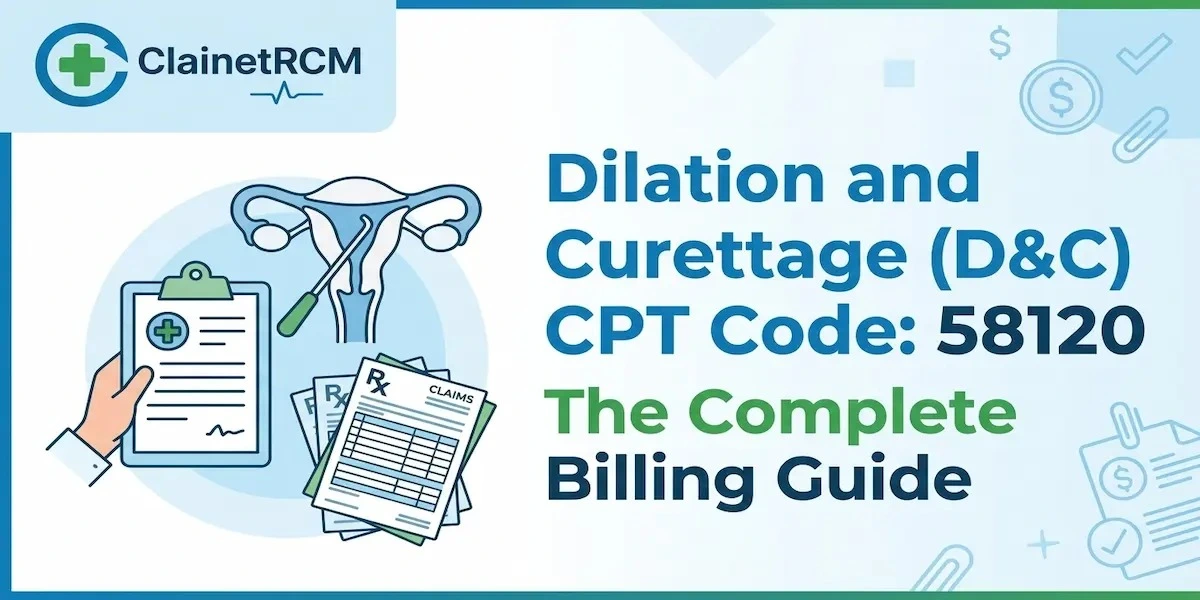
The main dilation and curettage CPT code is 58120, which describes a diagnostic and/or therapeutic D&C performed for nonobstetrical reasons. If the patient is pregnant, has had a miscarriage, or has just delivered, you do not use 58120. You move to a different family of codes, and picking the wrong family is one of the most common reasons these claims bounce.
I have spent decades around coding desks, and D&C is a procedure that looks simple on paper and causes trouble in practice. The code itself is easy to remember. The decisions around it are where revenue is lost: obstetric versus nonobstetric, dilation versus no dilation, hysteroscopy versus blind curettage, and what the documentation actually supports.
This guide walks through all of it in plain language, with current 2026 Medicare data, so your coders, billers and providers can code D&C correctly the first time.
Quick Answer: D&C CPT Codes at a Glance
- 58120: Dilation and curettage, diagnostic and/or therapeutic (nonobstetrical)
- 58100: Endometrial sampling (biopsy) without cervical dilation
- 57505: Endocervical curettage, not done as part of a D&C
- 57558: Dilation and curettage of the cervical stump
- 59812: Treatment of incomplete abortion, any trimester, completed surgically
- 59820 and 59821: Treatment of missed abortion, completed surgically (first and second trimester)
- 59840: Induced abortion by dilation and curettage
- 59160: Postpartum curettage
- 58558: Hysteroscopy with endometrial sampling and/or polypectomy, with or without D&C
What Is a Dilation and Curettage Procedure?
A D&C is a gynecologic procedure in which the cervix is gradually opened with dilators, and a curette is used to scrape or remove tissue from the uterine lining. Providers perform it to find the cause of abnormal bleeding, to obtain tissue for pathology, or to remove tissue that should not be there.
From a coding standpoint, the dilation is the detail that matters most. The cervix must actually be dilated for 58120 to apply. A procedure that samples the lining without dilating the cervix belongs in a different code.
CPT 58120 Explained
CPT 58120 is the nonobstetrical D&C code. It covers both diagnostic and therapeutic intent, which means you use the same code whether the provider is collecting tissue to investigate bleeding or removing tissue to treat a problem such as a polyp or hyperplasia.
Here is what you need to know about it in 2026:
| Detail | Information |
|---|---|
| Descriptor | Dilation and curettage, diagnostic and/or therapeutic (nonobstetrical) |
| Global period | 010 (10 days) |
| Work RVU | 3.50 |
| Total RVU, non-facility | 8.93 |
| Total RVU, facility | 6.28 |
| National Medicare estimate, non-facility | about $298 |
| National Medicare estimate, facility | about $210 |
These figures come from the 2026 Medicare Physician Fee Schedule, which uses a conversion factor of $33.4009. They are national numbers before geographic adjustment, so your actual payment will move up or down by locality. Commercial payers set their own rates, usually as a percentage of Medicare or under a negotiated contract.
The gap between facility and non-facility payment is worth noticing. When the procedure is done in a hospital or ambulatory surgery center, the facility bills for its own overhead and the physician's practice expense RVU drops. When it is done in an office, the practice carries those costs and is paid more for the professional claim.
When Is CPT 58120 Appropriate?
Use 58120 when a nonpregnant patient undergoes cervical dilation followed by curettage. The most common clinical reasons include:
- Abnormal uterine bleeding that has not been explained by imaging or office testing
- Postmenopausal bleeding
- A thickened endometrium on ultrasound
- Suspected endometrial hyperplasia or cancer
- Endometrial polyps found or suspected
- An office biopsy that was inadequate, nondiagnostic or not tolerated
- Therapeutic removal of tissue to control heavy bleeding
The clinical indication is what supports medical necessity. A payer reading the claim wants to see a diagnosis that justifies an operative procedure and not just an office sampling. That connection between the diagnosis, the plan of care and the operative note is where most medical necessity denials start.
D&C CPT Codes by Clinical Scenario
This is the part most online guides skip. The right code depends on why the D&C was done and the patient's pregnancy status.
| Scenario | CPT Code |
|---|---|
| Nonpregnant patient, diagnostic or therapeutic D&C | 58120 |
| Miscarriage, incomplete abortion, completed surgically | 59812 |
| Missed abortion, first trimester, completed surgically | 59820 |
| Missed abortion, second trimester, completed surgically | 59821 |
| Septic abortion, completed surgically | 59830 |
| Induced abortion by D&C | 59840 |
| Postpartum retained tissue | 59160 |
| Cervical stump (after supracervical hysterectomy) | 57558 |
| Hysteroscopy with sampling or polypectomy, with or without D&C | 58558 |
If you remember one rule, make it this one: 58120 is nonobstetrical only. The moment pregnancy or delivery is part of the story, the code changes.
CPT 58120 vs 58100 vs 57505
These three codes get confused constantly because they all involve sampling tissue from the uterus or cervix.
58100 is an endometrial biopsy performed without cervical dilation. Think of a Pipelle sample in the office. The cervix is not dilated, and a small tissue sample is collected.
58120 requires cervical dilation followed by curettage. The note should describe progressive dilation and the curettage that followed.
57505 is an endocervical curettage, which samples the cervical canal and not the uterine cavity. It is reported when it is not performed as part of a D&C.
A practical test for coders: read the operative note and ask whether dilators were used. If the answer is no, you are almost certainly looking at 58100. If the note describes dilation to a specific size and then curettage of the uterine cavity, 58120 is the match.
Also remember that when 58100 and 58120 are performed in the same session, the biopsy is generally bundled into the D&C under NCCI edits. You cannot collect both payments for the same sampling of the same tissue.
D&C With Hysteroscopy: Which Code Wins?
Hysteroscopy changes the picture, and a lot of denials start here.
When a hysteroscopy is performed with endometrial sampling and/or polypectomy, 58558 is the code, and its descriptor already says "with or without dilation and curettage." That means the D&C is built into 58558. Reporting 58120 on top of it is a classic unbundling error.
A few related hysteroscopy codes worth knowing:
- 58555: Diagnostic hysteroscopy
- 58558: Surgical hysteroscopy with sampling and/or polypectomy, with or without D&C
- 58559: Lysis of intrauterine adhesions
- 58560: Division or resection of an intrauterine septum
- 58561: Removal of leiomyomata
- 58563: Endometrial ablation
If a provider performs a blind D&C and then a diagnostic hysteroscopy to inspect the cavity, check the current NCCI edits and payer policy before billing both. Diagnostic hysteroscopy is designated as a separate procedure and is commonly bundled when done with other uterine procedures.
D&C for Miscarriage: Do Not Use 58120
Patients and even some practice staff search for the "D&C CPT code for miscarriage" and land on 58120. That is the wrong code.
For a miscarriage managed surgically:
- Use 59812 when the patient has an incomplete abortion and the surgical treatment completes it.
- Use 59820 for a missed abortion in the first trimester and 59821 for the second trimester.
- Use 59830 when the miscarriage is septic.
These obstetric codes carry diagnosis codes from the O02 and O03 families, such as O02.1 for missed abortion or O03.4 for incomplete spontaneous abortion without complication. A claim that pairs 58120 with a pregnancy loss diagnosis sends an immediate mismatch signal to the payer.
Documentation Checklist for D&C Claims
Good coding starts in the operative note. Before releasing a D&C claim, a coder should be able to find each of these items:
- The indication, stated clearly, such as postmenopausal bleeding or thickened endometrium
- Pregnancy status, confirming the patient is not pregnant for nonobstetrical coding
- A description of cervical dilation, including the dilators used
- A description of the curettage and the findings
- The specimen sent to pathology
- Anesthesia type and the setting where the procedure was performed
- Any additional procedures performed during the same session
- Complications, if any, and the patient's condition at the end of the case
When the note says only "D&C performed" with no detail, coders and auditors cannot confirm the procedure matches the code. Strong templates solve this. Practices that struggle with documentation gaps often benefit from working with a team that provides medical coding services, because a second set of expert eyes on the note before submission catches problems while they are still cheap to fix.
ICD-10-CM Diagnosis Codes Commonly Paired With 58120
The diagnosis is what proves necessity. These are among the most common pairings, but always code to the highest specificity the provider documents:
- N93.8 / N93.9: Other specified or unspecified abnormal uterine and vaginal bleeding
- N92.0 / N92.1: Excessive and frequent menstruation (regular or irregular cycle)
- N95.0: Postmenopausal bleeding
- N84.0: Polyp of corpus uteri
- N85.00 to N85.02: Endometrial hyperplasia, including endometrial intraepithelial neoplasia
- R93.89: Abnormal findings on diagnostic imaging, such as a thickened endometrium
- C54.1 / D07.0: Malignant neoplasm or carcinoma in situ of the endometrium, when confirmed
Choosing "abnormal bleeding, unspecified" when the note supports postmenopausal bleeding is a small error that can cost a claim, because payers often attach tighter coverage criteria to more specific diagnoses.
Modifiers That Matter With D&C
Modifiers tell the payer how the procedure fits into the larger picture of care.
- Modifier 51 applies when multiple procedures are performed in the same session, although many payers apply multiple procedure reductions automatically.
- Modifier 59 or the X modifiers (XE, XS, XP, XU) may be needed when two procedures that are normally bundled were truly distinct, such as performed on separate sites or in separate sessions. Use them only when the documentation proves it. Misuse of modifier 59 is a well known audit target.
- Modifier 25 is for a significant, separately identifiable E/M service on the same day as the D&C. The decision to perform the procedure is part of the procedure, so a routine pre-op discussion does not qualify.
- Modifier 58 is for a staged or related procedure by the same physician during the postoperative period.
- Modifier 78 is for an unplanned return to the operating room for a related complication during the global period.
- Modifier 79 is for an unrelated procedure during the global period.
- Modifier 22 can be considered for substantially increased work, but it requires clear documentation of what made the case harder.
- Modifier 52 or 53 applies if the procedure was reduced or discontinued.
Understanding the 10-Day Global Period
CPT 58120 carries a 010 global period. That means the payment includes the procedure, the usual preoperative work on the day of surgery, and routine follow-up care for 10 days afterward.
In practice, this means:
- A routine postoperative visit within 10 days is not separately billable.
- A same-day E/M needs modifier 25 and documentation that proves it was significant and separate.
- A complication that requires a return to the operating room is reported with modifier 78.
Front desk and billing teams should know the global period before they schedule or charge a follow-up visit. Charging a global visit is one of the easiest ways to create a denial and a refund request later.
Related Billing: Anesthesia, Pathology and Facility Claims
A D&C is rarely a single claim. Several parties bill for their own piece:
- The surgeon bills 58120 on the professional claim.
- The anesthesia provider bills using the anesthesia code for vaginal procedures, including endometrial procedures, which is 00940, plus time and any qualifying circumstances.
- The pathologist bills for the specimen, typically 88305 for endometrial curettings.
- The facility bills the hospital outpatient or ASC claim for the use of the operating room and supplies.
Place of service also matters. The same code pays differently in an office, an ASC and a hospital outpatient department, and billing the wrong place of service will produce a payment that does not match the actual setting.
Common D&C Billing Mistakes and Denials
After watching these claims for years, the same problems come up again and again:
- Using 58120 for a pregnancy-related D&C. The obstetric codes exist for a reason.
- Billing 58120 with 58558. The D&C is already included in the hysteroscopy code.
- Billing 58100 and 58120 together. The biopsy is generally bundled into the D&C.
- Weak medical necessity. The diagnosis does not justify an operative procedure, or no prior conservative workup is documented.
- Missing prior authorization. Many commercial plans require approval for scheduled D&C procedures, particularly in a facility.
- Inventing a code. Some websites list a "58121" for therapeutic D&C. There is no such code in CPT. If your reference tool shows it, stop trusting that tool.
- Wrong place of service. The claim says office when the procedure happened in an ASC.
- Global period violations. Separate charges for routine follow-up care.
Most of these are preventable before the claim ever leaves the building. Confirming coverage with benefits verification and securing prior authorization ahead of the date of service removes two of the biggest sources of avoidable denials. When a claim does come back, a structured denial management process helps you appeal with the right documentation and track which payers keep repeating the same mistake. If you want a broader framework, our guide on preventing claim denials covers the habits that work across specialties.
Why D&C Coding Matters for OB/GYN Revenue
A single D&C claim is not large, which is exactly why practices underestimate the risk. A national Medicare estimate of roughly $298 in a non-facility setting looks small, but when an error repeats across dozens of cases, or when an audit pulls a sample, the dollars and the compliance exposure add up.
Gynecology practices also deal with a mix of nonobstetric and obstetric work, so coders need to move comfortably between code families in the same day. If your team is stretched, specialized OB/GYN medical billing support can keep these distinctions straight and protect clean claim rates.
Frequently Asked Questions
What is the CPT code for a dilation and curettage?
The CPT code for a nonobstetrical dilation and curettage is 58120. It covers both diagnostic and therapeutic D&C in a patient who is not pregnant.
What is the CPT code for D&C after a miscarriage?
Use 59812 for an incomplete abortion completed surgically. For a missed abortion, use 59820 in the first trimester or 59821 in the second trimester. Do not use 58120.
What is the difference between CPT 58100 and 58120?
CPT 58100 is an endometrial biopsy without cervical dilation. CPT 58120 requires cervical dilation followed by curettage of the uterine cavity.
Can 58120 be billed with hysteroscopy?
Usually not with surgical hysteroscopy for sampling or polypectomy. Code 58558 already includes D&C, so billing 58120 as well is generally an unbundling error. Always verify against current NCCI edits and payer policy.
What is the global period for CPT 58120?
The global period is 10 days (010). Routine postoperative care in that window is included in the payment.
How much does Medicare pay for CPT 58120?
Under the 2026 Medicare Physician Fee Schedule, the national estimate is about $298 in a non-facility setting and about $210 in a facility setting, before geographic adjustment. Your locality and payer contract will change the final amount.
Does a D&C need prior authorization?
It depends on the payer and the setting. Many commercial plans require authorization for scheduled D&C procedures, especially in a hospital or surgery center. Verify with each payer before the date of service.
Is there a CPT code 58121?
No. There is no CPT code 58121 for a therapeutic D&C. Both diagnostic and therapeutic nonobstetrical D&C are reported with 58120.
Final Thoughts
Dilation and curettage coding comes down to a few disciplined questions. Was the patient pregnant? Was the cervix dilated? Was a hysteroscope involved? Does the diagnosis support an operative procedure? If your team answers those four questions from the documentation every time, most D&C denials disappear.
Codes and payment rates change, so build a habit of confirming them every January against the latest CPT and Medicare releases, and check each payer's policy before billing. A reliable process always beats a good memory.
Stop Losing Revenue on Gynecology Claims
Clean coding, faster payments and fewer denials, handled by a team that knows OB/GYN billing inside out.
Book Your Free Billing Review
ClainetRCM Billing Team
ClainetRCM is a Boston-based revenue cycle management company specializing in medical billing, coding, and denial management for healthcare providers across all 50 states. Our AAPC and AHIMA certified coders track every ICD-10-CM update so claims go out coded to the current fiscal year's release.