
If you bill for gastroenterology services, you already know that an EGD claim rarely gets denied because of the CPT code alone. It gets denied because the ICD-10 code attached to it doesn't match what the payer expects to see. That one mismatch, between diagnosis and procedure, is responsible for a large share of the denials gastroenterology practices deal with every month.
This guide breaks down exactly which ICD-10 codes apply to an esophagogastroduodenoscopy (EGD), how ICD-10-CM diagnosis codes differ from ICD-10-PCS procedure codes, and how to avoid the documentation gaps that trigger rejections.
What Is an EGD Procedure
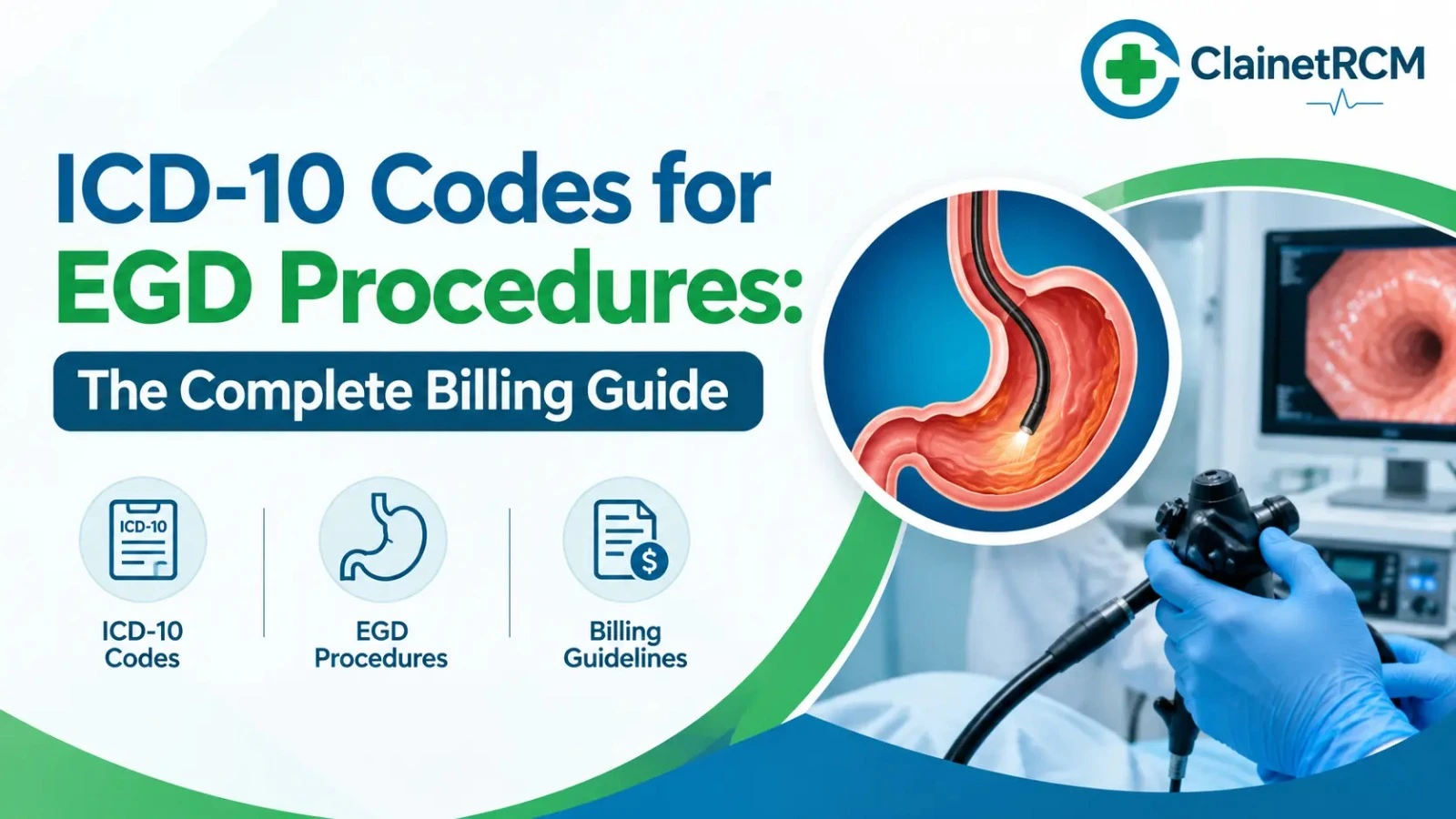
An esophagogastroduodenoscopy, commonly shortened to EGD, is a diagnostic and sometimes therapeutic endoscopic procedure. A physician passes a flexible scope through the mouth to examine three connected structures: the esophagus, the stomach, and the duodenum (the first part of the small intestine).
Providers order an EGD for symptoms like persistent heartburn, difficulty swallowing, unexplained weight loss, upper abdominal pain, suspected ulcers, gastrointestinal bleeding, or as a screening tool for conditions such as Barrett's esophagus. The procedure can be purely diagnostic, or it can include biopsy, polyp removal, dilation, or hemostasis, depending on what the physician finds during the exam.
ICD-10-CM vs ICD-10-PCS: The Distinction Most Guides Skip
This is where a lot of coding confusion starts, so it's worth separating the two systems clearly before anything else.
ICD-10-CM codes describe the diagnosis, meaning the reason the EGD was performed. These are the codes payers use to decide whether the procedure was medically necessary. Examples include K21.9 for GERD or K29.70 for gastritis.
ICD-10-PCS codes describe the procedure itself, but only in the inpatient hospital setting. Outpatient endoscopy centers, ambulatory surgical centers, and physician offices don't use ICD-10-PCS at all. Instead, they report the procedure using a CPT code (such as 43235 or 43239) alongside the ICD-10-CM diagnosis code.
So the practical rule is simple: if the EGD happened in a hospital inpatient stay, you may need an ICD-10-PCS code. If it happened in any outpatient setting, which covers the overwhelming majority of EGDs, you only need the ICD-10-CM diagnosis code paired with the correct CPT code. If your practice needs a refresher on which CPT code fits which scenario, our EGD CPT code guide walks through each variation, from a plain diagnostic exam to EGD with biopsy or band ligation.
Common ICD-10-CM Diagnosis Codes Used With EGD
These are the diagnosis codes coders see most often when justifying an EGD claim. Every code must be supported by the physician's documented findings or the stated reason for the exam, not just copied from a template.
| ICD-10-CM Code | Description |
|---|---|
| K21.9 | Gastro-esophageal reflux disease without esophagitis |
| K21.0 | Gastro-esophageal reflux disease with esophagitis |
| K29.70 | Gastritis, unspecified, without bleeding |
| K25.9 | Gastric ulcer, unspecified as acute or chronic, without hemorrhage or perforation |
| K27.9 | Peptic ulcer, site unspecified, without hemorrhage or perforation |
| R10.13 | Epigastric pain |
| R13.10 | Dysphagia, unspecified |
| K92.2 | Gastrointestinal hemorrhage, unspecified |
| K22.70 | Barrett's esophagus without dysplasia |
| K90.0 | Celiac disease |
| Z13.810 | Encounter for screening for upper gastrointestinal disorder |
Notice that one code on this list, Z13.810, behaves differently from the rest. It's covered separately below because it's the code that causes the most confusion.
Screening EGD vs Diagnostic EGD: Why It Changes the Code
A screening EGD is performed on a patient with no active symptoms, usually to check for something like Barrett's esophagus in a patient with long-standing GERD, or as part of a surveillance protocol. In that scenario, Z13.810 is the appropriate primary diagnosis code.
A diagnostic EGD is performed because the patient already has symptoms, such as dysphagia, epigastric pain, or suspected bleeding. In that case, the symptom code or the confirmed condition drives the diagnosis, not Z13.810.
Billing teams sometimes default to Z13.810 out of habit, even when the patient's chart clearly documents active symptoms. Payers catch this quickly, and it's one of the more preventable denial reasons on EGD claims. The fix isn't complicated: read the indication section of the procedure note before assigning the code, every single time.
Pairing ICD-10 Codes With the Right CPT Code
An ICD-10 code on its own doesn't get a claim paid. It has to logically match the CPT code it's billed alongside. A few common pairings:
- CPT 43235 (diagnostic EGD, no intervention) pairs well with symptom-based codes like R13.10 or R10.13.
- CPT 43239 (EGD with biopsy) needs a diagnosis that justifies tissue sampling, such as K29.70, K21.0, or K90.0.
- CPT 43255 (EGD with control of bleeding) pairs with K92.2 or a site-specific bleeding ulcer code.
- CPT 43249 (EGD with dilation) pairs with a stricture or stenosis code rather than a general reflux code.
Payers run automated edits that flag any pairing outside their approved list, so mismatched combinations get rejected before a human reviewer even looks at the claim. Our gastroenterology billing specialists review these pairings against each payer's current policy before claims go out, which is usually where practices doing their own billing start losing time.
Documentation That Supports the Code
A code is only as strong as the documentation behind it. For EGD claims, that means the procedure note should clearly state:
- The specific indication for the exam (symptom, suspected condition, or screening protocol)
- Findings at each anatomical site examined
- Whether a biopsy, injection, dilation, or other intervention was performed
- The severity or location of any abnormality found
When the indication section is vague, coders end up guessing, and a guessed code is a code that's likely to get downcoded or denied on review.
Why EGD Claims Get Denied and How to Prevent It
A few patterns show up repeatedly in EGD denials:
Diagnosis doesn't support medical necessity. The ICD-10 code doesn't match the payer's approved diagnosis list for that CPT code. This is the single most common EGD denial reason, and it's almost entirely preventable with a pre-submission check.
Screening code used for a symptomatic patient, or vice versa. As covered above, this mismatch is easy to catch if someone actually reads the note.
Missing modifier on a repeat or incomplete procedure. If the scope couldn't reach the duodenum, modifier 52 typically applies, and skipping it leads to a flat denial rather than a partial payment.
Unbundling separate procedures. Billing a biopsy code and a separate procedure code for the same lesion in the same session usually triggers a bundling edit.
Most of these issues are caught before submission with a structured claim scrub, which is exactly what our denial management service is built around. If your practice is already seeing a pattern of EGD denials, it's worth reviewing our broader guide on preventing claim denials as well.
Prior Authorization and Benefits Verification for EGD
Some payers require prior authorization for EGD, particularly when it's a screening procedure, when it's a repeat exam within a short time frame, or when it's bundled with an advanced intervention like endoscopic ultrasound. Skipping this step is one of the fastest ways to get an otherwise correctly coded claim denied outright.
Before scheduling, it's worth confirming both the authorization requirement and the patient's coverage details. Our prior authorization and benefits verification teams handle this upfront, so the claim isn't fighting an avoidable denial after the procedure has already happened.
Frequently Asked Questions
What is the ICD-10 code for an EGD procedure?
There isn't a single ICD-10 code for "EGD" itself, because ICD-10-CM codes describe the diagnosis, not the procedure. The diagnosis code depends on why the EGD was performed, such as K21.9 for GERD, R13.10 for dysphagia, or Z13.810 for a screening exam.
Does EGD use ICD-10-PCS codes?
Only in the inpatient hospital setting. Outpatient EGDs, which make up most procedures, are reported with a CPT code and an ICD-10-CM diagnosis code, not ICD-10-PCS.
Can Z13.810 be used for every EGD?
No. Z13.810 applies only to a screening exam on a patient without active symptoms. A diagnostic EGD performed because of symptoms needs a symptom or condition-based code instead.
What ICD-10 code works with CPT 43239?
CPT 43239 (EGD with biopsy) is typically supported by codes like K29.70, K21.0, K90.0, or another condition that reasonably explains why tissue was sampled.
Why do EGD claims get denied most often?
The leading cause is a diagnosis code that doesn't align with the payer's approved list for the CPT code billed, closely followed by missing modifiers on incomplete procedures.
Getting EGD Coding Right, Every Time
EGD coding looks straightforward on the surface, but the diagnosis-to-procedure pairing, the screening-versus-diagnostic distinction, and payer-specific coverage rules are where most practices lose reimbursement without realizing it. A single misapplied code across a month of endoscopy volume adds up fast.
Struggling With EGD or GI Claim Denials?
Let our certified coding team review your gastroenterology billing before claims go out the door.
Talk to a Clainet RCM specialist today
ClainetRCM Billing Team
ClainetRCM is a Boston-based revenue cycle management company specializing in medical billing, coding, and denial management for healthcare providers across all 50 states. Our AAPC and AHIMA certified coders track every ICD-10-CM update so claims go out coded to the current fiscal year's release.