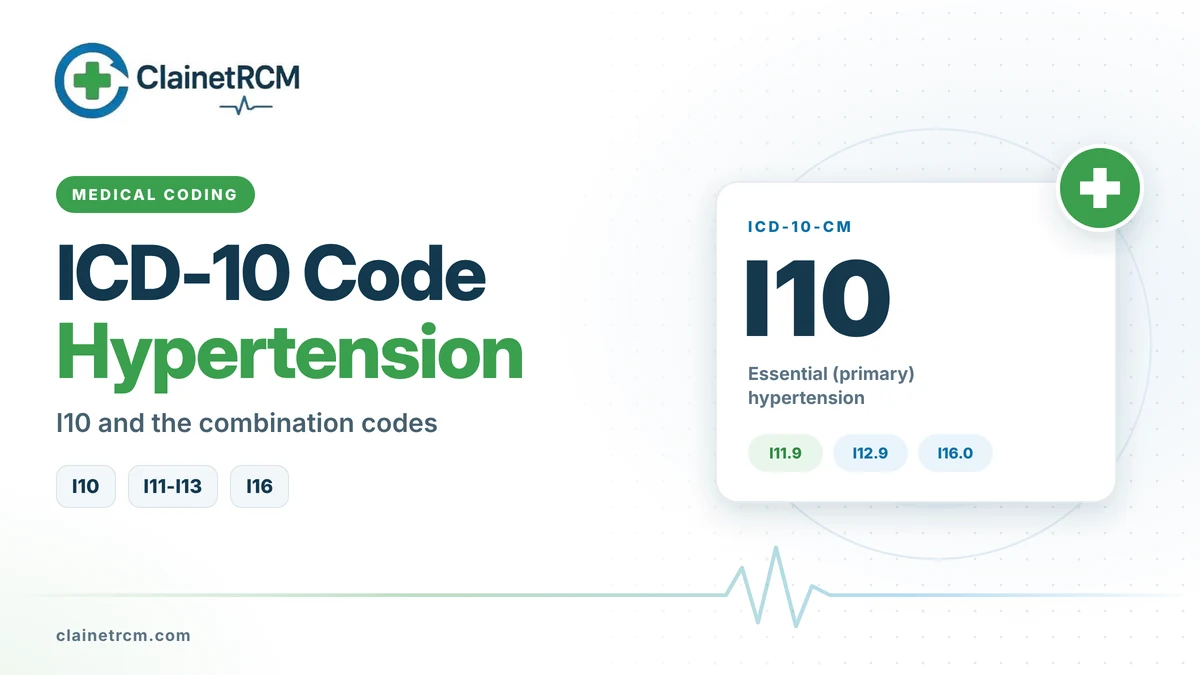
The ICD-10 code for hypertension looks simple: I10 for essential hypertension. But ICD-10-CM assumes a link between hypertension and certain heart and kidney conditions, so many patients with high blood pressure need a combination code instead. Hypertensive urgency, emergency, resistant hypertension and secondary hypertension each have their own codes, and the choice affects quality reporting and risk adjustment.
Quick answer: Use I10 for essential (primary) hypertension with no related heart or kidney disease. When the patient also has heart failure or certain other heart conditions, use I11.- (hypertensive heart disease); with chronic kidney disease, use I12.-; with both, use I13.-. Add codes for the heart failure type (I50.-) and CKD stage (N18.-). Report hypertensive urgency with I16.0, emergency with I16.1 and crisis unspecified with I16.9, along with the underlying hypertension code. Resistant hypertension is I1A.0, secondary hypertension is I15.-, and an elevated reading without a hypertension diagnosis is R03.0.
ICD-10 Code for Hypertension and Combination Codes
| Code | Description | Code also |
|---|---|---|
| I10 | Essential (primary) hypertension | — |
| I11.9 | Hypertensive heart disease without heart failure | — |
| I11.0 | Hypertensive heart disease with heart failure | Heart failure type (I50.-) |
| I12.9 | Hypertensive CKD, stage 1 to 4 or unspecified | CKD stage (N18.1 to N18.4, N18.9) |
| I12.0 | Hypertensive CKD, stage 5 or end-stage renal disease | N18.5 or N18.6, plus Z99.2 if on dialysis |
| I13.10 | Hypertensive heart and CKD without heart failure, CKD stage 1 to 4 | CKD stage |
| I13.0 | Hypertensive heart and CKD with heart failure, CKD stage 1 to 4 | I50.- and CKD stage |
| I13.11 | Hypertensive heart and CKD without heart failure, CKD stage 5 or ESRD | N18.5 or N18.6 |
| I13.2 | Hypertensive heart and CKD with heart failure and CKD stage 5 or ESRD | I50.- and N18.5 or N18.6 |
The Presumed Link Rule
ICD-10-CM presumes a cause-and-effect relationship between hypertension and:
- Heart failure and certain heart conditions, such as those classified to I50.- or I51.4 to I51.7, I51.89 and I51.9. Code them to I11.- or I13.- even if the provider does not write “due to hypertension.”
- Chronic kidney disease, coded to I12.- or I13.-.
The presumption does not apply when the provider documents a different cause, and it does not cover every heart condition. Coronary artery disease, for example, is not presumed to be hypertensive: a patient with hypertension and coronary artery disease is coded I10 plus I25.10.
Hypertensive Urgency, Emergency and Crisis
| Code | Description | Documentation |
|---|---|---|
| I16.0 | Hypertensive urgency | Severely elevated blood pressure without acute organ damage |
| I16.1 | Hypertensive emergency | Severely elevated blood pressure with acute organ damage |
| I16.9 | Hypertensive crisis, unspecified | Crisis documented without urgency or emergency specified |
Code also the hypertensive disease (I10 to I15) and any acute organ damage the provider documents.
Other Hypertension Codes
- I1A.0, resistant hypertension. Use when the provider documents hypertension that stays above goal despite multiple medications, with the code for the type of hypertension.
- I15.-, secondary hypertension. Use when high blood pressure is caused by another condition, such as renovascular disease or an endocrine disorder, and code the underlying condition too.
- R03.0, elevated blood pressure reading. Use when the reading is high but the provider has not diagnosed hypertension.
- Uncontrolled or poorly controlled hypertension. There is no separate code; assign the code for the type of hypertension.
- Pregnancy. Hypertension in pregnancy is coded from O10 to O16, not I10.
- Pulmonary hypertension is a different condition, coded to I27.-.
Hypertension With Diabetes and CKD
Chronic kidney disease can be linked to both diabetes and hypertension at the same time. When a patient has type 2 diabetes, hypertension and CKD, report the diabetic CKD code (E11.22), the hypertensive CKD code (I12.- or I13.-) and the CKD stage (N18.-), unless the provider documents that the kidney disease has another cause.
Documentation and Risk Adjustment
Essential hypertension (I10) does not carry a risk adjustment weight in the current Medicare Advantage model, but heart failure and advanced CKD do. That makes it important to document:
- The type and acuity of heart failure, such as chronic diastolic heart failure
- The CKD stage, including 3a or 3b
- Whether dialysis is required
- Medication changes, blood pressure readings and the assessment and plan for each condition
Pairing With CPT Codes
Hypertension supports many services: office E/M visits, EKGs (93000), ambulatory blood pressure monitoring (93784), self-measured blood pressure monitoring (99473, 99474) and remote patient monitoring. For quality programs, report blood pressure control with Category II codes such as 3074F (systolic below 130), 3075F (systolic 130 to 139) and 3077F (systolic 140 or higher), plus 3078F, 3079F or 3080F for the diastolic reading.
Coding Examples
| Scenario | Codes |
|---|---|
| Essential hypertension, no complications | I10 |
| Hypertension with CKD stage 3a | I12.9, N18.31 |
| Hypertension with chronic diastolic heart failure and CKD stage 4 | I13.0, I50.32, N18.4 |
| Hypertension with coronary artery disease | I10, I25.10 |
| Hypertensive urgency in a patient with essential hypertension | I16.0, I10 |
Common Errors
- Coding I10 plus I50.- instead of I11.0 when heart failure is present
- Coding I10 plus N18.- instead of I12.- when CKD is present
- Leaving out the CKD stage or heart failure type codes
- Using I16.- without the underlying hypertension code
- Coding hypertension for a single elevated reading without a diagnosis
Frequently Asked Questions
The ICD-10 code for essential (primary) hypertension is I10. Use a combination code from I11 to I13 when the patient also has related heart disease or chronic kidney disease.
Use I11.0 (or I13.0 or I13.2 when CKD is also present) for the hypertensive heart disease with heart failure, and add an I50.- code for the type of heart failure.
Yes, unless the provider documents that the CKD has another cause. Code hypertension with CKD to I12.- and add the CKD stage.
Hypertensive urgency is I16.0. Code also the underlying hypertension, such as I10.
Use R03.0 when the provider notes an elevated reading but has not diagnosed hypertension.
Final Thoughts
The ICD-10 code for hypertension depends on what else the patient has, so combination rules and specificity matter. Learn how we support cardiology practices on our cardiology billing page, or review related symptom coding in our shortness of breath ICD-10 guide.
Code Chronic Conditions to Full Specificity
Our coders apply ICD-10-CM combination rules, capture heart failure and CKD stages and support risk adjustment documentation for every hypertension visit.
Get Coding Help
Written by
ClainetRCM Billing Team
ClainetRCM is a Boston-based revenue cycle management company specializing in medical billing, coding, credentialing and denial management for healthcare providers across all 50 states. Our AAPC and AHIMA certified team works inside your existing EHR, files claims within 24 to 48 hours and reviews every AR bucket on a 14-day cycle.