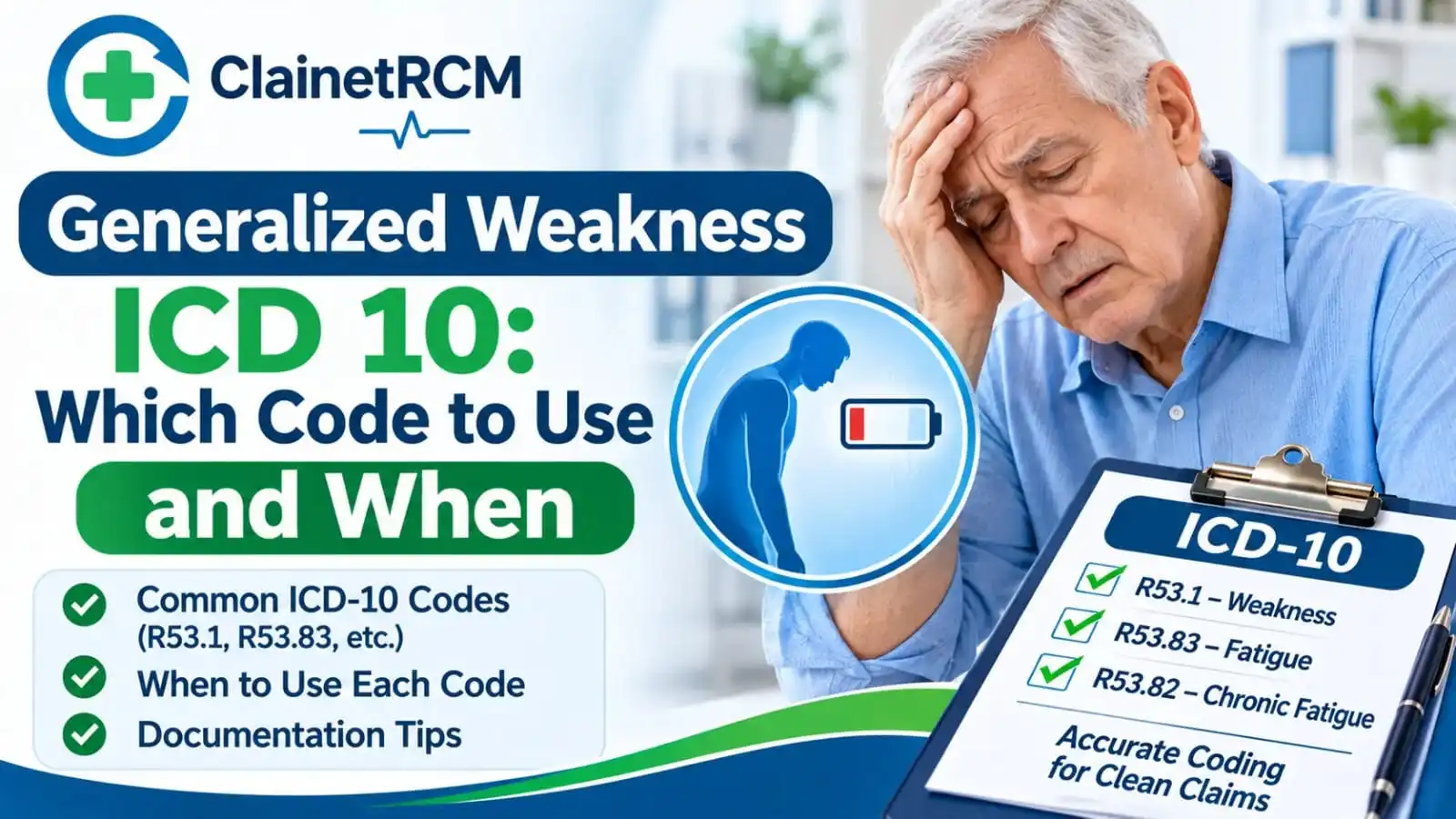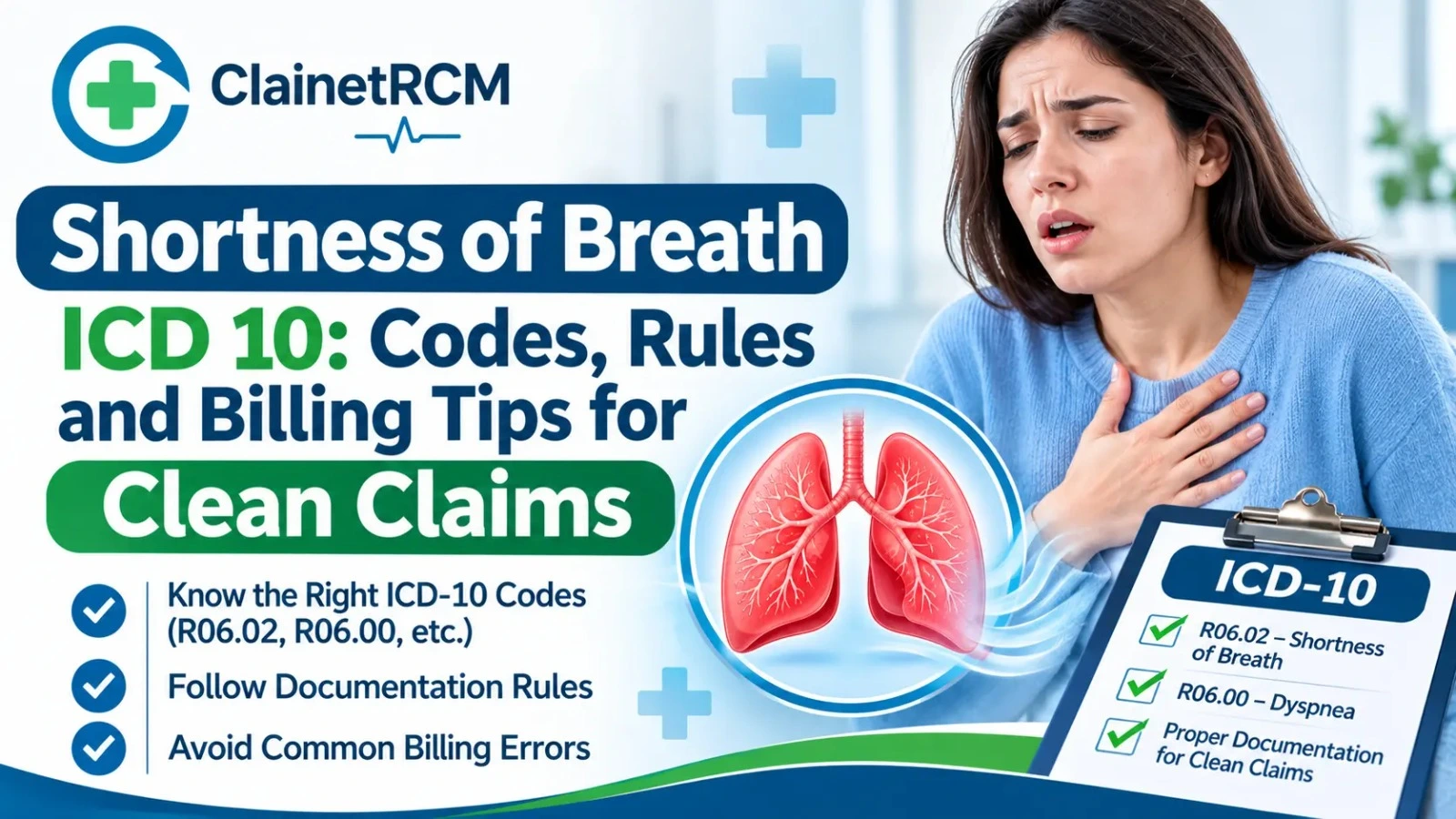
The ICD 10 code for shortness of breath is R06.02. It is a valid, billable symptom code in the ICD-10-CM set, and it stays valid in the FY2027 code year that began on October 1, 2026.
That is the quick answer. The harder part is knowing when R06.02 is the right choice and when it quietly causes a denial. I have watched practices lose money on this one code for years, and almost never because the code itself was wrong. The trouble comes from the documentation behind it, the diagnosis order on the claim, and the tests billed alongside it.
This guide walks through the full R06 family, the rules that decide which code you pick, how to link symptoms to services, and what to fix when a payer pushes back.
Quick answer: shortness of breath ICD 10 codes at a glance
| Code | Description | Use it when |
|---|---|---|
| R06.02 | Shortness of breath | The provider documents “shortness of breath” or “SOB” and no cause is confirmed |
| R06.00 | Dyspnea, unspecified | The provider documents “dyspnea” without more detail |
| R06.01 | Orthopnea | Breathlessness that appears when lying flat and eases when sitting up |
| R06.03 | Acute respiratory distress | Documented acute respiratory distress, not a specific syndrome or failure |
| R06.09 | Other forms of dyspnea | A documented form of dyspnea that has no dedicated code |
| R06.89 | Other abnormalities of breathing | Breathing abnormalities that do not fit another R06 code |
R06.03 was added to the code set on October 1, 2022. If your superbill or encounter form still lists only the older R06.0x codes, it is worth updating.
What the R06 category actually covers
All of these codes sit in Chapter 18 of ICD-10-CM, which holds symptoms, signs and abnormal findings not classified elsewhere. The category is R06, abnormalities of breathing. Under it, R06.0 is the dyspnea subcategory, and that is where shortness of breath lives.
The category also includes codes people often search for alongside shortness of breath:
- R06.1 for stridor
- R06.2 for wheezing
- R06.82 for tachypnea
- R06.83 for snoring
- R06.4 for hyperventilation
Related codes outside R06 come up constantly in the same encounters. R09.02 is hypoxemia, R05.x covers cough, R07.x covers chest pain, and R00.2 is palpitations.
One more point on scope. ICD-10-CM keeps certain serious conditions out of this symptom category. Acute respiratory distress syndrome (J80), respiratory failure (J96.-) and respiratory arrest (R09.2) have their own codes, and the Excludes1 notes tell you not to report them together with the symptom code. If the provider documents one of those conditions, code the condition, not the symptom.
R06.02 vs R06.00: is there a real difference?
Yes, though clinicians treat the two terms as the same thing. The classification does not.
R06.02 maps to the words “shortness of breath.” R06.00 maps to “dyspnea, unspecified.” The ICD-10-CM Index sends the word dyspnea, including the nocturnal and paroxysmal forms, to R06.00. It sends the phrase shortness of breath to R06.02.
So the coder’s job is simple. Follow the provider’s words. If the note says “shortness of breath,” use R06.02. If it says “dyspnea” and nothing more, use R06.00. If the provider writes both in the same note, R06.02 is the safer and more specific pick for the symptom as the patient described it.
This is also why template-driven notes can hurt you. A provider who clicks “dyspnea” from a dropdown may be handing the coder a less specific code than the patient actually reported.
When to use R06.02 as the first-listed diagnosis
Symptom codes are not second-class codes. Official guidelines allow them, and they expect them, when a definitive diagnosis has not been established. R06.02 works as the first-listed diagnosis when:
- Shortness of breath is the main reason for the visit.
- The provider has not yet confirmed a cause.
- The workup is still in progress, such as an ECG, chest X-ray, labs or pulmonary function testing.
A common example is a patient who walks into a primary care clinic with two weeks of breathlessness. The provider examines them, orders a chest X-ray and a BNP, and schedules a follow-up. At that visit, R06.02 is the correct primary diagnosis. Nobody knows the cause yet, and the claim should say exactly that.
When not to use R06.02
This is where many claims go wrong. The guidelines say signs and symptoms that are routinely part of a disease process should not be coded separately. Shortness of breath is a textbook example.
If the provider diagnoses any of the following, shortness of breath is integral to the condition and should not be added:
- COPD with acute exacerbation (J44.1)
- Congestive heart failure (I50.-)
- Asthma (J45.-)
- Pneumonia (J18.-)
- Pulmonary embolism (I26.-)
Adding R06.02 on top of a confirmed diagnosis does not make the claim stronger. It makes it look careless, and in some payer edits it creates a conflict that triggers a review.
A related trap is using a symptom code when the provider has documented a diagnosis in the assessment but the coder only read the chief complaint. Always code from the assessment and plan, not from the first line of the note.
Outpatient and inpatient rules are different
Outpatient and professional claims follow a strict rule on uncertain diagnoses. If the provider writes “probable pneumonia,” “suspected PE” or “rule out CHF,” you do not code the condition. You code the signs and symptoms that prompted the workup. For an outpatient visit, that usually means R06.02 plus whatever other symptoms are documented.
Inpatient facility coding works the other way for uncertain diagnoses documented at discharge. Those can be coded as if they were confirmed, which is why the same patient can carry a symptom code on a clinic claim and a definitive diagnosis on the hospital claim. Both are correct. They follow different rules.
If you bill for a practice that sees both settings, such as a pulmonology practice, keep this split in front of your coders. Mixing the two rules is one of the most frequent audit findings I see.
Shortness of breath on exertion, at rest, chronic and acute
Patients and providers describe breathlessness in many ways, and people search for each variation. Here is how the main ones usually code.
Shortness of breath at rest. R06.02. There is no separate code.
Orthopnea. R06.01, when the provider documents breathlessness while lying flat.
Paroxysmal nocturnal dyspnea. R06.00, which is where the Index sends the nocturnal and paroxysmal forms. This one often points to a cardiac cause, so a diagnosis may soon replace the symptom code.
Acute shortness of breath. R06.02 if the provider documents shortness of breath. If the provider documents acute respiratory distress, R06.03 fits better. Acute or chronic is a clinical descriptor, not a separate R06.02 option.
Chronic shortness of breath. Also R06.02. Many resources define chronic dyspnea as lasting longer than four to eight weeks, but that duration is clinical context for the note, not something that changes the code.
Shortness of breath on exertion. Here the published sources disagree. Some coding references assign R06.02 and say no code separates exertional from resting dyspnea. Others point to R06.09, other forms of dyspnea, for dyspnea on exertion. The Index has no dedicated entry for it. My advice is to follow the exact words in the provider’s note, apply your organization’s written coding policy consistently, and check any payer-specific guidance. Whichever way you go, apply it the same way every time so your denial data stays clean.
Common code combinations in real encounters
Symptoms rarely travel alone. These pairings show up most often when no definitive diagnosis is documented:
| Documented presentation | Typical codes |
|---|---|
| Shortness of breath with cough | R06.02, plus R05.1 (acute), R05.3 (chronic) or R05.9 as documented |
| Shortness of breath with chest pain | R06.02, plus R07.9 or R07.89 as documented |
| Shortness of breath with palpitations | R06.02 and R00.2 |
| Shortness of breath with wheezing | R06.02 and R06.2 |
| Shortness of breath with low oxygen reading | R06.02 and R09.02 |
| Shortness of breath after a COVID-19 infection | U09.9 plus R06.02, per the provider’s documentation |
There is no combination code for shortness of breath and fatigue, so each symptom is reported on its own. Code all documented symptoms that are not integral to a confirmed diagnosis, and no more than that.
For patients whose breathlessness has a likely cardiac source, the claim may end up flowing through a cardiology workup. Cardiology billing brings its own diagnosis and procedure pairing rules, and it helps when the referring practice’s symptom coding is clean from the start.
Linking R06.02 to the services you bill
A symptom code carries the claim only as far as the payer’s medical necessity edits allow. These are the services most often billed with shortness of breath as the supporting diagnosis:
- Office visits. An evaluation and management code such as 99213 or 99214. Our guide to CPT code 99213 explains how the level is chosen.
- Chest X-ray. 71045 or 71046.
- ECG. 93000.
- Spirometry. 94010, and 94060 when a bronchodilator response is measured.
- Pulse oximetry. 94760 for a single measurement.
- Echocardiogram. 93306 for a complete transthoracic study.
- Labs. BNP or NT-proBNP (83880) and D-dimer (85379).
Basic tests like the ones above usually pass with R06.02 alone. Advanced imaging is another story. Many payers will not approve a chest CT, a nuclear stress test or a cardiac MRI on a bare symptom code. They want the duration, the findings, the failed first-line treatment or the abnormal result that justifies escalation. If your practice orders high-cost imaging, build a prior authorization step into the workflow so the clinical story is attached before the order goes out, not after the denial comes back.
What provider documentation should include
Good coding starts at the keyboard of the person seeing the patient. For shortness of breath, a note that holds up under review usually contains:
- The patient’s own description, using the words “shortness of breath” or “dyspnea.”
- Onset and duration, and whether it is getting better, worse or staying the same.
- Triggers and relievers, such as exertion, lying flat, allergens or position.
- Associated symptoms, including cough, chest pain, fever, wheezing, swelling or palpitations.
- Pertinent exam findings, including oxygen saturation, lung sounds and heart rate.
- The assessment, written as a symptom if no cause is confirmed.
- The plan, with each test tied to the reason it was ordered.
The last item matters more than most practices realize. A test with no stated reason is a test a payer can deny.
FY2027 update: what changed for R06 codes
The FY2027 ICD-10-CM code set took effect on October 1, 2026, and covers encounters through September 30, 2027. CMS and the CDC published the files in June 2026, and there is no grace period. Code selection depends on the date of service for professional and outpatient claims, and on the discharge date for inpatient claims.
Published code lookups show the R06 family unchanged in this release, so R06.02 remains valid for the whole year. The wider update still includes new, deleted and revised codes elsewhere in the set, and some of those can reject claims that used to pay. I would still check the official CMS tabular listing for R06 before building any edit or template around it, since sources differ on small details.
Why claims with R06.02 get denied, and how to fix them
Most denials tied to this code fall into a few patterns.
Medical necessity (CARC 50). The service was not considered necessary for the diagnosis given. Fix: add documentation of duration, severity and findings, link each test to the symptom in the note, and consider whether a more specific diagnosis is now supported.
Diagnosis inconsistent with the procedure (CARC 11). The diagnosis does not match the service billed. Fix: verify the diagnosis pointers on the claim and make sure the symptom actually supports the test.
Diagnosis not covered (CARC 167). The payer does not cover the service for that diagnosis. Fix: check the payer’s policy, and appeal with the clinical record if the provider documented a stronger indication.
Missing or invalid information (CARC 16). Often a diagnosis pointer or order of codes problem. Fix: correct and resubmit.
A consistent denial pattern on one code usually points to a process problem, not a one-off error. A structured denial management review will show whether the root cause sits in documentation, coding or the payer’s edits. The same discipline that prevents these denials also supports a high first-pass rate, which our guide on clean claims in medical billing covers in more detail.
Common shortness of breath coding mistakes
- Reporting R06.02 alongside a confirmed diagnosis it is part of.
- Using R06.00 when the provider wrote “shortness of breath.”
- Coding a “rule out” or “suspected” condition on an outpatient claim.
- Skipping documented associated symptoms that support medical necessity.
- Listing the symptom first when a definitive diagnosis is established.
- Assuming a code is valid because it was last year.
- Treating exertional dyspnea differently from one coder to the next.
Frequently asked questions
R06.02. It is a billable symptom code in ICD-10-CM and remains valid in the FY2027 code set.
R06.00 is dyspnea, unspecified. Related dyspnea codes are R06.01 for orthopnea, R06.03 for acute respiratory distress and R06.09 for other forms of dyspnea.
Yes. It is a complete, billable code and Medicare, Medicaid and commercial payers accept it.
R06.00 captures dyspnea with no more detail. R06.02 captures the documented phrase shortness of breath. Code the term the provider actually used.
Usually not. Shortness of breath is integral to those conditions, so you report the confirmed diagnosis instead of the symptom.
Sources differ. Some references use R06.02 and others use R06.09. Follow the provider’s exact wording and your written coding policy, and check payer guidance.
Yes, when shortness of breath is the reason for the visit and no definitive diagnosis has been made.
Final thoughts
Shortness of breath looks like an easy code, and that is exactly why it causes trouble. R06.02 is the right answer to the search question, but the claim only gets paid when the note, the diagnosis order and the billed services all tell the same story.
Get the provider’s wording right, drop the symptom once a diagnosis is confirmed, tie every test to a documented reason, and recheck your code set each October. Do those four things and this code stops being a denial risk.
Tired of symptom code denials eating your revenue?
Our certified coders and billing specialists review your documentation, fix coding gaps and recover lost payments, so your team can focus on patients.
Talk to Clainet RCM today
Written by
ClainetRCM Billing Team
ClainetRCM is a Boston-based revenue cycle management company specializing in medical billing, coding, credentialing and denial management for healthcare providers across all 50 states. Our AAPC and AHIMA certified team works inside your existing EHR, files claims within 24 to 48 hours and reviews every AR bucket on a 14-day cycle.