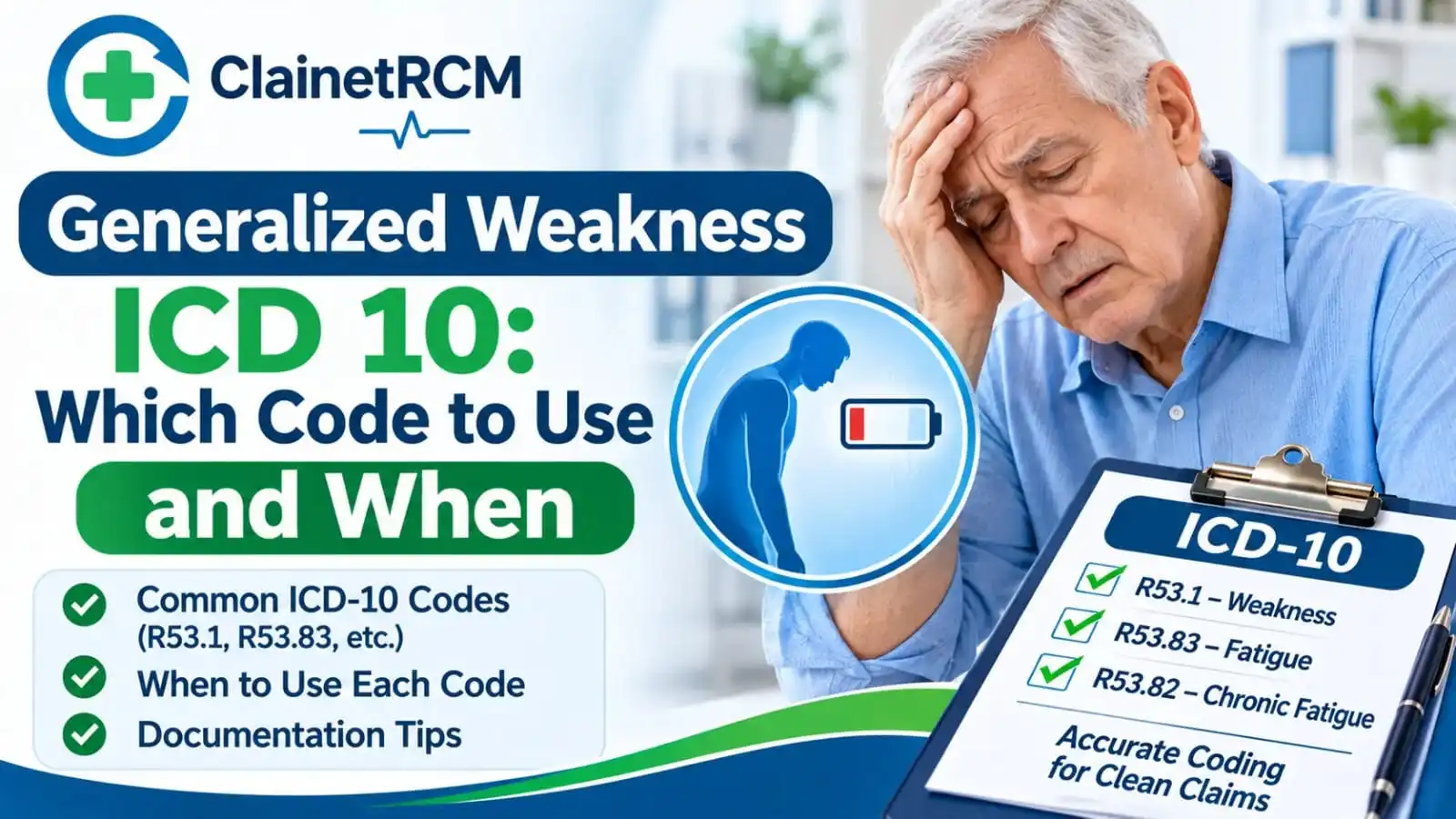
If a provider writes “generalized weakness” in a note, the default ICD-10-CM code is R53.1 (Weakness). If the provider documents generalized muscle weakness, the better fit is M62.81 (Muscle weakness, generalized). These two codes look almost identical, but they are not interchangeable, and picking the wrong one is one of the quietest ways to invite a medical necessity denial.
Both codes are billable and valid for claims from October 1, 2026 through September 30, 2027. Neither code changed in the FY2027 update, so everything in this guide applies to current claims.
Quick Answer: Generalized Weakness ICD 10 Codes
| Code | Description | Use it when |
|---|---|---|
| R53.1 | Weakness | Provider documents generalized weakness or asthenia with no confirmed cause |
| M62.81 | Muscle weakness (generalized) | Provider documents reduced muscle strength as the clinical finding, common in therapy and rehab |
| R53.81 | Other malaise | Provider documents general debility or physical deterioration |
| R53.83 | Other fatigue | Patient complaint is tiredness or lack of energy, not weakness |
| R54 | Age-related physical debility | Weakness is attributed to old age or frailty |
| M62.84 | Sarcopenia | Provider diagnoses age-related loss of muscle mass and strength |
If you only need one line to remember, here it is: R53.1 is the symptom as the patient reports it. M62.81 is the strength deficit the clinician has actually assessed.
What Generalized Weakness Actually Means in Coding
Generalized weakness means a patient feels weak all over, not in one limb or one side of the body. Clinically it is a symptom, not a disease. It can come from anemia, infection, thyroid problems, electrolyte imbalance, medication side effects, heart failure, dehydration, depression, neuromuscular conditions and many other causes.
That matters for coding because ICD-10-CM treats weakness as a sign or symptom. The Official Guidelines allow you to report a symptom code when the provider has not reached a definitive diagnosis. Once a cause is confirmed and the weakness is a routine part of that condition, the symptom code is generally not reported on top of it.
After many years of reviewing claims, I can tell you the pattern. Weakness codes show up most often on first visits, emergency encounters, hospital admissions and therapy referrals, which are exactly the points where the cause is still unknown.
R53.1 Weakness: The Default Code
R53.1 sits in category R53, Malaise and fatigue, inside Chapter 18 (Symptoms, signs and abnormal clinical and laboratory findings). The Alphabetic Index sends “Weakness, generalized” and “Asthenia” straight to R53.1.
When R53.1 is the right choice
- The provider documents “generalized weakness,” “weakness,” “feels weak,” or “asthenia.”
- No specific finding has been measured and no cause has been established.
- The visit is an evaluation of the complaint itself, such as a workup for the cause.
When R53.1 is the wrong choice
- A confirmed diagnosis explains the weakness, such as hypothyroidism or anemia.
- The provider documents weakness attributed to old age. That belongs to R54.
- The provider documents sarcopenia. That belongs to M62.84.
- The provider documents generalized muscle weakness. That belongs to M62.81.
R53.1 carries Excludes1 notes for age-related weakness (R54), generalized muscle weakness (M62.81) and sarcopenia (M62.84). An Excludes1 note means the two conditions should not be reported together on the same claim.
For inpatient stays, R53.1 groups to MS-DRG 947 and 948 (Signs and symptoms). As a symptom code, it should not stay as the principal diagnosis once a definitive diagnosis is established.
M62.81 Muscle Weakness (Generalized): The Therapy Favorite
M62.81 lives in Chapter 13 (Diseases of the musculoskeletal system and connective tissue), in the category for other disorders of muscle. The key word in its description is “muscle.” It tells the payer that the clinician found reduced strength, not just that the patient said “I feel weak.”
When M62.81 fits
- The provider documents generalized muscle weakness.
- Manual muscle testing or functional testing shows reduced strength in multiple areas.
- A therapist or physician is building a treatment plan around strength deficits.
A clean documentation example: “Patient presents with generalized muscle weakness, 4/5 strength in bilateral hip flexors and quadriceps, difficulty rising from a chair without arm support.” That sentence supports M62.81 and also supports medical necessity for therapy.
Compare it to: “Patient reports feeling weak for two weeks.” That sentence supports R53.1 and nothing stronger.
If your team handles rehab claims, our guide to physical therapy billing covers how diagnosis choices connect to visit limits and payer edits.
R53.1 vs M62.81: The Side by Side Comparison
| Feature | R53.1 | M62.81 |
|---|---|---|
| Name | Weakness | Muscle weakness (generalized) |
| Chapter | Symptoms and signs | Musculoskeletal system |
| Typical wording | “Generalized weakness,” “asthenia,” “feels weak” | “Generalized muscle weakness,” “decreased strength” |
| Supported by | Patient complaint | Clinical exam or testing |
| Common setting | Primary care, ED, hospital admission | Physical and occupational therapy, rehab, geriatrics |
| Report together? | No (Excludes1) | No (Excludes1) |
The most common error I see is a biller choosing M62.81 because it “sounds more specific” when the note only says “generalized weakness.” Coders code what the provider documents. If the note does not support muscle weakness, do not upgrade the code. If you think the code should be more specific, send a query to the provider.
Related Codes That Get Confused With Generalized Weakness
R53.81, Other malaise. This includes debility, general physical deterioration and chronic debility. It fits a patient who is declining overall, not just weak.
R53.83, Other fatigue. Use it when the complaint is tiredness, exhaustion or lack of energy. A patient who says “I am worn out” has fatigue. A patient who says “my legs will not hold me up” has weakness.
R53.0, Neoplastic (malignant) related fatigue. Sequence the neoplasm code first.
R54, Age-related physical debility. This covers frailty and senile debility. If the provider links the weakness to aging, R54 is the correct choice. Practices that serve older adults should look closely at how their providers phrase this, and our overview of geriatrics billing explains the claim patterns that come with this population.
M62.84, Sarcopenia. A true diagnosis of age-related muscle loss. It needs provider documentation of the diagnosis itself.
R53.2, Functional quadriplegia. Complete immobility due to severe disability or frailty, not for general weakness.
R29.810, Facial weakness. Facial droop or weakness, which has a very different clinical meaning.
Hemiparesis codes (G81.-). Weakness on one side of the body is not generalized weakness. It is coded by side and type.
Documentation Tips That Prevent Denials
Weakness codes are low specificity by nature, so payers read the note closely. Documentation is what separates a paid claim from a denied one.
A strong note for a weakness encounter includes:
- Onset and duration. “Progressive over three weeks” tells a different story than “since this morning.”
- Distribution. Say generalized, bilateral, proximal or distal. Do not leave it vague.
- Objective findings. Strength grades, gait observations, ability to rise from a chair, grip strength.
- Associated symptoms. Fever, weight loss, dizziness, shortness of breath, numbness.
- Workup ordered. Labs, imaging, medication review, referrals.
- Clinical impression. If the cause is suspected but not confirmed, document the symptom and the workup. In outpatient settings, do not code diagnoses described as probable, suspected or rule out. Code the symptom.
One practical habit: ask providers to write “generalized weakness” or “generalized muscle weakness” exactly as they mean it. The wording decides the code.
Sequencing and Claim Form Tips
On a CMS-1500 professional claim, you can report up to 12 diagnosis codes, and each service line can point to up to four of them. When weakness is the reason for the visit and the cause is unknown, list R53.1 first. If the workup finds a cause, replace the symptom code with the confirmed diagnosis on later claims.
Avoid stacking multiple weakness codes on the same claim just to look thorough. Because of the Excludes1 notes, R53.1 and M62.81 should not appear together, and payers use automated edits to catch conflicts.
Accurate code selection is a skill that improves with a trained eye, which is one reason many practices lean on professional medical coding support when volume grows.
Why Weakness Claims Get Denied
Symptom codes get denied less because they are wrong and more because they are weak on their own. Here are the denial patterns I see most:
CO-50 (not medically necessary). The diagnosis does not justify the service billed. This is common when R53.1 is paired with an advanced imaging study or a high-level visit without supporting documentation.
CO-11 (diagnosis inconsistent with procedure). The payer’s edit does not match the diagnosis to the procedure code. Therapy codes billed with only a symptom code are a frequent trigger.
Frequency and visit limit denials. Therapy payers may ask for a more specific diagnosis or functional reporting after a set number of visits.
Unspecified or symptom code rejections. Some payer policies limit which diagnoses are accepted as the primary reason for certain services. Always check the payer’s own coverage policy, since these rules vary.
The fix is almost always upstream. Better documentation, a clear link between the finding and the service, and a clean code choice stop most of these before submission. When denials do land, structured denial management turns each rejection into an appeal or a process correction. For a broader view on stopping them early, see our guide to claim denials prevention.
Real World Coding Examples
Example 1: Primary care visit, no cause yet
A 58 year old patient says she has felt weak for two weeks. Exam is unremarkable and labs are ordered. Provider documents “generalized weakness, workup in progress.”
Code: R53.1
Example 2: Therapy evaluation
A therapist documents generalized muscle weakness after a hospital stay, with 3+/5 strength in the lower extremities and difficulty with stairs.
Code: M62.81
Example 3: Cause confirmed
The patient’s labs return with severe iron deficiency anemia, and the provider documents weakness due to the anemia.
Code: the anemia diagnosis. Weakness is a symptom of the confirmed condition, so it is generally not reported separately.
Example 4: Older adult with decline
A provider documents “age-related debility with frailty.”
Code: R54
Example 5: Tired, not weak
A patient reports exhaustion after minimal activity, with no loss of strength on exam.
Code: R53.83
Common Mistakes to Avoid
- Reporting R53.1 and M62.81 together on the same claim.
- Using M62.81 when the note has no objective strength finding.
- Choosing R53.83 for a weakness complaint, or R53.1 for pure fatigue.
- Continuing to bill the symptom code after the cause has been diagnosed.
- Coding “probable” or “suspected” causes in the outpatient setting.
- Using generalized weakness codes for one-sided or one-limb weakness.
- Relying on old code lists. Always confirm against the current fiscal year code set.
Frequently Asked Questions
The ICD-10-CM code for generalized weakness is R53.1 (Weakness). If the provider documents generalized muscle weakness, the code is M62.81.
Yes. R53.1 is a billable, specific code and is valid for claims from October 1, 2026 through September 30, 2027.
R53.1 reports weakness as a symptom the patient describes. M62.81 reports decreased muscle strength that the provider has documented as the clinical finding. They have Excludes1 notes with each other and should not be reported together.
No. The Excludes1 relationship means you choose one based on provider documentation.
If the provider ties the weakness to aging or frailty, use R54 (Age-related physical debility). If the provider diagnoses sarcopenia, use M62.84. Otherwise, use R53.1 or M62.81 depending on the documentation.
They are separate concepts. Weakness is R53.1 and fatigue is R53.83. Report each only if the provider documents it.
No. R53.1 and M62.81 had no changes in the FY2027 update effective October 1, 2026.
It is a symptom. It is acceptable to report it when no definitive diagnosis has been made, but it should not be reported when a confirmed condition fully explains it.
Final Thoughts
Generalized weakness looks like an easy code to pick, and that is exactly why it causes so many avoidable problems. R53.1 when the patient reports weakness with no cause, M62.81 when the clinician documents reduced muscle strength, and a more specific code whenever the provider gives you one. Let the documentation lead and the code will follow.
If your team is spending too much time fixing diagnosis errors and chasing symptom code denials, a reliable billing partner makes a real difference.
Tired of Symptom Code Denials Slowing Down Your Revenue?
Clainet RCM helps practices get diagnosis coding right the first time, cut avoidable denials and get paid faster.
Talk to Our Billing Experts Today
Written by
ClainetRCM Billing Team
ClainetRCM is a Boston-based revenue cycle management company specializing in medical billing, coding, credentialing and denial management for healthcare providers across all 50 states. Our AAPC and AHIMA certified team works inside your existing EHR, files claims within 24 to 48 hours and reviews every AR bucket on a 14-day cycle.