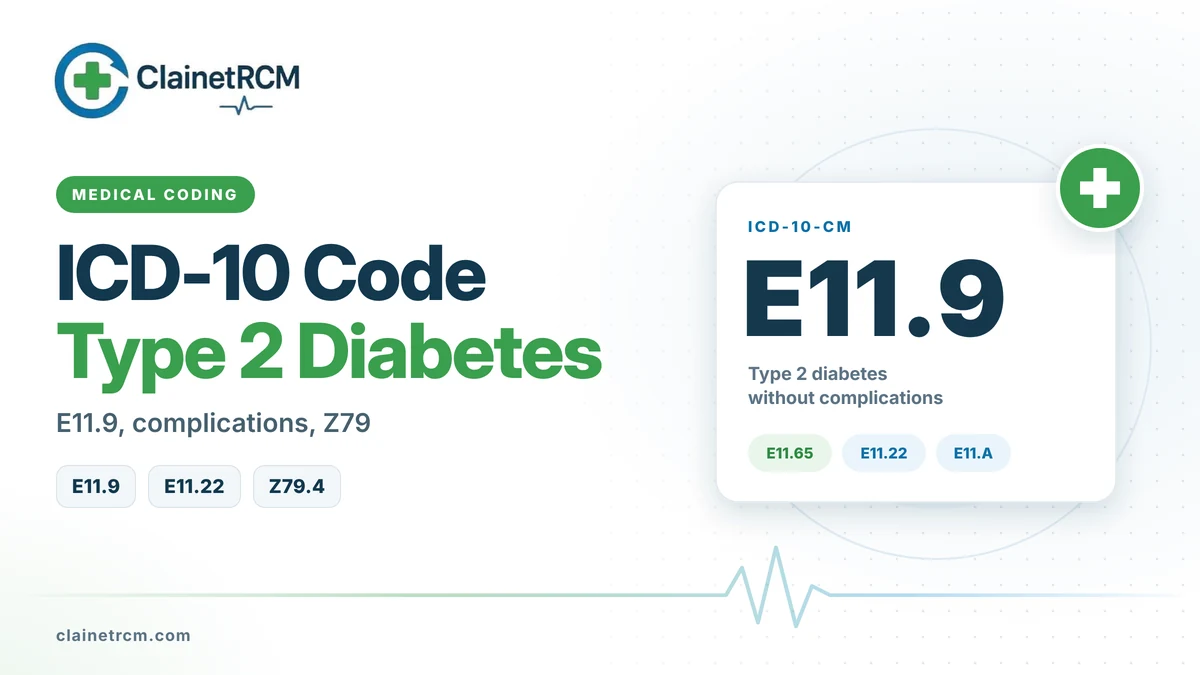
The ICD-10 code for type 2 diabetes is E11.9 only when the patient has no documented complications. Most patients with long-standing diabetes have at least one related condition, such as kidney disease, neuropathy or retinopathy, and ICD-10-CM expects each to be coded with its own E11 combination code. Medication codes and the newer remission code complete the picture for claims, quality measures and risk adjustment.
Quick answer: Use E11.9 for type 2 diabetes without complications. Otherwise, assign an E11 code for each documented complication, such as E11.22 (diabetic chronic kidney disease) with the CKD stage, E11.42 (diabetic polyneuropathy), E11.621 (foot ulcer) with the ulcer code, E11.65 (hyperglycemia) or E11.649 (hypoglycemia without coma). Use E11.A for type 2 diabetes without complications in remission. Add long-term drug therapy codes: Z79.4 for insulin, Z79.84 for oral hypoglycemics and Z79.85 for injectable non-insulin drugs such as GLP-1 receptor agonists.
ICD-10 Code for Type 2 Diabetes: Common Codes
| Code | Description | Code also |
|---|---|---|
| E11.9 | Type 2 diabetes without complications | — |
| E11.65 | With hyperglycemia | — |
| E11.649 | With hypoglycemia without coma | Hypoglycemia level (E16.A-) when documented |
| E11.22 | With diabetic chronic kidney disease | CKD stage (N18.-) |
| E11.40, E11.42 | With diabetic neuropathy, unspecified; with polyneuropathy | — |
| E11.3- | With diabetic retinopathy or other eye complications | Seventh character for the eye on many codes |
| E11.51 | With peripheral angiopathy without gangrene | — |
| E11.621 | With foot ulcer | Ulcer site and depth (L97.4- or L97.5-) |
| E11.69 | With other specified complication | The complication |
| E11.A | Without complications, in remission | — |
Use as many E11 codes as needed to describe every documented complication.
Complications ICD-10-CM Presumes Are Linked
The ICD-10-CM index lists many conditions under “with” for diabetes, such as chronic kidney disease, neuropathy, peripheral angiopathy and foot ulcers. These conditions are presumed to be diabetic complications and are coded with the E11 combination code, even if the provider does not write “diabetic,” unless the provider documents another cause. Conditions not listed under “with” need the provider to link them.
Long-Term Drug Therapy Codes
- Z79.4, long-term (current) use of insulin
- Z79.84, long-term (current) use of oral hypoglycemic drugs
- Z79.85, long-term (current) use of injectable non-insulin antidiabetic drugs
When a patient uses insulin plus an oral drug, or insulin plus an injectable non-insulin drug, assign both applicable codes. Do not assign Z79.4 when insulin is given only temporarily, such as during a hospital stay, to bring a type 2 patient’s glucose under control.
Uncontrolled, Hyperglycemia and Hypoglycemia
ICD-10-CM has no code for “uncontrolled” diabetes. The index directs terms such as uncontrolled, poorly controlled or out of control to hyperglycemia (E11.65) or hypoglycemia (E11.649 or E11.641), based on what the provider documents. Since October 1, 2024, hypoglycemia levels can be added with E16.A1 to E16.A3.
Type 2 Diabetes in Remission
Effective October 1, 2025, E11.A reports type 2 diabetes without complications, in remission. Use it only when the provider documents remission, typically after sustained normal glucose levels without diabetes medication. If the patient still has a diabetic complication, such as CKD, code that complication with its E11 code instead.
When the Type or Setting Changes the Code
- Type not documented. If the provider does not state the type of diabetes, ICD-10-CM defaults to type 2 (E11).
- Insulin without a type. A patient described only as insulin-requiring is still coded E11 with Z79.4 unless type 1 diabetes is documented.
- Pregnancy. Pre-existing type 2 diabetes in pregnancy is coded O24.1- first, followed by the E11 codes; gestational diabetes is O24.4-.
- Other types. Type 1 diabetes is E10, drug- or chemical-induced diabetes is E09 and diabetes due to an underlying condition is E08.
Risk Adjustment and Documentation
In the current Medicare Advantage risk model (V28), the diabetes HCC categories carry the same weight whether or not complications are coded, but related conditions such as advanced CKD and vascular disease carry their own weight, and specific coding still drives quality measures and care management. Every chronic condition should be supported by MEAT documentation: monitoring, evaluation, assessment and treatment. A problem list entry alone does not support a code.
Pairing With CPT Codes
Diabetes supports many services and quality codes: A1C testing (83036), urine albumin tests, diabetic eye exams, CGM interpretation (95251), diabetes self-management training, and foot exams for patients with loss of protective sensation (G0245 to G0247). Report A1C results with Category II codes such as 3044F (below 7%), 3051F (7% to below 8%), 3052F (8% to 9%) and 3046F (above 9%).
Coding Examples
| Scenario | Codes |
|---|---|
| Type 2 diabetes, diet-controlled, no complications | E11.9 |
| Type 2 diabetes with CKD stage 3b, on insulin and metformin | E11.22, N18.32, Z79.4, Z79.84 |
| Type 2 diabetes with hyperglycemia, on semaglutide | E11.65, Z79.85 |
| Type 2 diabetes with right heel ulcer limited to breakdown of skin | E11.621, L97.411 |
| Type 2 diabetes in remission after weight loss, no complications | E11.A |
Common Errors
- Coding E11.9 when complications are documented
- Coding a diabetic complication without its manifestation code, such as the CKD stage or ulcer site
- Forgetting the Z79 medication codes
- Assigning Z79.4 for temporary insulin use
- Coding diabetes from a problem list without MEAT documentation
- Reporting E11.9 together with other E11 complication codes
- Using E11.A when the patient still has a documented diabetic complication
Frequently Asked Questions
E11.9. Use it only when the provider documents no diabetic complications.
There is no “uncontrolled” code. Use E11.65 for hyperglycemia or E11.649 for hypoglycemia, based on the documentation.
Yes. Add Z79.4 for long-term insulin use, plus Z79.84 or Z79.85 when the patient also uses oral or injectable non-insulin drugs.
E11.A, effective October 1, 2025, reports type 2 diabetes without complications in remission, as documented by the provider.
Yes. Assign as many E11 codes as needed to describe all documented complications.
Final Thoughts
The ICD-10 code for type 2 diabetes should tell the full story of the patient’s disease, treatment and complications. Learn how we support diabetes care on our endocrinology billing page, or read our generalized weakness ICD-10 guide for more on symptom coding.
Capture Every Diabetes Complication Accurately
Our coders apply ICD-10-CM diabetes rules, link complications correctly and support risk adjustment documentation so your claims and quality data are complete.
Get Coding Help
Written by
ClainetRCM Billing Team
ClainetRCM is a Boston-based revenue cycle management company specializing in medical billing, coding, credentialing and denial management for healthcare providers across all 50 states. Our AAPC and AHIMA certified team works inside your existing EHR, files claims within 24 to 48 hours and reviews every AR bucket on a 14-day cycle.