The ICD-10 code for obesity has become more precise in recent years. Since October 1, 2024, ICD-10-CM includes codes for obesity class 1, 2 and 3, and the BMI codes have been expanded for both children and adults, most recently on October 1, 2026. Pairing the right obesity code with the right BMI code matters for claims, risk adjustment and coverage of weight management services.
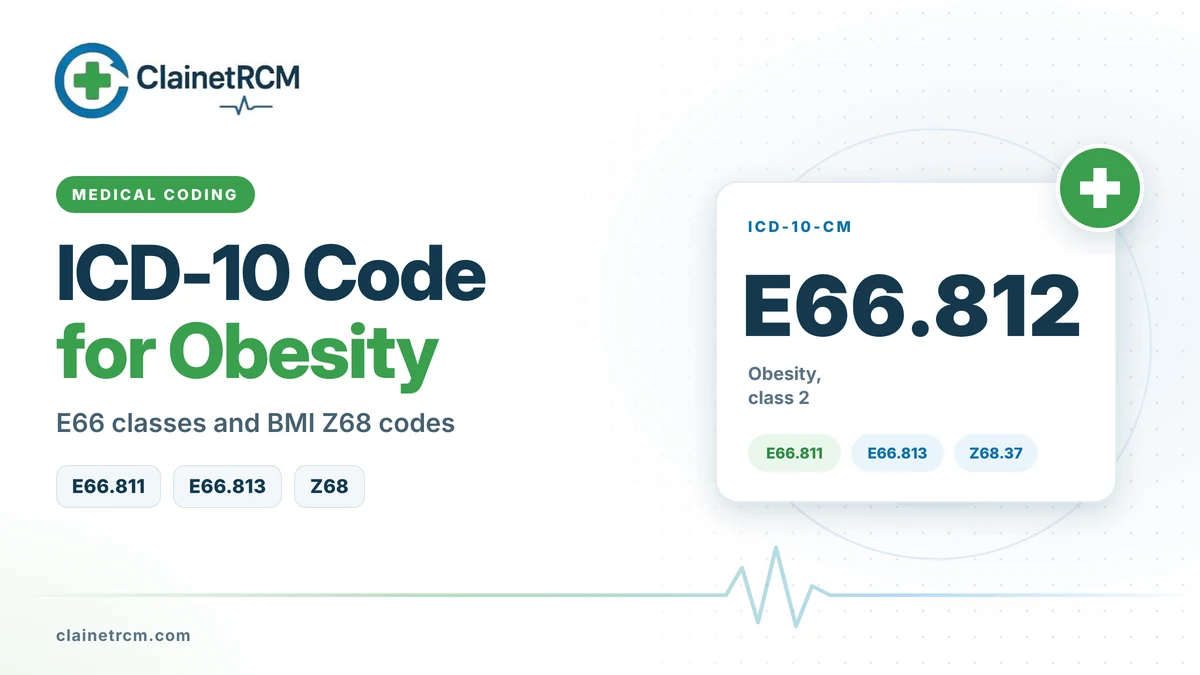
Quick answer: Use E66.811, E66.812 or E66.813 when the provider documents obesity class 1, 2 or 3. Use E66.01 for morbid (severe) obesity due to excess calories, E66.3 for overweight and E66.9 when obesity is not specified further. Add a BMI code from Z68 as a secondary code, such as Z68.30 to Z68.39 for adults with a BMI of 30 to 39.9, Z68.41 to Z68.45 for a BMI of 40 or more, and Z68.54 to Z68.56 for children. Medicare covers intensive behavioral therapy for obesity (G0447) when BMI is 30 or more.
ICD-10 Code for Obesity: E66 Options
| Code | Description |
|---|---|
| E66.811 | Obesity, class 1 |
| E66.812 | Obesity, class 2 |
| E66.813 | Obesity, class 3 |
| E66.01 | Morbid (severe) obesity due to excess calories |
| E66.09 | Other obesity due to excess calories |
| E66.1 | Drug-induced obesity |
| E66.2 | Morbid (severe) obesity with alveolar hypoventilation |
| E66.3 | Overweight |
| E66.89 | Other obesity, not elsewhere classified |
| E66.9 | Obesity, unspecified |
When the provider documents “class 3 obesity,” assign E66.813 rather than E66.01.
BMI Codes
| BMI range | Adult code |
|---|---|
| 18.4 or less | Z68.18 (new October 1, 2026) |
| 18.5 to 19.9 | Z68.19 (new October 1, 2026) |
| 20 to 29.9 | Z68.20 to Z68.29 |
| 30 to 39.9 | Z68.30 to Z68.39 |
| 40 to 44.9 | Z68.41 |
| 45 to 49.9 | Z68.42 |
| 50 to 59.9 | Z68.43 |
| 60 to 69.9 | Z68.44 |
| 70 or greater | Z68.45 |
For children and teens, the pediatric BMI codes are based on percentiles: Z68.51 (below the 5th percentile), Z68.52 (5th to below the 85th), Z68.53 (85th to below the 95th), Z68.54 (95th percentile to below 120% of the 95th), Z68.55 (120% to below 140% of the 95th) and Z68.56 (140% of the 95th percentile or greater). Code Z68.1 is no longer valid for dates of service on or after October 1, 2026.
Rules for Using BMI Codes
- Secondary only. BMI codes are reported only with an associated diagnosis, such as obesity or overweight, and never as the first-listed diagnosis.
- Who documents. BMI can be taken from the notes of other clinicians, such as a nurse or dietitian, but the weight diagnosis itself must come from the provider.
- Match the class. The obesity class should be consistent with the BMI recorded, and the provider’s documentation decides the diagnosis.
Risk Adjustment
In the current Medicare Advantage risk model, morbid obesity (E66.01, E66.2), class 3 obesity (E66.813) and a BMI of 40 or more (Z68.41 to Z68.45) map to a payment HCC, while class 1 and class 2 obesity (E66.811, E66.812) and unspecified obesity (E66.9) do not. Document the BMI, the obesity class and how the condition affects the patient’s care, such as related conditions and treatment plans.
Weight Management Coverage
- Medicare intensive behavioral therapy. G0447 (individual, 15 minutes) and G0473 (group, 30 minutes) are covered for patients with a BMI of 30 or more in a primary care setting, with up to 22 visits in 12 months when weight-loss goals are met at six months.
- Medicare GLP-1 Bridge. Federal law bars Part D plans from covering weight-loss drugs, but a CMS demonstration that began July 1, 2026 and runs through December 31, 2027 covers Wegovy and Zepbound for weight reduction for eligible Part D enrollees who meet prior authorization criteria, with a $50 copay.
- Medicaid. States choose whether to cover obesity drugs, and some participate in CMS’s BALANCE model.
- Commercial plans. Coverage of drugs, counseling and bariatric surgery varies; documentation of BMI and related conditions is central to prior authorization.
Pairing With CPT and HCPCS Codes
- Medicare obesity counseling: G0447 (individual) and G0473 (group), with the BMI code supporting eligibility
- Commercial preventive counseling: codes such as 99401 to 99404 for risk factor reduction counseling, depending on the plan
- Medical nutrition therapy: 97802 to 97804, which Medicare covers for diabetes and kidney disease rather than obesity alone
- Bariatric surgery: procedure codes such as 43644 and 43775, which payers cover based on BMI and related conditions
Documentation Tips
- Record height, weight and BMI at the visit, along with the obesity class.
- Document related conditions, such as hypertension, sleep apnea or diabetes, and how obesity affects them.
- Describe the treatment plan, including counseling, medication or referral.
- For children, record the BMI percentile and the percent of the 95th percentile when the BMI is high.
Coding Examples
| Scenario | Codes |
|---|---|
| Adult, class 2 obesity, BMI 37.2 | E66.812, Z68.37 |
| Adult, class 3 obesity, BMI 42.0 | E66.813, Z68.41 |
| Adult, overweight, BMI 27.5 | E66.3, Z68.27 |
| Child, class 1 obesity, BMI at the 96th percentile | E66.811, Z68.54 |
| Adult with obesity not further specified, BMI 31 | E66.9, Z68.31 |
Frequently Asked Questions
It depends on the documentation: E66.811, E66.812 or E66.813 for obesity class 1, 2 or 3, E66.01 for morbid obesity due to excess calories and E66.9 for unspecified obesity.
A BMI code is not required, but it is strongly recommended when the BMI is documented, because it supports the diagnosis, risk adjustment and coverage decisions.
No. BMI codes are secondary codes that must accompany an associated diagnosis, such as obesity or overweight.
On October 1, 2026, Z68.1 was replaced by Z68.18 (BMI 18.4 or less) and Z68.19 (BMI 18.5 to 19.9) for adults.
Yes. Medicare covers intensive behavioral therapy for obesity, billed with G0447 or G0473, for patients with a BMI of 30 or more in a primary care setting.
Final Thoughts
The ICD-10 code for obesity works best when the class, the BMI and the plan of care all line up in the note. Learn how we support primary care on our family medicine billing page, or read our generalized weakness ICD-10 guide.
Document and Code Obesity Care Correctly
Our coders pair obesity class and BMI codes correctly, support risk adjustment and help your practice bill counseling and weight management services.
Get Coding Help
Written by
ClainetRCM Billing Team
ClainetRCM is a Boston-based revenue cycle management company specializing in medical billing, coding, credentialing and denial management for healthcare providers across all 50 states. Our AAPC and AHIMA certified team works inside your existing EHR, files claims within 24 to 48 hours and reviews every AR bucket on a 14-day cycle.