CGM CPT codes cover the professional services around continuous glucose monitoring: starting a patient on their own device, running a short professional study with clinic-owned equipment and interpreting the data. The device and sensors are billed separately, usually by a supplier or pharmacy. Each code has a minimum data requirement and a frequency limit, and Medicare has specific coverage criteria for the device itself.
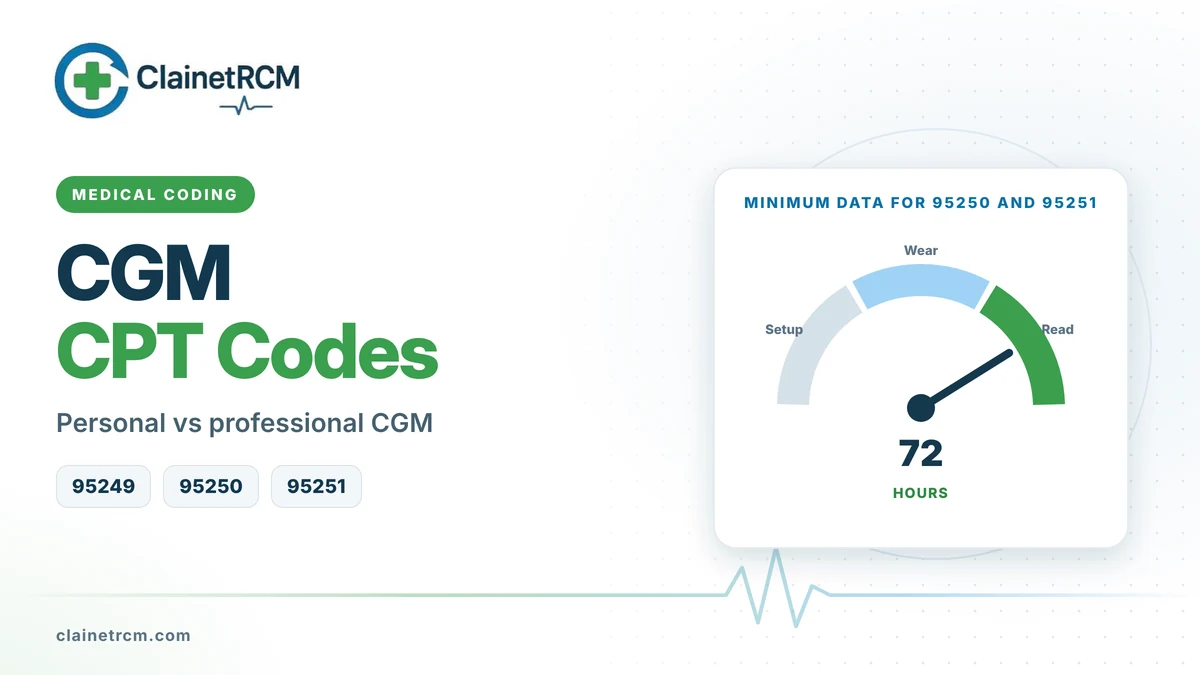
Quick answer: Use 95249 for startup and training when the patient owns the CGM (personal CGM), reported once for as long as the patient keeps that receiver. Use 95250 when the clinic provides the CGM equipment for a professional study, with at least 72 hours of data. Use 95251 for the physician’s or other qualified professional’s analysis, interpretation and report of at least 72 hours of CGM data, no more than once per month. Do not report 95251 with 99091, and add modifier 25 to a same-day E/M only when it is separately identifiable.
CGM CPT Codes at a Glance
| Code | Service | Key rules |
|---|---|---|
| 95249 | Personal CGM startup: sensor placement, hook-up, calibration, patient training and printout, with patient-provided equipment | Once for the duration the patient owns the data receiver |
| 95250 | Professional CGM: clinic-provided equipment, sensor placement, hook-up, calibration, training, sensor removal and printout | Minimum 72 hours of data; reported once per month |
| 95251 | Analysis, interpretation and report | Minimum 72 hours of data; once per month; physician or other qualified professional |
Codes 95249 and 95250 describe technical work often performed by trained clinical staff, such as a nurse or diabetes educator, under appropriate supervision. Code 95251 requires the interpretation and report of a physician or other qualified health care professional.
Personal vs Professional CGM
- Personal CGM belongs to the patient, who wears it continuously and shares data with the practice. Startup is 95249; ongoing interpretation is 95251.
- Professional CGM belongs to the clinic. The patient wears it for a short study, often 10 to 14 days, and returns it or the data is uploaded. The study is 95250, and the interpretation is 95251.
The 72-Hour Rule and Frequency Limits
Codes 95250 and 95251 both require at least 72 hours of CGM data. A study that stops early cannot be reported with these codes. Code 95251 can be reported no more than once per month, even if the physician reviews data at more than one visit. Some payers set their own frequency limits, such as a number of interpretations per year, so check each policy.
CGM and Remote Patient Monitoring
Many CGM systems send data automatically, which raises the question of remote patient monitoring (RPM) codes. Code 95251 is not reported with 99091, and payer policies differ on whether RPM codes can be billed for CGM data. Do not layer RPM codes on top of CGM services unless the payer clearly allows it and the RPM requirements, such as days of data and interactive communication time, are separately met.
Medicare Coverage for the CGM Device
Medicare covers CGM devices under the DME benefit through the Glucose Monitors coverage policy. In general, the patient must:
- Have diabetes
- Be treated with insulin, or have a history of problematic hypoglycemia, such as recurrent level 2 events (glucose below 54 mg/dL) despite treatment changes or a level 3 event requiring help from another person
- Have the CGM prescribed according to its FDA indications, with training sufficient to use it
- Have an in-person or Medicare-approved telehealth visit with the treating practitioner within six months before the order
To continue coverage, the patient needs a visit every six months to review adherence and the treatment plan. The supplier bills the monthly supply allowance and receiver with HCPCS codes such as A4239 and E2103 for non-adjunctive CGMs, so the practice’s job is to document that the criteria were met.
Documentation for 95251
- The device and the dates of the data reviewed
- Confirmation that at least 72 hours of data were analyzed
- Key metrics, such as time in range, glucose management indicator and hypoglycemia events
- Patterns identified and the clinical interpretation
- Treatment changes or recommendations
- The signature of the interpreting physician or other qualified professional
Example
An established patient with type 2 diabetes on insulin brings two weeks of personal CGM data to a follow-up visit. The endocrinologist reviews the report, adjusts basal insulin and manages the patient’s hypertension and lipids.
- E/M: 99214-25 for the separately identifiable management
- CGM interpretation: 95251
- Diagnoses: type 2 diabetes with the appropriate long-term insulin use code, plus the other conditions managed
Common Denials
- Less than 72 hours of data. Neither 95250 nor 95251 can be reported for a shorter study.
- More than one interpretation per month. Combine reviews into a single monthly report.
- Repeated 95249 claims. The startup code is not reported again for the same receiver.
- Missing interpretation. A printout without a signed clinical interpretation does not support 95251.
- Coverage criteria not documented. For Medicare device coverage, the visit and the insulin or hypoglycemia criteria must be in the record.
Frequently Asked Questions
Code 95249 is startup and training for a CGM the patient owns. Code 95250 is a professional CGM study using equipment the clinic owns and provides.
No more than once per month, and only when at least 72 hours of data were analyzed and a written interpretation was completed.
No. Code 95249 is reported once for the duration the patient owns the data receiver. A new receiver may support another startup, depending on payer policy.
Yes, when the E/M service is significant and separately identifiable, such as managing other conditions or making broader treatment decisions. Append modifier 25 to the E/M code.
Trained clinical staff can perform the hook-up, calibration and training under appropriate supervision. The interpretation (95251) must be completed by a physician or other qualified health care professional.
Final Thoughts
CGM CPT codes reward clear documentation of the data period, the device and the interpretation. Learn how we support diabetes and endocrine practices on our endocrinology billing page, or explore our specialty medical billing guide.
Get Paid for Every CGM Service
Our endocrinology billing team captures CGM startup, professional studies and monthly interpretations while checking payer frequency and coverage rules.
Get Diabetes Billing Help
Written by
ClainetRCM Billing Team
ClainetRCM is a Boston-based revenue cycle management company specializing in medical billing, coding, credentialing and denial management for healthcare providers across all 50 states. Our AAPC and AHIMA certified team works inside your existing EHR, files claims within 24 to 48 hours and reviews every AR bucket on a 14-day cycle.