A cardiologist and a family physician can share a building, an EHR, and even the same payer contracts, yet their billing problems have almost nothing in common. That gap is the reason specialty medical billing exists.
Specialty medical billing is the process of coding, submitting, and collecting payment for services using the codes, modifiers, documentation rules, and payer policies that belong to one medical specialty. A generic billing workflow treats every claim the same way. A specialty workflow knows that a 90-day global period changes how a follow-up visit gets paid, that a screening colonoscopy can turn diagnostic halfway through the procedure, and that a psychotherapy claim lives or dies on session time.
This guide explains how specialty billing works, what changes from one field to the next, which 2026 payment developments matter, what it costs, and how to pick a billing partner without regret.
Why generic billing breaks down in a specialty practice
Most billing errors I see are not careless mistakes. They are reasonable decisions made by someone who did not know the specialty rule. A biller who handled primary care for years will code a procedure visit the way they always have, and the claim will deny for a reason nobody on the team recognizes.
Specialty practices differ from general practices in four ways that matter for payment:
- Code sets are narrower and more complex. Surgical, diagnostic, and infusion services carry code families with tight rules about what can be reported together.
- Modifiers carry real money. Modifier 25, 59, 26, TC, 57, and PT can decide whether a service pays, pays at a reduced rate, or denies outright.
- Prior authorization is heavier. Imaging, injections, implants, specialty drugs, and many procedures need approval before the service happens.
- Documentation standards are specific. A pain management note, a Mohs surgery note, and a therapy note each need different elements to support medical necessity.
When a billing team lacks that knowledge, the practice pays for it through denials, underpayments, and charges that never get billed at all.
How specialty medical billing works, step by step
The cycle looks the same on paper for every practice. The difference is in how each step gets handled.
1. Eligibility and benefits check. Before the visit, the team confirms coverage, plan type, deductibles, and whether the specialty service needs a referral. Strong benefits verification at this stage prevents a large share of later denials, and it matters more in specialties where one procedure can cost the patient thousands.
2. Prior authorization. Many specialty services need approval first. The request has to include the right diagnosis, procedure code, and clinical notes. A missed or incomplete request is one of the most expensive errors in the cycle, which is why many practices hand prior authorization to a dedicated team.
3. Charge capture and coding. The clinical note becomes CPT, HCPCS, and ICD-10 codes. Specialty coding is where most revenue is won or lost. Certified coders who work in one field every day catch bundling edits, laterality, and modifier needs that a generalist will miss. If you want to understand what good coding support involves, our overview of medical coding services is a useful reference.
4. Claim scrubbing and submission. The claim goes through payer-specific and NCCI edits before it leaves the building. Claims that get stopped here are rejections, not denials, and they are cheap to fix if someone watches the clearinghouse rejections report daily.
5. Payment posting and reconciliation. Payments and adjustments are posted against each claim line. Underpayments only show up here, so this step is where contract knowledge pays off.
6. Denial follow-up and appeals. Denied claims get investigated, corrected, and appealed within the payer’s deadline.
7. Patient billing. Whatever the patient owes gets statemented clearly, with payment options that people actually use.
If any link in that chain is weak, cash flow slows down. If two are weak, the practice starts writing off money it earned.
What changes by specialty: a practical cheat sheet
Here is a short view of what trips up billing in common specialties. This is not complete, but it shows why one size does not fit all.
| Specialty | What makes billing different |
|---|---|
| Cardiology billing | Professional and technical component splits (modifiers 26 and TC) on echo and stress testing, device and implant coding, heavy prior authorization |
| Orthopedic billing | Global periods of 0, 10, or 90 days, modifiers 57, 58, 78, and 79, casting and supply coding, workers’ compensation claims |
| Dermatology billing | Modifier 25 on same-day visits and procedures, medical versus cosmetic services, staged Mohs surgery coding |
| Gastroenterology billing | Screening versus diagnostic colonoscopy, the PT modifier, polyp removal technique coding |
| Mental health billing | Time-based psychotherapy codes, telehealth place of service, authorization limits on visit counts |
| Anesthesiology billing | Base units plus time units plus modifying units, with its own conversion factor |
| Pain management billing | Laterality and level documentation on injections, fluoroscopy bundling, local coverage rules on medical necessity |
| OB/GYN billing | Global obstetric packages versus itemized prenatal, delivery, and postpartum care |
The pattern is consistent. Every specialty has two or three rules that cause most of its denials, and a team that knows them cold collects more.
Time-based services deserve a special mention. Therapy, psychotherapy, and care management all depend on documented minutes, and Medicare counts them in a particular way. Our explanation of the Medicare 8-minute rule shows how easy it is to lose units through a rounding mistake.
The numbers that should shape your 2026 billing plan
Billing advice that ignores current data ages quickly, so here is where things stand.
Denials keep climbing. Experian Health’s 2025 State of Claims survey found that 41 percent of providers now report denial rates above 10 percent, up from 30 percent in 2022. KFF’s analysis of federal data showed that ACA Marketplace plans denied about 19 percent of in-network claims in 2024. Premier Inc. has estimated that working a single denied claim costs roughly $57 in staff time and overhead, and that cost has been rising. Meanwhile, Premier also reported that private payers overturned more than 60 percent of the initial denials that providers chose to appeal. The takeaway is simple: many denials are wrong, and many practices never challenge them.
Medicare payment is shifting under specialists’ feet. For 2026, CMS set two conversion factors: $33.57 for clinicians in qualifying advanced alternative payment models and $33.40 for everyone else. That sounded like good news, and part of it was. Congress added a one-year 2.5 percent bump. But CMS also finalized a negative 2.5 percent efficiency adjustment on work RVUs for most non-time-based services, which cuts into procedural specialties. Time-based codes, telehealth-list services, and new codes were exempt.
2027 looks tighter. In its July 2026 proposed rule for calendar year 2027, CMS proposed conversion factors of $33.17 for qualifying APM participants and $32.84 for others, decreases of about 1.19 and 1.68 percent. The main driver is the expiration of that temporary 2.5 percent increase. The proposal also suggests reduced payment for an E/M visit billed on the same day as a global procedure, and it would turn the G2211 add-on into a modifier. A mandatory Ambulatory Specialty Model is also scheduled to begin January 1, 2027, so specialists should check whether their field is included. The comment period closed in September, and the final rule is expected this fall, so confirm every figure against the final version before you build your 2027 budget.
For a procedural specialty, those changes mean one thing. You cannot afford to leak revenue on the front end, because the back end is getting thinner.
The most common specialty billing mistakes
After decades in this work, the same problems keep showing up:
- Wrong or missing modifiers. Modifier 25 and 59 are the most abused and most audited modifiers in specialty billing. Use them only when the documentation supports a separate, distinct service.
- Ignoring global periods. Billing a post-op visit that falls inside a global period is a quick way to get a denial or a recoupment request.
- Weak medical necessity documentation. If the note does not show why the service was needed, the payer will say so.
- Late claims. Timely filing limits vary by payer, and a missed deadline cannot be appealed away in most cases.
- No denial analysis. Fixing one claim at a time never solves the pattern behind it. Good denial management tracks the cause, not just the claim.
- Undercoding out of fear. Practices that worry about audits often code lower than the documentation supports and quietly lose income every month.
- Outdated credentialing. A lapsed enrollment or a missing payer contract stops payment completely. The financial effect is bigger than most owners expect, as we explain in our article on how credentialing affects revenue.
In-house billing or a specialty billing partner?
Both can work. The right answer depends on volume, complexity, and how much management time you can spare.
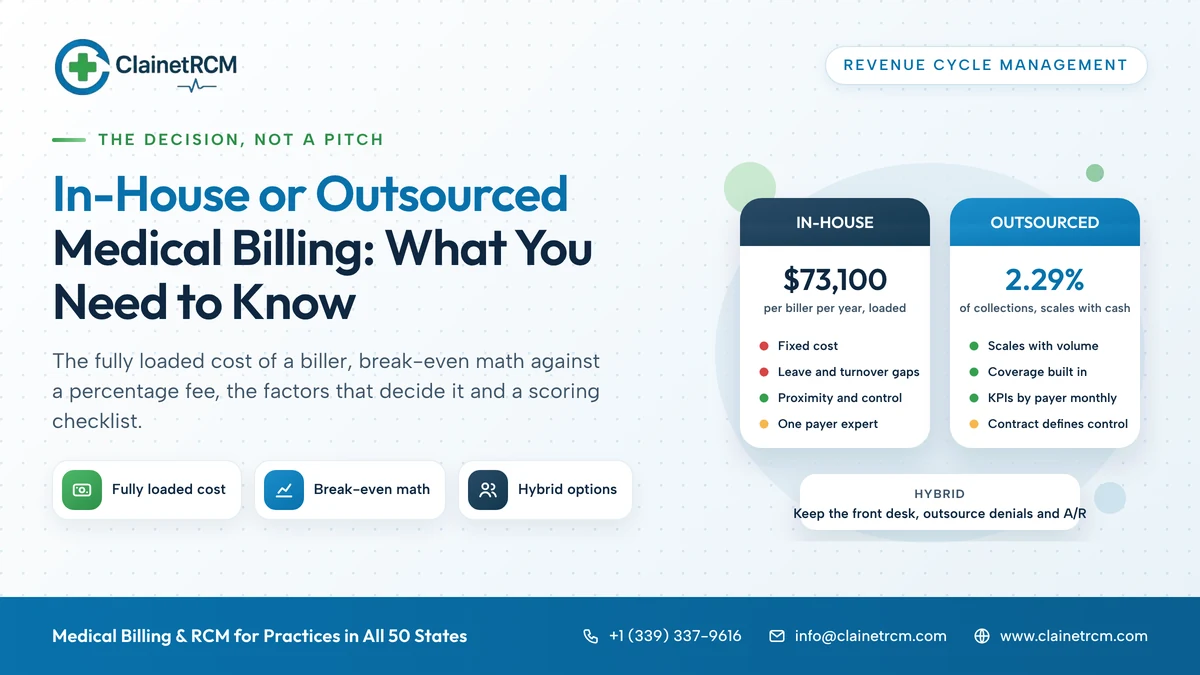
In-house billing makes sense when you have a stable, experienced biller, a small number of payers, and the capacity to cross-train staff so that one resignation does not stop your cash flow.
Outsourcing makes sense when your claim volume is growing, your denial rate is above your target, your biller is stretched across front desk duties, or your specialty has rules that only an experienced team keeps current on.
Cost is the question everyone asks. Outsourced billing is commonly priced as a percentage of collections, often in the range of 4 to 8 percent, with the rate depending on specialty complexity, claim volume, and the scope of services. Flat fee and per-claim models exist too. Compare that against the real cost of in-house billing, which includes salary, benefits, software, training, and the revenue lost to errors. If you want to see how a partner structures its fees, our pricing page is an example of the level of clarity you should expect from anyone you hire.
How to choose a specialty medical billing company
Use this checklist. A good partner should answer every point without hesitation.
- Specialty depth. Ask how many practices in your exact specialty they serve and who on their team codes for it. Certified coders with experience in your field matter more than a long list of logos.
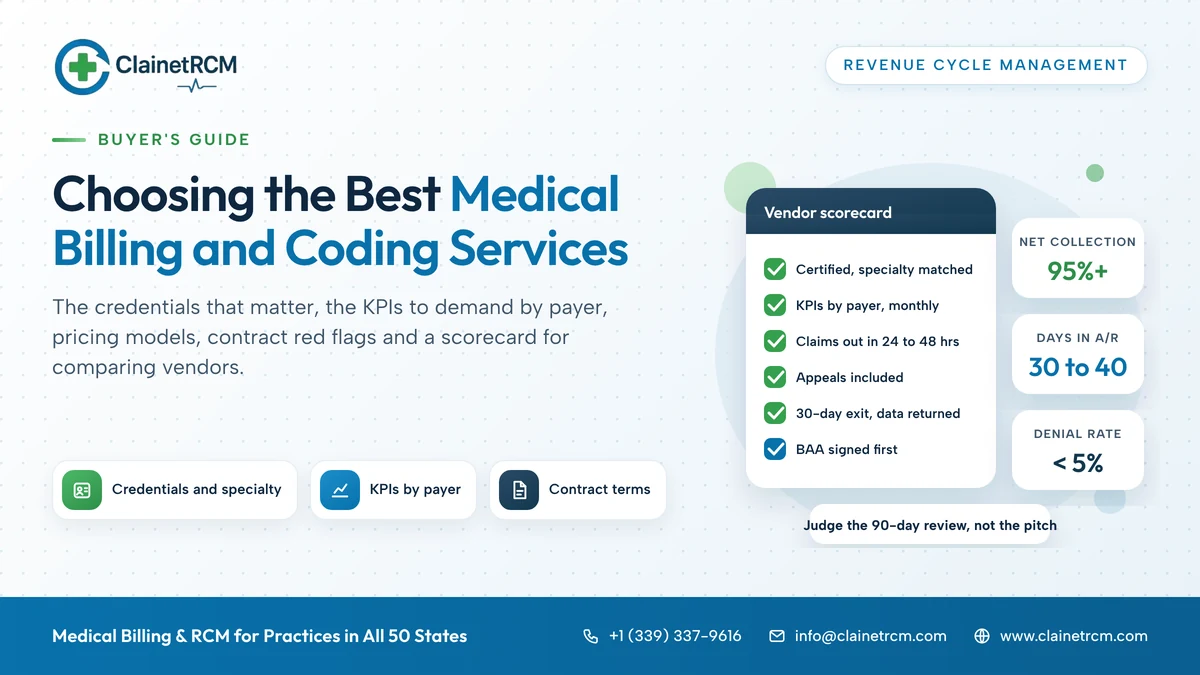
- Transparent reporting. You should see first-pass acceptance rate, denial rate by reason, days in A/R, and net collection rate every month, not a vague summary.
- Clear scope. Confirm whether eligibility, prior authorization, credentialing, coding, denial appeals, and patient billing are included or billed separately.
- Technology fit. They should work inside your EHR or practice management system, not force a painful migration.
- Compliance record. Ask about HIPAA safeguards, audit support, and how they handle coding queries.
- Contract terms. Look for month-to-month flexibility, clear data ownership, and no penalty for leaving.
- Communication. You should know who your account manager is and how fast they respond.
A partner that covers the whole revenue cycle management chain removes the handoff gaps where claims usually get lost.
Benchmarks to track, whatever route you choose
These are commonly used targets. Your specialty and payer mix may push them up or down, but they give you a starting point.
- First-pass clean claim rate: 95 percent or higher. Our guide to clean claims in medical billing shows how to get there.
- Denial rate: under 5 percent is a strong result, and anything above 10 percent signals a process problem.
- Days in A/R: under 40 days for most practices, tighter for high-volume specialties.
- Net collection rate: 95 percent or higher of what you are contractually owed.
- Percentage of A/R over 90 days: as low as you can keep it, since old balances rarely get collected.
If you track only one number, track the denial rate by reason. It points directly at the step in your cycle that needs repair.
Frequently asked questions
It is medical billing done with the codes, modifiers, documentation rules, and payer policies of a single specialty, such as cardiology, orthopedics, or mental health. The goal is fewer denials and more accurate payment than a general workflow delivers.
General billing covers common visit and procedure types across many fields. Specialty billing deals with complex code families, global periods, bundling edits, prior authorization rules, and documentation standards that are unique to one field.
Most outsourced billing companies charge a percentage of collections, commonly between 4 and 8 percent. Complex specialties and small practices can pay more. Some companies use flat monthly or per-claim pricing instead.
Any field with procedures, global periods, heavy authorization, or time-based codes benefits most. Cardiology, orthopedics, gastroenterology, dermatology, anesthesiology, pain management, and mental health are common examples.
Often, yes. A small practice usually cannot afford a full team of specialists in coding, authorization, and appeals, and one in-house biller is a single point of failure. Outsourcing gives access to that depth for a share of collections.
Verify eligibility before every visit, obtain authorization where required, document medical necessity clearly, scrub claims against payer and NCCI edits, and review denial reasons monthly so the same mistake does not repeat.
Stop Losing Revenue to Specialty Billing Errors
Our certified billing and coding specialists work in your field every day, so your claims go out right the first time. See how much faster your practice can get paid.
Talk to a Specialty Billing ExpertFinal thoughts
Specialty billing rewards the teams that know the rules of one field deeply and punishes the ones who treat every claim the same. With denial rates climbing and Medicare payment tightening for 2027, there is less room for guesswork than there was five years ago.
Start by looking at your own denial reasons. They will tell you whether your problem sits in eligibility, coding, documentation, or follow-up. Fix the biggest one first, track the result for 90 days, and build from there. If you would rather hand that work to a team that does it all day, our medical billing services are built for exactly that, and the full list of specialties we support shows where we work.

Written by
ClainetRCM Billing Team
ClainetRCM is a Boston-based revenue cycle management company specializing in medical billing, coding, credentialing and denial management for healthcare providers across all 50 states. Our AAPC and AHIMA certified team works inside your existing EHR, files claims within 24 to 48 hours and reviews every AR bucket on a 14-day cycle.