Choosing a medical billing and coding service is one of the few decisions a practice owner makes that touches every dollar the practice earns. Pick well and claims go out clean, denials get worked, and the physicians stop thinking about the revenue cycle. Pick badly and the problems are slow to show up and expensive to unwind: a vendor that reports one blended "collection rate," charges extra for every appeal, and holds your payer logins when you try to leave.
This guide gives you a practical way to evaluate medical billing and coding services: the credentials that matter, the metrics a vendor must commit to, how pricing models really compare, the contract terms that protect you, and a scorecard you can use to compare three companies side by side. It applies whether you are outsourcing for the first time or replacing a company that is not performing.
Last updated: October 2026
Key takeaways
- Judge a billing and coding company on four things: certified people matched to your specialty, a process you can see, measurable results by payer, and a contract you can exit cleanly.
- Ask for first-pass acceptance, first-pass payment, net collection rate, days in A/R and denial rate by payer, with the formulas written down. A single blended "collection rate" hides problems.
- The fee definition matters more than the percentage. Know what counts as collections, what is billed separately, and who owns your data and logins at termination.
- A written business associate agreement is required under HIPAA before any patient data changes hands, and Medicare payments must always be made in the practice's name.
- Run a 90-day evaluation against a baseline you measured before signing. If the numbers did not move, you should know why and be free to leave.
What You Are Actually Buying
"Medical billing and coding services" covers a wide range of work, and vendors package it differently. Before you compare companies, decide which parts of the revenue cycle you are handing over.
| Service area | What it includes | Who usually needs it |
|---|---|---|
| Medical coding | ICD-10-CM, CPT and HCPCS code assignment from the clinical note, modifier selection, NCCI edit review, coding audits | Procedural specialties, practices with documentation or audit risk, anyone without a certified coder on staff |
| Claims submission and follow-up | Charge entry, claim scrubbing, electronic submission, rejection correction, claim status follow-up | Every practice; this is the core of "billing only" services |
| Denial management and appeals | Denial triage, corrected claims, reopenings, written appeals, root-cause tracking | Practices with denial rates above 5 percent or a backlog of unworked denials |
| Accounts receivable management | Aging review on a fixed cycle, payer follow-up, underpayment recovery, old A/R cleanup | Practices with A/R over 120 days above 15 percent of total |
| Payment posting and reconciliation | ERA and EOB posting, contract variance checks, patient balance transfer, refunds | Every practice; often where underpayments are found |
| Front-end services | Eligibility and benefits verification, prior authorization, patient cost estimates | High-volume and high-deductible practices; specialties with authorization-heavy services |
| Credentialing and enrollment | Medicare, Medicaid and commercial payer enrollment, CAQH, revalidation, re-credentialing | New practices, growing groups, practices adding providers or locations |
Full revenue cycle management covers all of these end to end. Medical billing services alone cover claims through payment, with coding and front-end work added as needed. Knowing which you need prevents the most common mistake: paying for a full RCM package when the practice only needs denials and A/R worked, or buying billing-only when the real problem is coding.
1. Check the Credentials and the Specialty Match
Certification is the minimum, not the differentiator. The credentials to look for:
- CPC (Certified Professional Coder, AAPC): physician and outpatient coding across CPT, ICD-10-CM and HCPCS. The standard credential for coders working professional claims.
- CPB (Certified Professional Biller, AAPC): the claim lifecycle, payer rules, A/R follow-up, denials and compliance. The credential for the people who work your claims.
- CCS (Certified Coding Specialist, AHIMA): hospital and inpatient coding, including ICD-10-PCS. Essential if facility claims are in scope.
- RHIA (Registered Health Information Administrator, AHIMA): health information management, data governance and privacy. A sign of mature compliance oversight.
Then go a level deeper. Ask which coders will work your account, which specialties they have coded in the past year, and how the company handles the code-set updates that land every October (ICD-10-CM) and January (CPT and HCPCS). A cardiology practice and a behavioral health practice need different people. ClainetRCM assigns coders by specialty, and the specialty billing pages describe the code families, modifiers and payer policies each team works with every day.
2. Demand the Metrics, by Payer, With Definitions
A vendor that cannot show you its numbers for existing clients will not show you yours either. These are the measures that matter, with the targets most practice-management guidance agrees on.
| Metric | Formula | Target | Why it matters |
|---|---|---|---|
| First-pass acceptance rate | Claims accepted by payer edits on first submission ÷ claims submitted | 95 percent or higher | Rejections never reach adjudication and burn the filing window |
| First-pass payment rate | Claims paid on first adjudication ÷ claims adjudicated | 90 percent or higher; strong teams reach 95 | Shows whether claims are right, not just well formatted |
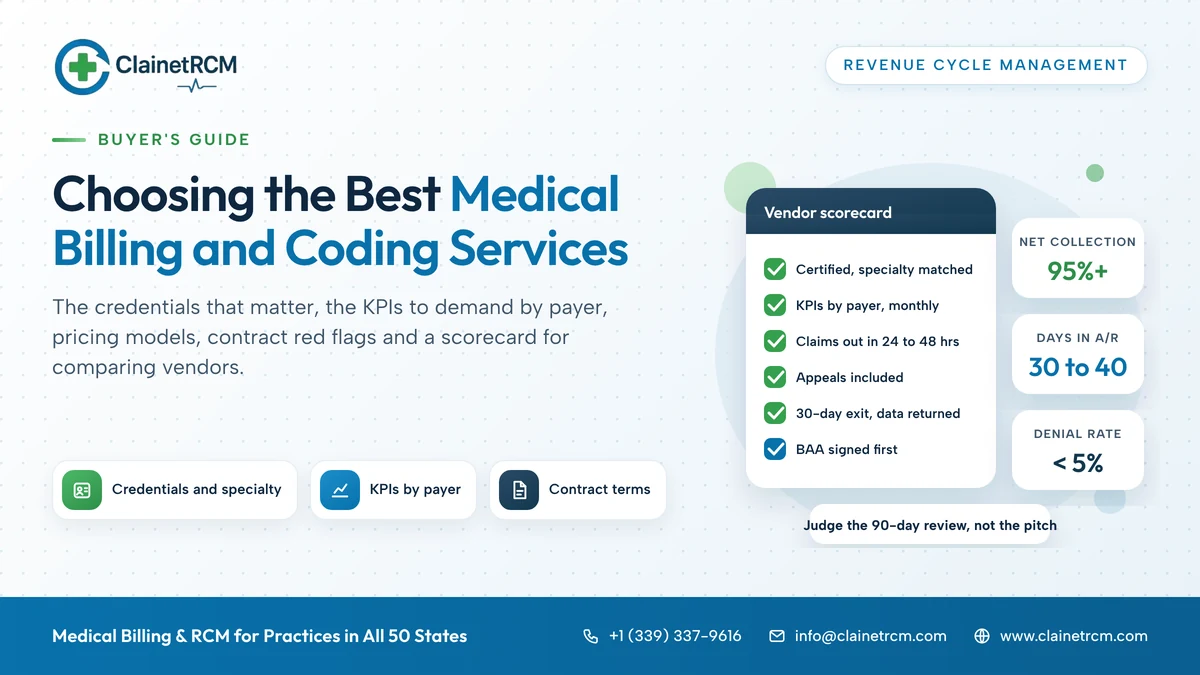
| Net collection rate | Payments ÷ (charges minus contractual adjustments), trailing 12 months | 95 percent or higher | The share of collectible revenue actually collected |
| Days in A/R | Total A/R ÷ average daily charges | 30 to 40 days | How fast claims turn into cash |
| Denial rate | Claims denied on first adjudication ÷ claims adjudicated | Under 5 percent; many practices sit at 7 to 10 | Every denial costs rework and delays payment |
| A/R over 120 days | Dollars older than 120 days ÷ total A/R | Under 15 percent | Where write-offs hide |
| Denial overturn rate | Appealed dollars recovered ÷ appealed dollars | Track by payer; no single target | Measures the quality of appeal work |
Two rules make these useful. First, the vendor must commit to the formulas in writing, because a "collection rate" calculated on gross charges will always look worse than one calculated on net, and a dashboard that counts a claim as paid when any line pays will flatter the denial rate. Second, ask for the numbers broken out by payer. A blended 96 percent can hide one payer at 85.
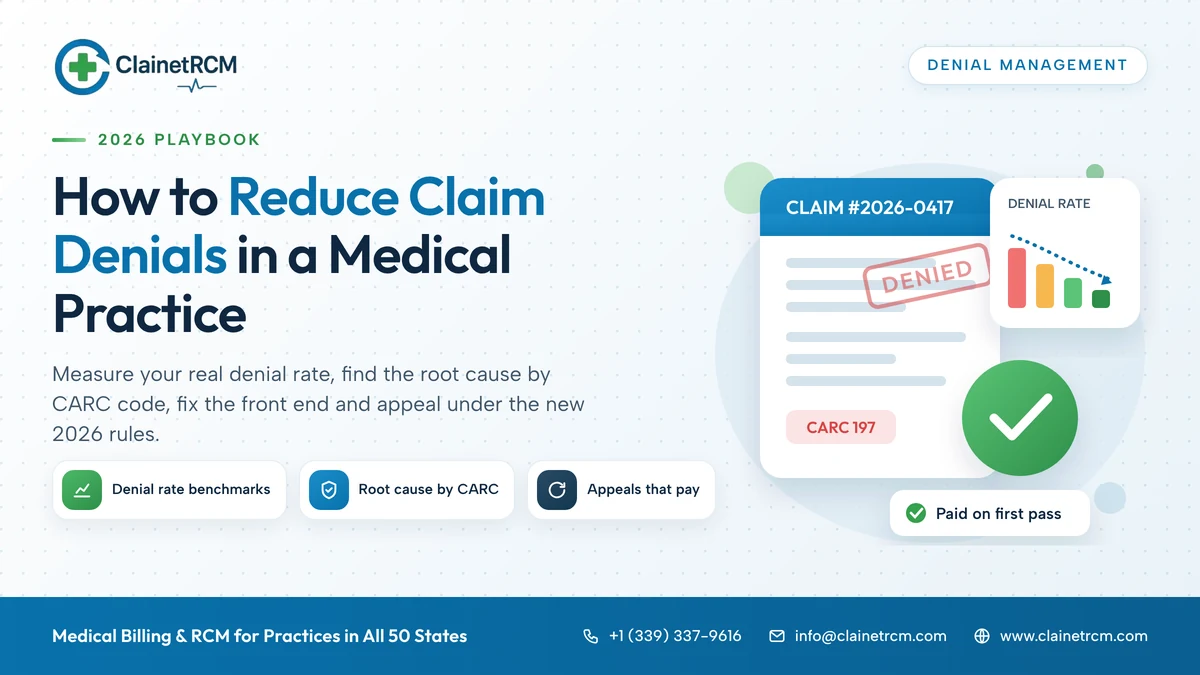
The context for those targets is not comfortable. Experian Health's 2025 State of Claims survey found 41 percent of providers reporting denial rates of 10 percent or higher, up from 30 percent in 2022, and 68 percent said submitting clean claims had become harder than a year earlier. The companies worth hiring are the ones whose client numbers run against that trend. Our guides to clean claims and reducing claim denials explain what the underlying work looks like.
3. Look at the Process, Not the Pitch
Results come from habits, so ask the vendor to walk you through a claim from encounter to payment and listen for specifics.
- Charge lag. How many hours between the encounter and claim submission? Within 24 to 48 hours is the standard to expect; a week of lag adds a week to days in A/R for no reason.
- Scrubbing. What edits run before submission: NCCI, payer-specific rules, eligibility, modifier logic? Who reviews the scrubber exceptions, a person or a queue?
- Rejections. Who works clearinghouse rejections and how fast? Same day is the answer you want, because rejected claims keep aging. See clearinghouse rejections in medical billing for why.
- Denials. Is every denial worked, or only those above a dollar threshold? Is the root cause logged? Are appeals included in the fee?
- A/R cycle. How often is each aging bucket touched? Every 14 days is a disciplined cadence; "monthly" means claims cross deadlines unnoticed.
- Posting. Are payments reconciled against your contracted fee schedules so underpayments are caught, or just posted?
- Reporting. What arrives monthly, in what format, and who sits down with the physicians to go through it?
The technology question belongs here too. The 2025 CAQH Index estimated that electronic transactions saved the US healthcare system $258 billion in 2024 and that a further $21 billion could be saved with full automation. A vendor still keying claims by hand, faxing records or checking eligibility by phone is spending your money. Ask whether they work inside your existing practice management system or require you to switch; the best answer for most practices is that you keep your software and your data.
4. Understand the Pricing Model Before You Compare Rates
Three models dominate, and each creates different incentives.
| Model | How it works | Where it fits | Watch for |
|---|---|---|---|
| Percentage of collections | A fixed percentage of the money collected on claims the vendor worked. ClainetRCM billing starts at 2.29 percent; industry estimates commonly run 4 to 9 percent | Most independent practices; aligns the vendor with your cash | The definition of "collections", monthly minimums, and whether patient payments or old A/R are included |
| Per claim | A flat fee per claim submitted, often a few dollars | High-volume, low-dollar claims such as labs or therapy visits | No incentive to follow up on unpaid claims; appeals usually extra |
| Flat monthly fee | A fixed retainer per provider or per practice | Very high collections with simple claims; predictable budgeting | The fee does not fall when volume falls; scope creep clauses |
Two compliance points apply to percentage pricing. Under 42 CFR 424.73, Medicare pays a billing agent only when the agent's compensation is not tied to the amounts billed or collected and payment is made in the provider's name, which in practice means payer payments must go to the practice's own account, never through the vendor. And the HHS Office of Inspector General has long noted that percentage arrangements can create an incentive to upcode, so ask how the company audits its own coding. Our pricing page sets out what the percentage covers and what is quoted separately, which is the level of detail you should demand from anyone.
5. Read the Contract for These Terms
Most bad vendor relationships were visible in the contract before signature. Check each of these before you sign anything.
- Business associate agreement. HIPAA requires a written BAA before protected health information is shared (45 CFR 164.504(e)). It must cover permitted uses, safeguards, breach and security incident reporting, subcontractor obligations, patient access support and return or destruction of data at termination.
- Definition of collections and the list of services billed separately (coding, credentialing, statements and postage, appeals, eligibility checks, interfaces).
- Setup fees and monthly minimums. Neither should be necessary for a standard practice.
- Term, notice and termination fees. Thirty-day notice with no penalty is achievable; 12 to 36 month terms with early-termination fees are common and worth refusing.
- Data ownership and exit. You own the billing data, and you get it back in a usable export, with payer portal and clearinghouse logins, at termination.
- Run-out. What happens to claims in progress when the contract ends, and what it costs.
- Audit rights. Your right to review the vendor's work on your claims, including coding samples.
- Where the work is done and by whom. Staff location, credentials and turnover, in writing.
6. Ten Questions to Ask on the First Call
- Which three clients in my specialty and of my size can I call?
- What are your first-pass acceptance and first-pass payment rates, by payer, for those clients?
- Who exactly will work my account, where are they, what are their credentials, and what is their turnover?
- Do you work inside my practice management system, or do I have to switch?
- What is your charge lag standard and your rejection turnaround?
- Are appeals included? Is there a dollar threshold below which you do not appeal?
- What does the monthly report contain, and who reviews it with us?
- How is the fee defined, and what is billed separately?
- What happens to my data, logins and open claims if I cancel?
- What do you do when my clearinghouse goes down?
That last question is not hypothetical. After the February 2024 Change Healthcare attack, an AMA survey found 80 percent of practices had lost revenue from unpaid claims and 55 percent had used personal funds to cover expenses. A vendor should be able to switch clearinghouses, and you should know who holds those accounts.
7. A Scorecard for Comparing Vendors
Score each company from 1 to 5 on the rows below and weight them for your situation. A practice drowning in denials should weight the denial rows; a practice adding providers should weight credentialing.
| Criterion | What a 5 looks like | What a 1 looks like |
|---|---|---|
| Specialty expertise | Certified coders who currently work your specialty; references in your specialty | Generalists; no references in your specialty |
| Transparency | KPIs by payer with written formulas; monthly review meeting | One blended percentage; reports on request only |
| Process discipline | Claims out in 24 to 48 hours; rejections same day; A/R every 14 days; every denial worked | Weekly batching; denials worked above a threshold; monthly A/R review |
| Pricing clarity | Percentage with a written definition of collections; no setup fee or minimum; appeals included | Extras for appeals, statements, credentialing; minimums; setup fee |
| Contract terms | 30-day notice, no penalty, data and logins returned, run-out defined | 12 to 36 month term, termination fee, vendor retains data |
| Compliance | BAA signed first; coding audits; payments to your account; staff location disclosed | "HIPAA certified" badge, no BAA offered until asked |
| Fit | Sized to your volume; named account manager; works in your software | Support queue; forces a software change |
When In-House Is the Better Answer
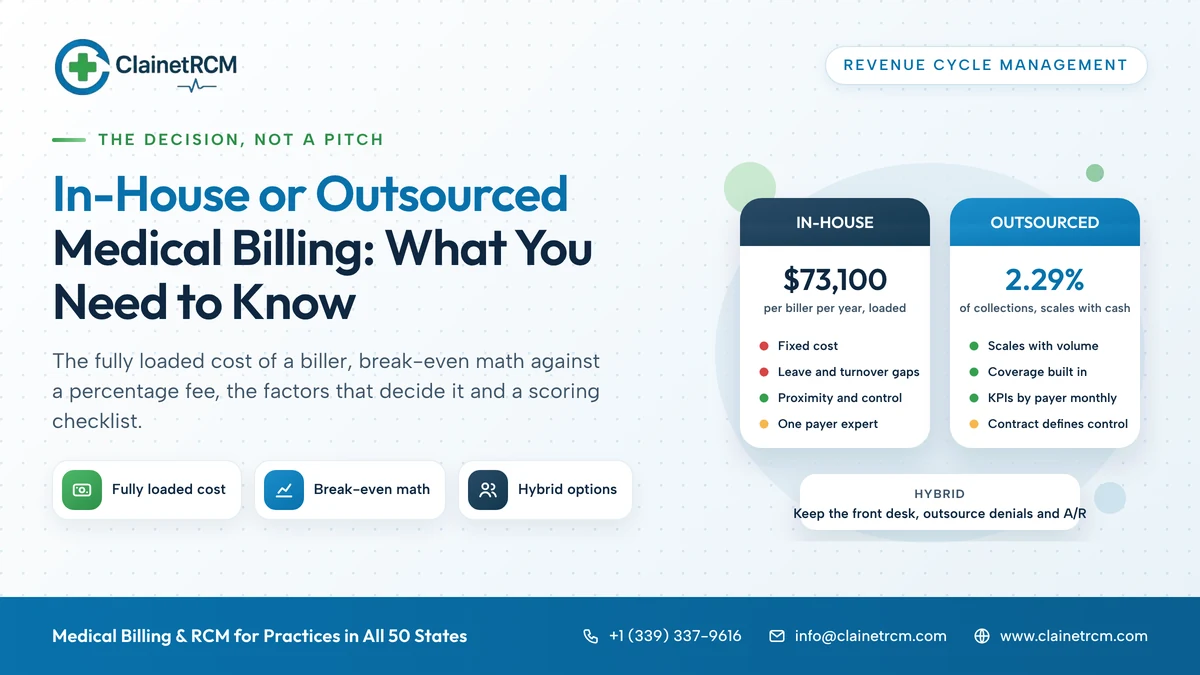
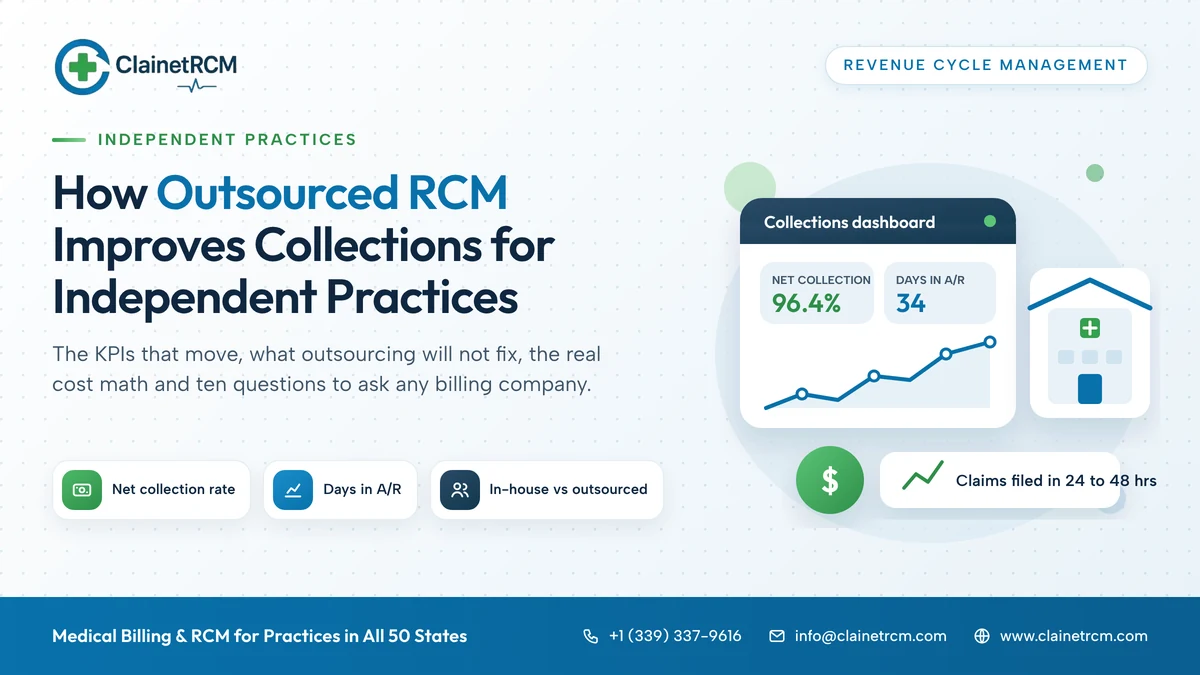
Not every practice should outsource. If your net collection rate is above 95 percent, days in A/R are 30 to 40, denials are under 5 percent and you have a tenured biller with a backup plan, the right move may be to keep what works and buy only the pieces you lack, such as coding audits or old A/R cleanup. Our guide to in-house vs outsourced medical billing works through the cost model, and how outsourced RCM helps independent practices improve collections is honest about what outsourcing will and will not fix.
What a Good Start Looks Like
- Sign the BAA, then pull the baseline KPIs with agreed formulas.
- Connect to your existing EHR and practice management system, load payer contracts and fee schedules, confirm clearinghouse and portal access, and reconcile the credentialing roster. Expect 7 to 14 business days.
- Run in parallel for the first few weeks: new claims out in 24 to 48 hours, old A/R triaged by age and recoverability, denials logged by root cause from day one.
- Fix upstream causes the denial log reveals: eligibility, authorization, coding, credentialing.
- At day 90, compare the same metrics to the baseline, by payer. Decide on the evidence.
Compare Us on the Scorecard
ClainetRCM reports first-pass acceptance, first-pass payment, net collection rate, days in A/R and denials by payer every month, works inside your existing software, includes appeals, and signs a BAA before any data moves. From 2.29 percent of collections, no setup fee, no long-term contract.
Request a Free Revenue AuditFrequently Asked Questions
Certified staff (CPC, CPB, CCS or RHIA) who currently work your specialty, measurable results by payer with written formulas, a visible process (claims out in 24 to 48 hours, rejections worked the same day, every denial worked, A/R reviewed on a fixed cycle), a clear fee definition with no setup fee or minimum, a signed business associate agreement, and contract terms that return your data and logins if you leave.
Most companies charge a percentage of monthly collections; industry estimates commonly run 4 to 9 percent, and ClainetRCM billing starts at 2.29 percent with no setup fee, no monthly minimum and no long-term contract. Per-claim pricing of a few dollars per claim and flat monthly retainers are the alternatives. The definition of "collections" and the list of services billed separately matter more than the headline rate.
At minimum: first-pass acceptance rate, first-pass payment rate, net collection rate, days in accounts receivable, denial rate by payer and reason, A/R over 120 days, and denial overturn rate by payer. Each should come with its formula in writing and should be reported monthly, by payer, with a review meeting.
It depends on your numbers and your volume. A practice with a tenured, certified biller and metrics at target can stay in-house and buy only what it lacks. A practice with rising denials, staff turnover, growing volume or several locations usually gets better results and lower fully loaded cost from a specialized company. Baseline your KPIs before deciding and measure again at 90 days.
Yes. HIPAA requires a written business associate agreement before protected health information is shared with a billing company. Under 45 CFR 164.504(e) it must limit permitted uses, require safeguards, require breach and security incident reporting, bind subcontractors, support patient access rights and require return or destruction of data at termination. Sign it before any records move.
Percentage arrangements are common, but under 42 CFR 424.73 Medicare pays a billing agent only when the agent's compensation is not tied to amounts billed or collected and payment is made in the provider's name. In practice that means Medicare and other payer payments must be deposited to the practice's own account, not routed through the vendor. Some states also have fee-splitting rules, so have counsel review the contract.
For most practices, yours. Working inside your existing EHR and practice management system keeps your data, your history and your reporting in one place, avoids a migration, and makes it easy to change vendors later. A company that insists you switch to its platform is creating lock-in. Ask what integration costs, if anything; it should be included.
A well-run transition takes 7 to 14 business days from signed agreement to first claim submission: BAA, baseline metrics, system access, payer and fee schedule setup, and a reconciled credentialing roster. Expect to run in parallel for a few weeks while old A/R is triaged, with a formal review of results against the baseline at 90 days.
The Bottom Line
The best medical billing and coding service for your practice is the one that can show you its results by payer, explain its process in specifics, price its work in terms you can audit, and let you leave if it fails. Use the scorecard, baseline your own numbers before you sign, and judge the relationship on the 90-day review rather than the sales call.

Written by
ClainetRCM Billing Team
ClainetRCM is a Boston-based revenue cycle management company specializing in medical billing, coding, credentialing and denial management for healthcare providers across all 50 states. Our AAPC and AHIMA certified team works inside your existing EHR, files claims within 24 to 48 hours and reviews every AR bucket on a 14-day cycle.