Independent practices are being squeezed from both sides. Operating costs rose about 11 percent for the typical medical group in the first half of 2026, Medicare physician payment is scheduled to fall again in 2027, and the experienced billers who used to keep collections steady are leaving for remote jobs at health systems and insurers. In that environment, a one-point drop in net collection rate is not a rounding error. It is a physician's salary.
Outsourced revenue cycle management is one of the few levers an independent practice can pull without hiring, buying software or giving up ownership. This guide explains honestly how outsourced RCM improves collections, what it cannot fix, what it costs compared with an in-house biller, when a practice should keep billing in-house, and the questions to ask before signing with any medical billing company, including us.
Last updated: October 2026
Key takeaways
- Outsourcing collects what you are owed faster and more completely. It does not raise what payers pay. The honest promise is a higher net collection rate, fewer write-offs and shorter days in accounts receivable.
- The gains come from process discipline: eligibility checked before every visit, claims scrubbed and filed within 24 to 48 hours, every denial worked, A/R reviewed on a fixed cycle, and payments reconciled against contracted rates.
- Measure before you sign. Baseline your net collection rate, days in A/R, first-pass denial rate and A/R over 120 days, with written definitions, or you will never be able to tell whether the vendor improved anything.
- The fee definition matters more than the percentage. Ask what counts as "collections," what is extra, who holds the payer logins and what happens to open claims if you cancel.
- Keep billing in-house if your numbers are already at target and your biller is tenured. Outsourcing is a fix for leakage, turnover and growth, not a substitute for a working team.
The Squeeze on Independent Practices in 2026
The American Medical Association's benchmark survey found that 42.2 percent of physicians were in private practice in 2024, and that practices with ten or fewer physicians fell from 61.4 percent of the total in 2012 to 47.4 percent. Adjusted for practice cost inflation, Medicare physician payment fell 33 percent between 2001 and 2025. Among physicians whose practices were sold, more than 70 percent said the need to negotiate higher payer rates was an important reason.
Medicare rates will not rescue anyone. The 2026 Medicare Physician Fee Schedule raised the conversion factor to $33.4009 for most physicians, a 3.26 percent increase, but that included a one-year 2.5 percent bump from the 2025 budget law and a new "efficiency adjustment" that cut work values on roughly 7,700 non-time-based codes. The 2027 proposed rule lets the bump expire and proposes $32.84, a 1.68 percent cut, for practices outside advanced alternative payment models.
Staffing is the third pressure. The Bureau of Labor Statistics puts the median wage for medical records specialists, which includes billers and coders, at $51,140 a year as of May 2025, with employment projected to grow 8 percent over the decade and about 14,000 openings a year. MGMA reports that experienced billers and coders are leaving practices for fully remote positions at insurers, health systems and RCM companies, often for more money. A solo or small-group practice competing for that talent against a hospital system usually loses.
That is the context in which 36 percent of practice leaders told MGMA they planned to outsource or automate part of their revenue cycle in 2025, and 14 percent named outsourcing as a top cost-cutting move for 2026.
What "Improve Collections" Actually Means
Vendors promise to "improve collections" without saying which number they mean. Use these metrics, with the targets most practice-management sources agree on, and make any vendor commit to them in writing.
| Metric | How to calculate it | Target for an independent practice | Why it matters |
|---|---|---|---|
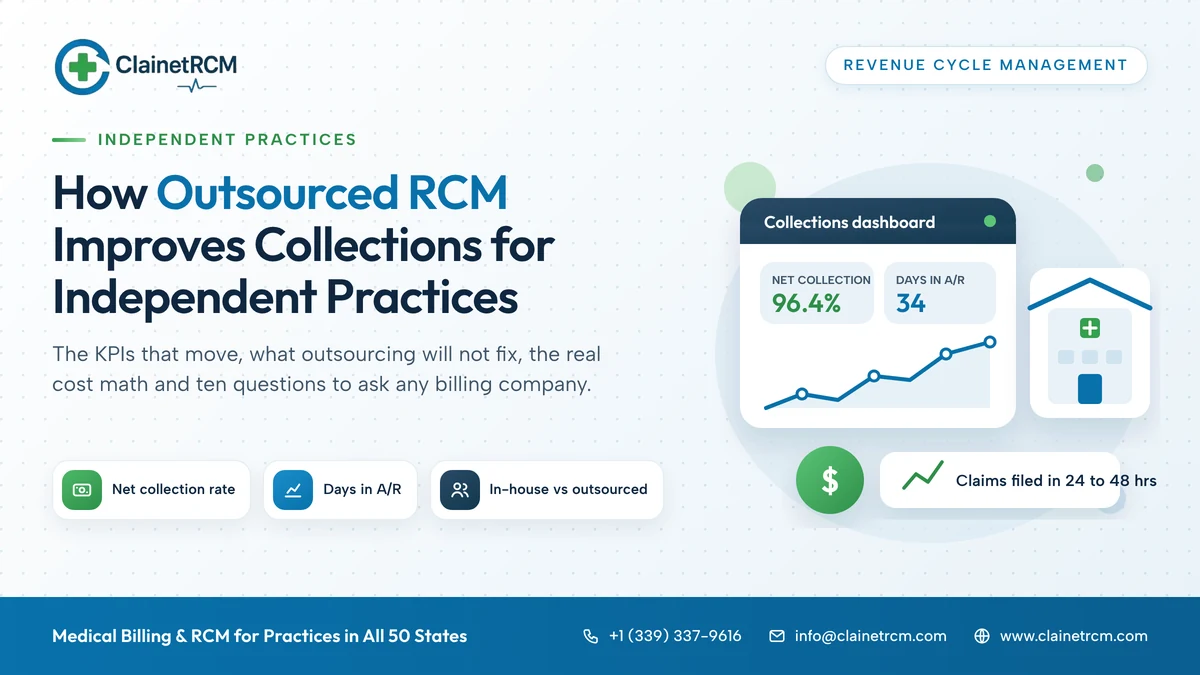
| Net collection rate | Payments received ÷ (charges minus contractual adjustments), trailing 12 months | 95 percent or higher | Shows how much of the collectible revenue you actually collected |
| Days in accounts receivable | Total A/R ÷ average daily charges | 30 to 40 days; AAFP says stay under 50 at minimum | Measures how fast claims turn into cash |
| First-pass denial rate | Claims denied on first adjudication ÷ claims adjudicated | Below 5 percent; MGMA median is 7 to 8 | Every denial costs rework and delays payment |
| Clean claim rate | Claims accepted and paid on first submission ÷ claims submitted | 95 percent or higher | Rejections and denials both restart the clock |
| A/R over 120 days | Dollars older than 120 days ÷ total A/R | Under 15 percent | Old A/R is where write-offs hide |
| Point-of-service collection rate | Copays and known balances collected at the visit ÷ amount due | As close to 100 percent of copays as the front desk can manage | MGMA data: practices collect 72 percent of copays at the visit but only about 27 percent of other patient balances |
MGMA's 2026 polling shows why these matter now: 32 percent of groups reported days in A/R higher than a year earlier, 48 percent named denials and appeals as their biggest source of lost revenue, and physician-owned groups held A/R over 120 days roughly flat while hospital-owned groups slipped by 9.5 to 15.9 points. Independence is worth protecting, and the revenue cycle is where it is protected. For the patient-side tactics, see our guide to how to improve patient collections.
Seven Ways Outsourced RCM Improves Collections
None of these are secrets. An in-house team can do every one of them. The reason outsourcing tends to improve the numbers is that a dedicated team does all seven every day, with backup when someone is out, and reports on them whether the news is good or bad.
1. Eligibility and benefits are verified before every visit
Missing or inaccurate claim data and registration errors are the most common denial causes in Experian Health's 2025 survey, and inactive coverage, wrong payer and coordination-of-benefits mistakes are where most of them start. A dedicated eligibility and benefits verification step 24 to 48 hours before the visit catches them while the patient can still be rescheduled or asked to pay, and gives the front desk an accurate copay and deductible figure to collect.
2. Claims go out clean, within 24 to 48 hours
Charge lag is invisible until you measure it. A claim that sits for a week before submission adds a week to days in A/R for no reason. A billing team that scrubs and files within 24 to 48 hours of the encounter, and works clearinghouse rejections the same day, shortens the cycle before the payer is even involved. Our guide to clean claims in medical billing covers the checks that matter.
3. Every denial is worked, not just the easy ones
In a short-staffed office, low-dollar denials are the first thing to slide, and they add up. Structured denial management triages every denial within 48 hours, picks the right remedy (corrected claim, reopening or appeal), appeals by dollar threshold and payer, and logs the root cause so the same error stops recurring. The process is laid out in how to reduce claim denials in a medical practice.
4. A/R is worked on a fixed cycle
Payers do not call to say a claim is stuck. Accounts receivable management on a fixed cycle, where every aging bucket is reviewed every 14 days and followed up by claim status, keeps money from quietly crossing the timely filing or appeal deadline. This is usually where the first visible improvement shows up, because old A/R that nobody had time to work gets touched.
5. Payments are posted and checked against the contract
Underpayments are not denials, so they do not show up in denial reports. A disciplined posting process reconciles every remittance against the contracted fee schedule, flags underpayments and incorrect contractual adjustments, and appeals them. Our article on post payment in medical billing walks through the workflow.
6. Coding is accurate for the specialty
Undercoding leaves money on the table; overcoding invites audits. Certified, specialty-matched medical coding review raises accuracy on both sides, especially for procedural specialties where modifier and bundling rules change every year.
7. Credentialing stays current
A provider who falls out of network because a revalidation or re-attestation was missed generates denials that look like billing errors and are often unrecoverable. RCM partners that also manage provider credentialing keep the enrollment roster, revalidation dates and CAQH attestations current, and onboard new providers before their first day using a credentialing checklist for newly hired providers.
Underneath all seven is reporting. A good partner sends monthly reports with net collection rate, days in A/R, denial rate by payer and reason, A/R aging and write-offs by cause, and sits down with the physicians to go through them. If a vendor's report is a single blended "collection rate," that is a warning.
What Outsourcing Will Not Fix
Honesty here saves both sides a bad year.
- Front-desk collections. A back-office team cannot collect the copay at check-in. It can give the front desk accurate amounts and scripts, but the collection happens in your lobby. With 33 percent of covered workers in high-deductible plans and the average single deductible at $1,886 (KFF, 2025), the lobby matters more every year.
- Documentation. A coder can only code what the note supports. If visits are under-documented, outsourcing will not create the revenue; it will tell you where the documentation falls short.
- Payer rates. Outsourced billing collects the contracted amount. Negotiating a better contract is a separate project, though a good partner's underpayment and denial data is the evidence you need for it.
- Patient balances that were never going to be paid. Better statements, payment plans and digital options raise patient collection, but no process turns an uncollectable balance into cash. Expect improvement, not miracles.
- A broken EHR migration. If you are mid-migration, finish it first. Changing billing teams and systems at the same time doubles the risk.
In-House vs Outsourced: The Real Cost Math
The fair comparison is not "salary versus percentage." It is the fully loaded cost of the in-house function versus the fee, measured against the collections each one actually produces.
| Cost or risk | In-house biller | Outsourced RCM |
|---|---|---|
| Direct labor | Median $51,140 a year per medical records specialist (BLS, May 2025), plus payroll taxes and benefits, typically adding 20 to 30 percent | A percentage of collections. ClainetRCM billing starts at 2.29 percent; industry sources commonly cite 4 to 10 percent |
| Software, clearinghouse and training | Practice management licenses, clearinghouse fees, coding references and continuing education | Usually included; confirm clearinghouse fees and EHR integration in writing |
| Coverage during leave or turnover | Billing stops, or a temp learns your payers from scratch | Team coverage; ask about staff continuity and who backs up your account |
| Cost when collections drop | Fixed. Salary does not fall with volume | Scales down with collections |
| Cost when the practice grows | Another hire, often before the volume justifies it | Scales up without recruiting |
| Specialty coding depth | Depends on the one person you hired | Should be specialty-matched and certified; verify credentials |
| Reporting | Whatever your biller has time to produce | Monthly KPI reporting should be part of the contract |
A worked example: a practice collecting $50,000 a month pays $1,145 a month at 2.29 percent and $3,500 a month at 7 percent. One in-house specialist at the BLS median costs about $4,262 a month in wages before benefits, software and the cost of the weeks when the position is vacant. The percentage model is cheaper for most small practices, but only if the vendor's collections are at least as good as the in-house team's. That is why the baseline and the KPI commitments matter more than the rate itself. See ClainetRCM pricing for what the percentage covers and what is quoted separately.
Read the fee definition, not just the number. Ask what counts as "collections" (insurance only, or patient payments too; front-desk copays; A/R that predates the contract; refunds), whether there is a monthly minimum or setup fee, and which services are billed separately. Common extras across the industry include coding, credentialing, patient statements and postage, appeals, eligibility checks and system interfaces. ClainetRCM does not charge extra to appeal, has no setup fee or minimum, and defines collections as money actually deposited into your account for claims we worked.
When You Should Not Outsource
Outsourcing is a decision, not a default. Keep billing in-house when most of these are true:
- Your net collection rate is above 95 percent, days in A/R are 30 to 40, first-pass denials are under 5 percent and A/R over 120 days is under 15 percent.
- You have a tenured biller who knows your payers, and a documented backup plan for when that person is out.
- Your revenue leakage is at the front desk (copays, eligibility), which a back-office vendor will not fix on its own.
- You are in the middle of an EHR or practice management migration.
- You have high collections and simple claims, where a flat per-provider fee may cost less than a percentage. Ask for both quotes.
- Your state restricts percentage-based billing arrangements for your license type and you have not had counsel review the contract.
If two or more of these are false, the numbers usually favor a trial: a defined scope, a 90-day review against the baseline, and no long-term commitment.
Ten Questions to Ask Any RCM Company
- Who will work my claims, where are they based, and what are their credentials? KLAS's 2025 review of end-to-end RCM outsourcing scored the largest vendors from 95.1 down to 55.6 out of 100, with inconsistent offshore quality a named complaint among the low scorers. Judge the team, not the brand, and expect transparency about where work is done.
- What KPIs will you report, how often, and with what definitions? Net collection rate, days in A/R, denial rate by payer and reason, A/R aging and write-offs by cause, monthly, with the formulas written down.
- How is the fee defined? What counts as collections, what is extra, and whether the rate can change.
- Where do payments go? Payer payments, including Medicare, should be made in the practice's name and deposited to the practice's own account. Medicare rules (42 CFR 424.73) bar paying a billing agent whose compensation is tied to the amounts billed or collected when the agent itself receives the payment, so the money should never route through the vendor.
- How do you audit coding? The HHS Office of Inspector General has warned since 1998 that percentage-based billing arrangements can create an incentive to upcode. Ask how the vendor samples and audits coded claims and who reviews the results.
- What does the business associate agreement include? HIPAA (45 CFR 164.502(e) and 164.504(e)) requires a written BAA before any patient data changes hands, covering permitted uses, safeguards, breach and security incident reporting, subcontractor obligations, patient access and amendment support, HHS access to records, and return or destruction of data at termination.
- What happens if your clearinghouse goes down? After the February 2024 Change Healthcare attack, an AMA survey found 80 percent of practices lost revenue from unpaid claims, 55 percent used personal funds to cover expenses and 31 percent could not make payroll. Ask whether the vendor can switch clearinghouses and who holds those accounts.
- Who owns the data and the logins? The practice should own its billing data, payer portal and clearinghouse credentials, and should get them back, with an export in a usable format, at termination.
- What is the exit? Notice period, termination fees, and a written rule for claims still in progress when the contract ends. ClainetRCM's terms are 30 days' notice, no termination penalty, and every file and open claim handed back.
- Can I talk to two clients in my specialty? References from practices your size, on your software, in your specialty.
Two compliance notes deserve counsel's review in some states. A few states, New York among them, have fee-splitting rules that restrict percentage-based payments for certain services to licensed professionals, and how they apply to billing companies is a legal question. And "HIPAA certified" badges carry no federal weight; what matters is the BAA and the safeguards behind it.
What the First 90 Days Look Like
A well-run transition does not interrupt cash flow. This is the sequence we follow at ClainetRCM, and it is a reasonable template to hold any vendor to.
- Days 1 to 3: BAA and baseline. Sign the business associate agreement before any data moves. Pull the baseline KPIs from your practice management system with agreed definitions.
- Days 3 to 14: setup. Connect to your existing EHR and practice management system (you keep your software), load the payer mix and fee schedules, confirm clearinghouse and portal access, and reconcile the credentialing roster. Onboarding takes 7 to 14 business days.
- Weeks 3 to 6: run in parallel. New claims go out within 24 to 48 hours. Old A/R is triaged by age and recoverability and worked by priority. Denials are logged by root cause from day one.
- Weeks 7 to 12: fix the upstream causes. The denial log tells you which eligibility, authorization, coding or credentialing gaps to close. Front-desk scripts and copay collection targets are set with the practice.
- Day 90: review against the baseline. Same formulas, same definitions, by payer. If the numbers did not move, you should know why, and you should be free to leave.
For a solo provider or small group, the private practice billing page explains how the service is sized to claim volume; the revenue cycle management and medical billing services pages cover the full scope and the billing-only option.
See What Your Practice Is Leaving Uncollected
Send us 90 days of remittance data and we will show you, by payer and reason, which claims were denied, underpaid or never worked, and what it would take to recover them. No cost, no obligation, and you keep the report either way.
Request a Free Revenue AuditFrequently Asked Questions
The measurable benefits are a higher net collection rate, shorter days in accounts receivable, a lower first-pass denial rate and less A/R over 120 days, which come from eligibility verification before every visit, claims filed within 24 to 48 hours, every denial worked, A/R reviewed on a fixed cycle and payments reconciled against contracts. The operational benefits are coverage during staff leave or turnover, specialty-matched certified coders, and monthly KPI reporting without adding headcount.
It improves collections when the vendor's process is more consistent than the practice's current one, which is usually the case for practices with turnover, growing volume or a backlog of unworked A/R. It does not raise payer rates or collect copays at the front desk. The only way to know is to baseline net collection rate, days in A/R, denial rate and A/R over 120 days before the contract, then measure the same numbers at 90 days.
Most medical billing companies charge a percentage of monthly collections; industry surveys commonly cite 4 to 10 percent, and ClainetRCM billing starts at 2.29 percent of collections with no setup fee, no monthly minimum and no long-term contract. Some vendors charge a flat fee per provider or per claim instead. The definition of "collections" and the list of services billed separately matter more than the headline rate.
Most practice-management benchmarks put the target at 95 percent or higher, calculated as payments received divided by charges minus contractual adjustments over a trailing 12 months. Below 90 percent usually indicates denials, underpayments or patient balances that are not being worked. Track it by payer so a single problem payer cannot hide inside the average.
Keep billing in-house when your net collection rate is above 95 percent, days in A/R are 30 to 40, first-pass denials are under 5 percent, A/R over 120 days is under 15 percent, and you have a tenured biller with a backup plan. Also hold off if you are mid-way through an EHR migration or if your leakage is at the front desk, since a back-office vendor will not fix copay collection on its own.
Percentage-based billing is common and permitted in most arrangements, with two conditions. Medicare rules at 42 CFR 424.73 require payment to be made in the provider's name, so Medicare payments must go to the practice's own account rather than to a billing agent paid on a percentage. Some states, including New York, have fee-splitting rules that may restrict percentage arrangements for certain licensed professionals, so have counsel review the contract if you practice in one of those states.
Under 45 CFR 164.504(e), the BAA must limit how the billing company uses and discloses protected health information, require appropriate safeguards, require reporting of improper uses, breaches and security incidents, bind any subcontractors to the same terms, support patient access and amendment rights, make the vendor's records available to HHS, require return or destruction of data at termination where feasible, and allow the practice to terminate for a material breach. It must be signed before any patient data is shared.
That depends entirely on the contract, which is why it should be settled before signing. Get in writing that the practice owns its billing data and will receive an export in a usable format, that payer portal and clearinghouse logins return to the practice, how claims still in progress at termination are handled, and the notice period and any termination fees. ClainetRCM's terms are 30 days' notice, no termination penalty, and every file, open claim and login handed back.
The Bottom Line
Outsourced RCM helps independent practices improve collections by doing the unglamorous things every day: verifying eligibility, filing clean claims fast, working every denial, touching every aging bucket on schedule, reconciling payments against contracts and keeping providers credentialed. It does not change payer rates or collect the copay at your front desk, and it is not the right move for a practice whose numbers are already at target.
If your net collection rate, days in A/R or denial rate are off target, baseline them this month, get a scoped proposal with KPI commitments and a clean exit, and judge the results at 90 days. That is the whole decision.

Written by
ClainetRCM Billing Team
ClainetRCM is a Boston-based revenue cycle management company specializing in medical billing, coding, credentialing and denial management for healthcare providers across all 50 states. Our AAPC and AHIMA certified team works inside your existing EHR, files claims within 24 to 48 hours and reviews every AR bucket on a 14-day cycle.