Every practice eventually asks the same question: should we keep medical billing in-house or outsource it? The honest answer is that both can work and both can fail. In-house billing fails when the one person who knows your payers leaves, when volume outgrows the desk, or when nobody has time to work denials. Outsourcing fails when the practice signs a vague contract, never measures a baseline, and discovers a year later that "improved collections" was never defined.
This guide is the decision itself, not a sales pitch for either side. It walks through what in-house billing really costs once you load the salary, how that compares to a percentage fee at different collection levels, the non-financial factors that usually decide it, a scoring checklist, and the hybrid options most articles leave out.
Last updated: October 2026
Key takeaways
- The fully loaded cost of one in-house biller is roughly 1.4 times base pay once benefits are added, before software, clearinghouse fees, training and the cost of vacancies.
- At the Bureau of Labor Statistics median wage for medical records specialists, that is about $73,000 a year for one person, which is the break-even point against a percentage fee at a given level of collections.
- Cost is rarely the deciding factor. Coverage during leave and turnover, denial follow-through, specialty coding depth and reporting usually decide it.
- Keep billing in-house when your metrics are already at target and you have a tenured biller with a backup plan. Outsource when denials are rising, volume is growing, or the same errors keep repeating.
- Hybrid models exist: keep front-desk and charge entry in-house and outsource denials, A/R follow-up or coding. Many practices do best there.
What In-House Billing Really Costs
Most comparisons stop at salary, which understates the in-house number by a wide margin. Build the full cost.
| Cost component | What to include | Reference point |
|---|---|---|
| Base pay | Salary or hourly wage for each billing and coding employee | BLS median for medical records specialists (which includes coders): $51,140 a year as of May 2025; experienced billers in high-cost markets earn more |
| Benefits and payroll taxes | Health insurance, retirement, paid leave, Social Security and Medicare taxes, unemployment insurance | Benefits were 30 percent of total private-industry compensation in June 2026 (BLS), which is about 43 percent on top of wages |
| Software | Practice management and clearinghouse fees, coding references, claim scrubber | Market estimates commonly run several hundred dollars per provider per month for PM and EHR; clearinghouse fees are often per claim or per provider |
| Training and certification | AAPC or AHIMA credentials, continuing education, annual code-set updates | Recurring; often skipped when budgets are tight, which is when errors start |
| Management time | Physician or administrator hours spent supervising billing, reviewing reports, handling escalations | Rarely counted, always real |
| Vacancy and turnover | Weeks with no one working claims, recruiting costs, training a replacement on your payers | MGMA reports experienced billers and coders leaving practices for remote jobs at insurers, health systems and RCM companies |
| Error cost | Denials, write-offs and timely filing losses from an overloaded desk | Experian Health, 2025: 41 percent of providers report denial rates of 10 percent or higher |
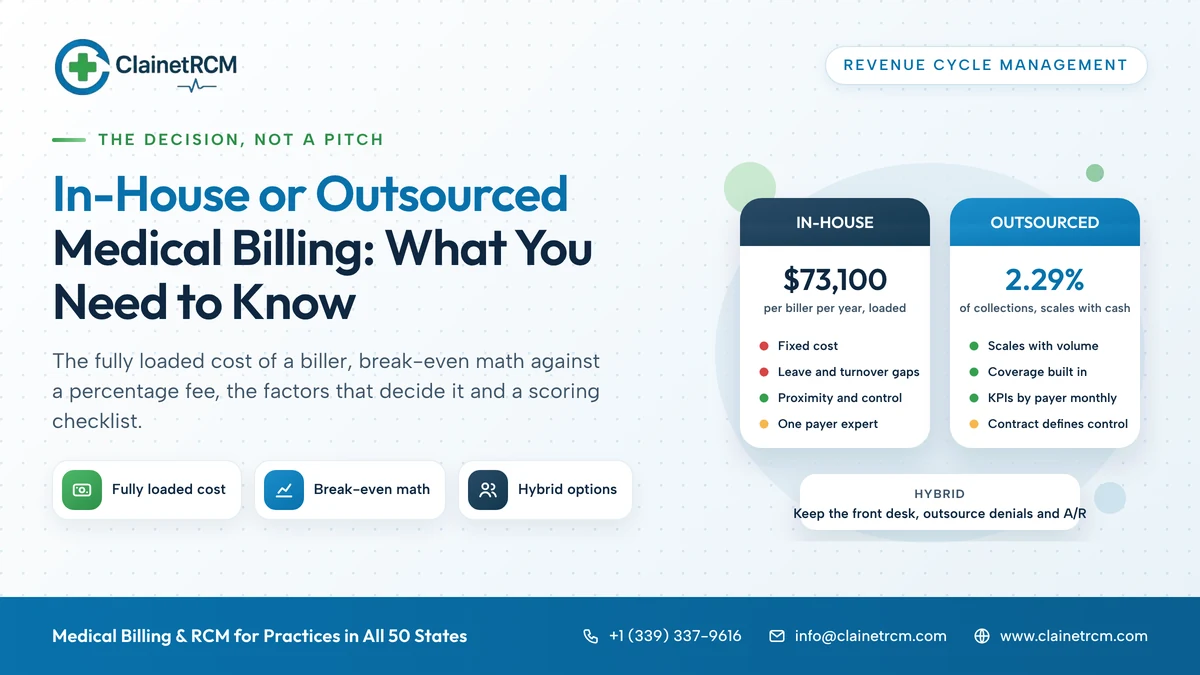
Put numbers on it for one biller at the BLS median: $51,140 in wages plus roughly 43 percent for benefits and payroll costs is about $73,100 a year, or around $6,100 a month, before software, training and vacancies. A practice that needs two billers, or a biller and a coder, doubles that. Those are the figures to compare against a fee, not the salary line alone.
The Break-Even Math Against a Percentage Fee
Outsourced billing is usually priced as a percentage of collections. The table shows what that fee costs each month at different collection levels, against the fully loaded cost of one in-house biller at the BLS median (about $6,100 a month).
| Monthly collections | Fee at 2.29 percent | Fee at 5 percent | Fee at 7 percent | One in-house biller (fully loaded) |
|---|---|---|---|---|
| $50,000 | $1,145 | $2,500 | $3,500 | About $6,100 |
| $100,000 | $2,290 | $5,000 | $7,000 | About $6,100 |
| $150,000 | $3,435 | $7,500 | $10,500 | About $6,100 |
| $250,000 | $5,725 | $12,500 | $17,500 | About $6,100 (but one person rarely handles this volume) |
| $400,000 | $9,160 | $20,000 | $28,000 | Two or more staff: $12,200 or more |
Three things the table does not show. One biller rarely keeps up with $250,000 a month of collections across multiple payers, so the in-house column understates staffing at higher volumes. The in-house cost does not fall when collections fall; the fee does. And the comparison only holds if the outsourced team collects at least as well as the in-house one, which is why the metrics matter more than the rate. ClainetRCM's pricing starts at 2.29 percent for billing-only work; industry estimates for the wider market commonly run 4 to 9 percent, so ask every vendor for its definition of "collections" and its list of extras before comparing numbers.
The compliance footnote on percentages. Under 42 CFR 424.73, Medicare pays a billing agent only when the agent's compensation is not tied to amounts billed or collected and payment is made in the provider's name. The practical rule is that payer payments go to the practice's own account, never through the billing company. Some states also have fee-splitting restrictions, so have counsel review any percentage contract.
The Factors That Usually Decide It
Practices that choose on cost alone often choose wrong. These are the factors that decide the outcome a year later.
Coverage and continuity
When an in-house biller is out for two weeks, claims stop. When they resign, the practice loses the only person who knew which payer wants which modifier. An outsourced team covers leave and turnover by design, but only if the contract names who works your account and commits to continuity. Ask.
Denial follow-through
A single biller juggling charge entry, posting, patient calls and submissions will always let low-dollar denials slide. Those are the denials that add up. MGMA's 2026 polling found 48 percent of practice leaders naming denials and appeals as their biggest source of lost revenue. Dedicated denial management works every denial on a schedule because that is the only job.
Specialty coding depth
Procedural specialties, behavioral health, home health and surgical practices all have coding rules that change every year. In-house works when you can hire and keep a certified coder in your specialty. If you cannot, the gap shows up as undercoding, which is invisible, and overcoding, which is an audit.
Reporting and visibility
Most in-house setups produce whatever reports the biller has time to run. Most good outsourcing contracts include monthly KPIs by payer and a review meeting. Visibility is the thing practice owners say they miss most after a bad outsourcing experience and value most after a good one.
Control and culture
Some owners want the biller down the hall, and that preference is legitimate. The honest version of the trade-off is that you give up some day-to-day control in exchange for process discipline and coverage. The way to keep control is reporting, data ownership and a short notice period, not proximity.
Vendor and concentration risk
Outsourcing adds a dependency. After the February 2024 Change Healthcare attack, an AMA survey found 80 percent of practices had lost revenue from unpaid claims and 55 percent had used personal funds to cover expenses. In-house practices were hit too, because the dependency was the clearinghouse, not the biller. The question for any vendor is whether they can switch clearinghouses and who holds those accounts.
When to Keep Billing In-House
- Your net collection rate is above 95 percent, days in A/R are 30 to 40, first-pass denials are under 5 percent and A/R over 120 days is under 15 percent.
- You have a tenured, certified biller who knows your payers, plus a documented backup for leave and departures.
- Your revenue leakage is at the front desk (eligibility, copays), which a back-office vendor will not fix on its own.
- You are in the middle of an EHR or practice management migration; change one thing at a time.
- Your collections are high and your claims are simple, so a flat-fee arrangement might cost less than a percentage. Get both quotes.
- You value proximity enough to pay for it, and you are measuring the numbers so you will know if that changes.
When to Outsource
- Denials or days in A/R are rising and the same reason codes keep returning month after month.
- Your biller spends more time reworking claims than submitting them, or claims are batched weekly because there is no time to do them daily.
- A biller just left, or the practice depends on one person with no backup.
- You are adding providers, locations or a new service line and do not want to hire ahead of the revenue.
- You need specialty coding you cannot recruit locally.
- Nobody is producing KPI reports, and the physicians cannot say what the net collection rate is.
MGMA's November 2024 poll found 36 percent of practice leaders planned to outsource or automate part of their revenue cycle in 2025, and in January 2026, 14 percent named outsourcing as a top cost-cutting move for the year. The trend is toward targeted outsourcing rather than all-or-nothing, which brings us to the hybrid options.
The Hybrid Options Most Articles Skip
| Model | Practice keeps | Vendor takes | Best for |
|---|---|---|---|
| Denials and A/R only | Charge entry, submission, posting | Denial management, appeals, aging A/R, underpayment recovery | Practices with a capable biller who cannot keep up with follow-up |
| Coding only | All billing | Code assignment, modifier review, coding audits | Procedural and surgical specialties without a certified coder |
| Front end only | Billing | Eligibility verification, prior authorization, cost estimates | High-deductible and authorization-heavy specialties |
| Old A/R cleanup | Current billing | A one-time project on aged claims, priced on recovery | Practices with a backlog and a working current process |
| Credentialing only | Billing | Enrollment, CAQH, revalidation, re-credentialing | Growing groups and multi-state practices |
| Full RCM | Clinical documentation and front desk | Everything from eligibility through final payment | Practices that want one accountable partner |
Hybrid arrangements work when the handoffs are defined: who owns a claim at each stage, how work moves between teams, and who reports which number. ClainetRCM offers accounts receivable management, denial management and medical coding as stand-alone services for exactly this reason.
A Scoring Checklist for the Decision
Score each statement from 0 (false) to 2 (true). Add them up.
- Our net collection rate is at or above 95 percent and we know the number.
- Our days in A/R are 40 or fewer.
- Our first-pass denial rate is under 5 percent.
- Fewer than 15 percent of our A/R is over 120 days.
- We have a certified biller or coder with at least two years on our payers.
- We have a documented backup for leave and departures.
- Every denial is worked within a week of arrival.
- Claims go out within 48 hours of the visit.
- We get monthly KPI reports by payer and review them.
- We are not adding providers or locations in the next 12 months.
A score of 16 to 20 says your in-house operation is working; protect it and buy only what you lack. A score of 10 to 15 points to a hybrid: outsource the weakest functions. A score under 10 means the practice is losing money to its billing process, and a full outsourcing evaluation is worth the time.
If You Outsource, How to Do It Without Losing Cash
- Baseline first. Net collection rate, days in A/R, denial rate and A/R over 120 days, by payer, with written formulas. Without this you can never prove the change worked.
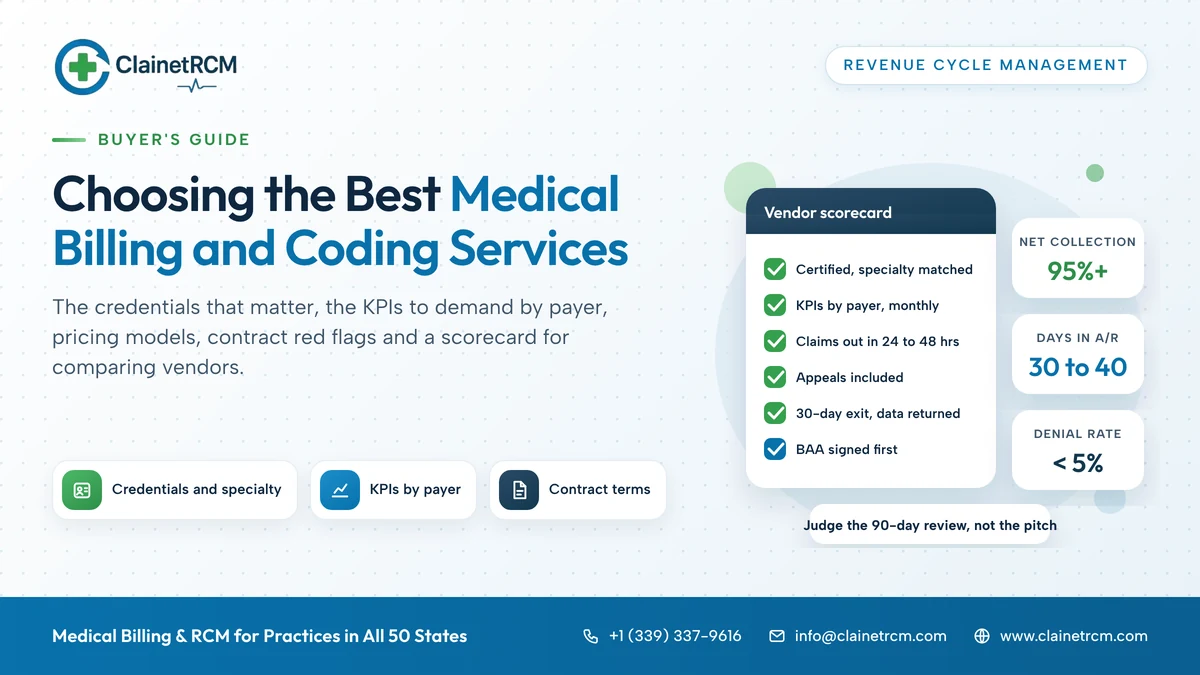
- Pick the vendor on evidence. References in your specialty, KPIs by payer for existing clients, staff location and credentials, a BAA before any data moves. Our guide to choosing medical billing and coding services has the scorecard.
- Keep your software. The vendor should work inside your existing practice management system so your data and history stay with you.
- Run in parallel. New claims go to the vendor from day one; the in-house biller finishes open items and transfers payer knowledge. Onboarding should take 7 to 14 business days.
- Define the exit on day one. Notice period, data export, return of logins and the rule for claims in progress.
- Review at 90 days against the baseline, by payer. Decide on the numbers.
For a fuller account of what to expect from outsourcing, including what it will not fix, see how outsourced RCM helps independent practices improve collections. Practices sized from solo to multi-location can see how the service scales on our private practice billing page.
Not Sure Which Way to Go? Start With the Numbers.
Send us 90 days of remittance data and we will show you your real net collection rate, denial rate and aging by payer, so the in-house or outsourced decision is made on evidence. No cost, no obligation, and you keep the report either way.
Request a Free Revenue AuditFrequently Asked Questions
It depends on your collections. One in-house biller at the Bureau of Labor Statistics median wage costs about $73,000 a year fully loaded (around $6,100 a month) before software, training and vacancies. A percentage fee costs $1,145 a month at 2.29 percent of $50,000 in collections and $3,435 at $150,000. Outsourcing is usually cheaper for small and mid-sized practices, but only if the vendor collects at least as well as your current team.
Less day-to-day control, dependence on a vendor's staff and systems, the risk of a contract with minimums, extras and lock-in, and the possibility of inconsistent quality if the vendor does not disclose who works your account. All of these are managed through the contract: KPI reporting by payer, named staff, data ownership, a short notice period and a signed business associate agreement.
Fixed cost that does not fall with volume, dependence on one or two people with no coverage for leave or turnover, limited specialty coding depth, denials that slide when the desk is busy, and reports that only get produced when someone has time. The fully loaded cost is also higher than most owners estimate once benefits, software and vacancies are counted.
The Bureau of Labor Statistics reports a median wage of $51,140 a year for medical records specialists as of May 2025. Benefits were 30 percent of total private-industry compensation in June 2026, which adds roughly 43 percent on top of wages, so the fully loaded cost is about $73,000 a year for one person at the median, before practice management software, clearinghouse fees, training and the weeks the position sits vacant.
Yes, and many practices should. Common hybrid models outsource denial management and A/R follow-up only, coding only, front-end eligibility and prior authorization only, a one-time old A/R cleanup, or credentialing only, while the practice keeps charge entry and submission in-house. The arrangement works when the handoffs and the reporting responsibilities are defined in writing.
When denials or days in A/R are rising, when the same denial reasons keep returning, when a biller has left or the practice depends on one person, when providers or locations are being added, when specialty coding cannot be recruited locally, or when nobody can state the net collection rate. If the metrics are at target and the team is stable, keep what works.
That is set by the contract, so settle it before signing. The practice should own its billing data, receive an export in a usable format, get payer portal and clearinghouse logins back, and have a written rule for claims still in progress. Working inside your own practice management system from the start makes the transition far simpler, because the history never left your system.
A well-run transition takes 7 to 14 business days from signed agreement to first claim submission: business associate agreement, baseline metrics, system access, payer and fee schedule setup, and a reconciled credentialing roster. Plan to run in parallel for a few weeks while open items are finished and old A/R is triaged, then review results against the baseline at 90 days.
The Bottom Line
In-house billing wins when the metrics are at target and the team is stable. Outsourcing wins when denials, turnover or growth have outrun the desk, and the contract gives you visibility, data ownership and a clean exit. Most practices land somewhere in between, outsourcing the functions that are leaking money and keeping the ones that work. Whatever you choose, measure the baseline first, because the decision is only as good as the numbers you make it with.

Written by
ClainetRCM Billing Team
ClainetRCM is a Boston-based revenue cycle management company specializing in medical billing, coding, credentialing and denial management for healthcare providers across all 50 states. Our AAPC and AHIMA certified team works inside your existing EHR, files claims within 24 to 48 hours and reviews every AR bucket on a 14-day cycle.