Remote patient monitoring CPT codes changed significantly in 2026, and more changes take effect in 2027. New codes now pay for shorter monitoring periods and shorter management time, while CMS has tightened who can receive the service and how it must start. Practices that monitor blood pressure, glucose, weight or oxygen saturation need to know both sets of changes.
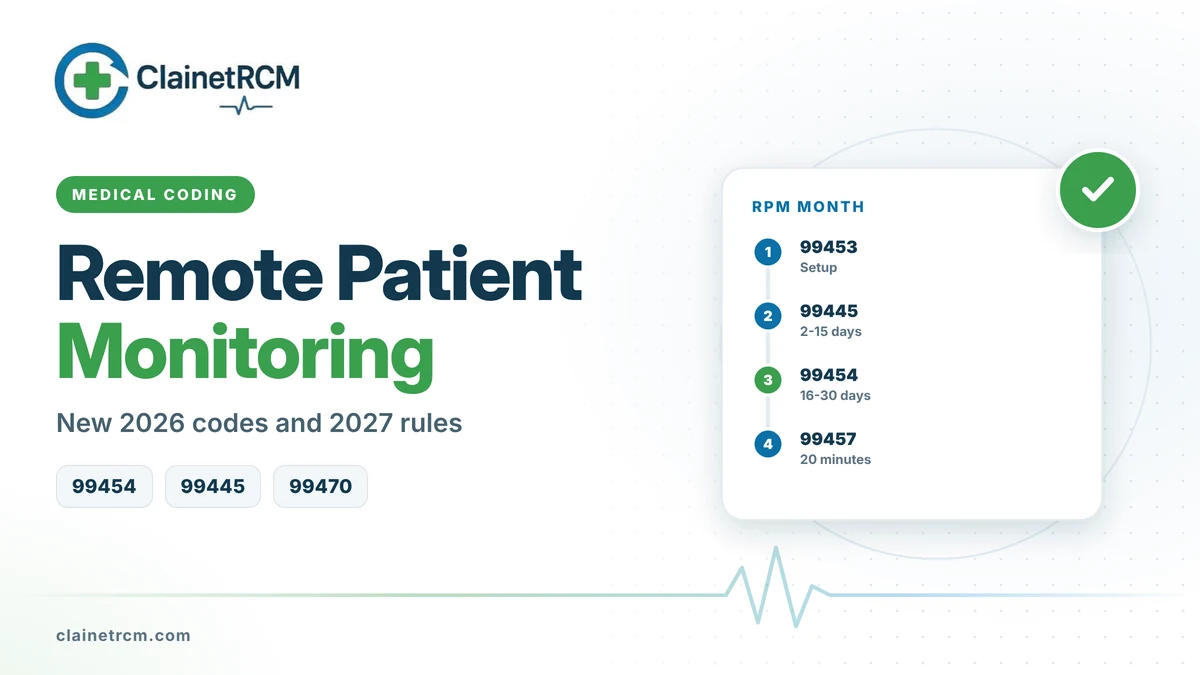
Quick answer: 99453 pays once per episode for setup and patient education. Device supply and data transmission is 99454 for 16 days or more of readings in a 30-day period, or 99445 for 2-15 days (new in 2026). Treatment management is 99457 for the first 20 minutes in a calendar month with at least one real-time interactive communication, 99458 for each additional 20 minutes, and 99470 for the first 10 minutes (new in 2026). The device must meet the FDA definition of a medical device and transmit data automatically. For 2027, Medicare’s final rule requires a separately billable initiating visit before RPM begins.
Remote Patient Monitoring CPT Codes at a Glance
| Code | Service | Requirement |
|---|---|---|
| 99453 | Initial setup and patient education on the device | Once per episode of care |
| 99454 | Device supply with daily recordings or programmed alerts | 16 to 30 days of data in a 30-day period |
| 99445 | Device supply with daily recordings or programmed alerts (new 2026) | 2 to 15 days of data in a 30-day period |
| 99457 | Treatment management, first 20 minutes in a calendar month | At least one real-time interactive communication |
| 99458 | Treatment management, each additional 20 minutes | Add-on to 99457 |
| 99470 | Treatment management, first 10 minutes in a calendar month (new 2026) | At least one real-time interactive communication |
| 99091 | Collection and interpretation of physiologic data by a physician or QHP | 30 minutes in a 30-day period |
The 2-15 day and 16-30 day device codes are alternatives, not a base and add-on pair; bill one or the other for a 30-day period. Likewise, bill 99470 for 10 to 19 minutes of management, or 99457 once you reach 20 minutes.
What Qualifies as RPM
- Physiologic data. Blood pressure, weight, blood glucose, pulse oximetry, heart rate, peak flow and similar measurements.
- A medical device. It must meet the FDA’s definition of a medical device.
- Automatic transmission. Data must be recorded and transmitted digitally, not typed in by the patient.
- Medical necessity. The patient’s condition must benefit from monitoring, such as uncontrolled hypertension or heart failure.
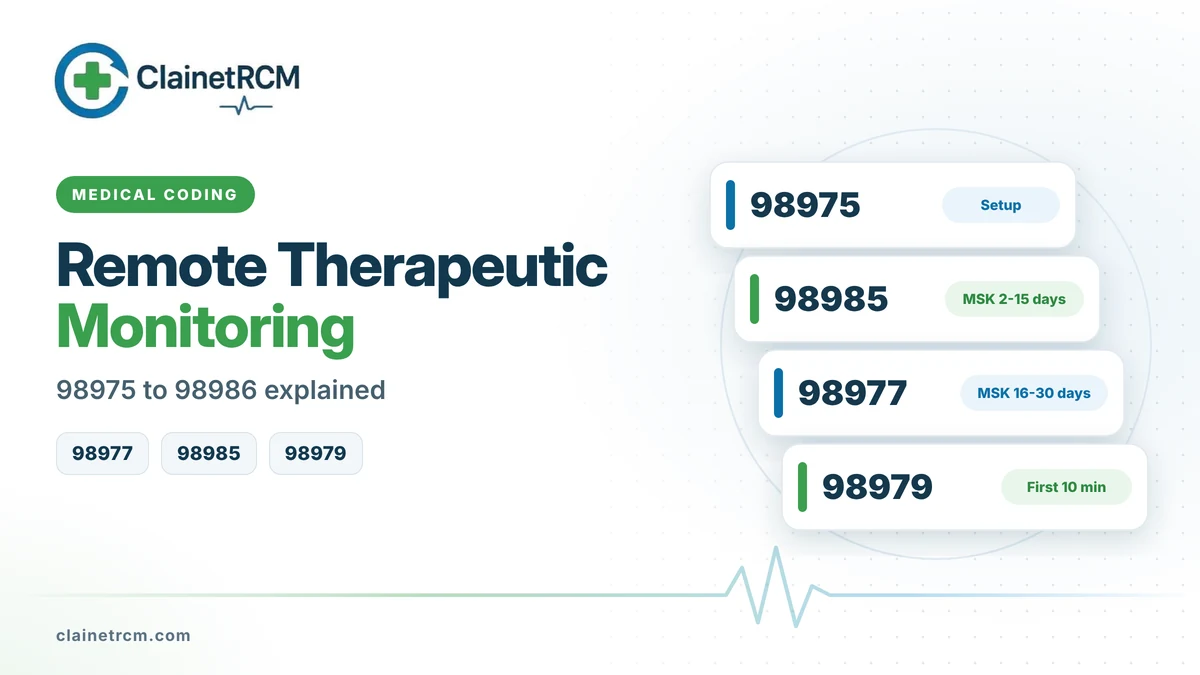
Non-physiologic data, such as therapy adherence or pain scores, is reported with remote therapeutic monitoring codes instead. See our guide to remote therapeutic monitoring CPT codes.
Who Can Bill RPM
Physicians and other practitioners who can bill E/M services can bill RPM, typically for an established patient whose condition they are managing. Clinical staff can furnish the management time under general supervision. Only one practitioner can bill device supply for a patient in a 30-day period, even if the patient sees several specialists.
Medicare Rules That Matter
- Consent. Obtain and document consent at the start of monitoring.
- Episode of care. 99453 is billed once per episode of care, not monthly.
- Interactive communication. 99457, 99458 and 99470 require at least one real-time, synchronous conversation with the patient or caregiver during the month.
- One device code per period. Bill 99454 or 99445, not both, for the same 30 days.
- No overlap with RTM. Do not bill RPM and remote therapeutic monitoring for the same patient in the same period.
What Changes in 2027
Medicare’s CY 2027 Physician Fee Schedule final rule, released November 4, 2026, tightens remote monitoring:
- Initiating visit. Practitioners must furnish a separately reportable initiating visit when RPM or RTM begins, similar to the requirement for chronic care management.
- Valuation updates. CMS updated payment for the remote monitoring codes.
- Third-party vendors. CMS proposed limiting payment to work performed by practice-employed staff but delayed that restriction, so practices using monitoring vendors have more time to adjust.
Review your enrollment workflow now so every new RPM patient has a qualifying visit on record before monitoring starts in 2027.
Billing RPM With Other Care Management
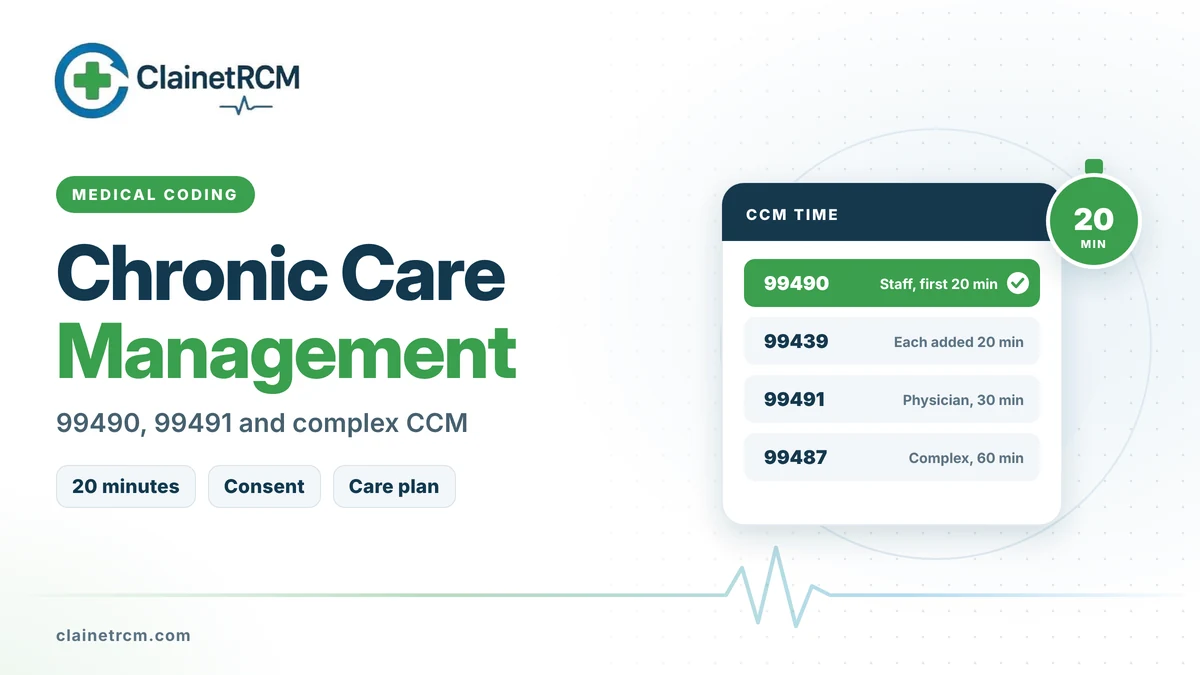
RPM can be billed in the same month as chronic care management, transitional care management and behavioral health integration, as long as time is not counted twice. Our chronic care management CPT codes guide explains how to combine them.
Billing Example
A patient with uncontrolled hypertension starts monitoring on March 3 after an office visit. The practice bills 99453 for setup. The patient transmits readings on 12 days in the first 30-day period, so the practice bills 99445. In March, the nurse spends 24 minutes reviewing data and talking with the patient by phone, so the practice bills 99457. The next month, the patient transmits on 22 days, so the practice bills 99454.
Common RPM Denials and Audit Risks
- Fewer than the required days of data for the device code billed
- No documented real-time interactive communication
- Self-reported readings rather than device-transmitted data
- Device codes billed by two practitioners for the same patient
- Missing consent or medical necessity
- Time logs that do not support 99457 or 99458
The HHS Office of Inspector General has reviewed RPM billing closely, so documentation should be audit-ready from day one.
Frequently Asked Questions
99445 for 2 to 15 days of device data in a 30-day period, and 99470 for the first 10 minutes of treatment management in a calendar month.
At least 16 days in a 30-day period. Use 99445 for 2 to 15 days.
Yes, when each service’s requirements are met and the same time is not counted toward both.
Starting in 2027, Medicare requires a separately reportable initiating visit when RPM begins. Monthly management can be done remotely.
No. RPM data must be transmitted by the device. Self-reported data does not qualify.
Final Thoughts
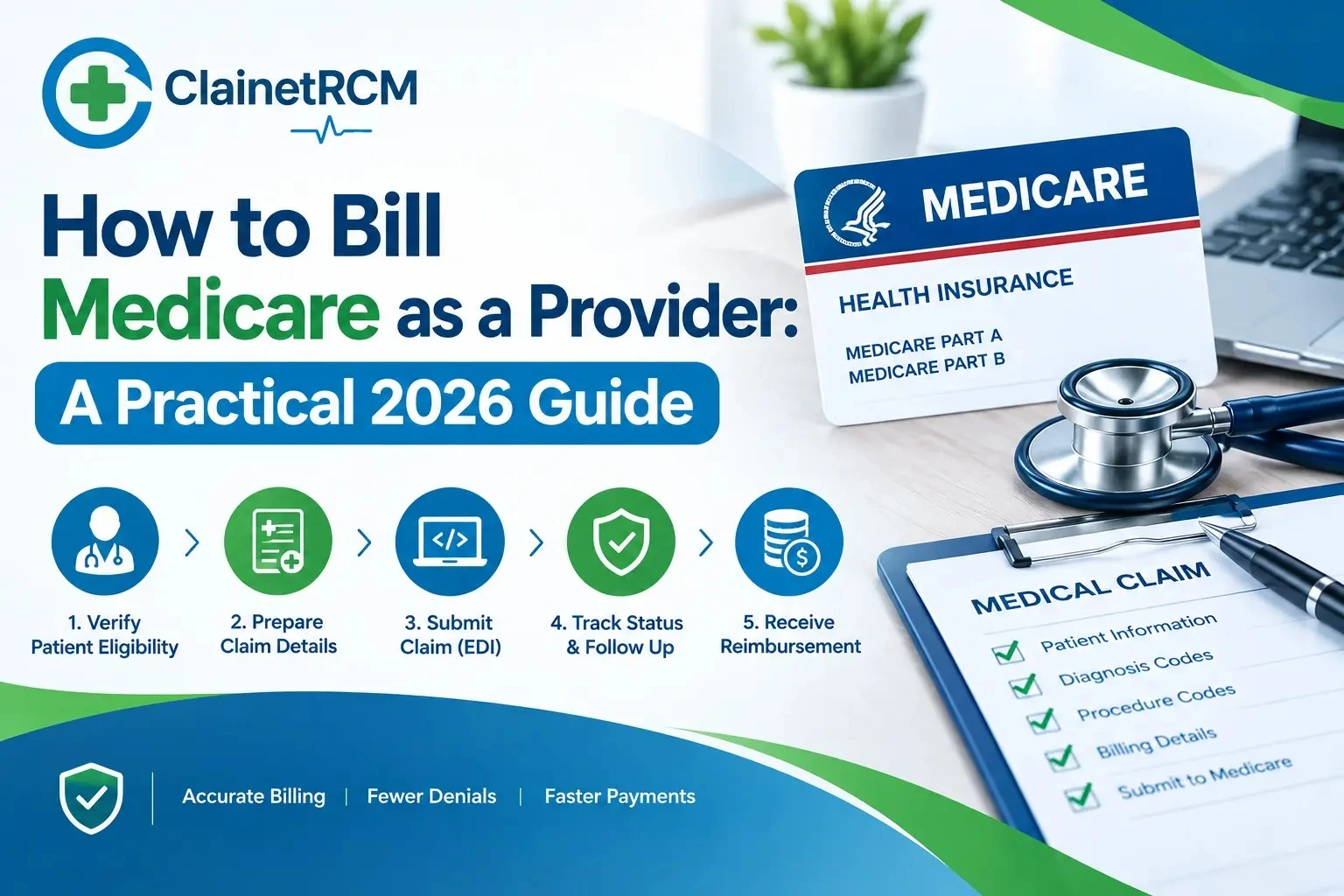
Remote patient monitoring CPT codes now fit more patients, but Medicare expects tighter documentation and, from 2027, an initiating visit. Track device days, management minutes and interactive contacts for every patient. Our cardiology billing team supports RPM programs for cardiology and primary care, and our guide on how to bill Medicare as a provider covers the basics.
RPM Billing That Survives Medicare Scrutiny
We track device days, management minutes and interactive contacts so every RPM claim is supported, including the 2027 rule changes.
Review My RPM Program
Written by
ClainetRCM Billing Team
ClainetRCM is a Boston-based revenue cycle management company specializing in medical billing, coding, credentialing and denial management for healthcare providers across all 50 states. Our AAPC and AHIMA certified team works inside your existing EHR, files claims within 24 to 48 hours and reviews every AR bucket on a 14-day cycle.