Quick answer: To bill Medicare as a provider, you need an NPI, an approved Medicare enrollment through PECOS, a decision on participation status, verified patient eligibility, accurate coding, and a clean claim sent electronically to your Medicare Administrative Contractor (MAC) within 12 months of the date of service. Then you read the remittance, post payments, and appeal denials on time.
That is the short version. The long version is where practices either get paid in two weeks or spend six months chasing money. I have watched both outcomes for decades, and the difference is rarely the claim itself. It is almost always what happened before the claim was created.
This guide walks through the whole process in the order you will actually live it, with the 2026 numbers that affect your payment.
Who Can Bill Medicare?
Medicare pays physicians, nurse practitioners, physician assistants, clinical nurse specialists, certified registered nurse anesthetists, physical and occupational therapists, clinical psychologists, clinical social workers, and many others. Institutions such as hospitals, skilled nursing facilities, home health agencies and hospices bill too, along with suppliers like labs, ambulance companies and durable medical equipment companies.
Each group enrolls on a different form and bills on a different claim type. A solo physician and a hospital are not walking the same road, so confirm your category before you start.
One rule applies to everyone: you cannot bill Medicare for a service if you are not enrolled. Sending claims under another provider’s number to get around a pending application is a compliance problem, not a shortcut.
Step 1: Get Your NPI
Every Medicare claim carries a National Provider Identifier. It is a free 10-digit number issued through NPPES. Individuals get a Type 1 NPI. Group practices and facilities get a Type 2 NPI.
Most providers already have one from school or a previous job. If yours is old, log in and confirm your taxonomy code and practice address match what you will put on your enrollment form. A mismatch here is one of the quietest causes of enrollment delays. If you would rather hand this off, our NPI registration support covers the setup and updates.
Step 2: Enroll in Medicare Through PECOS
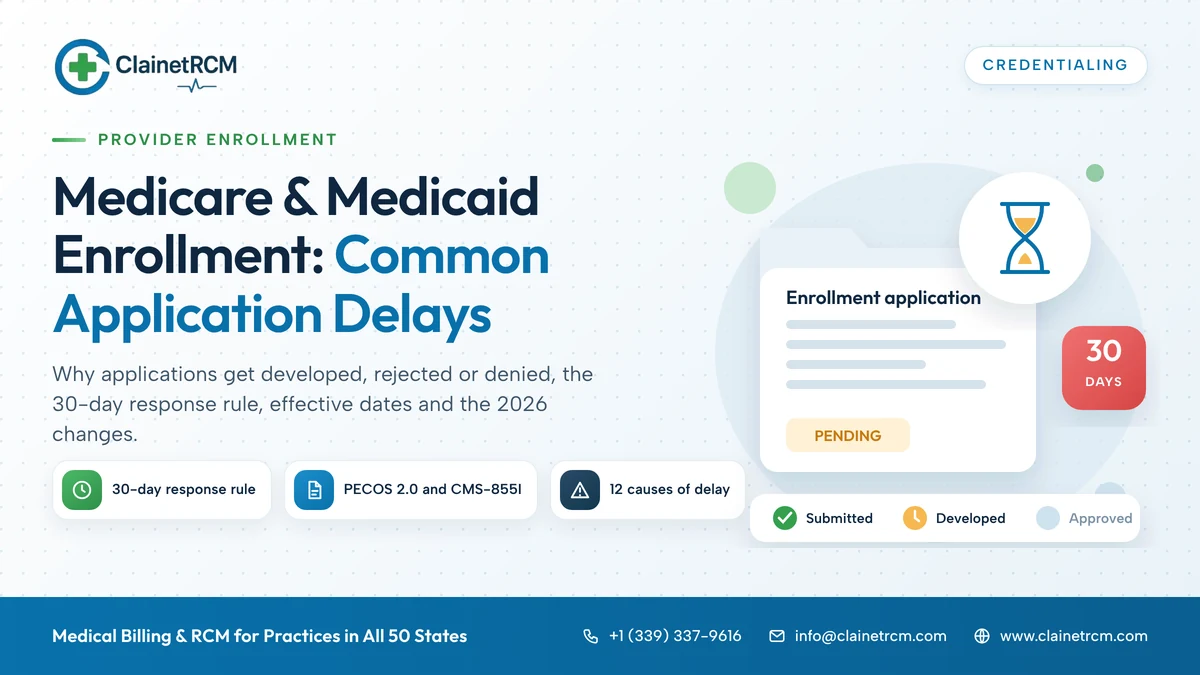
Enrollment is where most new practices lose time. You file through PECOS, the Provider Enrollment, Chain and Ownership System, or on paper if you prefer. Which CMS-855 form you use depends on who you are:
- CMS-855I for individual practitioners
- CMS-855B for groups and clinics
- CMS-855A for institutional providers
- CMS-855S for DMEPOS suppliers
Your application goes to the MAC that covers your state. The MAC can come back with development requests asking for documents, and every day you take to answer is a day added to your timeline. Plan for several weeks, and longer if anything is incomplete.
A few points I tell every client:
- Match names, addresses and tax IDs exactly across the NPI record, the application and your IRS paperwork.
- Link the individual provider to the group with the reassignment step so payments go to the right place.
- Once approved, practitioners can generally bill for services up to 30 days before the effective date, which gives you a small cushion.
- Report changes on time. Ownership changes and adverse legal actions are due within 30 days, and most other updates within 90 days. Missed reports can end with revoked billing privileges.
If PECOS feels like a maze, a dedicated Medicare provider enrollment service can run the application and the follow-up with the MAC for you. And once you are active, revalidation comes around roughly every five years, so put it on a calendar. Letting it lapse stops payments, which is why many practices use Medicare revalidation support as a safety net.
Step 3: Choose Your Participation Status
When you enroll, you pick one of three paths. This decision changes your payment on every claim.
Participating providers sign an agreement to accept Medicare’s approved amount as payment in full. You collect the deductible and 20 percent coinsurance from the patient, and Medicare pays the rest. You receive 100 percent of the fee schedule amount.
Non-participating providers are still enrolled but choose whether to accept assignment claim by claim. Medicare pays 95 percent of the fee schedule. If you do not accept assignment, you can charge up to the limiting charge, which is 115 percent of that reduced amount.
Opt-out providers leave Medicare entirely for two years by filing an affidavit and signing private contracts with patients. Opt-out is a serious step with strict rules, and it applies to every Medicare patient you see during that period.
Most practices participate. The lower payment and extra paperwork of the other options only make sense in narrow situations.
Step 4: Verify Eligibility Before Every Visit
Medicare cards do not tell you the whole story. Before the visit, check three things:
- Is Medicare primary? If the patient has employer coverage through active employment, Medicare may be secondary. Billing the wrong payer first is one of the most common reasons claims bounce. This is the Medicare Secondary Payer rule, and you are expected to have a process for it.
- Is it Original Medicare or Medicare Advantage? Advantage plans are run by private insurers. You bill the plan, not your MAC, and the plan has its own rules.
- What has the patient already used? Deductible status and any frequency limits on services like screenings can change what you collect at the front desk.
You can check through your MAC portal or a clearinghouse. Do it every visit, not once a year. Coverage changes more often than people expect. A structured benefits verification process pays for itself within a month.
Step 5: Document, Code and Capture the Charge
A Medicare claim is only as strong as the note behind it. Medicare pays for services that are reasonable and necessary, and the note has to show it.
Pick the right code set:
- CPT and HCPCS Level II describe what you did.
- ICD-10-CM describes why you did it.
- Modifiers explain special circumstances such as bilateral procedures or a significant, separately identifiable E/M visit.
Link each procedure to a diagnosis that supports medical necessity. Check National and Local Coverage Determinations for the service, because the diagnosis list a MAC accepts can differ from one region to another.
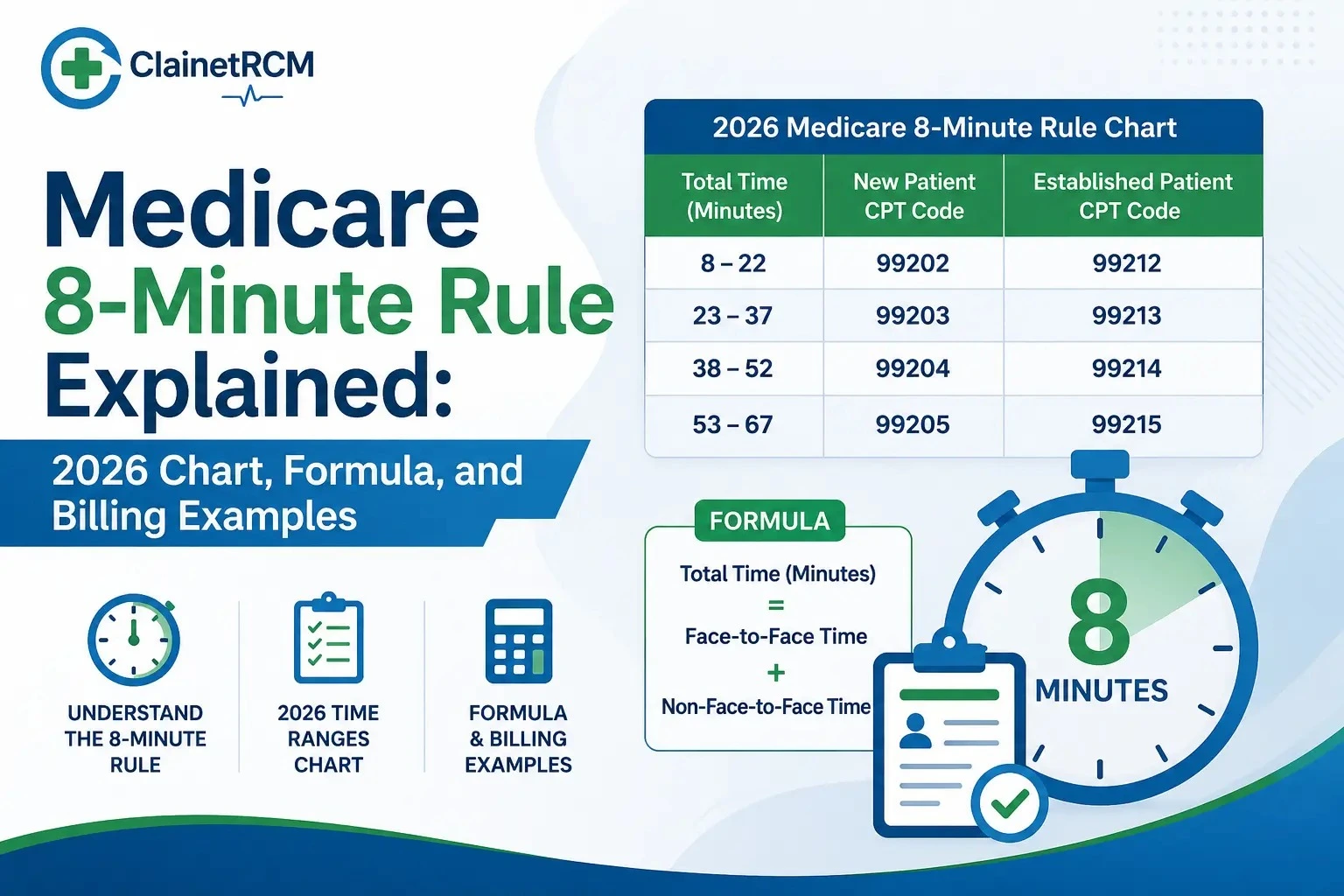
Timed services deserve extra care. Therapy practices should understand how the Medicare 8-minute rule turns minutes into units, since a miscount there is a classic audit finding.
If you expect Medicare may not cover a service, use an Advance Beneficiary Notice of Non-coverage (ABN, form CMS-R-131) before you deliver it. Without a signed ABN, you generally cannot bill the patient for a service Medicare denies as not medically necessary. Use the GA modifier when an ABN is on file.
Step 6: Choose the Right Claim Form
Medicare wants electronic claims. The Administrative Simplification Compliance Act requires them, with limited exceptions for very small providers.
| Who is billing | Paper form | Electronic format |
|---|---|---|
| Physicians, NPs, PAs, therapists, suppliers | CMS-1500 | 837P |
| Hospitals, SNFs, home health, hospice | UB-04 (CMS-1450) | 837I |
Institutional claims also carry a type of bill code that tells the payer what kind of facility claim it is. A hospital inpatient claim, for example, uses the pattern explained in our type of bill 111 guide.
Both billing and rendering NPIs matter on professional claims, and the place of service code changes payment, because facility and non-facility settings use different practice expense values.
Step 7: Scrub and Submit the Claim
Send claims to your MAC through its portal, a billing system or a clearinghouse. Scrub before you send. A good scrubber catches missing NPIs, invalid diagnosis pairings, unbundling errors and demographic mismatches before they cost you days.
Two clocks matter here:
- Timely filing: Medicare claims must be filed within 12 months of the date of service. Miss it and you lose the payment, with very few exceptions.
- Payment floor and ceiling: A clean electronic claim is generally not paid before day 14 and should be paid within 30 days. Paper claims wait longer.
The word that matters is clean. A claim with errors does not enter the payment clock the same way. If you want a deeper look at what makes a claim clean, read our breakdown of clean claims in medical billing. And when a clearinghouse returns a claim before it ever reaches Medicare, our guide to clearinghouse rejections explains how to read the report and fix the cause.
Step 8: Read the Remittance and Post Payment
Medicare sends payment by EFT with an electronic remittance advice (835). Patients get a Medicare Summary Notice. Do not post the check amount and move on. Read every line.
Look at:
- Allowed amount: what Medicare recognizes for the service.
- Deductible and coinsurance: what moves to the patient or a secondary payer.
- Adjustment codes: group codes like CO (contractual) and PR (patient responsibility) tell you who owes what. Our explainer on the CO-45 denial code shows how a routine contractual adjustment differs from an actual problem.
- Sequestration: a 2 percent reduction still applies to the Medicare portion of payment.
Bill the secondary payer or patient only for what the remit says is theirs.
Step 9: Work Denials and Appeals Quickly
Even good practices see denials. The goal is to fix the cause, not just resubmit.
Common reasons include missing or invalid information, services not covered, lack of medical necessity, duplicate claims, and filing after the deadline. Simple errors can usually be corrected and resubmitted. For real denials, Medicare has a five-level appeals path:
- Redetermination by the MAC, which you must request within 120 days of the initial determination
- Reconsideration by a Qualified Independent Contractor
- Hearing before an Administrative Law Judge
- Medicare Appeals Council review
- Judicial review in federal court
Most practices win or lose at level one, so put your strongest documentation there. Track denial reasons monthly, because patterns point to a front-end fix. Our guide on claim denials prevention shows how to build that feedback loop, and an outsourced denial management team can take over the appeals work when your staff is stretched.
Medicare Part A vs Part B Billing
| Part A | Part B | |
|---|---|---|
| Covers | Inpatient hospital, skilled nursing, hospice, some home health | Physician services, outpatient care, preventive services, many supplies |
| Who bills | Hospitals and facilities | Physicians, practitioners, suppliers, outpatient providers |
| Claim type | Institutional (UB-04 / 837I) | Professional (CMS-1500 / 837P) |
| Patient cost sharing | Deductible per benefit period, daily coinsurance in longer stays | Annual deductible plus 20 percent coinsurance |
Part D covers drugs and is billed through plans, not your MAC. Part C is Medicare Advantage, handled next.
Billing Medicare Advantage Is Different
Medicare Advantage patients carry a Medicare card, but the plan is run by a private insurer. That means its own credentialing, prior authorization rules, timely filing windows and appeals process. Treat it like a commercial payer with Medicare benefits. If you want to be in a plan’s network, you need to be credentialed with it separately, which is where Medicare Advantage credentialing comes in.
2026 Numbers Every Provider Should Know
Medicare changes every January, and 2026 brought a few shifts worth understanding.
Two conversion factors. For the first time, the Physician Fee Schedule has two. Clinicians who are qualifying participants in an advanced alternative payment model have a conversion factor of $33.5675, and everyone else uses $33.4009. Those are increases of 3.77 percent and 3.26 percent over 2025.
A temporary bump. Part of that increase comes from a one-year 2.5 percent boost enacted by Congress. Because it is temporary, plan your budget with the expiry in mind.
An efficiency adjustment. CMS applied a 2.5 percent reduction to work relative value units for most non-time-based services. For procedure-heavy specialties, this can cancel much of the conversion factor gain.
Practice expense changes. CMS shifted indirect practice expense away from facility-based services and toward office-based ones, which affects how your place of service choices pay.
Patient cost sharing. The 2026 Part B deductible is $283, up from $257, and the standard monthly premium is $202.90. Collect deductibles correctly, because patients who have not met it will owe more early in the year.
Check the current fee schedule lookup on your MAC’s site before quoting any rate, since values vary by locality.
A Quick Payment Example
Suppose Medicare’s fee schedule amount for a service is $100 in your locality, and the patient has already met the deductible.
- Participating: the allowed amount is $100. Medicare pays $80 (before sequestration). The patient owes $20.
- Non-participating, accepting assignment: the allowed amount is $95. Medicare pays $76. The patient owes $19.
- Non-participating, not accepting assignment: you may charge up to $109.25. Medicare pays $76 to the patient or to you if they assign benefits, and the patient is responsible for the balance within the limiting charge.
Small percentages become large annual differences across thousands of claims.
Mistakes That Cost Practices Real Money
After years of reviewing billing operations, the same problems keep showing up:
- Starting to see Medicare patients before enrollment is approved
- Billing Medicare first when it should be secondary
- Missing the 12-month filing deadline on old claims
- Skipping the ABN, then being unable to bill the patient
- Ignoring remit adjustment codes and writing off balances that were collectible
- Letting revalidation or a practice location change slip past the reporting deadline
- Using stale fee schedules or outdated coding after January updates
None of these is complicated. All of them come from not having a repeatable process.
Frequently Asked Questions
No. Claims from a provider who is not enrolled and active in PECOS will be rejected or denied, and billing under someone else’s number to avoid this can be treated as fraud.
It depends on the provider type, your MAC and how complete your application is. Plan for several weeks at minimum, and start well before your first Medicare patient.
Claims must be filed within 12 months of the date of service.
Medicare does not use networks the way commercial plans do. You need an approved enrollment, and participating providers accept Medicare’s approved amount as payment in full. Medicare Advantage plans, however, do use networks.
Professional claims use the CMS-1500 (837P electronically). Institutional claims use the UB-04 (837I electronically).
Review the remit codes, correct any simple error and resubmit, or file a redetermination request within 120 days if you believe the denial was wrong.
Participating providers accept assignment on every claim and receive 100 percent of the fee schedule. Non-participating providers receive 95 percent and may accept assignment case by case.
Final Thoughts
Billing Medicare is not mysterious, but it is unforgiving of loose ends. Enroll correctly, verify coverage every time, document so the medical necessity is obvious, send clean claims on time, and read what comes back. Do those five things consistently and Medicare becomes one of the most predictable payers in your mix.
If you would rather spend your hours on patients than on PECOS, remits and appeals, a medical billing partner can take that weight off your desk.
Stop Leaving Medicare Money on the Table
Clean enrollment. Faster payments. Fewer denials.
Our team handles Medicare enrollment, billing and denial follow-up so your practice gets paid correctly the first time.

Written by
ClainetRCM Billing Team
ClainetRCM is a Boston-based revenue cycle management company specializing in medical billing, coding, credentialing and denial management for healthcare providers across all 50 states. Our AAPC and AHIMA certified team works inside your existing EHR, files claims within 24 to 48 hours and reviews every AR bucket on a 14-day cycle.