Cardiology CPT codes cover two very different kinds of work: diagnostic testing such as EKGs, echocardiograms, stress tests and ambulatory monitors, and interventional procedures in the cath lab. Most diagnostic codes split into a professional component and a technical component, so the same test can be billed three different ways depending on where it is performed and who owns the equipment. Getting that choice right is the biggest single factor in clean cardiology claims.
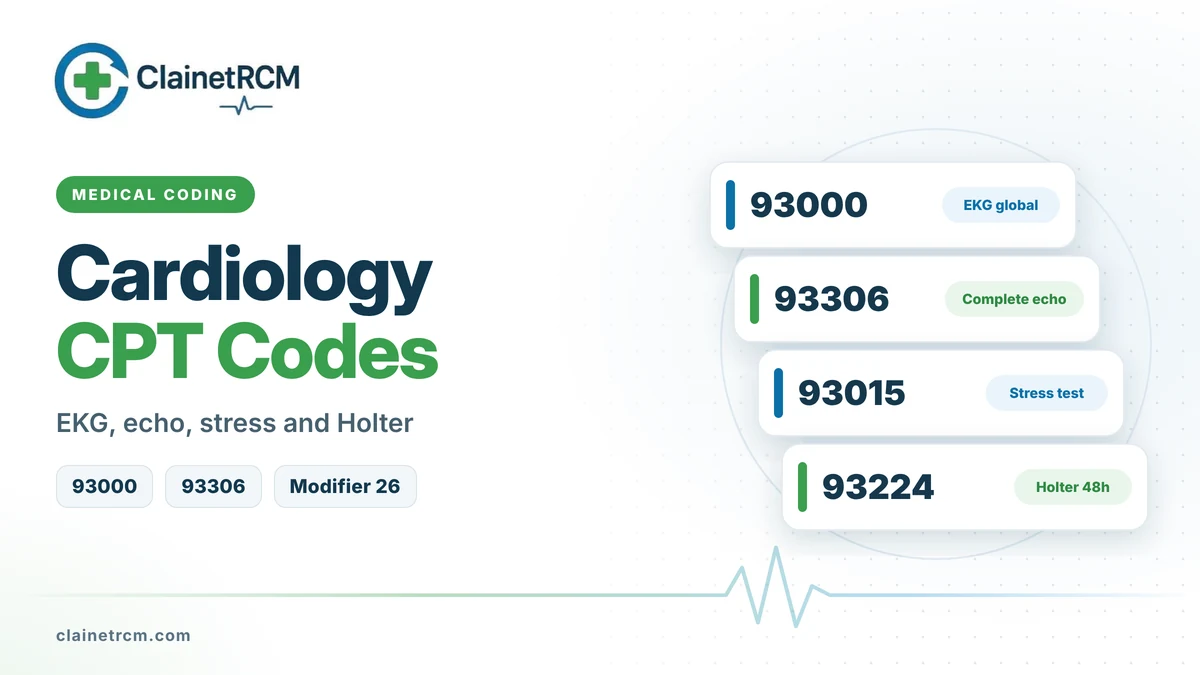
Quick answer: A routine 12-lead EKG is 93000 when the practice performs the tracing and the physician interprets it, 93005 for the tracing only and 93010 for the interpretation only. A complete transthoracic echo with spectral and color Doppler is 93306. An exercise stress test is 93015 globally, or 93016, 93017 and 93018 for its parts. Holter monitoring up to 48 hours is 93224 (or 93225 to 93227), and longer external monitoring uses 93241 to 93248. Tests with a professional and technical split take modifier 26 for the interpretation when the test is done in a hospital.
Cardiology CPT Codes for Electrocardiograms
| Code | Description | When to use it |
|---|---|---|
| 93000 | Routine ECG with at least 12 leads, with interpretation and report | Office performs the tracing and the physician reads it |
| 93005 | Tracing only, without interpretation and report | Office performs the tracing; someone else reads it |
| 93010 | Interpretation and report only | Physician reads an EKG performed by a hospital or another entity |
| 93040 to 93042 | Rhythm ECG, one to three leads | Rhythm strips; 93040 global, 93041 tracing, 93042 interpretation |
The EKG family uses separate codes instead of modifiers. Code 93000 is a global-test-only code, so modifiers 26 and TC do not apply; report 93005 or 93010 instead.
Echocardiography Codes
| Code | Description | Notes |
|---|---|---|
| 93306 | Complete transthoracic echo with spectral and color flow Doppler | The most common complete echo code |
| 93307 | Complete transthoracic echo without Doppler | Rarely used today |
| 93308 | Limited or follow-up transthoracic echo | For focused studies |
| 93320, 93321, 93325 | Doppler add-on codes | Not reported with 93306, which already includes Doppler |
| 93312 | Transesophageal echo (TEE) with interpretation | Probe placement and image acquisition included |
| 93350 | Stress echo, images and interpretation | Stress test billed separately with 93015 to 93018 |
| 93351 | Stress echo including the stress test supervision and ECG monitoring | Do not add stress test codes for the same physician |
Stress Testing
An exercise or pharmacologic cardiovascular stress test is billed with 93015 when one provider performs the whole service in the office. When responsibilities are split, report the parts: 93016 for physician supervision only, 93017 for the tracing only and 93018 for the interpretation and report only. Nuclear perfusion imaging (for example, 78452) is billed in addition to the stress test codes, and in the office the stress agent is billed with its own HCPCS drug code.
Ambulatory ECG Monitoring Codes
| Monitoring type | Global | Recording | Analysis | Review and interpretation |
|---|---|---|---|---|
| Holter, up to 48 hours | 93224 | 93225 | 93226 | 93227 |
| More than 48 hours, up to 7 days | 93241 | 93242 | 93243 | 93244 |
| More than 7 days, up to 15 days | 93245 | 93246 | 93247 | 93248 |
| Event monitor, up to 30 days | 93268 | 93270 | 93271 | 93272 |
Mobile cardiac telemetry is reported with 93228 for the physician’s review and interpretation and 93229 for the technical support. Choose the code family by how long the patient actually wore the device, not by how long it was ordered for.
Professional and Technical Components in Cardiology
Many cardiology tests, including echocardiograms, stress echo and nuclear studies, are diagnostic tests with both a professional and a technical component. Use these rules:
- Global billing applies when the practice owns the equipment, employs the staff who perform the test and the physician interprets it.
- Modifier 26 goes on the interpretation when the test is performed in a hospital outpatient department, inpatient unit or another facility. The facility bills the technical portion on its own claim.
- Modifier TC is used when the practice performs the test but an outside physician interprets it.
For a deeper look, see our guide to modifier 26 and TC.
2026 Interventional Cardiology Changes
CPT 2026 brought the largest cardiovascular overhaul in years. PCI coding was restructured: the additional-branch add-on codes (92921, 92925, 92929, 92934, 92938 and 92944) were deleted, the main PCI codes now describe “branch(es),” and new codes such as 92930 for complex PCI involving bifurcation or multiple lesions were added. Coronary thrombolysis codes 92975 and 92977 were deleted. Code 75577 now reports coronary plaque assessment, replacing Category III codes 0623T to 0626T, and the lower extremity revascularization series 37220 to 37235 was replaced by 46 new territory-based codes (37254 to 37299). Update charge masters, templates and claim edits before relying on 2025 habits.
Documentation Tips
- EKG: indication, rate, rhythm, intervals and a signed interpretation.
- Echo: complete or limited study, whether Doppler and color flow were performed and the findings.
- Stress test: protocol, duration, symptoms, ECG changes and who supervised.
- Monitoring: hookup date, total wear time, the analysis report and the physician’s review.
- Diagnosis: a supporting reason such as palpitations (R00.2), chest pain (R07.9) or atrial fibrillation (I48.91).
Frequently Asked Questions
Code 93000 is the global EKG: the tracing plus the physician’s interpretation and report. Code 93010 is the interpretation and report only, used when the tracing was performed by a hospital or another entity.
No. Code 93306 already includes spectral and color flow Doppler, so the Doppler add-on codes are not reported with it. They are used with 93307 or 93308 when Doppler is performed.
Use modifier 26 when the physician interprets a test that has a professional and technical split and the test was performed in a facility such as a hospital. Do not add it to codes that already describe only the interpretation, such as 93010.
External ECG monitoring for more than 48 hours and up to 7 days uses 93241 globally, or 93242, 93243 and 93244 for the separate components. Monitoring beyond 7 days and up to 15 days moves to 93245 to 93248.
With 93350, the stress test is reported separately with 93015 or its components. Code 93351 already includes the stress test supervision and continuous ECG monitoring, so the same physician does not add stress test codes.
Final Thoughts
Cardiology CPT codes reward attention to setting, equipment ownership and the components of each test. Learn how we support cardiology groups on our cardiology billing page, or read our overview of specialty medical billing to see how specialty rules affect your revenue cycle.
Get Every Cardiology Test Coded and Paid Correctly
Our cardiology coders handle EKG, echo, stress, monitoring and cath lab claims, including professional and technical splits, so your practice is paid for every study.
Talk to a Cardiology Coder
Written by
ClainetRCM Billing Team
ClainetRCM is a Boston-based revenue cycle management company specializing in medical billing, coding, credentialing and denial management for healthcare providers across all 50 states. Our AAPC and AHIMA certified team works inside your existing EHR, files claims within 24 to 48 hours and reviews every AR bucket on a 14-day cycle.