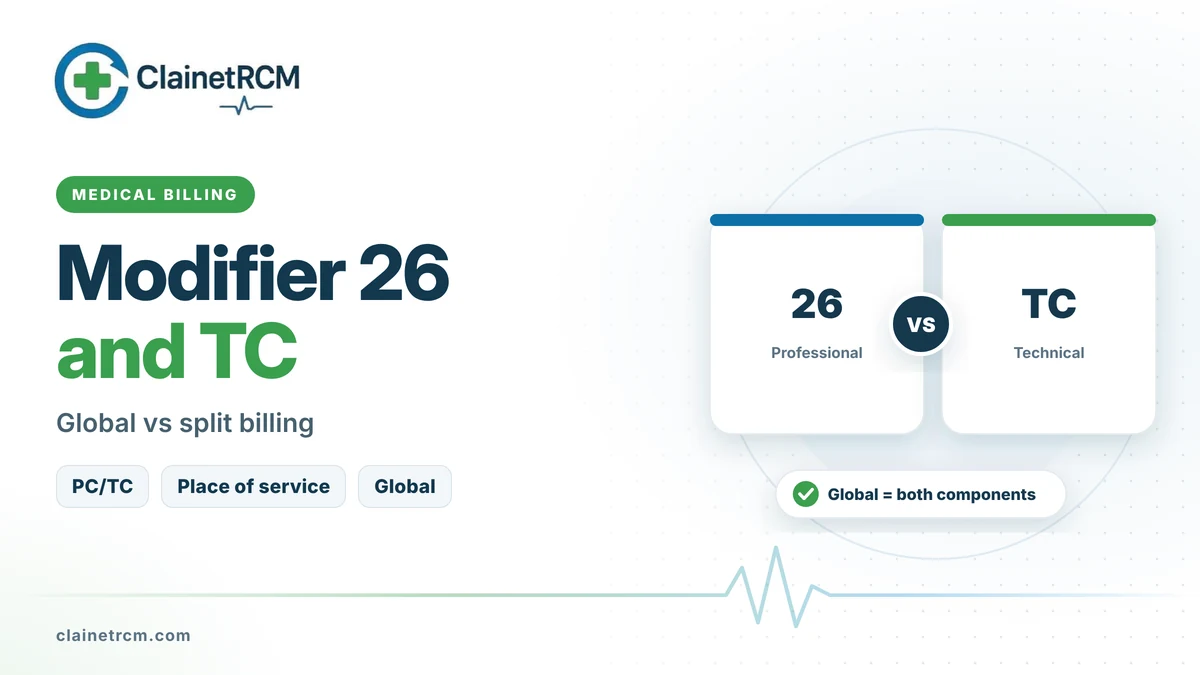
Modifier 26 and TC tell a payer which part of a diagnostic test you are billing. Many imaging studies and diagnostic tests have a professional component (the physician’s supervision, interpretation and report) and a technical component (the equipment, supplies and staff who perform the test). When one provider does both, the service is billed globally with no modifier. When the work is split, each party bills its own part.
Quick answer: Bill the code with no modifier (global) when your practice owns the equipment, performs the test and interprets it. Add modifier 26 when you only interpret the test, such as when it was performed in a hospital. Add modifier TC when you only perform the test and someone else interprets it. Check the code’s PC/TC indicator in the Medicare Physician Fee Schedule first: only indicator 1 codes take both modifiers, and some codes have separate component codes instead.
Professional Component vs Technical Component
| Component | What it covers | Who usually bills it |
|---|---|---|
| Professional (modifier 26) | Supervision, interpretation and the written report | Radiologist, cardiologist or other reading physician |
| Technical (modifier TC) | Equipment, supplies, technologist time and facility costs | The entity that owns the equipment |
| Global (no modifier) | Both components | A practice that performs and interprets the test |
PC/TC Indicators
The Medicare Physician Fee Schedule assigns every code a PC/TC indicator that tells you whether a split is allowed.
| Indicator | Meaning | Modifiers |
|---|---|---|
| 0 | Physician service, such as an office visit | 26 and TC not used |
| 1 | Diagnostic test with both components | 26 and TC allowed |
| 2 | Professional component only code, such as 93010 | 26 and TC not used |
| 3 | Technical component only code, such as 93005 | 26 and TC not used |
| 4 | Global test only code, such as 93000 | 26 and TC not used; bill the component codes instead |
| 5 | Incident-to service | 26 and TC not used |
| 6 | Laboratory physician interpretation | 26 allowed, TC not used |
| 7 | Physical therapy service | 26 and TC not used |
| 8 | Physician interpretation code | 26 allowed |
| 9 | Concept does not apply | 26 and TC not used |
Modifier 26 and TC by Place of Service
- Office, practice-owned equipment, your physician reads: bill globally with no modifier.
- Hospital outpatient or inpatient: the physician bills the interpretation with modifier 26 using the hospital’s place of service. The hospital bills the technical portion on its UB-04 under its own payment system, and inpatient technical services are part of the hospital’s inpatient payment.
- Office performs, outside physician reads: the office bills with modifier TC and the reading physician bills with modifier 26.
- Imaging center or independent diagnostic testing facility: it bills globally or the technical component, depending on how its interpretations are arranged.
Payers commonly deny a global claim for an indicator 1 code when the place of service is a hospital, because the facility is already billing the technical portion.
Purchased Tests and the Anti-Markup Rule
Sometimes a practice bills Medicare for a component it bought from an outside supplier, such as a purchased interpretation or a technical component performed elsewhere. Medicare’s anti-markup rule limits payment to the lowest of the supplier’s net charge to the billing practice, the billing practice’s actual charge and the fee schedule amount. Report purchased test information on the claim as your Medicare contractor requires, including the outside lab or purchased service field and the service location, and keep the purchase arrangement documented.
Example: CT of the Head in the Emergency Department
A patient receives a CT of the head without contrast (70450) in a hospital emergency department, and a contracted radiology group reads it.
- Radiology group: 70450-26 with place of service 23
- Hospital: 70450 on the UB-04 with the CT revenue code
- Result: each party is paid for its share, with no duplicate billing
If the same radiology group billed 70450 without a modifier, the claim would overlap the hospital’s technical billing and deny or be recouped later.
Common Denials and How to Avoid Them
- Global billing in a facility setting. Check the place of service before releasing the claim.
- Modifier 26 on a code that cannot take it. Codes such as 93010 already describe only the interpretation.
- Using modifiers instead of component codes. For global-test-only codes such as 93000, report the separate tracing or interpretation code.
- Both parties billing globally. Agree in writing who bills which component, especially in shared-equipment arrangements.
- Missing report. The professional component requires a signed interpretation and report.
Multiple Imaging Studies
When several imaging studies are performed in the same session, Medicare’s multiple procedure payment reduction applies separately to each component, and the technical component takes the larger reduction. Billing staff should expect lower allowed amounts on the second and later studies and should not treat those reductions as underpayments.
Frequently Asked Questions
Use it when your provider supervises, interprets and reports a diagnostic test but does not own the equipment or perform the technical portion, such as a reading of a study done in a hospital.
Use it when your practice performs the test with its own equipment and staff but an outside physician interprets it. The interpreting physician bills the professional component.
Generally no. For Medicare and most payers, the hospital bills the technical portion of tests performed in its outpatient or inpatient settings, so the physician bills only the professional component.
It means the code describes a diagnostic test with both a professional and a technical component, so modifiers 26 and TC can be used to bill each part separately.
Code 93000 is a global-test-only code that does not accept modifier 26. Bill 93010 for the interpretation only, or 93005 for the tracing only.
Final Thoughts
Modifier 26 and TC are simple once you check the PC/TC indicator, the place of service and who owns the equipment. See how we support imaging groups on our radiology billing page, or explore our overview of specialty medical billing.
Bill Every Test Component Correctly
We set up global and split billing rules for radiology, cardiology and diagnostic groups so professional and technical claims stop colliding.
Get Billing Help
Written by
ClainetRCM Billing Team
ClainetRCM is a Boston-based revenue cycle management company specializing in medical billing, coding, credentialing and denial management for healthcare providers across all 50 states. Our AAPC and AHIMA certified team works inside your existing EHR, files claims within 24 to 48 hours and reviews every AR bucket on a 14-day cycle.