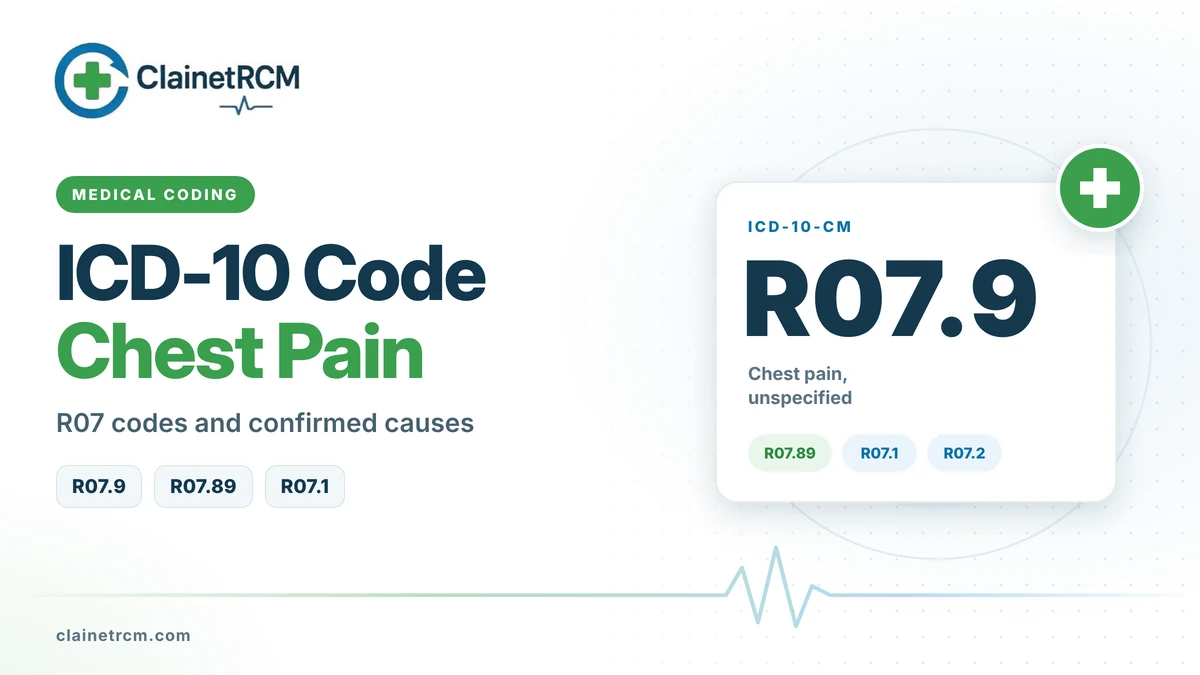
The ICD-10 code for chest pain is R07.9 when the provider documents chest pain without more detail. ICD-10-CM also has codes for chest pain on breathing, precordial pain, pleurodynia, intercostal pain and other chest pain, such as chest pressure or atypical chest pain. Knowing when a symptom code is right, and when the confirmed cause replaces it, is essential for emergency, observation and cardiology claims.
Quick answer: Use R07.9 for chest pain, unspecified, and R07.89 for other chest pain, including chest pressure, tightness, discomfort and atypical chest pain. Use R07.1 for chest pain on breathing, R07.2 for precordial pain, R07.81 for pleurodynia and R07.82 for intercostal pain. Code the symptom when no definitive diagnosis is made. When the provider confirms the cause, such as unstable angina (I20.0), NSTEMI (I21.4), GERD (K21.9) or costochondritis (M94.0), code the diagnosis and drop the chest pain code if it is part of that condition.
ICD-10 Code for Chest Pain: R07 Options
| Code | Description | Typical documentation |
|---|---|---|
| R07.9 | Chest pain, unspecified | Chest pain without further description |
| R07.89 | Other chest pain | Chest pressure, tightness, discomfort, atypical chest pain, anterior chest wall pain |
| R07.1 | Chest pain on breathing | Pain with respiration, painful breathing |
| R07.2 | Precordial pain | Pain over the heart |
| R07.81 | Pleurodynia | Pleuritic pain not attributed to a specific disease |
| R07.82 | Intercostal pain | Pain between the ribs |
When a Symptom Code Is the Right Choice
ICD-10-CM allows sign and symptom codes when the provider has not established a related definitive diagnosis. For chest pain, that often means:
- Emergency department visits where serious causes are ruled out but no cause is confirmed
- Office visits where testing is ordered and results are pending
- Observation stays, which follow outpatient coding rules
In outpatient settings, including observation, do not code a diagnosis documented as “rule out,” “probable,” “suspected” or “likely.” Code the chest pain or other symptoms instead. In the inpatient setting, uncertain diagnoses documented at the time of discharge are coded as if they were established.
Coding After the Cause Is Confirmed
Once the provider documents the cause, code that diagnosis. Chest pain that is a routine part of the confirmed condition is not coded separately.
| Confirmed cause | Code |
|---|---|
| Unstable angina | I20.0 |
| Other forms of angina | I20.89 |
| Atherosclerotic heart disease with angina | I25.11- |
| NSTEMI | I21.4 |
| Gastroesophageal reflux disease | K21.9 |
| Costochondritis | M94.0 |
| Pulmonary embolism | I26.- |
| Anxiety disorder | F41.- |
If the patient has chest pain that is not explained by the confirmed diagnosis, the chest pain can still be coded.
Chest Pain With Other Symptoms
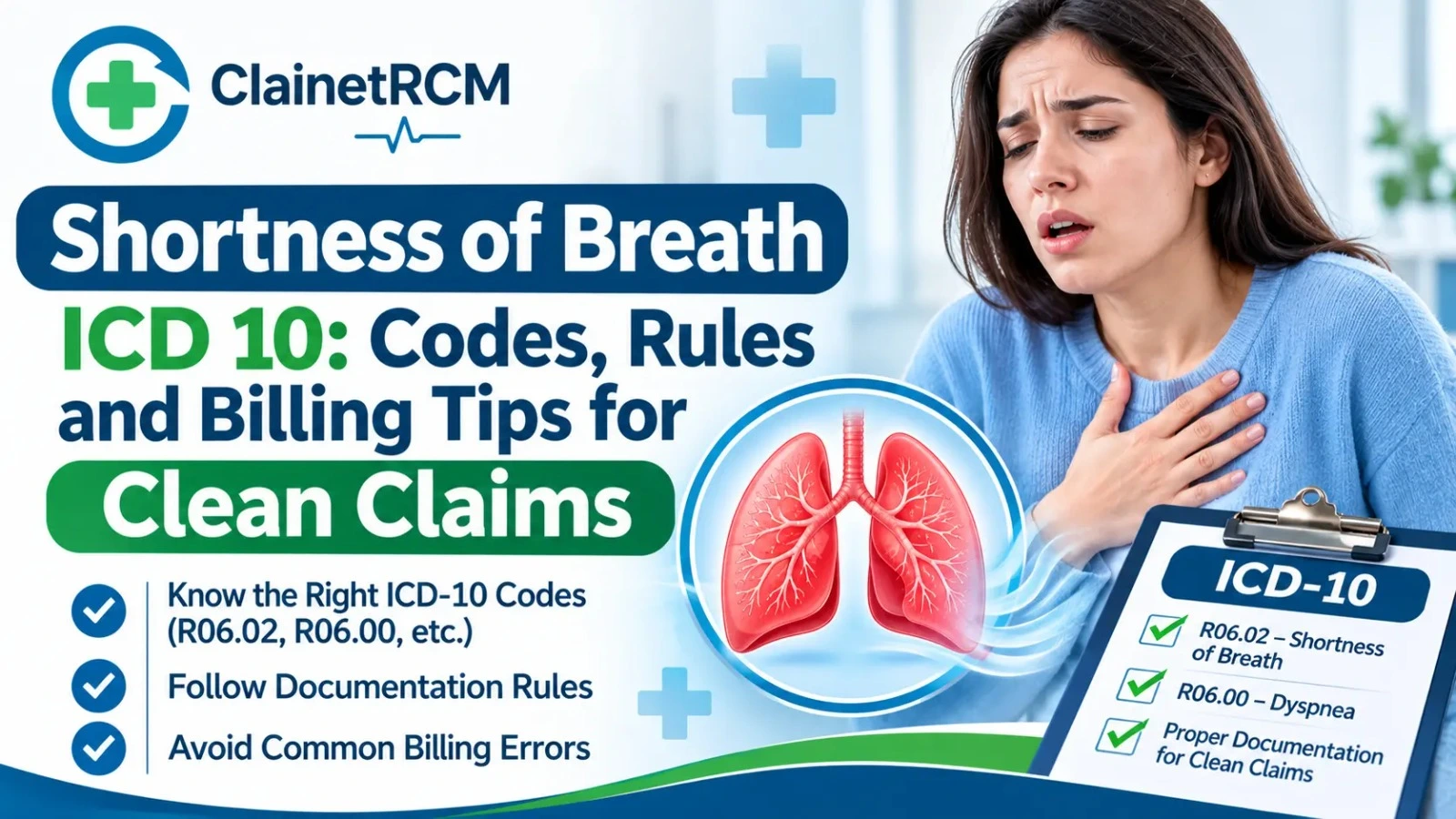
Patients with chest pain often have other symptoms, such as shortness of breath (R06.02), palpitations (R00.2) or sweating (R61). Code each symptom that is not routinely associated with the others and that the provider documents, when no definitive diagnosis explains them. Once a diagnosis is confirmed, drop the symptoms it explains.
Observation and Inpatient Settings
Observation stays are reported with the hospital inpatient or observation care E/M codes (99221 to 99239), but the diagnosis coding follows outpatient rules, so chest pain remains the reason for the stay when no cause is confirmed. For an inpatient admission, the condition established after study as chiefly responsible for the admission is sequenced first. When the workup is negative and no cause is found, the chest pain code can be the principal diagnosis.
Pairing With CPT Codes
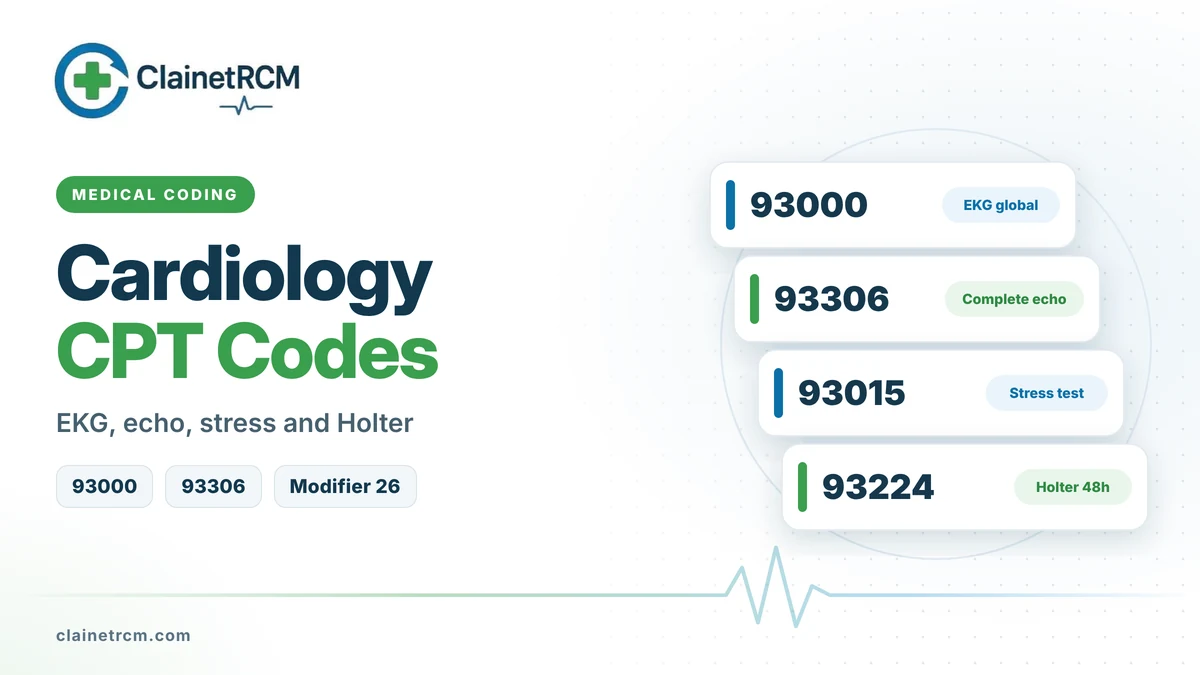
Chest pain is the medical necessity diagnosis for many services: emergency department E/M (99281 to 99285), observation and hospital care, EKGs (93000 or 93010), troponin testing (84484), chest X-rays (71045, 71046), stress testing (93015 to 93018) and coronary CT angiography (75574). Link each service to the most accurate diagnosis available on the date of service. A test ordered for chest pain should carry R07.- even if the final diagnosis comes later.
Coding Examples
| Scenario | Codes |
|---|---|
| ED visit, chest pain, cardiac causes ruled out, no diagnosis | R07.9 |
| Office visit, atypical chest pain, stress test ordered | R07.89 |
| Pain worse with deep breaths, no cause found | R07.1 |
| Follow-up: chest pain diagnosed as GERD | K21.9 |
| Inpatient discharge: chest pain “likely unstable angina” | I20.0 |
Documentation Tips
- Describe the pain: location, quality, timing and what makes it better or worse.
- Record pertinent findings and the tests performed or ordered.
- State the provider’s conclusion clearly, including when a cause has been excluded.
- For follow-up visits, document whether the cause has been established.
- Note cardiac risk factors, such as diabetes, hypertension or smoking, that influenced the workup.
Common Errors
- Coding a “rule out” diagnosis on an outpatient or observation claim
- Coding R07.9 when the provider described chest pressure or atypical pain (R07.89)
- Keeping the chest pain code after a confirmed diagnosis that explains it
- Linking a stress test to a screening code instead of the symptom that prompted it
Frequently Asked Questions
R07.9 is chest pain, unspecified. Use a more specific R07 code, such as R07.89 for chest pressure or atypical chest pain, when documented.
Atypical chest pain is coded R07.89, other chest pain.
Only if the chest pain is not a routine part of the confirmed diagnosis. If the diagnosis explains the pain, such as GERD or angina, code the diagnosis alone.
Code the chest pain symptom, such as R07.9, on outpatient and observation claims. Do not code the condition that was ruled out.
Chest pressure is coded R07.89, other chest pain.
Yes, when chest pain is the reason the test was ordered and no diagnosis has been established, R07.9 or a more specific R07 code supports medical necessity.
Outpatient rules. Uncertain diagnoses are not coded; code the symptoms instead.
Final Thoughts
The ICD-10 code for chest pain should change as the workup progresses, from symptom to confirmed cause. Learn how we support cardiology groups on our cardiology billing page, or review related symptom coding in our shortness of breath ICD-10 guide.
Code Symptoms and Diagnoses the Right Way
Our coders apply outpatient and inpatient diagnosis rules to chest pain visits so emergency, observation and cardiology claims meet medical necessity the first time.
Get Coding Help
Written by
ClainetRCM Billing Team
ClainetRCM is a Boston-based revenue cycle management company specializing in medical billing, coding, credentialing and denial management for healthcare providers across all 50 states. Our AAPC and AHIMA certified team works inside your existing EHR, files claims within 24 to 48 hours and reviews every AR bucket on a 14-day cycle.