The CO-29 denial code is the one billing teams dread most, because a claim denied for timely filing is usually lost revenue. The good news is that many CO-29 denials are wrong: the claim was filed on time, but the payer’s records do not show it. With the right proof, those claims can still be paid.
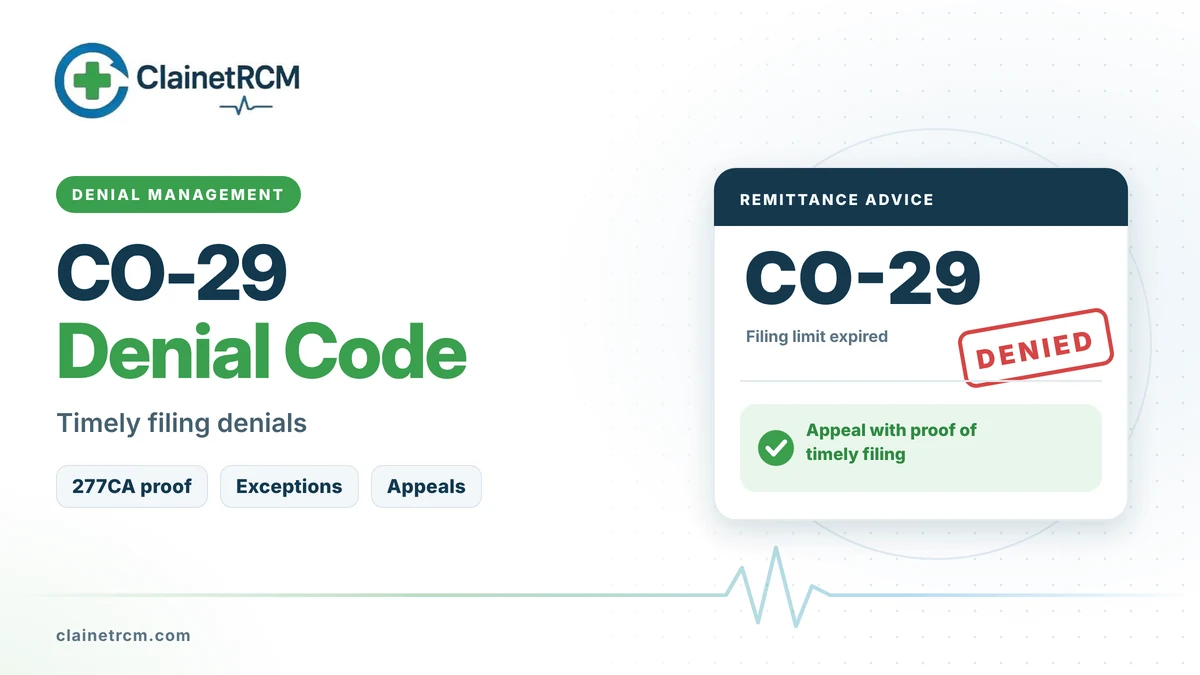
Quick answer: CO-29 is CARC 29, “The time limit for filing has expired.” The payer says the claim arrived after its filing deadline, which is one year from the date of service for Medicare and often 90 to 180 days for commercial plans. The patient cannot be billed. To overturn it, show proof of timely filing, such as a clearinghouse acceptance report (277CA) or the payer’s own acknowledgment, or show that an exception applies, such as retroactive eligibility or a delay caused by another payer.
What the CO-29 Denial Code Means
CARC 29 says the claim was received after the payer’s filing limit. The limit comes from:
- The provider contract for in-network commercial plans
- The plan’s provider manual for out-of-network claims
- Federal law for Medicare: the Medicare 12-month limit requires claims within 12 months (one calendar year) of the date of service
- State Medicaid rules, which vary by state
Most payers measure the limit from the date of service. For secondary claims, many measure from the date of the primary payer’s EOB. Our timely filing limits chart lists deadlines for the major payers.
Is the Denial Correct? Check These First
- When was the first submission? Pull the clearinghouse report for the original claim.
- Did the payer accept it? A 999 acknowledgment only shows the file was received. A 277CA claim acknowledgment shows the payer accepted the claim itself.
- Was the original rejected? If it was rejected at the front end and never corrected, the payer has no record of a timely claim.
- Is this a corrected claim? Some payers apply a separate, shorter deadline to corrected claims.
- Was this a secondary claim? Check whether the deadline runs from the primary payer’s EOB date.
Proof of Timely Filing That Payers Accept
- Clearinghouse acceptance reports (277CA) showing the payer accepted the claim before the deadline
- Payer acknowledgment or claim number from the payer’s portal
- The primary payer’s EOB date for secondary claims
- A prior denial or rejection notice from the same payer for the same claim, dated before the deadline
- Certified mail receipts for paper claims
A screenshot from your practice management system showing “billed” is usually not enough. Payers want evidence from the payer or the clearinghouse.
Exceptions That Can Extend the Deadline
- Retroactive eligibility, such as a patient approved for Medicaid or Medicare months after the visit
- Coordination of benefits delays, where another payer was billed first in good faith
- Administrative error by the payer, such as misdirected claims or incorrect information from the plan
- Medicare exceptions for retroactive Medicare entitlement and errors by Medicare or its contractors
Each payer defines its own exceptions, so read the provider manual and ask in writing.
How to Fix a CO-29 Denial
- Gather proof from the clearinghouse and payer portal.
- Send a reconsideration or appeal with the proof attached and a short cover letter listing the original submission date, payer claim number and acceptance report.
- Document exceptions with eligibility letters, primary EOBs or payer correspondence.
- Write off the balance if the claim truly was late. Do not bill the patient for a CO-29 adjustment.
How to Prevent CO-29 Denials
- Submit within days, not weeks. Aim to file every claim within 48 hours of the visit.
- Work rejections daily so rejected claims are corrected while time remains.
- Track claims without a payer response after 30 days and check status.
- Store acceptance reports in a way you can retrieve by claim.
- Build payer-specific deadlines into your follow-up queues, with alerts well before each limit.
CO-29 Denial Examples
Example 1: Accepted but lost. A claim was sent 40 days after the visit and accepted by the payer, according to the 277CA report. Five months later, a corrected claim triggers a CO-29 denial because the payer treats it as new. Fix: appeal with the original 277CA and the payer claim number, showing the first submission was timely.
Example 2: Rejected and never fixed. A claim was rejected at the clearinghouse for an invalid member ID and sat in a work queue for four months. When it was finally fixed and sent, it was past the 90-day limit. Fix: none, unless the payer will accept proof of the original attempt. This is a write off, and the real fix is daily rejection work.
Example 3: Retroactive Medicaid. A patient seen in January was approved for Medicaid in May, with coverage back to January. The claim, sent in June, denies for timely filing. Fix: appeal with the eligibility approval letter showing the retroactive coverage date.
Example 4: Secondary claim after a slow primary. The primary payer took eight months to pay. The secondary payer’s limit runs from the primary EOB date. Fix: appeal with the primary EOB showing the claim was filed within the secondary deadline.
Frequently Asked Questions
It means the payer says the claim was filed after its timely filing limit.
No. A timely filing denial is the provider’s responsibility.
A clearinghouse 277CA acceptance report, a payer acknowledgment or claim number, an earlier denial from the same payer or a primary payer EOB for secondary claims, all dated before the deadline.
Medicare claims must be filed within 12 months, or one calendar year, after the date of service.
Yes, when you can prove the claim was filed on time or that an exception applies. Without proof, the denial usually stands.
Final Thoughts
The CO-29 denial code is preventable with fast submission and daily follow-up, and it is often reversible with good records. Keep your acceptance reports, know every payer’s deadline and appeal with proof. Our denial management team handles timely filing appeals, and our Ambetter timely filing guide shows how one payer’s deadlines work.
Never Miss a Filing Deadline Again
We submit and follow up on every claim well inside each payer’s limit, and fight CO-29 denials with the proof payers accept.
Get a Free Denial Review
Written by
ClainetRCM Billing Team
ClainetRCM is a Boston-based revenue cycle management company specializing in medical billing, coding, credentialing and denial management for healthcare providers across all 50 states. Our AAPC and AHIMA certified team works inside your existing EHR, files claims within 24 to 48 hours and reviews every AR bucket on a 14-day cycle.