Every payment or denial on an electronic remittance comes with a code that explains it. Claim adjustment reason codes are the language payers use to tell you why they paid less than you billed, and learning to read them is the first step in working denials efficiently. This guide explains how the codes fit together and lists the ones practices see most.
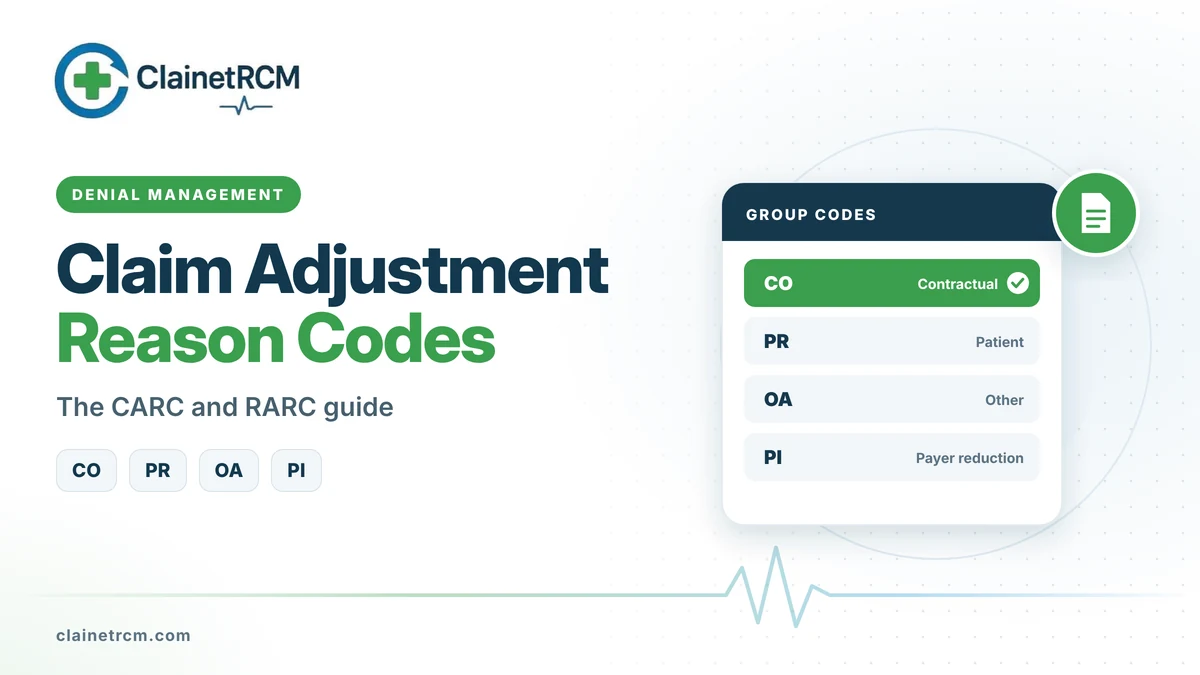
Quick answer: Claim adjustment reason codes (CARCs) explain why a claim or line was paid differently than billed. Each CARC appears with a group code that assigns financial responsibility: CO (contractual obligation, provider write-off), PR (patient responsibility), OA (other adjustment) or PI (payer-initiated reduction). Remittance advice remark codes (RARCs) add detail. X12 maintains CARCs, the lists are updated three times a year, and they appear on the electronic 835 remittance and paper EOBs.
How Claim Adjustment Reason Codes Work
A single adjustment on an 835 reads like a short sentence:
- Group code: who is responsible (CO, PR, OA or PI)
- CARC: why the amount was adjusted (for example, 45, “charge exceeds fee schedule”)
- Amount: how much was adjusted
- RARC (optional or required): extra detail, such as which field was missing
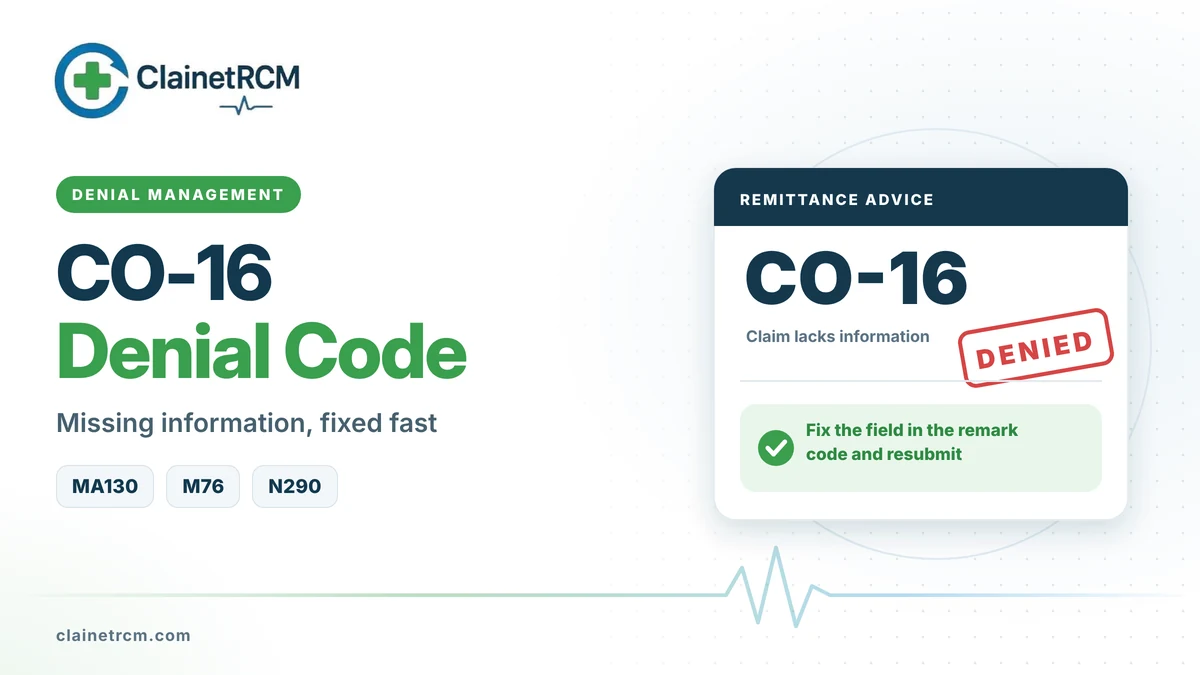
For example, CO-45 means a contractual write-off because the charge exceeded the allowed amount. PR-1 means the patient owes the deductible. CO-16 with MA130 means the claim was missing information and is unprocessable.
Group Codes
| Group code | Meaning | Can you bill the patient? |
|---|---|---|
| CO | Contractual obligation: the provider absorbs the amount under the contract or payer rules | No |
| PR | Patient responsibility: deductible, coinsurance, copay or non-covered services | Yes |
| OA | Other adjustment: neither the provider nor the patient is clearly responsible, such as duplicates or prior payer adjustments | Usually no |
| PI | Payer-initiated reduction: the payer reduced payment for a reason outside the contract terms | No, unless your contract allows it |
Medicare uses CO, PR and OA. Commercial payers may also use PI.
The Claim Adjustment Reason Codes Practices See Most
| CARC | Description (shortened) | Typical action |
|---|---|---|
| 1 | Deductible amount | Bill the patient (PR) |
| 2 | Coinsurance amount | Bill the patient or secondary (PR) |
| 3 | Co-payment amount | Collect from the patient (PR) |
| 4 | Procedure code inconsistent with the modifier used | Correct the modifier. See our CO-4 guide |
| 5 | Procedure code or bill type inconsistent with place of service | Correct POS or bill type |
| 6 | Procedure inconsistent with the patient’s age | Check the code and patient data |
| 11 | Diagnosis inconsistent with the procedure | Review coding and documentation |
| 16 | Claim lacks information or has billing errors | Fix the field named in the RARC. See our CO-16 guide |
| 18 | Exact duplicate claim or service | Follow the original claim. See our CO-18 guide |
| 22 | May be covered by another payer (COB) | Bill the primary. See our CO-22 guide |
| 23 | Impact of prior payer adjudication | Informational on secondary claims (OA) |
| 27 | Expenses incurred after coverage terminated | Verify eligibility and find current coverage |
| 29 | Time limit for filing has expired | Appeal with proof. See our CO-29 guide |
| 31 | Patient cannot be identified as our insured | Correct member data |
| 45 | Charge exceeds fee schedule or contracted amount | Contractual write-off. See our CO-45 guide |
| 50 | Not medically necessary | Review policy and appeal. See our CO-50 guide |
| 96 | Non-covered charge(s) | Check exclusions and patient liability |
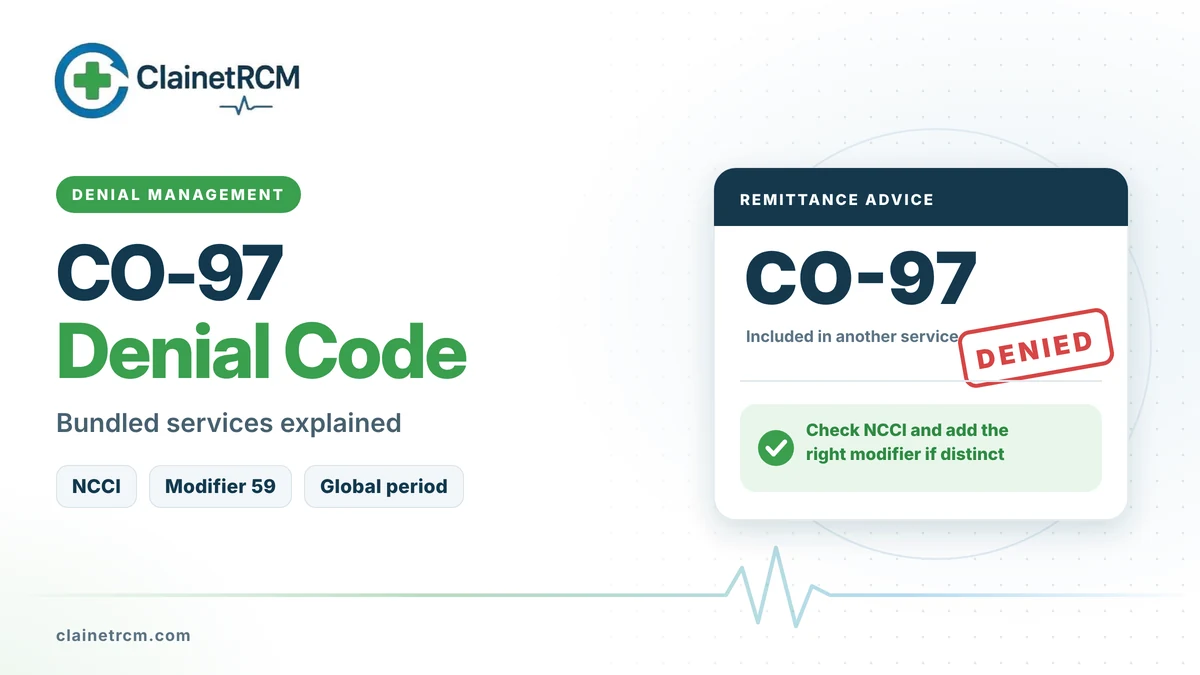
| 97 | Included in payment for another service | Check bundling. See our CO-97 guide |
| 109 | Not covered by this payer; send to the correct payer | Bill the correct payer or contractor |
| 119 | Benefit maximum reached | Check limits, bill secondary or patient |
| 151 | Information does not support this many or this frequency of services | Review frequency limits and documentation |
| 167 | Diagnosis not covered | Review diagnosis coding and policy |
| 170 | Payment denied for this type of provider | Check provider eligibility for the service |
| 185 | Rendering provider not eligible to perform the service | Check enrollment and credentials |
| 197 | Authorization absent | Find or request authorization. See our CO-197 guide |
| 204 | Not covered under the patient’s current benefit plan | Bill the patient. See our PR-204 guide |
| 236 | Procedure or modifier combination not compatible with another same-day procedure (NCCI) | Check NCCI edits and modifiers |
| 242 | Services not provided by network or primary care providers | Check network status and referrals |
| 252 | Attachment or other documentation required | Send the requested records |
| 253 | Sequestration reduction in federal payment | Medicare’s 2% reduction; write off |
| B7 | Provider not certified or eligible on this date of service | Check enrollment effective dates |
Remittance Advice Remark Codes (RARCs)
RARCs start with M, MA or N and give detail that the CARC alone does not. Some are informational, labeled “Alert.” Others are required, such as with CARC 16, which must always have at least one remark code. Examples:
- MA130: claim is unprocessable; submit a new claim with complete information
- M76: missing or invalid diagnosis
- N290: missing or invalid rendering provider identifier
- N115: decision based on a Local Coverage Determination
- N522: duplicate of a claim processed as a crossover claim
How to Work Adjustments Efficiently
- Sort by group code first. PR adjustments go to patient billing. CO and PI adjustments go to the denial team. OA needs review.
- Group CO denials by CARC and RARC to find patterns, such as weekly M76 errors from one location.
- Set an action for each code: correct and resubmit, appeal, write off or bill another payer.
- Track denial rate and recovery by code so fixes go where the money is.
- Keep code lists current. CARC and RARC lists change three times a year, around March 1, July 1 and November 1.
Frequently Asked Questions
They are standard X12 codes that explain why a claim or service line was paid differently than billed, used on the 835 remittance and on EOBs.
A CARC explains the reason for an adjustment. A RARC adds detail, such as which field was missing or which policy applied.
CO is contractual obligation (provider write-off), PR is patient responsibility, OA is other adjustment and PI is a payer-initiated reduction.
The CARC and RARC lists are updated three times a year, around March 1, July 1 and November 1.
X12 publishes the current CARC list, and the RARC list is published alongside it. Medicare implements updates through recurring change requests.
Final Thoughts
Claim adjustment reason codes turn a confusing remittance into a to-do list. Sort by group code, act by reason code and fix the patterns behind repeat denials. Our denial management services work every adjustment on your 835s, and our guide on why claims keep getting denied covers the most common root causes.
Turn Your Remittance Codes Into Recovered Revenue
We read every adjustment on your 835s, appeal what should pay, write off what should not and fix the patterns behind repeat denials.
Get a Free Denial Review
Written by
ClainetRCM Billing Team
ClainetRCM is a Boston-based revenue cycle management company specializing in medical billing, coding, credentialing and denial management for healthcare providers across all 50 states. Our AAPC and AHIMA certified team works inside your existing EHR, files claims within 24 to 48 hours and reviews every AR bucket on a 14-day cycle.