The CO-16 denial code is one of the most common adjustments on any remittance, and one of the most fixable. It does not mean the service is not covered. It means the payer could not process the claim as submitted because something was missing, invalid or inconsistent.
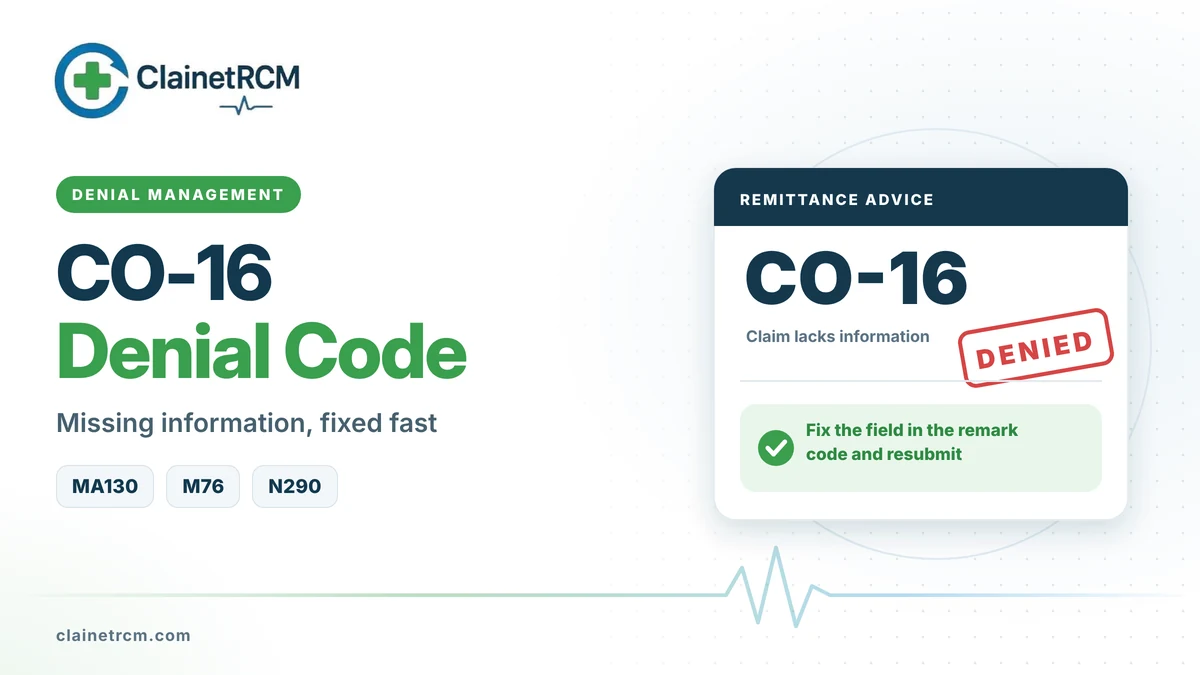
Quick answer: CO-16 is Claim Adjustment Reason Code (CARC) 16, “Claim/service lacks information or has submission/billing error(s),” with group code CO (contractual obligation), so you cannot bill the patient. CARC 16 must come with at least one remittance advice remark code (RARC), such as MA130, M76 or N290, that tells you exactly what is wrong. Fix that item and send a new or corrected claim. An appeal is usually not the right path.
What the CO-16 Denial Code Means
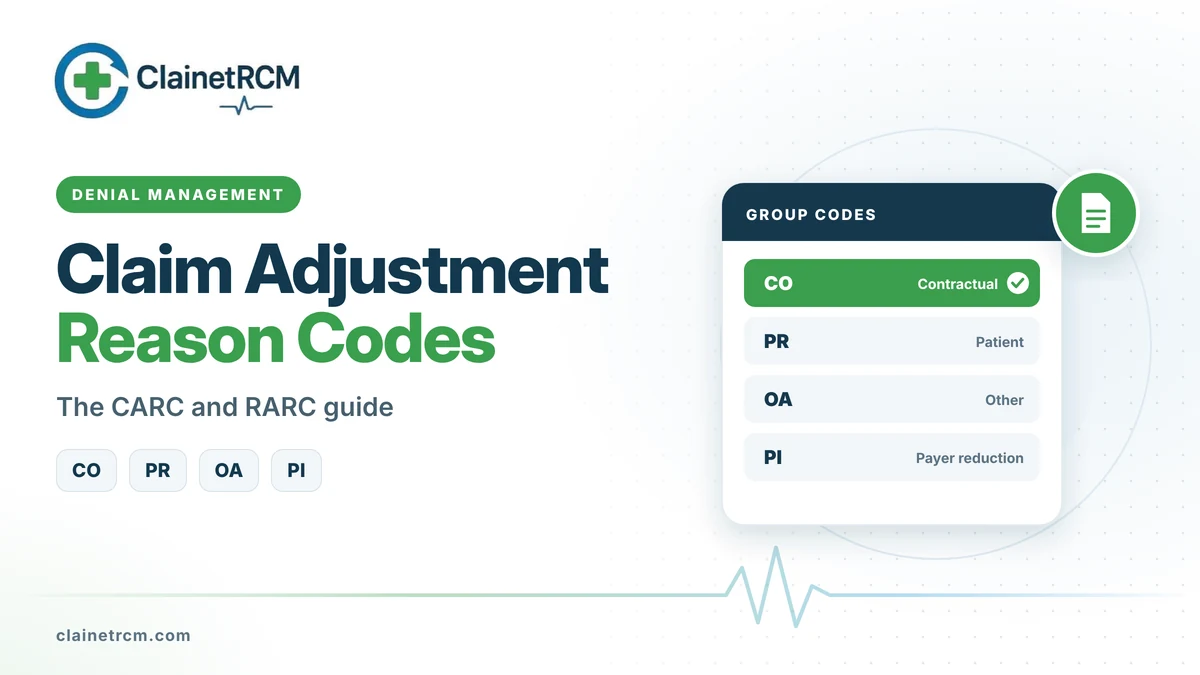
Every adjustment on an 835 or EOB has three parts: a group code, a reason code and, often, a remark code.
- CO means the adjustment is the provider’s responsibility under the contract or payer rules. The patient cannot be billed for it.
- 16 means the claim or line “lacks information or has submission/billing error(s).”
- The RARC gives the specific reason. X12’s usage note for CARC 16 requires at least one remark code, so look for it on the same line or at the claim level.
Medicare treats many CO-16 claims as unprocessable. When the remark code MA130 appears, the claim was never adjudicated, so there are no appeal rights. You submit a new claim with the corrected information.
Common Remark Codes Paired With CO-16
| RARC | What it means | Typical fix |
|---|---|---|
| MA130 | The claim contains incomplete or invalid information and is unprocessable; no appeal rights | Correct the data element named in the other remark codes and submit a new claim |
| M76 | Missing, incomplete or invalid diagnosis or condition | Add or correct the ICD-10-CM code, to the highest specificity |
| M51 | Missing, incomplete or invalid procedure code | Correct the CPT or HCPCS code |
| M77 | Missing, incomplete, invalid or inappropriate place of service | Use the correct POS code |
| N290 | Missing, incomplete or invalid rendering provider primary identifier | Add the rendering provider’s individual NPI |
| N264 / N265 | Missing or invalid ordering provider name / identifier | Add the ordering provider’s name and NPI, and confirm they are enrolled |
| N286 | Missing or invalid referring provider primary identifier | Add the referring provider NPI |
| N382 | Missing, incomplete or invalid patient identifier | Correct the member ID |
| M119 | Missing, incomplete, invalid, deactivated or withdrawn NDC | Add a valid 11-digit NDC and units |
| MA04 | Secondary payment cannot be considered without primary payer information | Attach or enter the primary payer’s payment data |
Common Causes of CO-16
- Demographic errors: wrong member ID, misspelled name or wrong date of birth
- Provider data gaps: missing rendering, ordering or referring NPI, or a taxonomy that does not match enrollment
- Coding gaps: missing diagnosis pointer, an invalid or deleted code, or missing units
- Drug claims: missing NDC, NDC unit of measure or quantity
- Place of service and facility data: missing or invalid POS, or missing service facility address
- Coordination of benefits: a secondary claim without the primary payer’s adjudication data
- Claim form formatting: data in the wrong loop or segment of the 837, which the clearinghouse passed but the payer rejected
How to Fix a CO-16 Denial
- Read every remark code. The RARC names the field. Some claims carry two or three remark codes, and you need to fix all of them.
- Compare the claim to the source documents. Check the eligibility response, the encounter note, the provider’s enrollment record and any primary payer EOB.
- Correct the data. Update the patient, provider or coding information in your practice management system so the same error does not repeat.
- Choose the right resubmission. If the claim was unprocessable (MA130 or a payer’s equivalent), submit a new claim. If the claim was processed with a CO-16 line, most payers want a corrected claim with frequency code 7 and the original claim number.
- Track the resubmission against the timely filing limit. A CO-16 denial does not extend the filing deadline, so fix it quickly.
How to Prevent CO-16 Denials
- Verify eligibility before every visit and copy the member ID exactly as the payer returns it. Our eligibility and benefits verification team does this for every appointment.
- Keep provider data current: NPIs, taxonomy codes and enrollment status for every rendering, ordering and referring provider.
- Use clearinghouse edits to catch missing fields before submission, and review rejection reports daily. See our guide to clearinghouse rejections.
- Build payer-specific rules for NDCs, ordering providers and secondary claims into charge entry.
- Track CO-16 by remark code. If M76 shows up every week, the problem is a workflow, not a one-off error.
Frequently Asked Questions
CO-16 means the claim or service line lacks information or has a submission or billing error. The provider must correct it, and the patient cannot be billed for the adjustment.
No. The CO group code makes it the provider’s responsibility. Fix the claim and resubmit it to the payer.
Usually not. Most CO-16 denials, and all unprocessable claims with MA130, are fixed by sending a new or corrected claim. Appeal only if you are sure the claim was complete and the payer made an error.
A rejection happens at the clearinghouse or payer front end, before the claim enters adjudication. A CO-16 denial appears on the remittance after the payer has received the claim.
It should. X12 requires at least one remark code with CARC 16, and that code tells you which field to fix.
Final Thoughts
The CO-16 denial code is a data problem, not a coverage problem. Read the remark code, fix the field and the workflow behind it, and resubmit quickly. Tracking CO-16 by remark code is one of the fastest ways to raise your clean claim rate. Our denial management team works these claims every day, and our CO-45 guide explains the most common contractual adjustment.
Fix Missing-Information Denials for Good
Our denial team corrects and resubmits CO-16 claims fast, then fixes the front-end and charge entry gaps that caused them.
Get a Free Denial Review
Written by
ClainetRCM Billing Team
ClainetRCM is a Boston-based revenue cycle management company specializing in medical billing, coding, credentialing and denial management for healthcare providers across all 50 states. Our AAPC and AHIMA certified team works inside your existing EHR, files claims within 24 to 48 hours and reviews every AR bucket on a 14-day cycle.