The CO-4 denial code is a modifier problem. The payer either found a modifier that does not belong with the procedure code, or a modifier that should be there is missing. It is one of the quickest denials to fix once you see the pattern, and one of the easiest to prevent with good claim edits.
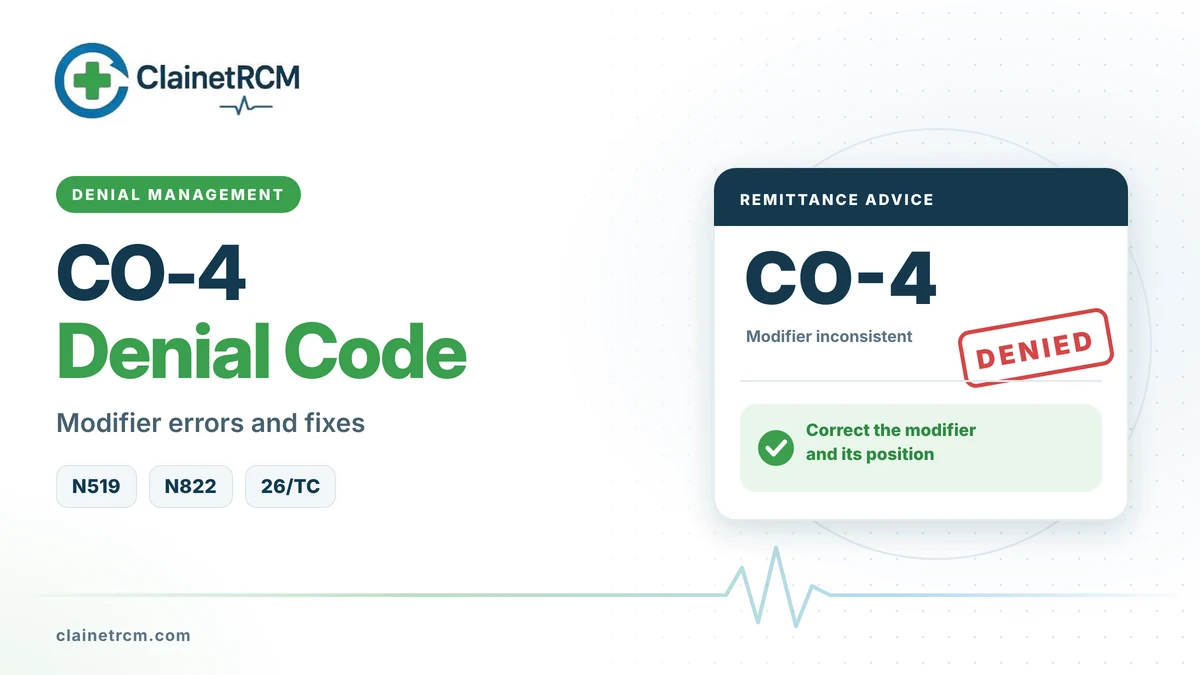
Quick answer: CO-4 is CARC 4, “The procedure code is inconsistent with the modifier used.” It also appears when a required modifier is missing. Because the group code is CO, the patient cannot be billed. Read the remark code, such as N519 (invalid combination of modifiers) or N822 (missing procedure modifier), correct the modifier and send a corrected claim.
What the CO-4 Denial Code Means
CARC 4 tells you the payer’s edits rejected the combination of procedure code and modifier on the line. Typical triggers:
- A modifier that is invalid for the code, such as modifier 26 on a code with no professional component
- Two modifiers that conflict, such as RT and LT on one line when the payer wants separate lines
- A missing modifier the payer requires, such as a therapy modifier on a therapy code
- Modifiers in the wrong order, when the payer reads only the first position for pricing
Common Modifier Errors Behind CO-4
| Error | Example | Fix |
|---|---|---|
| TC modifier or modifier 26 on a global-only code | 26 on an office visit | Remove the modifier |
| Missing 26 or TC on a split service | Radiologist reading a hospital X-ray billed without 26 | Add modifier 26 |
| Laterality missing or conflicting | Knee injection without RT or LT, or both on one line | Add RT or LT, or use 50 per payer rules |
| Therapy discipline modifier missing | PT code without GP | Add GP, GO or GN |
| Assistant at surgery modifier on a code that does not allow assistants | 80 on a minor procedure | Remove or check the payer’s assistant policy |
| Bilateral modifier on a code that is already bilateral | 50 on a code described as bilateral | Remove modifier 50 |
| Informational modifiers placed first | GA before a pricing modifier | Put pricing modifiers (26, TC, 50) first |
How to Fix a CO-4 Denial
- Read the remark codes. N519 points to an invalid combination of modifiers. N822 points to a missing modifier. N823 points to an incomplete or invalid modifier.
- Check the code’s rules. The Medicare Physician Fee Schedule indicators show whether a code allows 26 and TC, bilateral payment, assistants or co-surgeons. Commercial plans publish modifier policies too.
- Review the documentation to confirm laterality, the component performed and who performed it.
- Send a corrected claim with frequency code 7 and the original claim number, unless the payer asks for a new claim.
- Update your charge master and EHR defaults if a template is applying the wrong modifier.
How to Prevent CO-4 Denials
- Use a claim scrubber that checks modifiers against fee schedule indicators and payer edits.
- Map default modifiers by setting, such as 26 for professional reads billed for hospital patients.
- Require laterality in documentation and charge entry for procedures on paired body parts.
- Train staff on modifier order: pricing modifiers first, then informational ones.
- Review CO-4 trends monthly by CPT code and provider.
For bundling-related modifier issues, see our CO-97 guide, and for same-day visits see our modifier 25 guide.
CO-4 Denial Examples
Example 1: Radiology read without modifier 26. A radiologist interprets a chest X-ray for a hospital outpatient and bills 71046 with no modifier. The payer expects the professional component only, because the hospital bills the technical side. The line denies CO-4. Fix: send a corrected claim with 71046-26.
Example 2: Therapy code without a discipline modifier. A physical therapy clinic bills 97110 without GP. Medicare requires the therapy discipline modifier on every outpatient therapy line. Fix: add GP and resubmit.
Example 3: Conflicting laterality. A knee injection is billed 20610-RT-LT on one line. The payer expects either two lines (one RT and one LT) or a single line with modifier 50, depending on its bilateral policy. Fix: rebill the way the payer’s policy requires and check the bilateral indicator on the fee schedule.
Example 4: Modifier in the wrong position. A radiologist’s claim for a knee X-ray read lists 73560-GA-26. The payer reads pricing modifiers only in the first position and rejects the line. Fix: reorder the modifiers to 73560-26-GA and resubmit.
A Quick CO-4 Workflow
- Pull the remit line and every remark code.
- Look up the code’s fee schedule indicators (PC/TC, bilateral, assistant, co-surgeon).
- Confirm the documentation: which component, which side, which provider.
- Correct the modifier and its position.
- Resubmit as a corrected claim and log the root cause.
Frequently Asked Questions
It means the procedure code is inconsistent with the modifier used, or a required modifier is missing.
No. CO-4 is the provider’s responsibility. Correct the modifier and resubmit.
Usually not. A corrected claim with the right modifier is faster. Appeal only if the modifier was correct and the payer’s edit is wrong.
Common ones include N519 (invalid combination of modifiers), N822 (missing procedure modifier) and N823 (incomplete or invalid procedure modifier).
Yes. Many payers read pricing modifiers, such as 26, TC and 50, only in the first position, so put them before informational modifiers.
No. CO-16 means the claim lacks information the payer needs to process it, and a remark code names what is missing. CO-4 is narrower: the modifier billed is invalid for the procedure code, or a modifier the payer requires is missing. Both are usually fixed with a corrected claim rather than an appeal, so check the remark codes before you decide.
Final Thoughts
The CO-4 denial code is a quick fix, but repeated CO-4 denials point to a template or training gap. Fix the claim, then fix the source. Our medical coding team audits modifier use, and our denial management team corrects and resubmits these claims quickly.
Get Modifiers Right the First Time
Our coders check every modifier against payer rules before claims go out, and correct CO-4 denials fast when they slip through.
Get a Free Coding Review
Written by
ClainetRCM Billing Team
ClainetRCM is a Boston-based revenue cycle management company specializing in medical billing, coding, credentialing and denial management for healthcare providers across all 50 states. Our AAPC and AHIMA certified team works inside your existing EHR, files claims within 24 to 48 hours and reviews every AR bucket on a 14-day cycle.