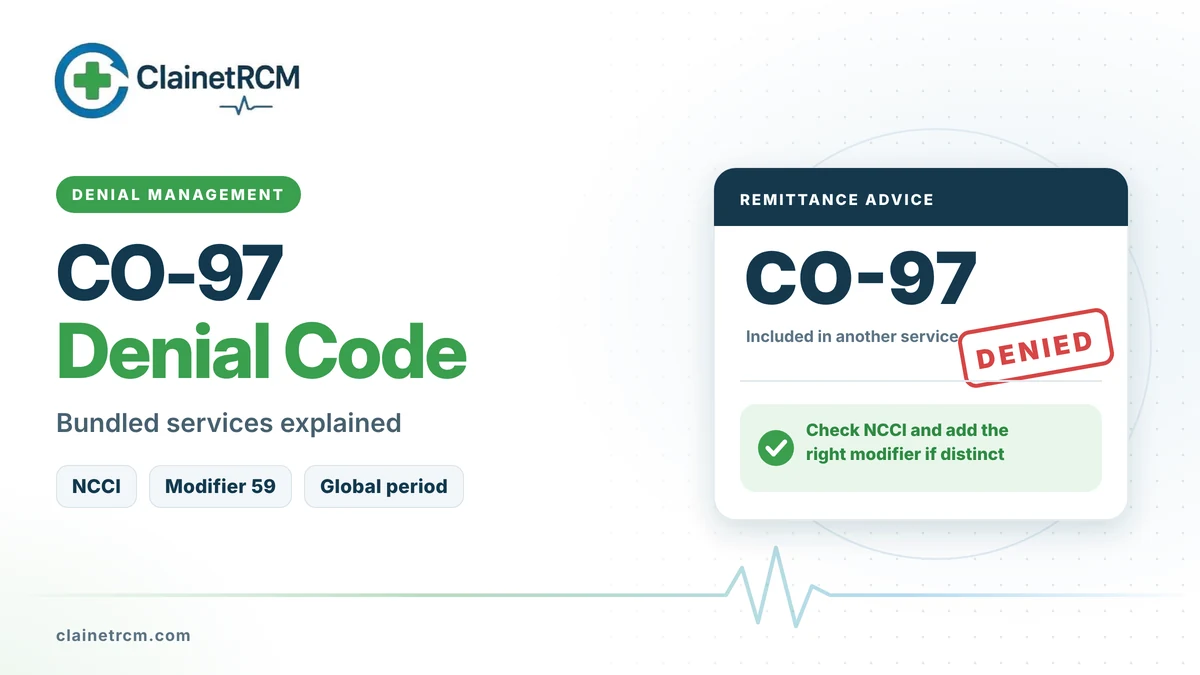
The CO-97 denial code tells you the payer considers a service part of another service it has already paid. Sometimes that is correct and the line should simply be written off. Often, though, the services were truly separate and a missing modifier or documentation gap caused the denial. Knowing which situation you are in is the whole job.
Quick answer: CO-97 is CARC 97, “The benefit for this service is included in the payment/allowance for another service/procedure that has already been adjudicated.” It usually comes from NCCI procedure-to-procedure edits, a global surgical period or a payer’s own bundling rules. If the services were distinct, correct the claim with the right modifier (such as 25, 59 or an X modifier) and supporting documentation. If they were not, write off the line. The patient cannot be billed for a CO adjustment.
What the CO-97 Denial Code Means
CARC 97 says the service you billed is included in the payment for another service. The group code CO makes the adjustment a provider write-off unless you can show the services were separate.
Common remark codes that come with it:
| RARC | Meaning |
|---|---|
| M15 | Separately billed services or tests have been bundled as components of the same procedure; separate payment is not allowed |
| M80 | Not covered when performed during the same session or date as a previously processed service for the patient |
| M144 | Pre- or post-operative care payment is included in the allowance for the surgery or procedure |
| N390 | This service or report cannot be billed separately |
Why CO-97 Happens
1. NCCI procedure-to-procedure (PTP) edits. The National Correct Coding Initiative pairs codes that should not normally be billed together for the same patient on the same date. Each pair has a column 1 code (paid) and a column 2 code (bundled). A modifier indicator of 0 means the pair can never be unbundled. An indicator of 1 means a modifier is allowed when the services were truly distinct.
2. Global surgical periods. Surgery payments include routine pre-operative visits, the procedure and routine post-operative care for 0, 10 or 90 days. A routine follow-up visit billed during the global period comes back as CO-97 with M144.
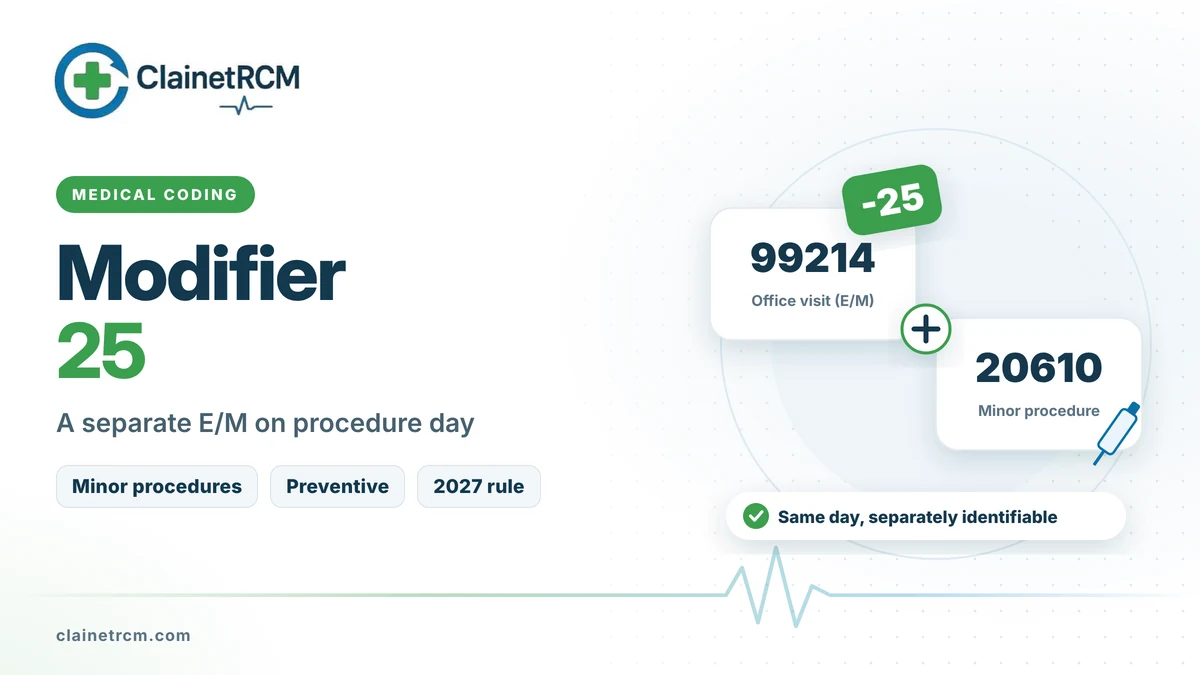
3. E/M visits with procedures. An office visit on the same day as a minor procedure is bundled unless it is significant and separately identifiable and carries modifier 25. See our modifier 25 guide.
4. Payer-specific bundling. Commercial plans run their own edit libraries, which can bundle more than NCCI does.
How to Fix a CO-97 Denial
- Identify the paired code. Find the service the payer says it already paid. It may be on the same claim or a different one.
- Check the edit. Look up the pair in the NCCI PTP tables (or the payer’s policy) and note the modifier indicator.
- Review the documentation. Were the services performed at different sessions, at different anatomic sites, through separate incisions or for separate problems?
- Correct or write off. If the services were distinct and the indicator allows it, send a corrected claim with the appropriate modifier: 59 or XE, XS, XP or XU for procedures, 25 for a separate E/M, or 24 or 79 for unrelated services in a global period. If the services were not distinct, write off the line. Adding a modifier to force payment is a compliance risk.
- Appeal when the claim was coded correctly with a valid modifier and documentation supports it, but the payer still bundled it.
Modifier Quick Guide for Bundling Denials
| Situation | Modifier |
|---|---|
| Separate, significant E/M on the day of a minor procedure | 25 |
| Decision for major surgery made at the visit | 57 |
| Distinct procedure: different session | XE (or 59) |
| Distinct procedure: separate organ or structure | XS (or 59) |
| Distinct procedure: different practitioner | XP (or 59) |
| Distinct procedure: unusual non-overlapping service | XU (or 59) |
| Unrelated E/M during a post-op period | 24 |
| Unrelated procedure during a post-op period | 79 |
How to Prevent CO-97 Denials
- Run NCCI edits before submission in your claim scrubber, and update them every quarter when CMS releases new tables.
- Train coders on modifier 59 and X modifiers. Use them only when the documentation shows a distinct service.
- Track global periods for every surgical patient so follow-up visits are not billed by mistake.
- Document separately when an E/M and a procedure happen on the same day.
- Review payer policies for plans that bundle more than Medicare.
CO-97 Denial Example
A patient has a lesion excised from the back and, at the same session, a separate laceration on the hand repaired. Both codes are billed, and the repair is denied as bundled into the excision. The excision and repair were at different anatomic sites, and the NCCI edit for the pair allows a modifier. Fix: send a corrected claim with modifier XS (or 59) on the repair, and keep the operative note that describes both sites.
Frequently Asked Questions
It means the payer considers the service included in the payment for another service that has already been processed. The provider must write it off unless the services were truly separate.
No. CO adjustments are the provider’s responsibility.
Only if the services were genuinely distinct and the NCCI edit allows a modifier. If the edit has a modifier indicator of 0, no modifier will unbundle the pair.
They are related. CARC 236 specifically says a procedure or modifier combination is not compatible with another procedure on the same day under NCCI or similar rules. CARC 97 is broader and also covers global period and payer bundling.
If the original claim was missing a modifier or had the wrong one, send a corrected claim. If it was coded correctly and still denied, appeal with the documentation.
Final Thoughts
The CO-97 denial code is a signal to check the edit, the documentation and the modifier, in that order. Some bundling denials are correct and should be written off quickly. The rest are revenue you can recover. Our denial management services sort the two fast, and our medical coding team fixes the patterns upstream.
Stop Losing Money to Bundling Edits
We review every CO-97 denial against NCCI and payer rules, appeal the ones that should pay and fix the coding patterns that trigger the rest.
Get a Free Denial Review
Written by
ClainetRCM Billing Team
ClainetRCM is a Boston-based revenue cycle management company specializing in medical billing, coding, credentialing and denial management for healthcare providers across all 50 states. Our AAPC and AHIMA certified team works inside your existing EHR, files claims within 24 to 48 hours and reviews every AR bucket on a 14-day cycle.