Modifier 25 is the most used, and probably the most scrutinized, modifier in outpatient medicine. It tells the payer that an E/M visit on the same day as a procedure or other service was real, separate work, and not just the evaluation that comes with the procedure. Used correctly, it gets you paid for two services. Used by habit, it draws audits, payer cuts and refund demands.
Quick answer: Modifier 25 is appended to an E/M code, never to the procedure, when the physician performs a significant, separately identifiable E/M service on the same day as a procedure or other service. It is common with minor procedures (0- or 10-day global periods) and with preventive visits. The decision to perform a minor procedure is already included in the procedure’s payment, so it does not justify modifier 25 on its own. For a major procedure (90-day global), the decision for surgery is billed with modifier 57 instead. Starting in 2027, Medicare will pay 20% less for the lower-paid service when a modifier 25 office visit and a 0-day global procedure fall on the same day.
What Modifier 25 Means
CPT defines modifier 25 as a “significant, separately identifiable evaluation and management service by the same physician or other qualified health care professional on the same day of the procedure or other service.”
Three ideas sit inside that definition:
- Significant: the E/M involved real work, not just a quick check before the procedure.
- Separately identifiable: the E/M work can be pulled apart from the pre-procedure and post-procedure work that is already paid with the procedure.
- Same physician, same day: the modifier describes two services by the same practitioner on one date.
A different diagnosis is not required. A patient can have a separately identifiable E/M and a procedure for the same condition, as long as the E/M went beyond the usual evaluation for the procedure.
When Modifier 25 Applies
- E/M plus a minor procedure. The patient comes in with a new problem or a worsening chronic condition, and the physician evaluates it beyond what the procedure requires. Minor procedures have 0- or 10-day global periods, such as joint injections, biopsies, lesion destruction and laceration repair.
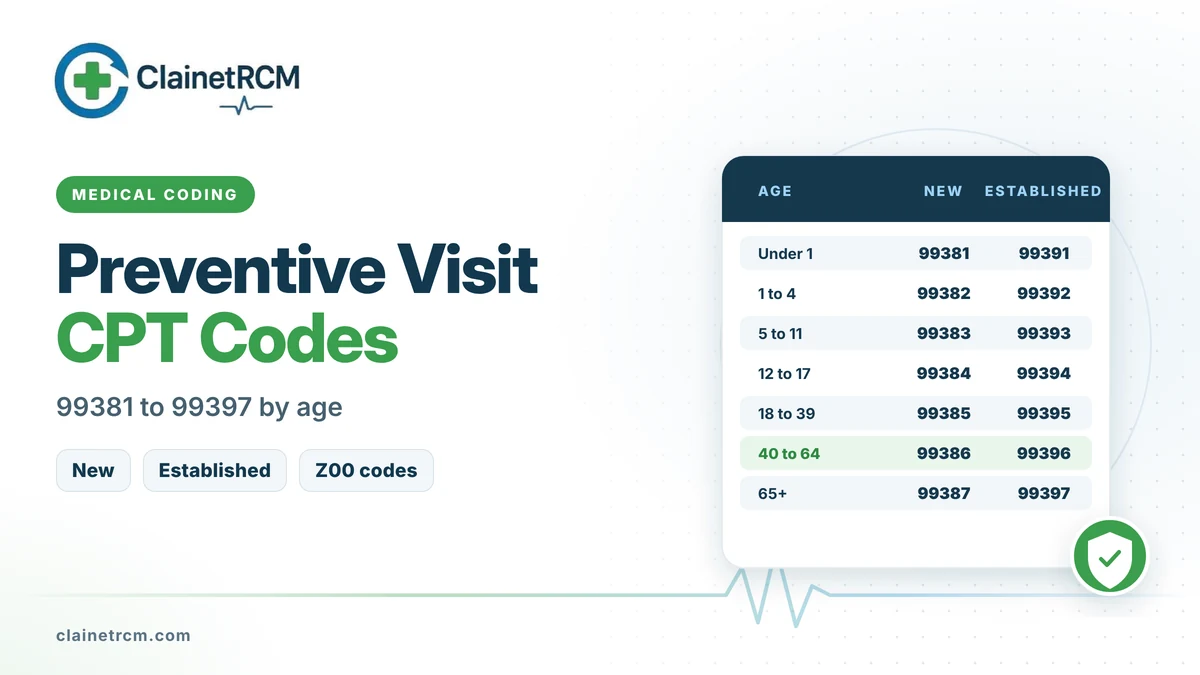
- E/M plus a preventive visit. A patient at their annual physical also needs a new problem worked up. The problem-oriented office visit carries modifier 25. See our preventive visit CPT codes guide.
- E/M plus an annual wellness visit. The problem-oriented visit carries modifier 25 alongside G0438 or G0439.
- E/M plus other services with NCCI edits. Some services, such as certain injections and tests, bundle with E/M visits under National Correct Coding Initiative (NCCI) edits. Modifier 25 signals that the visit was separate.
When Modifier 25 Does Not Apply
- The visit was only for the procedure. If the patient was scheduled for a joint injection and nothing else was addressed, bill only the injection.
- The E/M only decided to do the minor procedure. For minor procedures, CMS treats the decision to perform the procedure as part of the procedure. Only a significant, separately identifiable E/M beyond that decision is billable.
- The decision for major surgery. When an E/M on the day before or the day of a 90-day global procedure results in the decision for surgery, use modifier 57, not 25.
- Post-operative follow-up. Routine visits during a global period are included in the surgery. An unrelated E/M during the post-operative period uses modifier 24.
- On the procedure code. Modifier 25 goes on the E/M line only.
Modifier 25 Examples
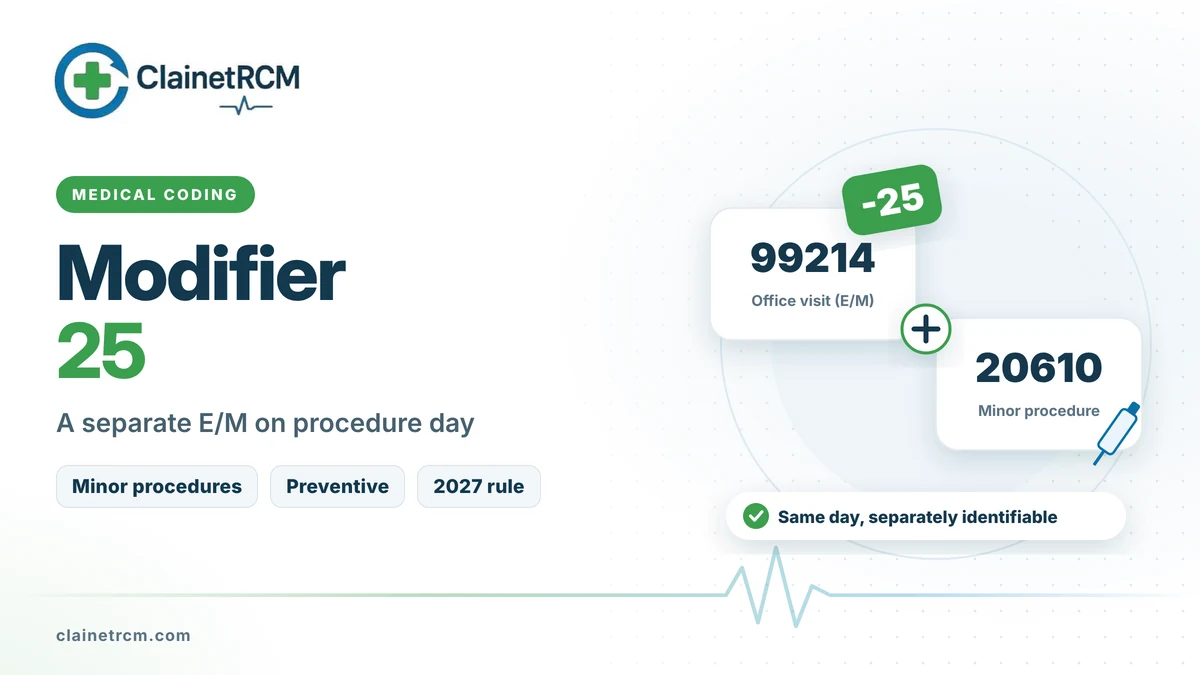
Example 1: Injection plus a separate problem (supported). A patient comes in for knee pain, and the physician decides to inject the knee. During the visit, the patient also reports dizziness and an elevated home blood pressure. The physician evaluates the dizziness, reviews the readings and adjusts the antihypertensive. Bill: 20610 for the injection, and 99214-25 for the visit, leveled on the dizziness and hypertension work only.
Example 2: Biopsy of a lesion found during a rash visit (supported). A patient presents with a widespread rash. The dermatologist evaluates and treats the rash, then notices a suspicious lesion on the back and performs a shave biopsy. Bill: the biopsy code, and the E/M with modifier 25 for the rash evaluation.
Example 3: Evaluation only for the injection (not supported). A patient with known knee osteoarthritis returns for a scheduled steroid injection. The physician confirms nothing has changed and injects. Bill: 20610 only. The brief evaluation is part of the procedure.
Example 4: Physical plus a new problem (supported). During an annual physical, a patient reports two weeks of chest tightness with exertion. The physician performs a focused evaluation, orders an EKG and a stress test and starts aspirin. Bill: the preventive code, the EKG and a problem-oriented E/M with modifier 25.
Documentation That Supports Modifier 25
- Separate the note. Use distinct sections for the problem-oriented E/M and the procedure, or write a separate E/M note.
- State the reason for the visit. A chief complaint that differs from the procedure, or a clear statement that the visit addressed more than the procedure, makes the claim easy to support.
- Level the E/M on separate work only. Do not count the evaluation that led to the procedure toward the E/M level.
- Document the decision-making. Show the problems addressed, data reviewed and management decisions for the E/M portion.
G2211 and Modifier 25
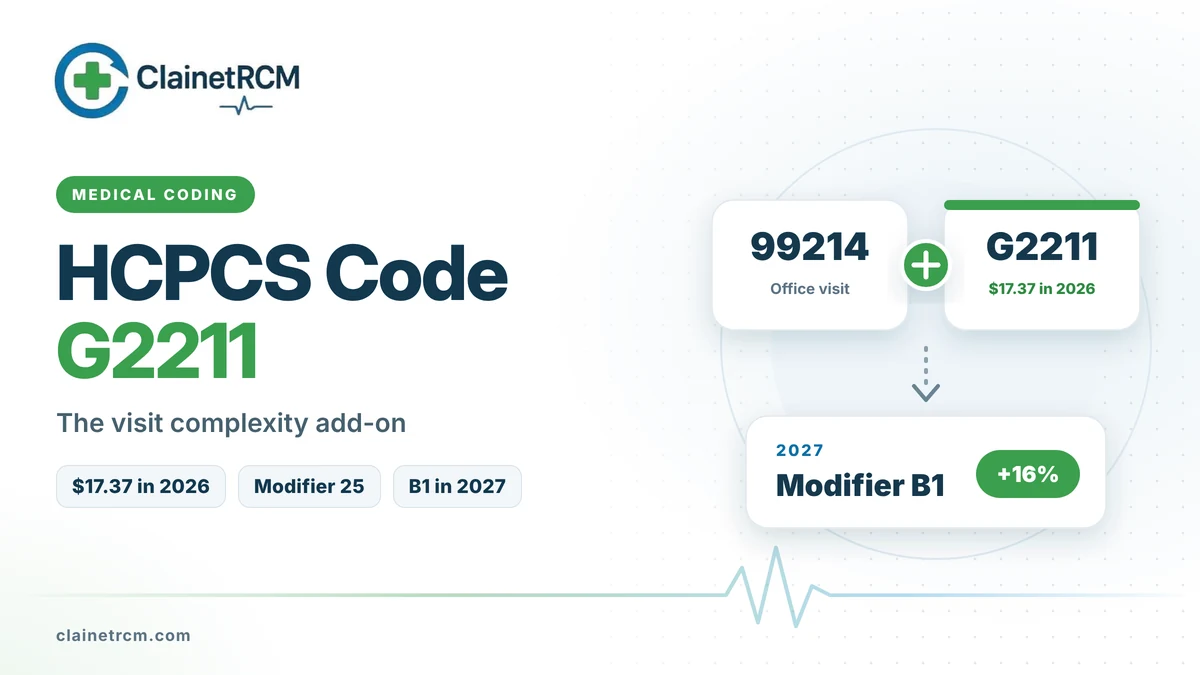
Medicare does not pay the G2211 complexity add-on on an E/M billed with modifier 25, with one exception that began January 1, 2025: G2211 is payable when the other same-day service is an annual wellness visit, a vaccine administration or a Medicare Part B preventive service. A visit with a minor procedure still does not qualify. In 2027, G2211 becomes modifier B1, and CMS generally kept these restrictions. See our G2211 guide.
Payer Policies to Watch
Commercial and Blue plans have moved aggressively on modifier 25:
- Blue Cross Blue Shield of Michigan began paying 50% of the allowed amount for office E/M codes 99202-99205 and 99212-99215 billed with modifier 25 on the same day as a 0- or 10-day global procedure, effective May 1, 2026.
- Independence Blue Cross reimburses an E/M with modifier 25 at 50% when it is billed on the same day as a minor procedure.
- Regence BlueCross BlueShield rescinded a similar payment reduction in 2025 after physician pushback.
- Cigna announced a policy requiring records for modifier 25 claims with minor procedures and then delayed it, saying it would continue to review it for future implementation.
Medicare has also flagged misuse. The HHS Office of Inspector General found improper modifier 25 billing for E/M services on the same day as intravitreal injections, and CMS reminds providers that only a significant, separately identifiable E/M unrelated to the decision to do the minor procedure is billable.
The 2027 Medicare Same-Day Reduction
The CY 2027 Physician Fee Schedule final rule, released November 4, 2026, creates a new same-day payment policy:
| Element | Final 2027 policy |
|---|---|
| Trigger | A separately identifiable office or outpatient E/M visit billed with modifier 25 on the same day as a procedure with a 0-day global period |
| Payment | The higher-paid service is paid in full; the lower-paid service is reduced by 20% |
| Who counts | The same physician, or a physician of the same specialty in the same group practice |
| Not included | Procedures with 10- or 90-day global periods, other E/M settings such as inpatient visits, and different specialties in the same group |
| Proposed version | 50% reduction across 0-, 10- and 90-day globals (not finalized) |
Dermatology, otolaryngology and podiatry are expected to see the largest impact. Practices that frequently pair office visits with 0-day procedures should model the revenue change now and confirm that every modifier 25 visit is documented as truly separate.
Modifier 25 Denials and How to Fix Them
- Bundling denials (CARC CO-97). The payer treated the E/M as included in the procedure. Review the note. If the E/M was separate, appeal with the documentation highlighted.
- Modifier missing or inconsistent (CARC CO-4). The E/M was billed without modifier 25, or the modifier was on the wrong line. Correct and resubmit.
- Payment reductions. Check whether a payer policy, such as a 50% reduction, applies before you appeal. An appeal of a reduction made under a published policy rarely succeeds unless the policy was applied in error.
Our denial management team works these denials every day, and our guide to why medical claims keep getting denied covers the patterns behind them.
Frequently Asked Questions
Modifier 25 identifies a significant, separately identifiable E/M service by the same physician or other qualified health care professional on the same day as a procedure or other service.
On the E/M code. Never append modifier 25 to the procedure.
No. A different diagnosis is not required, but the E/M must involve work beyond the usual evaluation for the procedure.
Modifier 25 applies to E/M services with minor procedures (0- or 10-day global periods) and other services. Modifier 57 applies when an E/M on the day before or the day of a major procedure (90-day global period) results in the decision for surgery.
Yes. When a patient needs significant, separately identifiable care for a problem during a preventive visit, bill the problem-oriented E/M with modifier 25.
Starting in 2027, when an office E/M with modifier 25 and a 0-day global procedure are billed on the same day by the same physician, or a same-specialty physician in the group, Medicare pays the lower-paid service at 80%.
Final Thoughts
Modifier 25 is legitimate and necessary, but it has to describe real, separate work. A clear chief complaint, separate documentation and an E/M level based only on the extra work will carry your claims through payer edits, audits and the new 2027 Medicare rules. Our medical coding team reviews same-day claims before they go out.
Make Every Modifier 25 Claim Defensible
Our coders review same-day E/M and procedure claims before submission, so modifier 25 is used only where it belongs and every E/M you bill holds up.
Get a Free Coding Review
Written by
ClainetRCM Billing Team
ClainetRCM is a Boston-based revenue cycle management company specializing in medical billing, coding, credentialing and denial management for healthcare providers across all 50 states. Our AAPC and AHIMA certified team works inside your existing EHR, files claims within 24 to 48 hours and reviews every AR bucket on a 14-day cycle.