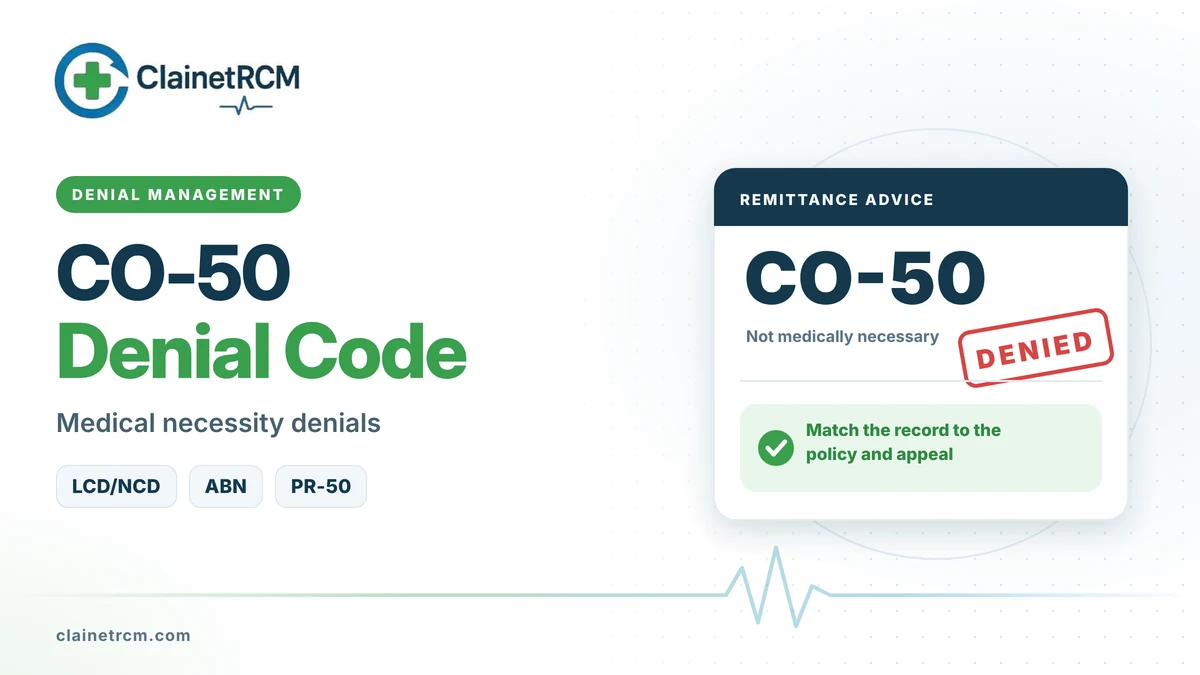
The CO-50 denial code is the payer telling you it does not believe the service was medically necessary. That can mean the diagnosis did not match a coverage policy, the documentation did not support the need or the service was performed more often than the policy allows. Unlike data errors, these denials need clinical reasoning to overturn.
Quick answer: CO-50 is CARC 50, “These are non-covered services because this is not deemed a ‘medical necessity’ by the payer.” With group code CO, the provider absorbs the loss and cannot bill the patient. For Medicare, the patient can be billed only when a valid Advance Beneficiary Notice (ABN) was signed and the claim carried the GA modifier, which turns the adjustment into PR-50. To fix CO-50, check the diagnosis coding against the LCD or NCD, add any missing documentation and appeal with the clinical record.
What the CO-50 Denial Code Means
CARC 50 says the payer reviewed the service and decided it was not medically necessary under its rules. In Medicare, those rules come from:
- National Coverage Determinations (NCDs) that apply nationwide
- Local Coverage Determinations (LCDs) and their billing and coding articles, published by each Medicare Administrative Contractor
- Frequency limits for screenings and repeat tests
Commercial plans use their own medical policies, which often borrow from LCDs, specialty guidelines or proprietary criteria.
Remark codes help explain the reason. N115 means the decision was based on an LCD. N386 means it was based on an NCD.
CO-50 vs PR-50: Who Pays
| Situation | Group code | Who pays |
|---|---|---|
| Medicare denies as not medically necessary and no valid ABN was obtained | CO-50 | Provider writes off |
| Medicare denies, a valid ABN was signed and the line carried modifier GA | PR-50 | Patient is liable (remark M38) |
| Service is statutorily excluded (never covered) | PR-96 or PR-204 | Patient pays; no ABN required |
An ABN must be given before the service, name the specific service and a genuine reason Medicare may deny it, and be signed by the patient. Blanket ABNs signed for every visit are not valid. See our GA, GY and GZ modifier guide for the modifier rules.
Common Causes of CO-50
- Diagnosis not on the covered list. The LCD article lists the ICD-10-CM codes that support the service, and the claim used a different one.
- Unspecified codes. A vague code may not meet the policy even when the patient’s actual condition would.
- Frequency limits exceeded, such as screening tests repeated too soon.
- Missing prerequisites, such as failed conservative treatment before an injection or imaging.
- Documentation does not support the policy criteria, such as missing test results or functional measures.
- Screening billed as diagnostic, or the reverse.
How to Fix a CO-50 Denial
- Pull the coverage policy. Find the LCD, NCD or payer policy and its list of covered diagnoses and criteria.
- Compare the claim and the chart. Did the provider document a covered diagnosis that was not coded? If so, correct the claim with the more specific code.
- Check frequency and prerequisites. Confirm dates of prior services and documented conservative care.
- Choose the path. For a coding error, send a corrected claim or request a reopening if the payer allows it. When the documentation supports necessity, file an appeal (for Medicare, a redetermination within 120 days of the initial determination) with the notes, test results and a short letter mapping the record to each policy criterion. If the service truly did not meet the policy, write off the line and fix the ABN process for next time.
- Request a peer-to-peer review where commercial payers offer one, especially for imaging and procedures.
How to Prevent CO-50 Denials
- Build LCD and NCD checks into ordering and charge entry, especially for labs, imaging, injections and therapy.
- Code to the highest specificity the documentation supports.
- Use ABNs correctly for Medicare services that may not meet coverage rules, and append GA, GZ or GY as appropriate.
- Document the reason for every test and procedure, including symptoms, prior treatment and expected impact on care.
- Review denial trends by CPT code and payer to spot policies your clinicians are not aware of.
CO-50 Denial Examples
Example 1: Unspecified diagnosis. A vitamin D test was billed with a diagnosis of fatigue, which is not on the LCD’s list of covered conditions. The chart shows the provider was monitoring the patient’s chronic kidney disease, which is covered. Fix: send a corrected claim with the documented, covered diagnosis.
Example 2: Too-frequent screening. A screening test was repeated 10 months after the last one, but the policy allows one every 12 months. Fix: if the second test was diagnostic because of new symptoms, correct the coding. If not, the denial stands. An ABN should have been obtained.
Example 3: Missing conservative care. A facet joint injection was denied because the policy requires documented failure of conservative treatment. The physical therapy notes were in the record but not sent. Fix: appeal with the therapy records and a letter mapping them to the policy criteria.
Frequently Asked Questions
It means the payer determined the service was not medically necessary under its coverage rules, and the provider is responsible for the adjustment.
Not when the group code is CO. For Medicare, you can bill the patient only if a valid ABN was signed before the service and the claim carried the GA modifier, which results in PR-50.
A Medicare redetermination must be filed within 120 days of receiving the initial determination.
CARC 50 is a general medical necessity denial. CARC 167 says the diagnosis or diagnoses billed are not covered for the service.
Only if the provider documented that diagnosis. Never change a diagnosis to match a policy without documentation to support it.
Final Thoughts
The CO-50 denial code is won or lost on documentation and diagnosis coding. Check the policy, match the record to its criteria and appeal when the care was necessary. Our denial management services build medical necessity appeals that reviewers can approve quickly, and our guide on how to reduce claim denials covers the prevention side.
Win the Medical Necessity Fight
We check LCDs, NCDs and payer policies before claims go out, and build appeals with the documentation reviewers look for.
Get a Free Denial Review
Written by
ClainetRCM Billing Team
ClainetRCM is a Boston-based revenue cycle management company specializing in medical billing, coding, credentialing and denial management for healthcare providers across all 50 states. Our AAPC and AHIMA certified team works inside your existing EHR, files claims within 24 to 48 hours and reviews every AR bucket on a 14-day cycle.