The CO-197 denial code is one of the most painful denials in medical billing because the service has already been delivered and the payer says it should never have happened without approval. Some CO-197 denials can be reversed. Many cannot. Prevention is worth far more than any appeal.
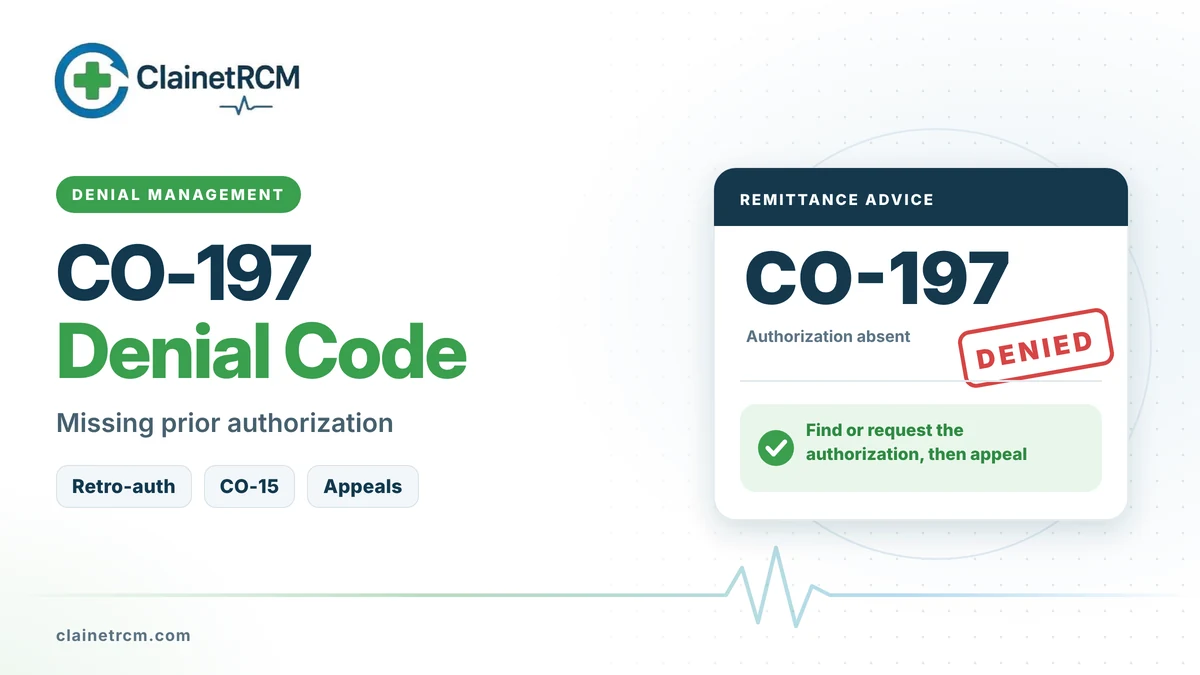
Quick answer: CO-197 is CARC 197, “Precertification/notification/authorization/pre-treatment absent.” It means the payer has no record of a required prior authorization or notification for the service. Because the group code is CO, the provider usually cannot bill the patient. Check whether an authorization exists under a different number, provider or date range. If none was obtained, ask about retro-authorization or appeal with proof of urgency. Then fix the front-end process that missed it.
What the CO-197 Denial Code Means
CARC 197 tells you the payer required a precertification, notification or authorization for the service and could not match one to the claim. The CO group code means the loss falls on the provider under the contract.
It is related to two other codes:
- CARC 15: “The authorization number is missing, invalid, or does not apply to the billed services or provider.” This often means an authorization exists but the claim did not carry it correctly.
- CARC 198: “Precertification/notification/authorization/pre-treatment exceeded.” The authorization exists, but the services billed go beyond what was approved.
Common Causes of CO-197
- No authorization was requested because staff did not know the service required one
- The authorization was for a different CPT code, such as an MRI without contrast approved and an MRI with and without contrast performed
- The dates do not match: the service fell outside the approved window
- The wrong provider or site is on the authorization, such as a different rendering provider or facility
- Units exceeded the approved number of visits or sessions
- The patient changed plans, and the new plan has different rules
- A notification requirement was missed, such as an inpatient admission notice within 24 hours
How to Fix a CO-197 Denial
- Search for an existing authorization. Check the payer portal for approvals under the patient, the ordering provider and the facility. If you find one, add the number and send a corrected claim.
- Compare the details. Make sure the CPT codes, units, dates and providers on the claim match the approval. If they differ, ask the payer to update the authorization.
- Request retro-authorization. Some payers allow retroactive authorization within a short window, often for urgent or emergency services or when eligibility could not be verified in advance. Ask before you appeal.
- Appeal with documentation. If the service was urgent, emergent or medically necessary and the payer’s rules allow it, appeal with the clinical notes and an explanation of why authorization could not be obtained in time.
- Decide on patient billing carefully. A CO denial cannot be shifted to the patient unless the contract and state law allow it and the patient agreed in writing beforehand.
Emergency Services and Authorization
Emergency services generally cannot require prior authorization. Under federal rules, most health plans must cover emergency services without prior authorization, regardless of network status. If a CO-197 denial lands on an emergency visit, appeal it and cite the plan’s emergency services obligations.
How to Prevent CO-197 Denials
- Check authorization requirements at scheduling, using each payer’s current prior authorization list. These lists change often.
- Tie every authorization to the order: codes, units, dates, rendering provider and site of service.
- Track expiration dates and visit counts so ongoing therapy does not run past the approval.
- Re-verify when the plan changes, especially at the start of the year.
- Use the 2026 CMS prior authorization rule to your advantage. Starting in 2026, Medicare Advantage, Medicaid and CHIP plans and plans on the federal exchanges must return decisions within 72 hours for expedited requests and seven calendar days for standard requests, and give a specific reason for denials.
- Outsource high-volume authorizations. Our prior authorization services handle requests, follow-up and documentation.
CO-197 Denial Examples
Example 1: Wrong code on the approval. An MRI of the lumbar spine without contrast was approved, but the radiologist performed it with and without contrast. The claim for the different CPT code denied CO-197. Fix: ask the payer to update the authorization to the performed code, citing the clinical reason, then send a corrected claim.
Example 2: Visits ran out. A physical therapy plan of care was approved for 12 visits. Visits 13 and 14 were billed and denied. Fix: request an extension or retro-authorization if the payer allows it. Going forward, track visit counts and request more visits before the last approved visit.
Example 3: New plan year. A patient’s employer changed plans on January 1. A recurring infusion that did not need authorization under the old plan required it under the new one. Fix: request retro-authorization with the clinical history, and re-verify every recurring service at the start of each plan year.
Frequently Asked Questions
It means the payer did not find a required precertification, notification or authorization for the service billed.
Usually not. The CO group code makes it a provider liability. Patient billing is only possible in limited cases where the contract and state law allow it and the patient agreed in writing in advance.
CO-197 means no authorization was found. CO-15 means the authorization number on the claim is missing, invalid or does not apply to the services or provider billed.
Sometimes. Many payers allow it for urgent situations or when coverage could not be verified in advance, usually within a short window. Ask the payer before filing an appeal.
Track approved visit counts and end dates, and request an extension before the current authorization runs out.
Final Thoughts
The CO-197 denial code is almost always a front-end miss. Recover what you can through existing approvals, retro-authorization and appeals, then close the gap at scheduling. Our denial management team works these claims quickly, and our guide on how to reduce claim denials covers the wider prevention plan.
Never Lose a Claim to a Missing Authorization
Our prior authorization team requests, tracks and attaches every authorization, and works CO-197 denials before the appeal window closes.
Talk to an Authorization Expert
Written by
ClainetRCM Billing Team
ClainetRCM is a Boston-based revenue cycle management company specializing in medical billing, coding, credentialing and denial management for healthcare providers across all 50 states. Our AAPC and AHIMA certified team works inside your existing EHR, files claims within 24 to 48 hours and reviews every AR bucket on a 14-day cycle.