The GA GY GZ modifiers tell Medicare whether you warned the patient that a service might not be covered, and that decides who pays when Medicare says no. Use the wrong one, or use the right one without a valid Advance Beneficiary Notice (ABN), and the practice usually absorbs the cost.
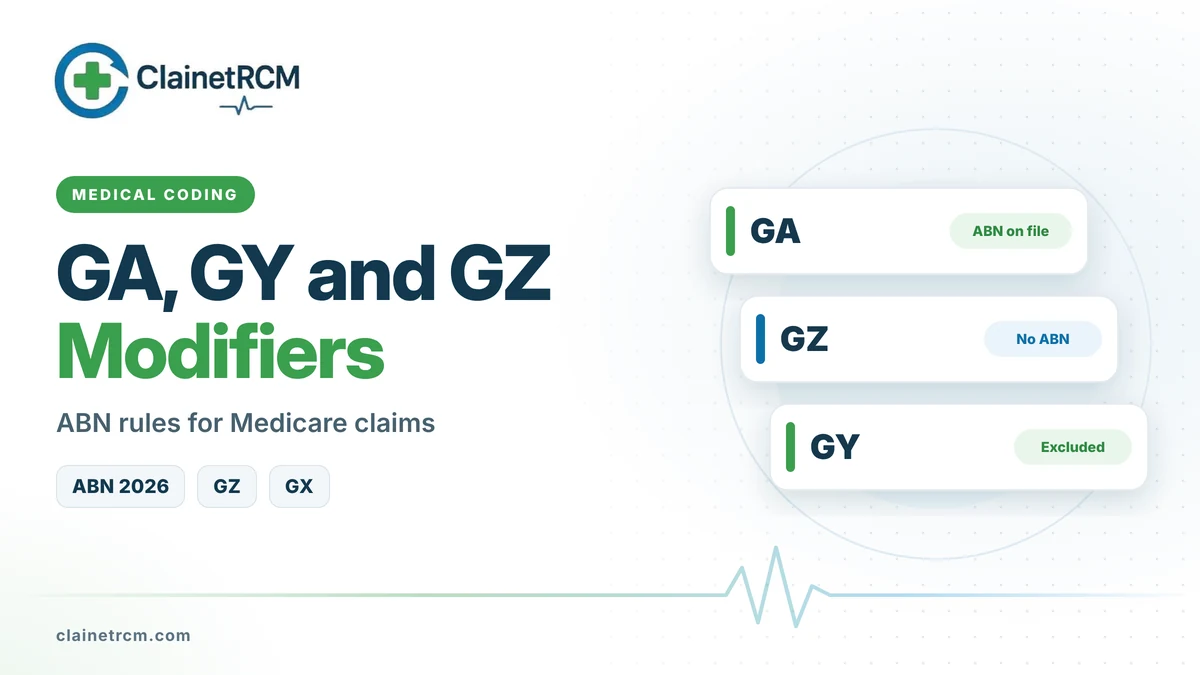
Quick answer: Use the GA modifier when a valid ABN (Form CMS-R-131) was given because Medicare is expected to deny the service as not reasonable and necessary; if Medicare denies, the patient is responsible. Use the GZ modifier when you expect a medical necessity denial but did not obtain an ABN; the provider is liable. Use the GY modifier for services that are statutorily excluded or not a Medicare benefit, such as cosmetic surgery or hearing aids; no ABN is required and the patient is responsible. Add the GX modifier when a voluntary ABN was given for an excluded service. CMS released an updated ABN in March 2026, and providers had to use it from May 12, 2026.
GA GY GZ Modifiers at a Glance
| Modifier | Meaning | ABN | Who pays if Medicare denies |
|---|---|---|---|
| GA | Waiver of liability statement issued as required by payer policy | Valid ABN on file | The patient |
| GZ | Item or service expected to be denied as not reasonable and necessary | No ABN | The provider |
| GY | Item or service statutorily excluded or not a Medicare benefit | Not required | The patient |
| GX | Notice of liability issued, voluntary under payer policy | Voluntary ABN given | The patient (often used with GY) |
These modifiers apply to Original Medicare. They are not used for Medicare Advantage, where the plan’s organization determination process decides coverage before the service.
When Medicare Requires an ABN
An ABN is required when you expect Original Medicare to deny an item or service that is normally covered because it is not reasonable and necessary in this case. Common examples:
- Tests or services that do not meet a local or national coverage determination, such as a lab test ordered with a diagnosis the policy does not cover
- Screening services provided more often than Medicare allows
- Chiropractic maintenance therapy after maximum improvement
- Services that exceed frequency limits in an LCD
An ABN is not required for services that are never covered by law, such as routine physicals, cosmetic procedures, hearing aids and most routine foot care. You can give a voluntary notice, and many practices do, to set expectations.
What Makes an ABN Valid
- The current form. OMB approved the updated CMS-R-131 on March 13, 2026, with an expiration date of March 31, 2029. The previous version could be used only until May 12, 2026. English and Spanish versions are available.
- Delivered before the service, with enough time for the patient to decide without pressure.
- Specific. It names the item or service and gives a clear reason Medicare may not pay. Generic statements such as “Medicare may not pay” do not qualify.
- A good-faith cost estimate. CMS considers an estimate within $100 or 25% of the actual charge, whichever is greater, acceptable.
- The patient’s choice and signature. The patient selects an option, signs and dates the form and receives a copy.
- Retained for five years.
Routine or blanket ABNs given to every patient for every service are invalid, and so are ABNs given during a medical emergency or under duress.
How Each Modifier Changes the Remittance
- GA: If Medicare denies, the adjustment carries group code PR (patient responsibility), and you can bill the patient.
- GZ: Medicare automatically denies GZ lines with group code CO (contractual obligation), and you cannot bill the patient.
- GY: Medicare denies the excluded service as patient responsibility. Many patients’ secondary insurance needs that denial before it will pay, which is one reason GY claims are still submitted.
Examples
- A Medicare patient wants a vitamin D test, but the diagnosis does not meet the LCD. The practice gives a valid ABN, the patient chooses option 1, and the claim is billed with GA.
- The same test is run without an ABN because the front desk missed it. Bill with GZ; the practice cannot collect from the patient if Medicare denies.
- A patient requests a cosmetic procedure. Bill with GY, and add GX if a voluntary ABN was given.
- A chiropractor continues maintenance care after maximum improvement and has a valid ABN. Bill the manipulation with GA and without AT. See our chiropractic CPT codes guide.
Common ABN Mistakes
- Using an expired version of the ABN form
- Leaving the reason or cost estimate blank
- Obtaining the signature after the service
- Giving every patient an ABN regardless of the service
- Billing GA without an ABN in the record
- Using an ABN for a Medicare Advantage patient
Frequently Asked Questions
Both mean you expect a medical necessity denial. GA means a valid ABN was given, so the patient can be billed. GZ means no ABN was given, so the provider is liable.
For services that Medicare never covers by law or that are not a Medicare benefit, such as cosmetic procedures or hearing aids.
No. A voluntary notice can be given, and GX can be added with GY to show it was.
No. The ABN applies only to Original Medicare. Medicare Advantage plans use their own pre-service determination process.
For dates of service on or after May 12, 2026, an outdated form can invalidate the ABN, which leaves the provider liable.
Final Thoughts
The GA GY GZ modifiers only protect revenue when the ABN behind them is valid and current. Build ABN checks into scheduling, use the 2026 form and match each claim to the right modifier. Our medical coding services team audits ABN and modifier workflows, and our guides on how to bill Medicare as a provider and the CO-50 denial code cover related Medicare billing rules.
Protect Your Right to Bill the Patient
We build compliant ABN workflows, apply GA, GY, GZ and GX correctly and track denials so patient responsibility holds up.
Review My ABN Process
Written by
ClainetRCM Billing Team
ClainetRCM is a Boston-based revenue cycle management company specializing in medical billing, coding, credentialing and denial management for healthcare providers across all 50 states. Our AAPC and AHIMA certified team works inside your existing EHR, files claims within 24 to 48 hours and reviews every AR bucket on a 14-day cycle.