Chiropractic CPT codes are few, but the rules around them are strict, especially for Medicare. A single visit can turn on how many spinal regions were treated, whether care was active or maintenance, and whether a valid ABN is on file. This guide explains the manipulation codes, the AT modifier and how to bill the rest of a chiropractic visit.
Quick answer: Chiropractic manipulative treatment (CMT) codes are 98940 (1 to 2 spinal regions), 98941 (3 to 4 regions), 98942 (5 regions) and 98943 (extraspinal, one or more regions). Medicare pays chiropractors only for 98940 to 98942, and only for manual manipulation of the spine to correct a subluxation. Add the AT modifier for active, corrective treatment. Maintenance therapy is not covered: bill with the GA modifier when a valid ABN is on file, or GZ when it is not. Commercial plans may also pay for exams, X-rays and therapies.
Chiropractic CPT Codes at a Glance
| Code | Description | Regions |
|---|---|---|
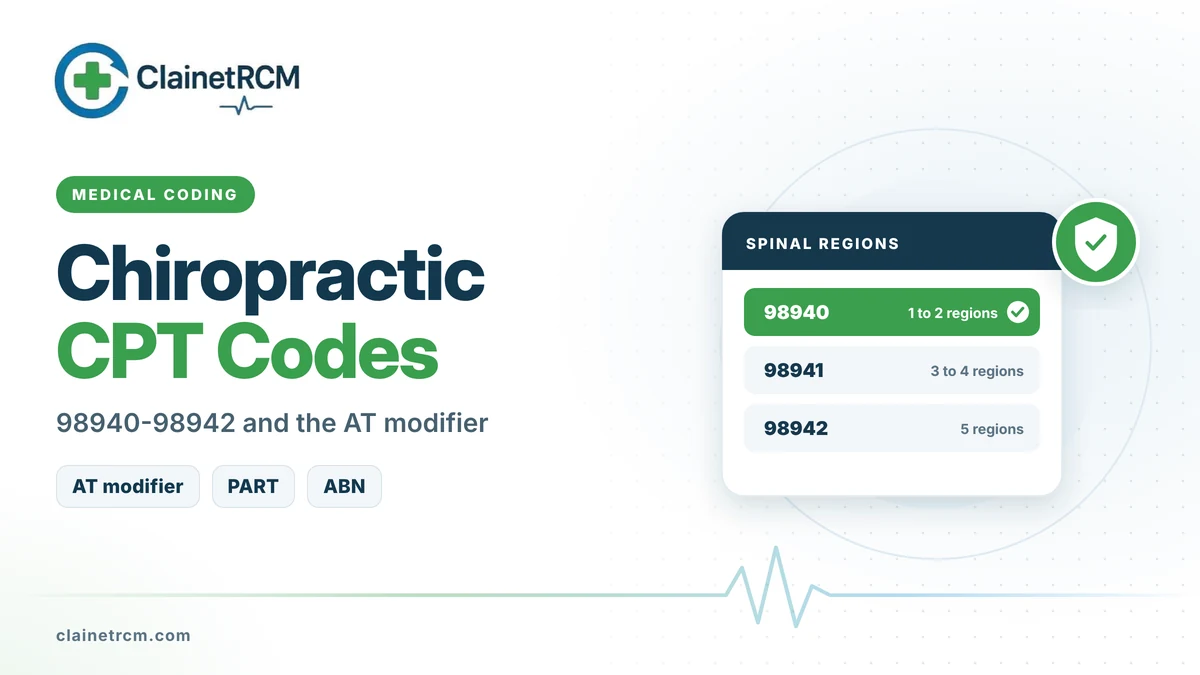
| 98940 | Chiropractic manipulative treatment, spinal | 1 to 2 regions |
| 98941 | Chiropractic manipulative treatment, spinal | 3 to 4 regions |
| 98942 | Chiropractic manipulative treatment, spinal | 5 regions |
| 98943 | Chiropractic manipulative treatment, extraspinal | 1 or more regions |
The five spinal regions are cervical (including the atlanto-occipital joint), thoracic (including costovertebral and costotransverse joints), lumbar, sacral and pelvic (sacroiliac joint). The five extraspinal regions are the head (including the TMJ), lower extremities, upper extremities, rib cage and abdomen.
Choose the code by the number of regions actually treated and documented, not the number examined.
Medicare Coverage Rules
Medicare covers only one chiropractic service: manual manipulation of the spine to correct a subluxation. That means:
- 98940, 98941 and 98942 are the only codes Medicare pays to chiropractors.
- Exams, X-rays, therapies and 98943 are not covered when performed by a chiropractor, although X-rays ordered from another provider can be used for documentation.
- An X-ray is not required to demonstrate subluxation; a physical examination can establish it.
Documenting Subluxation With PART
Medicare accepts a physical exam showing at least two of the four PART criteria, one of which must be asymmetry or misalignment, or range of motion abnormality:
- Pain or tenderness
- Asymmetry or misalignment
- Range of motion abnormality
- Tissue or tone changes
Document the specific level of subluxation, the treatment plan with goals and frequency, and the patient’s progress at each visit.
The AT Modifier and Maintenance Care
Append AT when manipulation is active, corrective treatment expected to improve the patient’s condition. Once the patient reaches maximum therapeutic benefit and care becomes preventive or maintenance, Medicare no longer covers it:
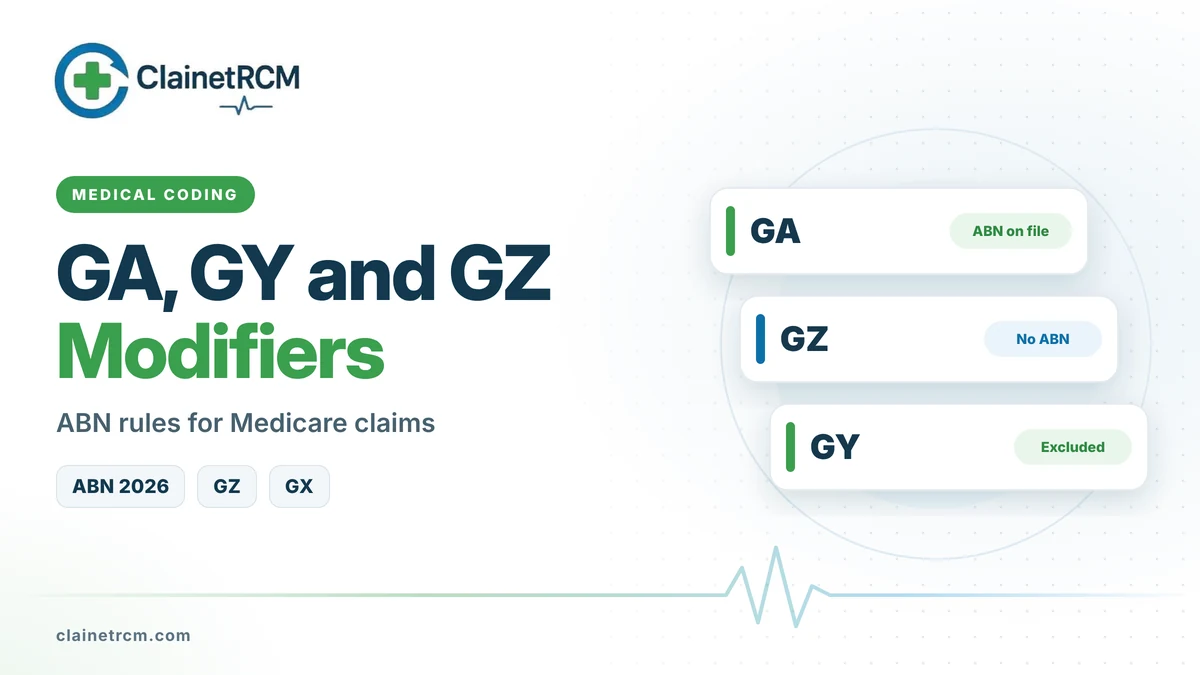
- GA: a valid ABN was given before the service, so the patient can be billed if Medicare denies.
- GZ: no ABN was given, so the practice cannot bill the patient.
CMS released an updated ABN (Form CMS-R-131) in March 2026, and practices had to switch to it by May 12, 2026. Our GA, GY and GZ modifiers guide explains how to complete it.
Diagnosis Coding for Medicare
Most Medicare contractors expect the segmental dysfunction (subluxation) code for each treated region, such as M99.03 for the lumbar region, paired with a supporting neuromusculoskeletal diagnosis, such as a low back pain or radiculopathy code. Check your contractor’s billing article for the required pairs, and see our guide to the ICD-10 code for low back pain.
Billing Commercial Chiropractic Visits
Commercial plans often cover more services, subject to visit limits and medical necessity:
- E/M visits for new patients and for re-examinations or new conditions, with modifier 25 when billed on the same day as CMT and the E/M is significant and separately identifiable.
- Therapies such as 97140 (manual therapy), 97110 (therapeutic exercise), 97112 (neuromuscular re-education) and 97012 (mechanical traction).
- X-rays taken in the office, when the practice is equipped and credentialed for imaging.
NCCI edits bundle 97140 into CMT when performed on the same region. When manual therapy is performed on a different region, document it separately and use modifier 59 or XS. Our modifier 59 guide covers when that is appropriate.
Billing Example
A Medicare patient with acute low back pain and lumbar and pelvic subluxations documented by PART findings receives manipulation of the lumbar and pelvic regions. Bill 98940-AT, with M99.03 and M99.05 plus a supporting diagnosis such as M54.50. Three months later the patient has reached maximum improvement and chooses to continue monthly visits after signing a valid ABN. Bill 98940-GA without AT.
Common Chiropractic Denials and Fixes
| Denial | Cause | Fix |
|---|---|---|
| Medicare denial for maintenance | AT used after maximum improvement | Use GA with a valid ABN, or GZ without one |
| Missing AT | Active care billed without AT | Add AT for corrective treatment |
| Level not supported | 98941 billed with only two regions documented | Code from the regions treated and documented |
| Bundling of 97140 | Manual therapy on the same region as CMT | Bill separately only for a different region, with documentation |
| Visit limit reached | Commercial plan’s annual chiropractic limit exceeded | Verify benefits before treatment and track visits used |
Frequently Asked Questions
The number of spinal regions treated: one to two for 98940, three to four for 98941 and five for 98942.
No. Medicare does not pay chiropractors for extraspinal manipulation.
For active, corrective treatment of a subluxation that is expected to improve the patient’s condition.
No. Medicare covers only spinal manipulation when furnished by a chiropractor.
Append GZ. Medicare will deny the service, and the practice cannot bill the patient.
Record the treatment goals, the planned frequency and duration of visits, and the objective measures you will use to track progress, then re-evaluate on schedule. Medicare expects a documented plan for active treatment, and commercial payers use the same details to decide whether ongoing visits are still medically necessary.
Final Thoughts
Chiropractic CPT codes reward accurate region counts, clear active treatment documentation and disciplined ABN use. Our chiropractic billing team handles Medicare and commercial claims for chiropractic practices, and our specialty medical billing guide explains why specialty rules matter for revenue.
Chiropractic Claims That Hold Up
We code manipulations by region, apply AT, GA and GZ correctly, manage ABNs and bill commercial therapies without bundling denials.
Get Chiropractic Billing Help
Written by
ClainetRCM Billing Team
ClainetRCM is a Boston-based revenue cycle management company specializing in medical billing, coding, credentialing and denial management for healthcare providers across all 50 states. Our AAPC and AHIMA certified team works inside your existing EHR, files claims within 24 to 48 hours and reviews every AR bucket on a 14-day cycle.