Modifier 59 is one of the most powerful modifiers in medical coding, and one of the most misused. It tells a payer that two services normally bundled together were truly separate on this occasion. Used correctly, it gets distinct services paid. Used to push claims past edits, it is a leading audit target.
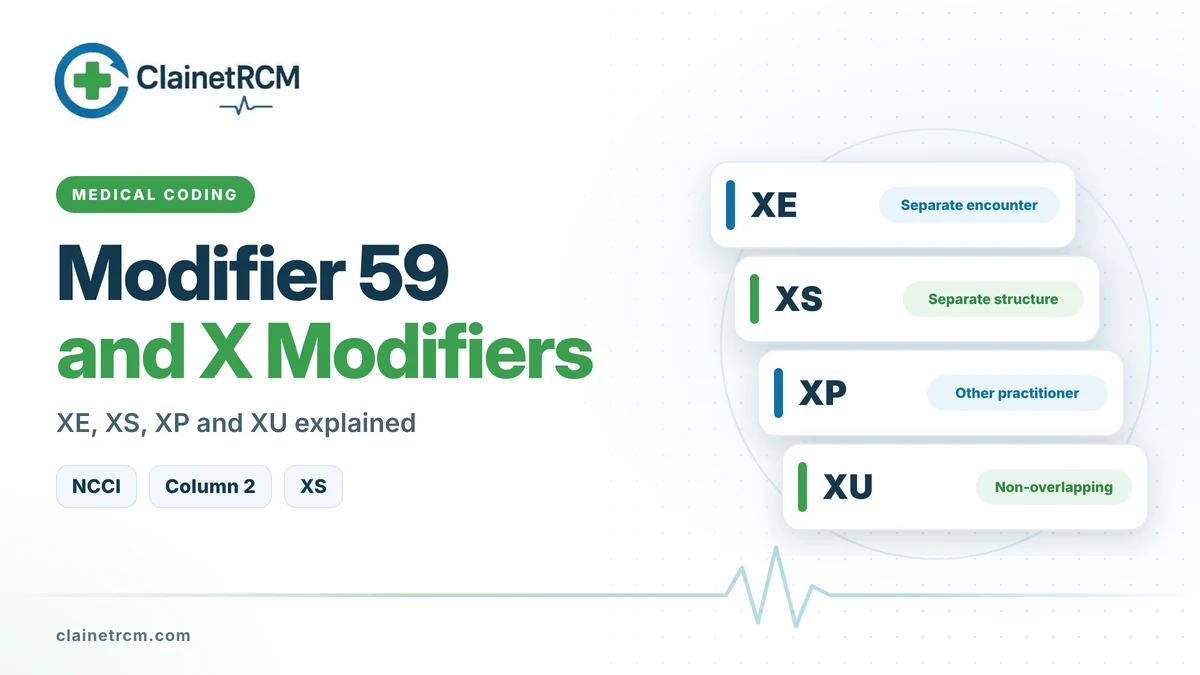
Quick answer: Modifier 59 identifies a distinct procedural service: a procedure or service that was separate from other non-E/M services on the same day because it was performed at a different session, on a different site or organ system, through a separate incision, on a separate lesion, or for a separate injury. Since 2015, CMS has offered four more specific modifiers: XE (separate encounter), XS (separate structure or organ), XP (separate practitioner) and XU (unusual non-overlapping service). Use them only when an NCCI procedure-to-procedure edit with a modifier indicator of 1 applies and the documentation proves the services were distinct. Never use 59 on an E/M code; that is modifier 25.
What Modifier 59 Means
CPT defines modifier 59 as a distinct procedural service. It applies when documentation shows one of these:
- A different session or patient encounter
- A different procedure or surgery
- A different site or organ system
- A separate incision or excision
- A separate lesion
- A separate injury or area of injury in extensive injuries
It is a modifier of last resort. If a more descriptive modifier explains the situation, such as RT or LT, finger and toe modifiers, 24, 25, 57, 58, 78, 79 or 91, use that instead.
The X{EPSU} Modifiers
| Modifier | Meaning | Example |
|---|---|---|
| XE | Separate encounter: the service was performed during a separate encounter on the same day | A wound repair in the morning and an unrelated injection in an afternoon visit |
| XS | Separate structure: performed on a separate organ or structure | Injections into the knee and the shoulder on the same day |
| XP | Separate practitioner: performed by a different practitioner | Rarely used, since different practitioners usually bill separately |
| XU | Unusual non-overlapping service: does not overlap the usual components of the main service | Therapy services performed in separate time intervals |
CMS describes the X modifiers as more selective versions of modifier 59. Modifier 59 remains valid, but some payers require the X modifiers, and they give reviewers a clearer reason. Do not report modifier 59 and an X modifier on the same line.
How NCCI Edits Work
The National Correct Coding Initiative publishes procedure-to-procedure edits (PTP edits): pairs of codes that are usually not billed together. The column 1 code is generally the more comprehensive service, and the column 2 code is bundled into it.
| Modifier indicator | What it means |
|---|---|
| 0 | No modifier can bypass the edit; the column 2 code is never paid with the column 1 code |
| 1 | A modifier such as 59 or an X modifier can bypass the edit when the services are truly distinct |
| 9 | The edit is no longer active |
Append the modifier to the column 2 code, the one that would otherwise be denied. Medically unlikely edits (MUEs) are a separate system that caps units, and modifier 59 does not override them on its own.
Common Correct Uses
- Therapy services. 97530 and 97140 performed in separate 15-minute intervals, documented with times, using 59 or XU on the column 2 code.
- Separate lesions. A biopsy of one lesion and an excision of a different lesion, with XS on the biopsy.
- Endoscopy. A biopsy of one polyp and a snare removal of a different polyp during the same colonoscopy, with XS or 59 on the biopsy code.
- Different joints. Injections into two different major joints, with XS on the second.
- Chiropractic. Manual therapy on a region different from the one manipulated, with 59 or XS on 97140.
Common Misuse
- Adding 59 to every bundled pair to get the claim paid
- Using 59 when the services were performed on the same site in the same session
- Using 59 on an E/M code instead of modifier 25
- Using 59 where a more specific modifier, such as RT/LT or 79, applies
- Missing documentation that shows what made the service distinct
The HHS Office of Inspector General (OIG) has long scrutinized modifier 59. In a review of claims from 2003, it found that 40% of code pairs billed with modifier 59 did not meet program requirements, and modifier use remains a common target in payer audits.
Documentation That Supports Modifier 59
The note should make the distinction obvious to a reviewer:
- Different anatomic sites with laterality
- Separate lesions with size and location
- Different sessions with times
- Separate time intervals for timed services
- The medical reason each service was needed
Payer Differences
Medicare accepts both 59 and the X modifiers. Some commercial plans and Medicaid programs require the X modifiers, some do not recognize them, and some apply their own bundling edits beyond NCCI. Check each payer’s modifier policy, and track denials by modifier to catch problems early. Bundling denials usually appear as CARC 97, covered in our CO-97 denial code guide.
Frequently Asked Questions
To show that a procedure or service was distinct or independent from another non-E/M service performed on the same day, so an NCCI edit can be bypassed when appropriate.
XS is a more specific version of 59 that means a separate structure or organ. Many payers prefer it when it applies.
No. Use modifier 25 for a significant, separately identifiable E/M service. Our modifier 25 guide explains it.
The column 2 code in the NCCI edit pair, which is the code that would otherwise be bundled.
No. Medically unlikely edits are separate. Units above the MUE generally require a different approach, such as separate lines with appropriate modifiers and documentation, or an appeal.
Final Thoughts
Modifier 59 and the X modifiers exist to get truly distinct services paid, not to bypass edits. Use them only with an NCCI pair that allows a modifier and documentation that proves the distinction. Our medical coding services team audits modifier use, and our guide to claim denials prevention shows how modifier accuracy fits into a broader denial strategy.
Use Modifier 59 Only When It Is True
Our coders review NCCI pairs, documentation and payer rules so distinct services get paid and modifier misuse never becomes an audit finding.
Get a Modifier Audit
Written by
ClainetRCM Billing Team
ClainetRCM is a Boston-based revenue cycle management company specializing in medical billing, coding, credentialing and denial management for healthcare providers across all 50 states. Our AAPC and AHIMA certified team works inside your existing EHR, files claims within 24 to 48 hours and reviews every AR bucket on a 14-day cycle.