The ICD-10 code for low back pain changed in October 2021, and the related disc degeneration codes changed again in October 2024. Practices that still use the old codes, or that stop at a nonspecific pain code, see denials from payers that expect specificity, especially for physical therapy, chiropractic, pain management and imaging claims.
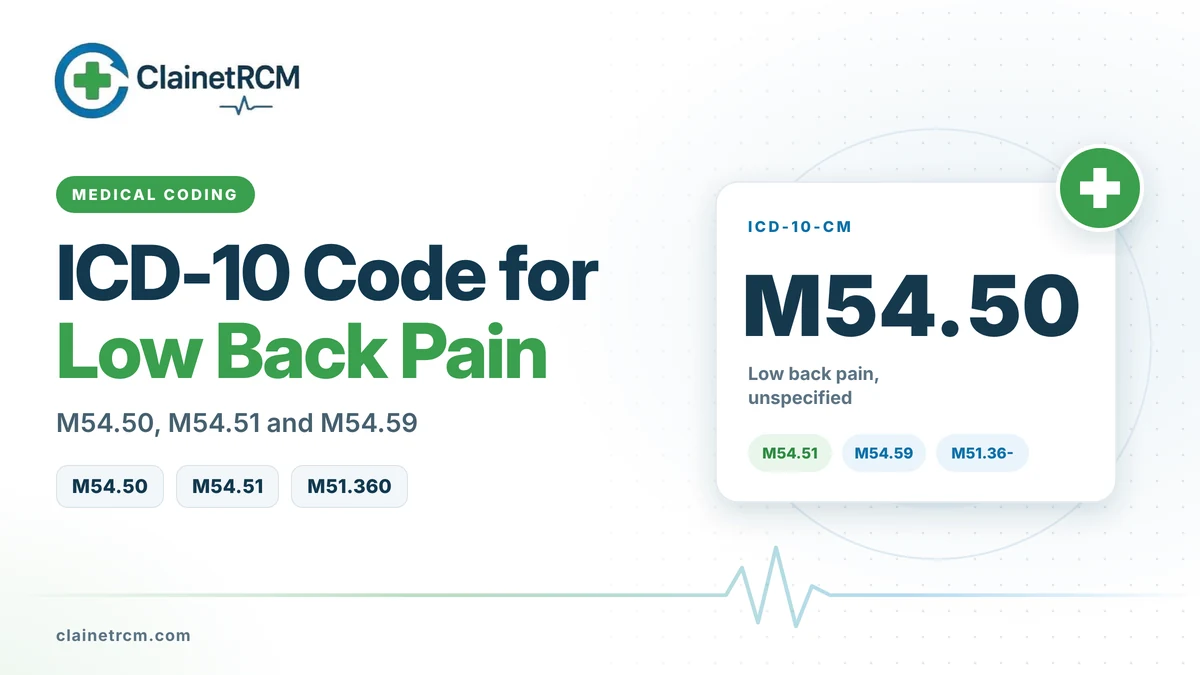
Quick answer: Use M54.50 (low back pain, unspecified) when the provider documents low back pain without more detail. Use M54.51 for vertebrogenic low back pain, which originates from the vertebral endplates, and M54.59 for other specified low back pain. The old code M54.5 is no longer valid. When pain radiates, consider M54.41 or M54.42 (lumbago with sciatica, right or left), M54.16 (lumbar radiculopathy) or M51.16 (lumbar disc disorder with radiculopathy). Lumbar disc degeneration now requires a sixth character, such as M51.360 (discogenic back pain only) or M51.362 (back and leg pain).
ICD-10 Code for Low Back Pain: Main Options
| Code | Description | Use when |
|---|---|---|
| M54.50 | Low back pain, unspecified | Low back pain without further specification |
| M54.51 | Vertebrogenic low back pain | Pain attributed to vertebral endplate pathology, such as Modic changes |
| M54.59 | Other low back pain | Other specified low back pain, such as mechanical low back pain documented as such |
| M54.40 / M54.41 / M54.42 | Lumbago with sciatica, unspecified side / right side / left side | Low back pain with sciatica |
| M54.30 / M54.31 / M54.32 | Sciatica, unspecified side / right / left | Sciatica without low back pain |
| M54.16 / M54.17 | Radiculopathy, lumbar / lumbosacral region | Radicular symptoms not attributed to a disc disorder |
| M51.16 / M51.17 | Intervertebral disc disorder with radiculopathy, lumbar / lumbosacral | Disc-related radiculopathy |
| M48.061 / M48.062 | Spinal stenosis, lumbar region, without / with neurogenic claudication | Lumbar stenosis |
| M47.816 | Spondylosis without myelopathy or radiculopathy, lumbar region | Facet or degenerative arthropathy |
| S39.012A | Strain of muscle, fascia and tendon of lower back, initial encounter | Acute strain from an injury |
The 2021 Change: M54.5 Was Expanded
Since October 1, 2021, M54.5 has been a non-billable category. Claims must use M54.50, M54.51 or M54.59. M54.51 was created largely to support coverage of basivertebral nerve ablation (CPT 64628 and 64629), which treats vertebrogenic pain, so it should be used only when the provider documents a vertebrogenic source, usually with MRI findings.
The 2024 Change: Disc Degeneration Codes
Since October 1, 2024, M51.36 (lumbar) and M51.37 (lumbosacral) require a sixth character that tells payers whether the degeneration is causing pain:
| Sixth character | Meaning | Lumbar code | Lumbosacral code |
|---|---|---|---|
| 0 | Discogenic back pain only | M51.360 | M51.370 |
| 1 | Lower extremity pain only | M51.361 | M51.371 |
| 2 | Discogenic back pain and lower extremity pain | M51.362 | M51.372 |
| 9 | Without mention of back or lower extremity pain | M51.369 | M51.379 |
These codes come with Excludes1 notes. A code ending in 0 (back pain only) is not reported with a low back pain code from M54.5-. A code ending in 1 (leg pain only) is not reported with sciatica codes from M54.3-. A code ending in 2 (both) is not reported with lumbago with sciatica codes from M54.4-. The disc code already describes the pain.
Chronic Pain and Other Secondary Codes
- G89.29 (other chronic pain) or G89.4 (chronic pain syndrome) can be added when the provider documents chronic pain and the encounter is for pain control or management.
- External cause codes describe how an injury happened for strains and trauma.
- Z codes capture relevant history, such as Z98.1 for arthrodesis status after a fusion.
Specificity for PT, Chiropractic and Pain Claims
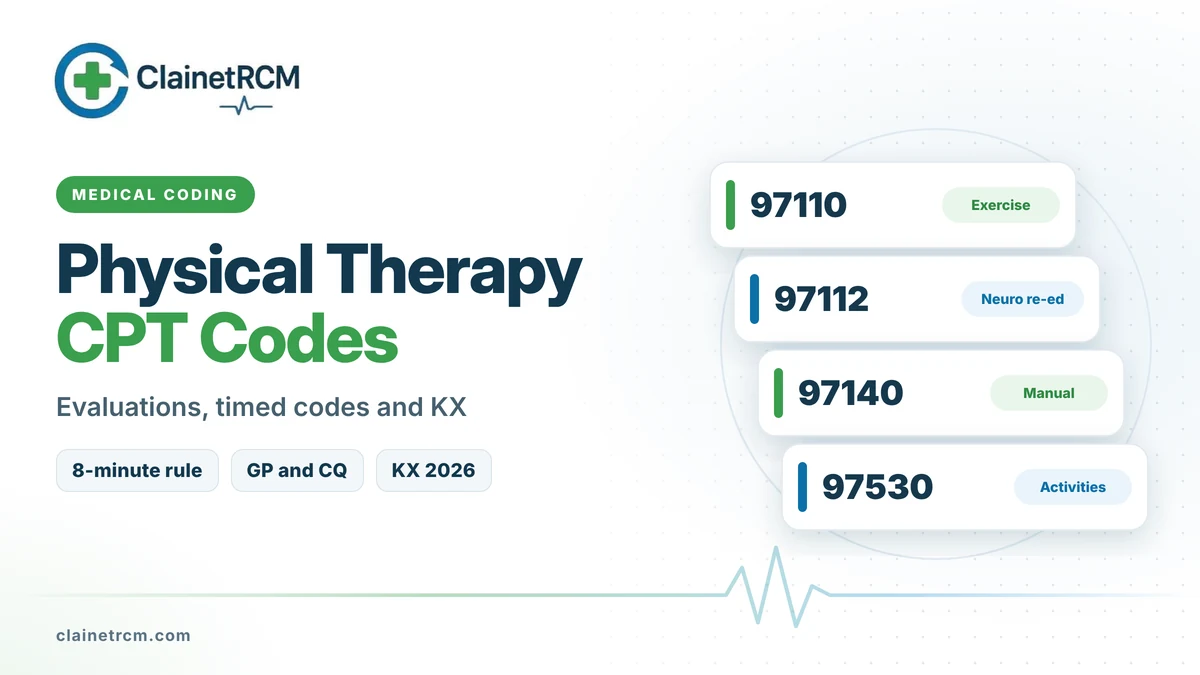
- Physical therapy: Use the condition treated, such as a disc disorder, stenosis or strain, rather than pain alone when it is documented. See our physical therapy CPT codes guide.
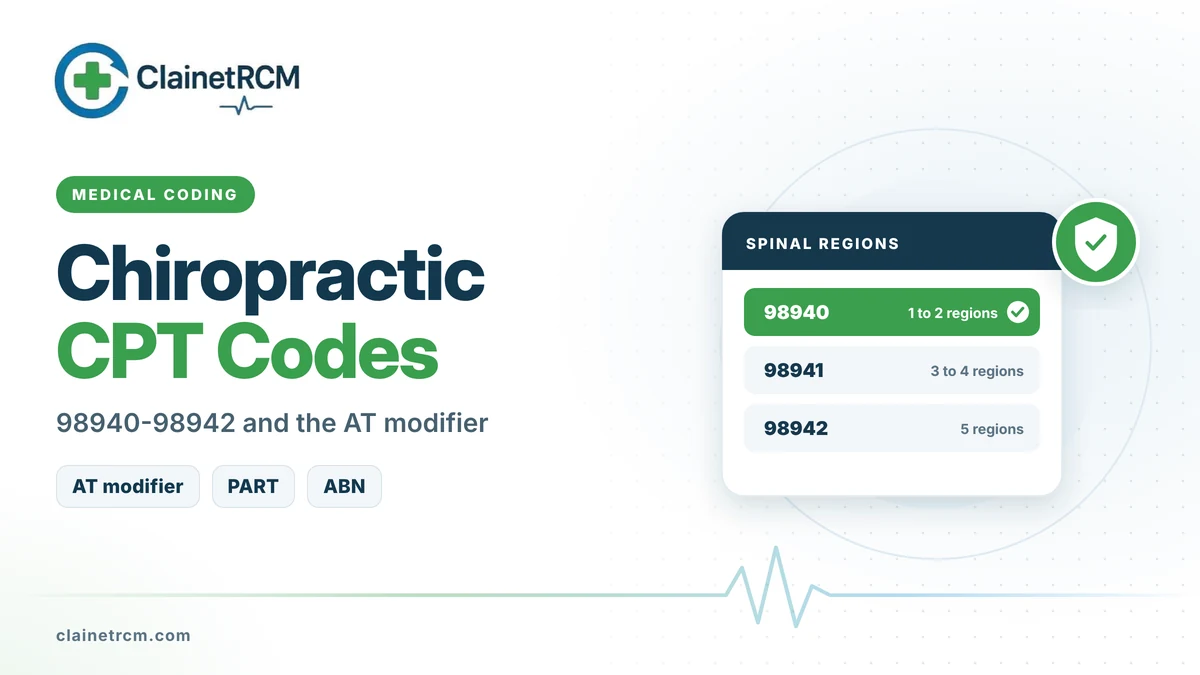
- Chiropractic: Medicare expects the segmental dysfunction code for the treated region, such as M99.03, paired with a supporting diagnosis such as M54.50. See our chiropractic CPT codes guide.
- Pain management: Epidural injections need radicular diagnoses, and facet procedures need axial pain diagnoses consistent with facet origin. See our pain management CPT codes guide.
- Imaging: Many payers deny lumbar MRI for nonspecific low back pain without red flags or failed conservative care.
Documentation Tips
- Location, laterality and radiation of pain
- Cause, such as injury, degeneration or stenosis
- Duration: acute or chronic
- Neurologic findings, such as weakness, reflex changes or a positive straight leg raise
- Imaging findings, when they support a specific diagnosis
- Functional limitations and response to prior treatment
Coding Examples
- “Acute low back pain after lifting, no radiation.” Code M54.50, or S39.012A if the provider documents a strain.
- “Low back pain radiating down the left leg below the knee, sciatica.” Code M54.42.
- “L4-5 disc degeneration with axial back pain and right leg pain.” Code M51.362.
- “Lumbar stenosis with neurogenic claudication.” Code M48.062.
Back Pain Codes Payers Question Most
Payers flag claims that pair nonspecific pain codes with expensive services, such as M54.50 alone on an MRI, an epidural injection or a long course of therapy. They also reject combinations that break Excludes1 rules, such as M54.50 with M51.360. A quick pre-billing check of diagnosis pairs against these rules prevents most of those denials.
Frequently Asked Questions
M54.50 for unspecified low back pain. Use M54.51 for vertebrogenic pain or M54.59 for other specified low back pain.
No. Since October 1, 2021, M54.5 must be reported with a fifth character: M54.50, M54.51 or M54.59.
M54.50 or a more specific code for the cause, plus G89.29 when chronic pain management is the focus.
M54.41, lumbago with sciatica, right side.
Pain originating from the vertebral endplates, often with Modic changes on MRI. It is coded M54.51.
No. Code the definitive diagnosis when the provider documents one, such as a lumbar disc disorder or spinal stenosis, instead of the symptom code. ICD-10-CM guidelines say signs and symptoms that are routinely associated with a confirmed diagnosis should not be coded separately.
Final Thoughts
The right ICD-10 code for low back pain is the most specific one the record supports, and payers increasingly expect that specificity. Our chiropractic billing and coding teams review spine documentation every day, and our guide to generalized weakness ICD-10 coding covers another common symptom code.
Spine Diagnosis Coding Done Right
We review spine documentation and diagnosis codes so PT, chiropractic, pain and orthopedic claims meet payer and LCD requirements.
Get a Coding Review
Written by
ClainetRCM Billing Team
ClainetRCM is a Boston-based revenue cycle management company specializing in medical billing, coding, credentialing and denial management for healthcare providers across all 50 states. Our AAPC and AHIMA certified team works inside your existing EHR, files claims within 24 to 48 hours and reviews every AR bucket on a 14-day cycle.