Physical therapy CPT codes look simple until you add Medicare’s timing rules, therapy modifiers, plan of care requirements and payer edits. Most PT revenue leaks come from the same few places: evaluation levels that do not match documentation, timed units miscounted, and missing GP, CQ or KX modifiers. This guide covers the codes PT practices bill most and the rules that decide whether they pay.
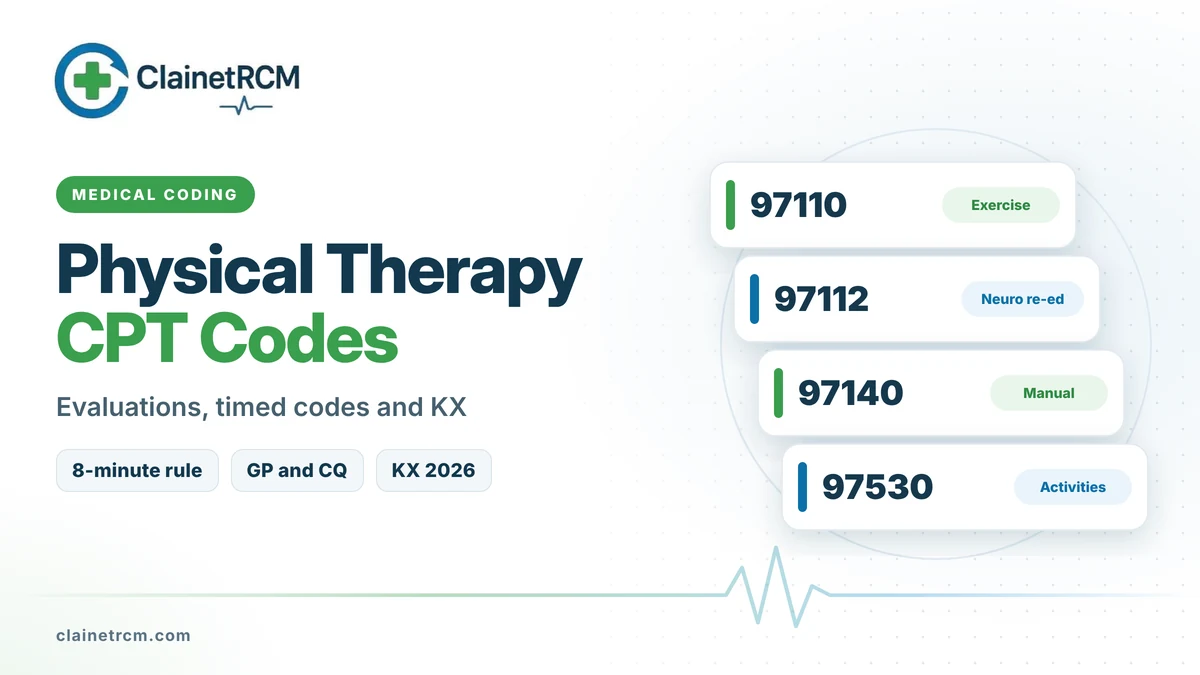
Quick answer: Physical therapy evaluations use 97161 (low complexity), 97162 (moderate), 97163 (high) and 97164 (re-evaluation). The most billed treatment codes are timed, 15-minute codes such as 97110 (therapeutic exercise), 97112 (neuromuscular re-education), 97140 (manual therapy) and 97530 (therapeutic activities). Medicare counts timed units with the 8-minute rule. Every Medicare PT line needs the GP modifier, services furnished in part by a PTA need the CQ modifier (paid at 85%), and claims above the 2026 KX threshold of $2,480 for PT and speech-language pathology combined need the KX modifier.
Physical Therapy CPT Codes for Evaluations
| Code | Description | Typical time | What drives the level |
|---|---|---|---|
| 97161 | PT evaluation, low complexity | 20 minutes | No personal factors or comorbidities affecting the plan, 1 to 2 body structure, function or participation elements, stable presentation |
| 97162 | PT evaluation, moderate complexity | 30 minutes | 1 to 2 personal factors or comorbidities, 3 or more elements, evolving presentation |
| 97163 | PT evaluation, high complexity | 45 minutes | 3 or more personal factors or comorbidities, 4 or more elements, unstable and unpredictable presentation |
| 97164 | PT re-evaluation | 20 minutes | Established plan of care with new findings, a significant change or a lack of expected progress |
Evaluations are untimed, so the typical times are guides rather than requirements. The level is chosen from the history, examination, clinical presentation and clinical decision making. Medicare does not pay for routine re-evaluations; document the change in condition that made 97164 necessary.
Most Billed Timed PT Codes
| Code | Service (each 15 minutes) | When it fits |
|---|---|---|
| 97110 | Therapeutic exercise | Strength, endurance, range of motion and flexibility |
| 97112 | Neuromuscular re-education | Balance, coordination, proprioception and posture |
| 97116 | Gait training | Walking and stair training |
| 97140 | Manual therapy techniques | Mobilization, manipulation, manual traction and soft tissue work |
| 97530 | Therapeutic activities | Dynamic, functional activities such as lifting, transfers and reaching |
| 97535 | Self-care and home management training | ADLs, home safety and adaptive equipment training |
| 97750 | Physical performance test or measurement | Functional capacity and performance testing with a written report |
| 97035 | Ultrasound | Therapeutic ultrasound, when skilled and medically necessary |
Common untimed services include 97012 (mechanical traction), 97016 (vasopneumatic devices) and 97150 (group therapy). Medicare bundles 97010 (hot or cold packs) and uses G0283 instead of 97014 for unattended electrical stimulation.
The 8-Minute Rule
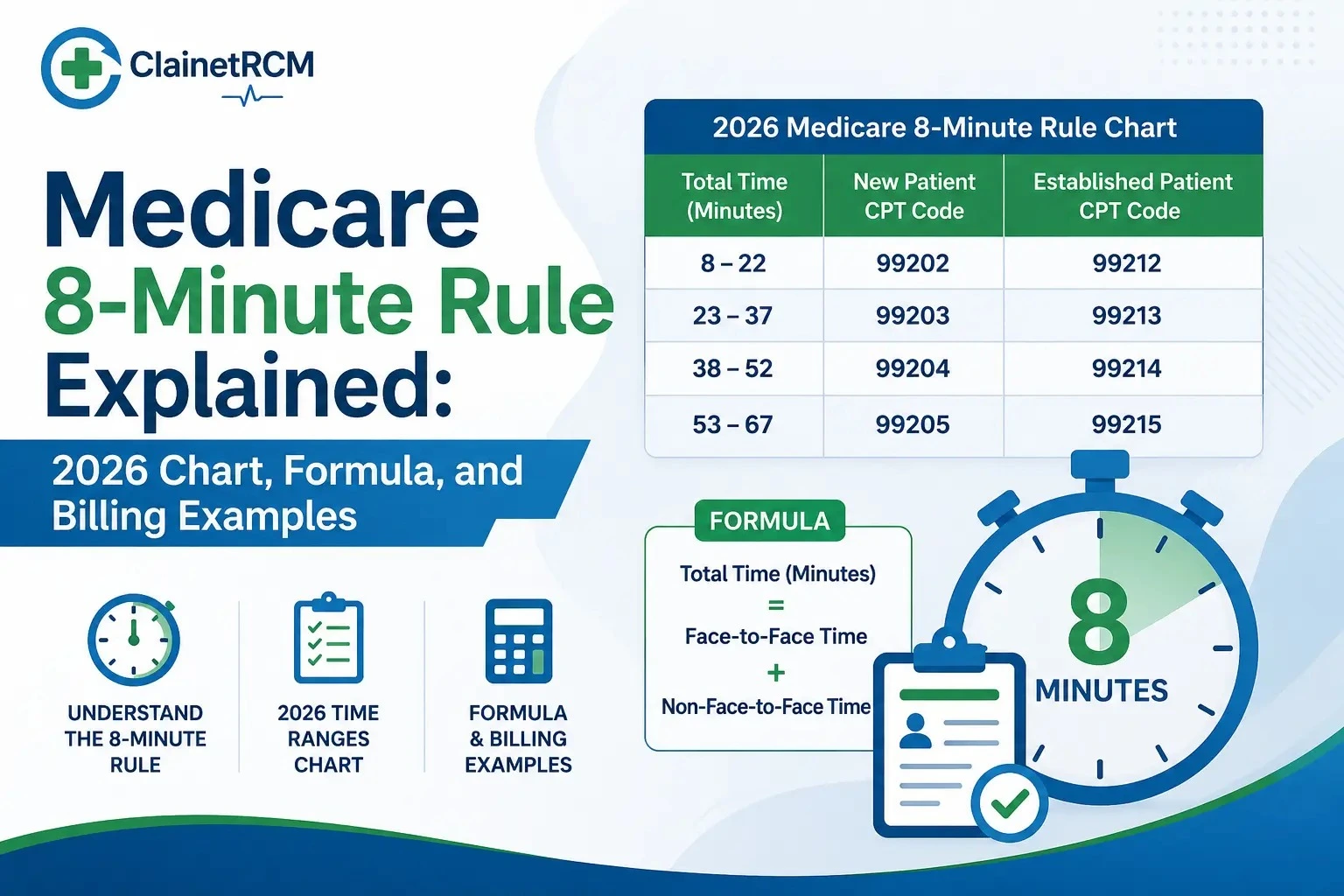
Medicare adds up all timed minutes for the visit and converts them to units: 8 to 22 minutes is one unit, 23 to 37 is two, 38 to 52 is three and 53 to 67 is four. Units are then assigned to the codes with the most minutes. Many commercial payers follow CPT’s per-code midpoint rule instead, which can produce a different result. Our Medicare 8-minute rule guide walks through every scenario.
Example: 23 minutes of 97110, 15 minutes of 97140 and 7 minutes of 97112 total 45 timed minutes, which is three units. Bill 97110 x 2 and 97140 x 1. The 7 minutes of 97112 are documented but not billed separately, because 97110 has more remaining minutes.
Modifiers Every PT Claim Needs
- GP on every service furnished under a physical therapy plan of care, including when the payer is not Medicare but follows Medicare rules.
- CQ when a physical therapist assistant furnishes more than 10% of a service. Medicare pays those services at 85% of the fee schedule.
- KX once the patient’s combined PT and SLP allowed amount passes the annual threshold, attesting that continued care is medically necessary.
- 59 or XU only when an NCCI edit pairs two codes that were truly performed in separate intervals, such as 97530 and 97140. Our modifier 59 guide explains when it applies.
Medicare Rules for PT Practices in 2026
- Plan of care. A physician or NPP must certify the plan of care, generally within 30 days of the evaluation, and recertify at least every 90 days or when the plan changes significantly.
- KX threshold. $2,480 for PT and speech-language pathology combined in 2026, with a separate $2,480 threshold for occupational therapy.
- Targeted medical review. Claims above $3,000 can be selected for review. That threshold stays at $3,000 until 2028.
- Multiple procedure payment reduction. Medicare reduces the practice expense portion of the second and later units of “always therapy” services furnished on the same day.
- PTA supervision. In private practice, PTs can supervise PTAs under general supervision.
- Telehealth. Medicare’s temporary telehealth flexibilities, including those that let therapists bill telehealth, run through December 31, 2027.
ICD-10 Pairing for PT Claims
Use diagnosis codes that describe the condition being treated, not just the symptom. For spine patients, the low back pain and disc degeneration codes changed in recent years; see our guide to the ICD-10 code for low back pain. Add external cause and post-surgical aftercare codes when they apply.
Common PT Denials and Fixes
| Denial | Cause | Fix |
|---|---|---|
| Missing GP | Therapy modifier left off | Add GP to every therapy line |
| Units exceed time | Units billed above documented minutes | Recount with the 8-minute rule |
| KX missing | Threshold passed without KX | Track accrual and append KX when appropriate |
| Plan of care not certified | Signature missing or late | Track certification and recertification dates |
| NCCI bundling | 97530 and 97140 billed together without distinct intervals | Document separate intervals and use 59 or XU only when true |
Frequently Asked Questions
Evaluation codes 97161 to 97164 and timed treatment codes such as 97110, 97112, 97140 and 97530.
Base it on the history, examination, clinical presentation and decision making documented, not on time alone.
$2,480 for physical therapy and speech-language pathology combined, with a separate $2,480 threshold for occupational therapy.
When a PTA furnishes more than 10% of a service billed under Medicare. Those services are paid at 85%.
Yes, when they are performed in separate 15-minute intervals and documented that way. A modifier is required to bypass the NCCI edit.
Final Thoughts
Physical therapy CPT codes pay reliably when evaluations match documentation, timed units follow the right counting rule and every Medicare line carries the right modifiers. Our physical therapy billing team manages PT claims, plans of care and KX tracking. For related coding, see our guides to occupational therapy CPT codes and the Medicare 8-minute rule.
Get Paid for Every Unit of Therapy
We code PT visits by documented minutes, apply GP, CQ and KX correctly and track plans of care so Medicare and commercial claims pay.
Get a Free PT Billing Review
Written by
ClainetRCM Billing Team
ClainetRCM is a Boston-based revenue cycle management company specializing in medical billing, coding, credentialing and denial management for healthcare providers across all 50 states. Our AAPC and AHIMA certified team works inside your existing EHR, files claims within 24 to 48 hours and reviews every AR bucket on a 14-day cycle.