The CO-18 denial code says the payer already has this claim or service on file. Most of the time, that is true, and the fix is to stop resubmitting and follow the first claim. Sometimes the service really was performed twice, or the second claim was meant to correct the first, and the claim needs a modifier or a replacement code instead.
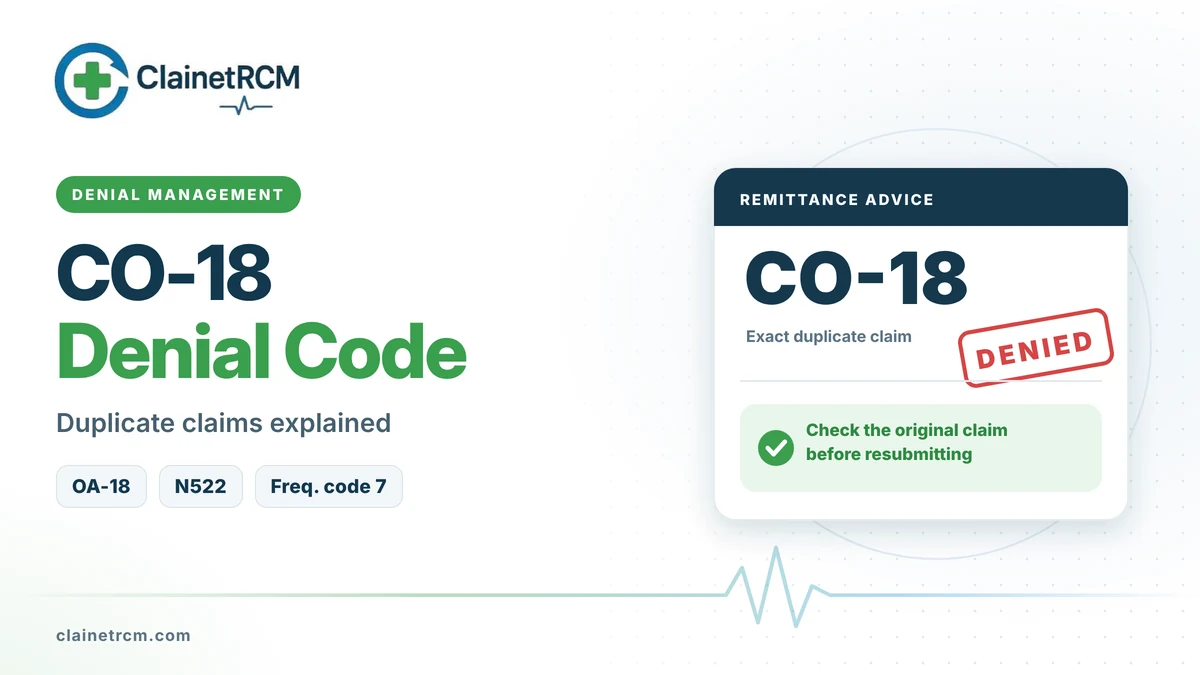
Quick answer: CO-18 is CARC 18, “Exact duplicate claim/service.” X12 says CARC 18 should be used with group code OA (other adjustment) except where state workers’ compensation rules require CO, so many remittances, including Medicare’s, show OA-18. Either way, the patient is not billed. First find the original claim and its status. If it is a true duplicate, do nothing more. If you were correcting a claim, resubmit with frequency code 7. If the service was repeated, add the right modifier, such as 76 or 91.
What the CO-18 Denial Code Means
CARC 18 means the payer matched your claim or line to one it already received for the same patient, date of service, procedure code and provider. It does not judge whether the first claim was paid correctly. It only stops the same item from being processed twice.
CO-18 vs OA-18. The official X12 description of CARC 18 limits it to group code OA, except where state workers’ compensation regulations require CO. In practice, some payers still send CO-18, which is why the term is so widely searched. Treat both the same way.
Medicare often pairs CARC 18 with remark code N522, “Duplicate of a claim processed, or to be processed, as a crossover claim,” which is one of the most common Medicare claim errors.
Why Duplicate Denials Happen
- Resubmitting instead of following up. A claim that has not paid after 30 days is sent again, while the original is still processing.
- Correcting a claim the wrong way. A corrected claim sent as a new original (frequency code 1) instead of a replacement (frequency code 7).
- Crossover claims. Medicare automatically forwards the claim to the supplemental payer, and the practice also sends it directly.
- Repeated services without modifiers. Two identical injections, labs or procedures on the same day without modifier 76, 77, 91 or a distinct procedural modifier.
- Split billing errors. The same service billed by two providers in the same group, or on both a professional and institutional claim when only one is allowed.
How to Fix a CO-18 Denial
- Find the original claim. Search by patient, date of service and code. Check the payer portal for its status.
- If the original paid or is still processing: take no further action on the duplicate. Close it in your system so it is not worked again.
- If the original denied for another reason: fix that reason and send a corrected claim, not a new one.
- If you meant to correct the original: resubmit with frequency code 7 and the original claim number. Use frequency code 8 to void a claim sent in error.
- If the service was truly repeated: send a corrected claim with the right modifier: 76 for a repeat procedure by the same physician, 77 for a repeat procedure by a different physician, 91 for a repeat clinical diagnostic lab test (the repeat lab modifier), or 59 or XE, XS, XP, XU for distinct services.
- For crossover duplicates (N522): confirm the crossover went through and let the secondary payer process it.
How to Prevent Duplicate Denials
- Follow up before resubmitting. Check claim status through the payer portal or a 276/277 inquiry before sending anything again.
- Use frequency codes correctly for every corrected or voided claim.
- Know your crossover payers so staff do not send separate secondary claims when Medicare forwards them automatically.
- Add repeat-service modifiers in charge entry when the same code is billed more than once a day.
- Track duplicate denials as a workflow metric. They cost staff time without bringing in revenue.
CO-18 Denial Examples
Example 1: Resubmitted too soon. A practice sends a claim, sees no payment after three weeks and sends it again. The original was in process and pays a week later. The second claim comes back OA-18. Fix: nothing. Close the duplicate in the system and teach staff to check status before resubmitting.
Example 2: Correction sent as a new claim. A coder fixes a diagnosis code and sends the claim as a new original. The payer sees the same patient, date and procedure and denies it as a duplicate. Fix: resubmit with frequency code 7 and the original claim number so the payer replaces the first claim.
Example 3: Two injections, one code. A patient receives two trigger point sessions at different times on the same day, and both are billed with the same code and no modifier. Fix: if the documentation supports two separate sessions, send a corrected claim with modifier 76 on the second line.
Example 4: Medicare crossover. A Medicare claim is automatically crossed over to the patient’s Medigap plan, and staff also send the claim to the Medigap plan directly. The Medigap plan denies the direct claim as a duplicate. Fix: let the crossover claim process and stop sending direct claims for that plan.
Frequently Asked Questions
It means the payer considers the claim or service an exact duplicate of one it already received.
X12 says CARC 18 should be used with group code OA except where state workers’ compensation rules require CO. Medicare and many payers report it as OA-18, while some still use CO-18.
No. A duplicate denial is not a patient balance. Follow the original claim.
Use frequency code 7 (replacement) with the original claim number, or follow the payer’s corrected claim process. Do not send it as a new claim.
Yes, if it was truly performed twice and documented. Send a corrected claim with modifier 76, 77, 91 or a distinct procedural modifier as appropriate.
Final Thoughts
The CO-18 denial code usually means your team is doing extra work, not losing revenue. Check status before resubmitting, use replacement codes and add repeat modifiers when services are repeated. Our denial management team builds these habits into daily follow-up, and our guide to clearinghouse rejections covers the front-end side of claim submission.
Stop Paying Staff to Chase Duplicate Denials
We track every claim to final status, use the right replacement codes and fix the resubmission habits that create duplicate denials.
Get a Free Denial Review
Written by
ClainetRCM Billing Team
ClainetRCM is a Boston-based revenue cycle management company specializing in medical billing, coding, credentialing and denial management for healthcare providers across all 50 states. Our AAPC and AHIMA certified team works inside your existing EHR, files claims within 24 to 48 hours and reviews every AR bucket on a 14-day cycle.