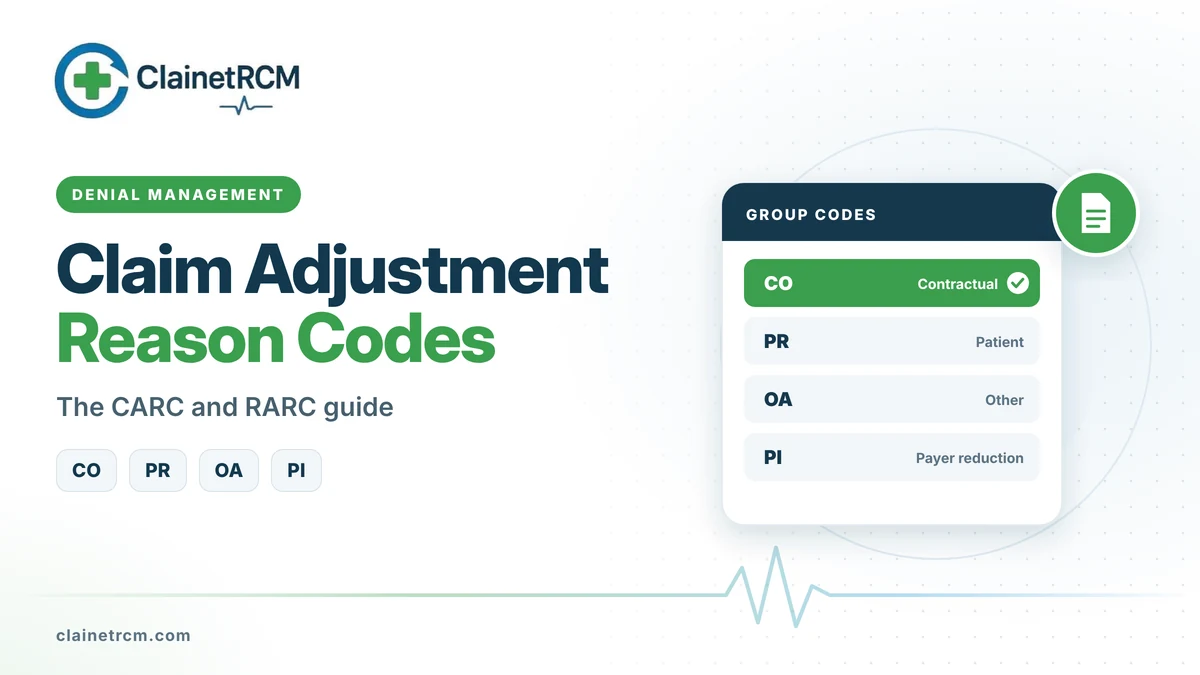
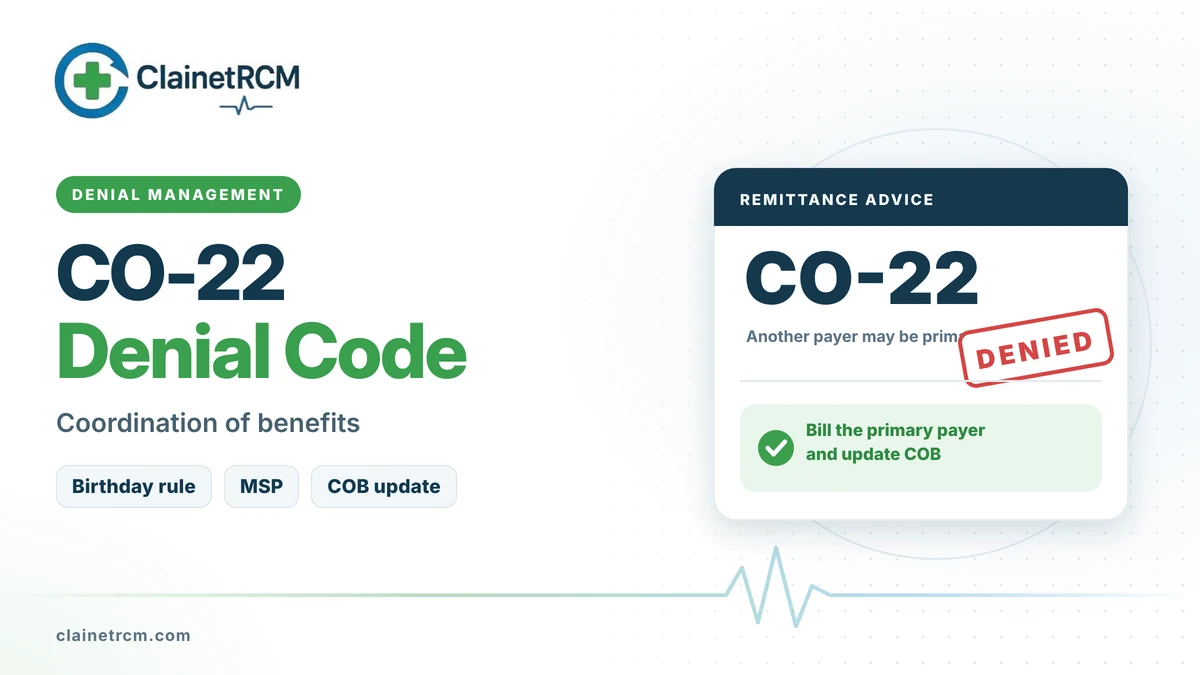
The CO-22 denial code means the payer believes another insurance plan should pay first. The claim is not necessarily wrong. The payer’s records about the patient’s other coverage may be outdated, or the patient may not have told you about a second plan. Either way, the claim will not pay until the coverage order is settled.
Quick answer: CO-22 is CARC 22, “This care may be covered by another payer per coordination of benefits.” The payer thinks it is secondary. Confirm the patient’s coverage, bill the true primary payer first, then send the secondary claim with the primary payer’s payment information. If the payer’s records are wrong, the patient usually has to update coordination of benefits (COB) with the plan before the claim can be reprocessed.
What the CO-22 Denial Code Means
CARC 22 tells you the payer has information showing other coverage that should be primary for this date of service. Common remark codes include:
- MA04: secondary payment cannot be considered without the identity of or payment information from the primary payer
- N479: missing explanation of benefits (coordination of benefits or Medicare Secondary Payer)
Who Pays First: The Main Rules
| Situation | Usually primary |
|---|---|
| Patient has their own employer plan and is a dependent on a spouse’s plan | The patient’s own plan |
| Child covered by both parents’ plans | The plan of the parent whose birthday falls earlier in the calendar year (birthday rule) |
| Medicare patient 65 or older, still working, employer has 20 or more employees | The employer group health plan |
| Medicare patient 65 or older, still working, employer has fewer than 20 employees | Medicare |
| Medicare due to disability, covered by a large group health plan (100 or more employees) | The group health plan |
| Medicare patient with retiree coverage | Medicare |
| Medicare patient with a work injury or auto accident | Workers’ compensation or the liability or no-fault insurer for the related care |
| Medicaid with any other coverage | The other coverage; Medicaid is the payer of last resort |
Medicare’s rules are known as Medicare Secondary Payer (MSP) rules. Dual-eligible patients with Medicare and Medicaid bill Medicare first.
Common Causes of CO-22
- The patient has two active plans and the secondary was billed first
- The payer’s records show old coverage that has since ended
- The patient did not complete the plan’s annual COB questionnaire
- A work-related or accident claim was billed to health insurance before the liability insurer
- A secondary claim was sent without the primary EOB data
How to Fix a CO-22 Denial
- Check eligibility for all plans on the date of service. The payer’s eligibility response often shows the other coverage it has on file.
- Talk to the patient. Ask whether the other coverage is still active and which plan they consider primary.
- If the other plan is primary: bill it first. When it pays, send the secondary claim with the primary payment and adjustment data.
- If the payer’s records are wrong: ask the patient to call the plan and update COB. Many plans will only change their records based on the member’s statement. Then ask the payer to reprocess the claim.
- For Medicare MSP issues: the patient or provider can contact Medicare’s Benefits Coordination and Recovery Center to correct the record.
- Watch the filing limits for both payers while the coverage question is resolved.
How to Prevent CO-22 Denials
- Ask about other coverage at every visit, not just at registration.
- Use an MSP questionnaire for Medicare patients when required.
- Verify all plans before the visit and record the coverage order in the account.
- Send secondary claims electronically with the primary payer’s adjudication data.
- Flag accident and injury visits so liability coverage is checked first.
Our eligibility and benefits verification team confirms coverage order before visits, and our coordination of benefits guide covers secondary billing in depth.
CO-22 Denial Examples
Example 1: Spouse’s plan on file. A patient’s commercial plan denies a visit with CO-22 because its records show coverage through the patient’s spouse. The patient confirms that plan ended last year. Fix: ask the patient to call the plan and update COB, then request reprocessing.
Example 2: Medicare patient still working. A 67-year-old patient covered by a large employer plan is billed to Medicare first. Medicare’s records show the employer plan as primary, so the claim comes back as an MSP denial. Fix: bill the employer plan first, then send Medicare the secondary claim with the primary payment details.
Example 3: Child with two plans. A child is covered by both parents. The father’s birthday is in March and the mother’s is in July. Under the birthday rule, the father’s plan is primary, but the claim went to the mother’s plan first. Fix: bill the father’s plan, then the mother’s.
Example 4: Car accident. A patient injured in a car accident is billed to their health plan, which denies the claim pending information about the auto insurer. Fix: get the auto claim details, bill the no-fault or liability carrier as required by state law and send the health plan the outcome.
Frequently Asked Questions
It means the payer believes another plan should pay first under coordination of benefits rules.
Not for the adjustment itself. Bill the correct primary payer. If the patient refuses to update COB with their plan, your financial policy may allow you to bill them, so check your contract and state rules.
Usually the patient, by contacting their health plan. Some plans accept updates from providers, but most rely on the member.
For a child covered by both parents’ plans, the plan of the parent whose birthday comes first in the calendar year is primary. The year of birth does not matter.
Medicare is secondary for beneficiaries 65 or older who are covered through current employment by an employer group health plan with 20 or more employees, for disabled beneficiaries covered by a large group health plan, and for care related to workers’ compensation, no-fault or liability claims, among other situations.
Final Thoughts
The CO-22 denial code is solved by knowing who pays first and getting the plan’s records to match. Ask about coverage every visit, verify all plans and send secondary claims with complete primary data. Our denial management team clears COB backlogs quickly.
Bill the Right Payer First, Every Time
Our eligibility team confirms coverage order before every visit, and our denial team clears CO-22 claims with the right primary payer data.
Talk to a Billing Expert
Written by
ClainetRCM Billing Team
ClainetRCM is a Boston-based revenue cycle management company specializing in medical billing, coding, credentialing and denial management for healthcare providers across all 50 states. Our AAPC and AHIMA certified team works inside your existing EHR, files claims within 24 to 48 hours and reviews every AR bucket on a 14-day cycle.