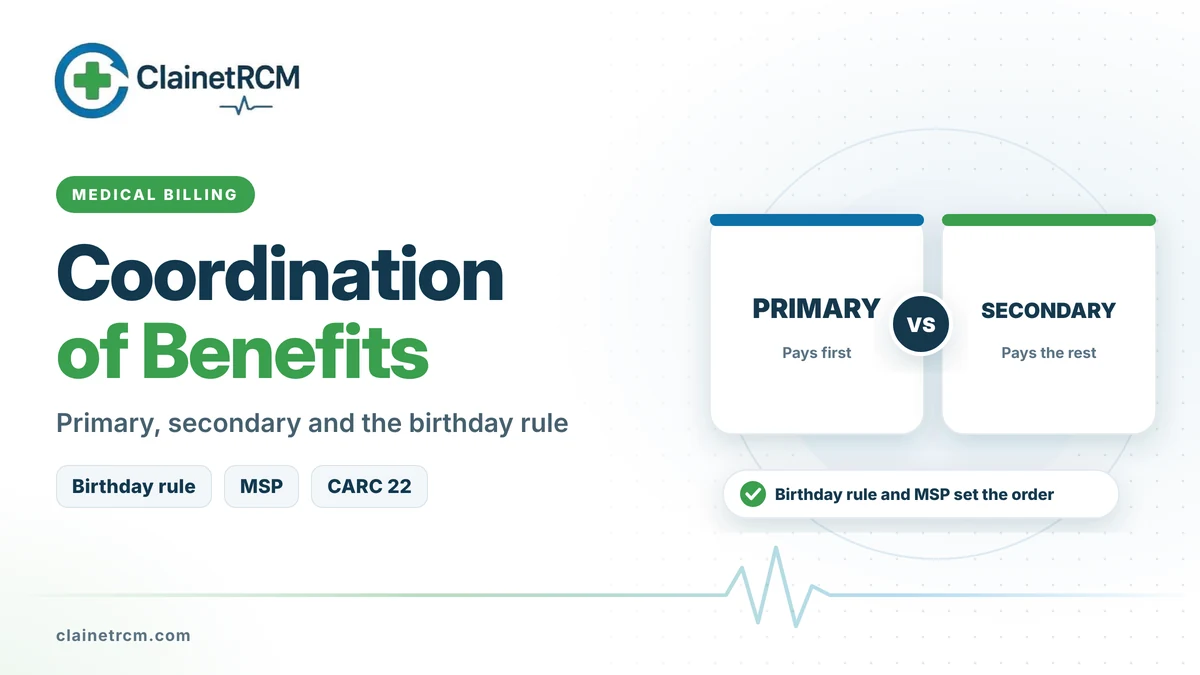
Coordination of benefits (COB) is how insurers decide who pays first when a patient has more than one plan. When the order is wrong, the claim denies, often with CARC 22, and both payers wait for each other while the claim ages toward its filing deadline. Getting COB right at check-in is one of the fastest ways to cut denials.
Quick answer: The primary payer pays first, and the secondary payer considers what is left. A plan covering the patient as an employee pays before a plan covering them as a dependent. For children of married parents, the birthday rule makes the plan of the parent whose birthday falls earlier in the calendar year primary. Medicare Secondary Payer rules make an employer group plan primary for people 65 and older if the employer has 20 employees or more, and for disabled beneficiaries if the employer has 100 employees or more. Medicaid is the payer of last resort. Bill the secondary claim with the primary payer’s payment data.
Standard Coordination of Benefits Rules
Most commercial plans follow the NAIC model COB rules, applied in this order:
| Rule | Who is primary |
|---|---|
| Non-dependent vs dependent | The plan covering the patient as an employee, member or retiree pays before the plan covering them as a dependent |
| Dependent children of married or cohabiting parents | The plan of the parent whose birthday (month and day) comes first in the year |
| Dependent children of divorced or separated parents | A court decree that assigns responsibility; if none, the custodial parent’s plan, then the custodial parent’s spouse, then the non-custodial parent, then that parent’s spouse |
| Active vs retired or laid-off coverage | The plan covering the person as an active employee |
| COBRA or state continuation coverage | The plan covering the person as an employee or dependent pays before continuation coverage |
| Longer vs shorter coverage | If no other rule decides, the plan that has covered the person longer |
The birthday rule uses only the month and day, not the year. If both parents share a birthday, the plan that has covered the parent longer is primary.
Medicare Secondary Payer Rules
| Situation | Primary payer |
|---|---|
| Age 65 or older with group coverage through own or spouse’s current employment, employer with 20 or more employees | Group health plan |
| Age 65 or older, employer with fewer than 20 employees | Medicare |
| Disability with group coverage through own or family member’s current employment, employer with 100 or more employees | Group health plan |
| End-stage renal disease with group health coverage | Group health plan for the first 30 months of Medicare eligibility (the 30-month coordination period), then Medicare |
| Workers’ compensation, no-fault or liability insurance | That insurance, for services related to the injury or illness |
| Retiree coverage | Medicare |
| COBRA coverage | Generally Medicare, except during the ESRD coordination period |
Hospitals must ask Medicare Secondary Payer questions at registration, and every practice benefits from doing the same. When a Medicare patient says they are still working or are covered by a working spouse, confirm the employer’s size.
Medicaid, TRICARE and Other Government Coverage
- Medicaid is the payer of last resort. Bill every other source first, including Medicare and commercial plans.
- TRICARE pays after other health insurance, except Medicaid and TRICARE supplements.
- TRICARE For Life is secondary to Medicare for beneficiaries who have both.
- VA coverage does not coordinate with Medicare. A service is paid by one or the other, not both.
How to Bill a Secondary Claim
- Bill the primary payer first and wait for its remittance.
- Post the primary payment and adjustments exactly as the remittance shows them.
- Send the secondary claim with COB data. Electronic claims carry the primary payer’s paid amounts and adjustment codes in the 837; paper claims need the primary EOB attached.
- Watch the secondary filing window. Many payers count it from the primary payer’s remittance date, often 60 to 180 days. Medicare’s 12-month limit from the date of service still applies when Medicare is secondary.
- Use crossover when available. Medicare automatically forwards many claims to Medigap and some secondary plans, so check the remittance for a crossover message before you send a duplicate.
COB Denials and How to Fix Them
| Denial | Meaning | Fix |
|---|---|---|
| CARC 22 | Care may be covered by another payer per coordination of benefits | Confirm the correct primary payer, bill it, then resubmit with COB data. See our CO-22 denial code guide |
| CARC 23 | Payment adjusted because of a prior payer’s adjudication | Normal secondary processing; review against the primary EOB |
| Patient’s COB on file is outdated | The payer needs the patient to update other-insurance information | Ask the patient to call the plan, then resubmit |
| Missing primary EOB | Secondary claim sent without primary data | Resubmit with complete COB information |
Best Practices at Check-In
- Ask every patient, at every visit, whether they have any other coverage.
- Scan both sides of every insurance card.
- Record the subscriber’s name, date of birth and employer for each plan.
- Ask Medicare patients the Medicare Secondary Payer questions.
- Verify eligibility for both plans before the visit. Our insurance verification checklist covers what to confirm.
Frequently Asked Questions
The process insurers use to determine which plan pays first and how much each pays when a patient has more than one plan.
For a child covered by both parents’ plans, the plan of the parent whose birthday falls earlier in the calendar year is primary. The parents’ ages do not matter.
When a patient 65 or older has group coverage through current employment at an employer with 20 or more employees, when a disabled patient has coverage through an employer with 100 or more employees, during the ESRD coordination period, and for injuries covered by workers’ compensation, liability or no-fault insurance.
Rarely. Medicaid is the payer of last resort and pays after all other coverage.
The claim usually denies for coordination of benefits, and the delay can push the claim past the correct payer’s filing deadline.
Final Thoughts
Coordination of benefits errors are almost always front-end errors. Ask about other coverage at every visit, apply the rules above, and send secondary claims with complete primary payment data. Our benefits verification team confirms primary and secondary coverage before each appointment, and our guide to the medical claims process shows where COB fits in the billing cycle.
Stop Losing Money to COB Denials
Our benefits verification team confirms primary and secondary coverage before each visit, and our billers file secondary claims with complete payment data.
Fix My COB Process
Written by
ClainetRCM Billing Team
ClainetRCM is a Boston-based revenue cycle management company specializing in medical billing, coding, credentialing and denial management for healthcare providers across all 50 states. Our AAPC and AHIMA certified team works inside your existing EHR, files claims within 24 to 48 hours and reviews every AR bucket on a 14-day cycle.