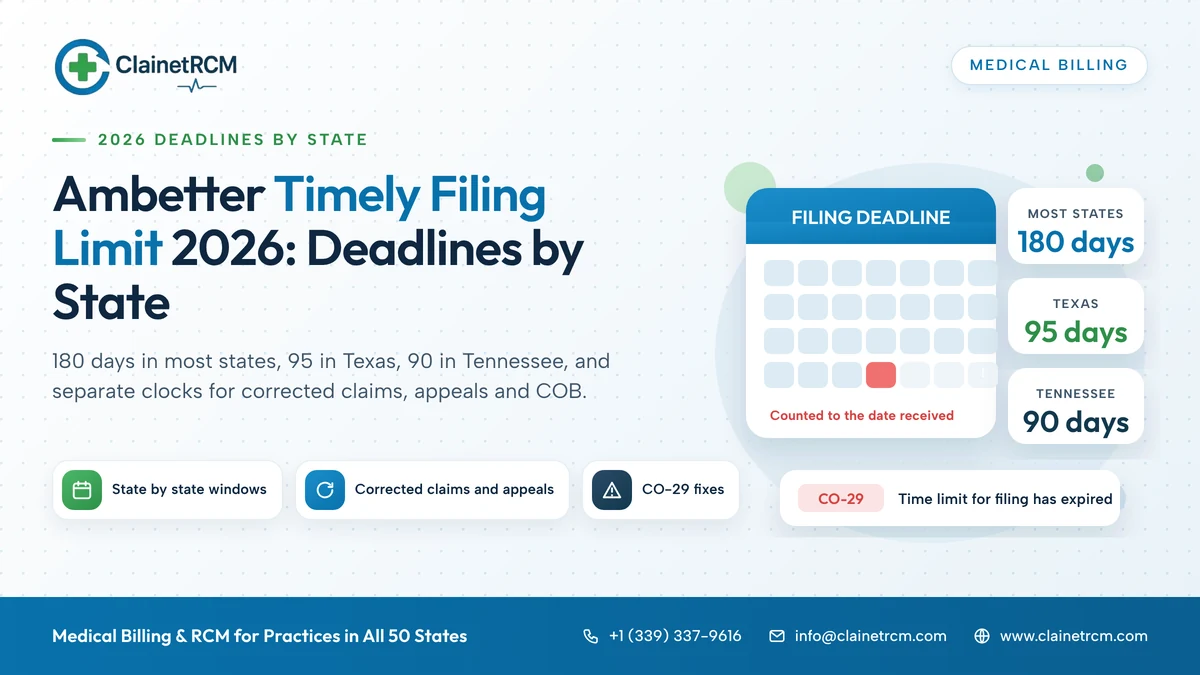
The Ambetter timely filing limit is 180 calendar days from the date of service in most state plans. That number is not universal. Texas allows 95 days, Tennessee allows 90, and Ambetter from Fidelis Care in New York also lists 90. Appeals, corrected claims and secondary claims run on separate clocks that start from different dates.
If you only remember one thing from this guide, make it this: the number you need depends on the state plan printed on the patient’s ID card, and on whether you are participating with that plan.
Ambetter Timely Filing at a Glance
| Submission type | Most common window | Clock starts on |
|---|---|---|
| Initial claim (participating) | 180 days | Date of service (discharge date for inpatient and observation) |
| Initial claim (non-participating) | 90 days in many plans | Date of service |
| Reconsideration or claim dispute | 90 to 180 days, varies by plan | Date on the original EOP |
| Secondary claim (COB) | 90 to 180 days, varies by plan | Date on the primary payer’s EOP |
All figures are calendar days unless a plan says otherwise.
What Is a Timely Filing Limit?
A timely filing limit is the deadline a payer sets for receiving your claim. Miss it and the payer denies the claim for expired filing time, usually with adjustment code CO-29. Most contracts treat that balance as a write-off, so you cannot send it to the patient.
Every payer sets its own limit, and your participation agreement can override a published number. That is why a quick Google answer can cost a practice real money.
Why the Ambetter Filing Deadline Changes by State
Ambetter is Centene’s Health Insurance Marketplace product. It is a commercial plan sold under the Affordable Care Act, not Medicaid and not Medicare Advantage. Centene runs it through a different company in each state, such as Superior HealthPlan in Texas, Sunshine Health in Florida, Peach State Health Plan in Georgia and Home State Health in Missouri.
Each state plan publishes its own claims guide. Two plans can both say “Ambetter” on the card and still give you very different deadlines. Billers who search by the Ambetter name alone often land on another state’s rule and file late without knowing it.
Ambetter Timely Filing Limit by State
I pulled these figures directly from the current state claims, disputes and recovery guides on AmbetterHealth.com. Each guide carries its own “last updated” date, so recheck it when a new plan year begins.
| State plan | Initial claim (par / non-par) | Reconsideration or dispute (par / non-par) | COB from primary EOP (par / non-par) |
|---|---|---|---|
| Texas (Superior HealthPlan) | 95 / 95 | 120 / 120 | 95 / 95 |
| Tennessee | 90 / 90 | 180 / 90 | 90 / 90 |
| Florida (Sunshine Health) | 180 / 180 | 90 / 90 | 90 / 90 |
| Georgia (Peach State) | 180 / 90 | 180 / 90 | 180 / 90 |
| Missouri (Home State Health) | 180 / 365 | 180 / 180 | 180 / 365 |
A few other plans worth knowing about:
- South Carolina (Absolute Total Care): For claims received on or after July 1, 2024, the plan allows 180 calendar days from the date of service. It used to be 120 business days. Older cheat sheets still show the old number.
- New York (Ambetter from Fidelis Care): Fidelis lists 90 days for initial claims and 60 days from the remittance advice for corrected claims. It also uses a different payer ID than the rest of Ambetter, so confirm it before you send.
- Arizona (Arizona Complete Health): The published quick reference guide lists 120 days. Check the provider manual for dispute and COB windows, since the guide does not spell them out.
For any state not listed here, open that plan’s Provider Resources page, find the Claims, Disputes and Recovery guide, and read the Timely Filing box. If two documents disagree, follow the one with the newer date and keep a copy.
Do Out-of-Network Providers Get 365 Days?
Not usually. This is one of the most repeated mistakes in billing blogs. Missouri is the one plan in the table above that gives non-participating providers 365 days for initial claims. Georgia and Tennessee give non-participating providers 90 days, Texas gives 95, and Florida gives 180.
Treat any “out-of-network gets a year” claim as wrong until your state’s own guide says otherwise.
Your enrollment date matters here too. A provider who sees Ambetter members before the participation effective date bills as non-participating, and in a state like Georgia that cuts the initial window from 180 days to 90. Clean insurance credentialing with a confirmed effective date in writing protects you from that surprise.
How Ambetter Counts the Filing Clock
Ambetter measures the deadline to the date it receives your claim, not the date you finish the charge or drop it in the mail. For inpatient and observation stays, the clock starts at discharge.
Three habits follow from that:
- Send electronically. Mail time comes out of your window. A paper claim mailed on day 90 of a 95-day plan can arrive late.
- Treat acknowledgments differently. A 999 only tells you the file’s structure passed. A 277CA that accepts the claim shows it entered Ambetter’s system, and that is the report you want in your records.
- Use the right payer ID. Electronic claims go to payer ID 68069 through Availity or your clearinghouse. Paper claims go to P.O. Box 5010, Farmington, MO 63640-5010 in the guides above. Ambetter does not accept handwritten, faxed or photocopied claim forms.
A Worked Example
Say you see a patient on Thursday, October 1, 2026. Count calendar days forward, with the day after the visit as day one:
| Window | Last day for Ambetter to receive the claim |
|---|---|
| 90 days (Tennessee) | Wednesday, December 30, 2026 |
| 95 days (Texas) | Monday, January 4, 2027 |
| 180 days (most plans) | Tuesday, March 30, 2027 |
I did not find any Ambetter document that promises a weekend or holiday extension, so plan to land the claim well before these dates. A 30-day internal cutoff gives you room to fix one rejection and resend.
Rejected Claims Do Not Stop the Clock
This is where most Ambetter timely filing losses begin. A rejected claim never entered adjudication. Ambetter has no record of receiving it, no claim number exists, and the filing clock keeps running.
Picture a batch of 40 claims where six reject for a missing taxonomy code. Nobody opens the report, and those six sit as “submitted” for eleven weeks. On a Texas plan, that is 77 of your 95 days gone. Working clearinghouse rejections every single day is the cheapest timely filing protection you can buy.
Fix a rejected claim and resend it as a new original claim with the same date of service. A denied claim is different. It needs a corrected claim or a reconsideration, and both of those run on the EOP clock, not the date of service.
Starting with a clean claim also cuts the number of rejections that eat into your window in the first place.
Corrected Claim Timely Filing
A corrected claim replaces a claim Ambetter already processed, so it cannot exist until you have an EOP. The deadline therefore runs from the EOP date, not the date of service. In most plans it matches the reconsideration window. In New York, Fidelis Care sets 60 days from the remittance advice.
Corrections fail at the front door more often than people expect. Use these basics:
- Electronic 837P or 837I: Put frequency code 7 in CLM05-3 to replace a claim, or 8 to void it. Add the original Ambetter claim number in a REF segment with qualifier F8.
- Paper CMS-1500: Enter the resubmission code and original claim number in box 22.
- Paper UB-04: Use a type of bill ending in 7 or 8 and the original claim number in form locator 64.
Frequency code 6 is not the Ambetter replacement code, so do not copy it from a random clearinghouse help page. And keep corrections out of the dispute mailbox. A correction sitting in the wrong queue is a correction that is aging.
Appeal, Reconsideration and Claim Dispute Deadlines
Ambetter’s guides describe the claim payment dispute process as the route for denials, including untimely filing denials. The request must reach Ambetter in writing within the plan’s window, counted from the date on the EOP.
Look at how much those windows move from state to state:
- Georgia and Missouri: 180 days for participating providers.
- Tennessee: 180 days for participating providers, 90 for non-participating.
- Texas: 120 days.
- Florida: 90 days.
Florida also separates its levels. A Level II dispute is due within 90 days of the Level I denial. File each level inside its own window, with the supporting documents attached, through the secure provider portal or by mail to the dispute address in your state’s guide. A late appeal is usually upheld as denied.
Secondary Claims and Coordination of Benefits
When Ambetter is the secondary payer, the clock does not start on the date of service. It starts on the date of the primary payer’s EOP, and Ambetter measures to the date it receives your claim. Florida’s guide says this in so many words: 90 days from the primary payer’s EOP date to the date received.
Your delay at the primary payer does not shrink Ambetter’s window, but a primary EOB that sits in a mail pile for six weeks absolutely does. Work every primary EOB the day it arrives, send it along with the secondary claim, and confirm payer order at check-in so you are not billing Ambetter first by mistake.
Grace Period Claims and the Filing Clock
Marketplace members who receive advance premium tax credits get a three-month grace period when they stop paying premiums. Under federal rules, the plan must pay appropriate claims in the first month and may pend claims in months two and three. If the member never catches up, coverage ends and those pended claims can deny.
The grace period does not pause your filing limit. Submit on schedule, track pended claims until they pay or deny, and verify premium status before nonemergency visits. Strong benefits verification on the actual date of service catches most of these cases before the patient leaves the front desk.
What Happens After a Timely Filing Denial
Ambetter denies late claims with CO-29. The CO group code marks the balance as a contractual obligation, so under most participation agreements you cannot bill the patient. Check your contract before you move any CO-29 balance.
You can still fight the denial if you can prove Ambetter received the claim on time. Build one clear argument per dispute: either Ambetter received it in time, or a different clock applied, such as COB or a corrected claim. Stacking three theories in one letter tells the reviewer you are not sure which one holds.
What Counts as Proof of Timely Filing
Lead with the evidence that proves receipt, not the evidence that proves you sent something.
| Evidence | What it proves |
|---|---|
| Ambetter claim number with a received date | Ambetter received and accepted the claim |
| 277CA acknowledgment accepting the claim | The claim entered adjudication |
| Secure portal submission record | Online receipt by the plan |
| Certified mail receipt plus a copy of the claim | Paper delivery |
| Clearinghouse transmission report | The file left your system |
| 999 acknowledgment | File structure only, not claim acceptance |
Late filing exceptions are narrow. Plans have recognized things like a catastrophic event that destroys records or errors made by the payer itself. Staff turnover and billing backlogs do not qualify. If you have a pile of CO-29s and are not sure which ones are recoverable, a structured denial management review starts with the claim history before anyone drafts a letter.
How to Keep Ambetter Claims Inside the Window
Most timely filing write-offs start inside the practice, not at the payer. These habits close the gap:
- Bill within 48 hours of the visit. On a 95-day plan, three weeks of waiting has already spent a fifth of your window.
- Confirm acceptance, not just transmission. Find the Ambetter claim number for each claim.
- Work rejections daily in their own queue, never on a monthly review.
- Sort aging by days left. A small Texas claim at day 80 needs attention before a large Florida claim at day 30.
- Keep a payer deadline sheet with each state plan’s initial, reconsideration and COB windows plus the version date of the guide you took them from.
- Assign an owner to claims that go quiet. Dedicated accounts receivable follow-up is how a claim at day 70 gets worked instead of forgotten.
For a wider look at stopping avoidable denials before they start, see our guide to claim denials prevention.
Stop Losing Ambetter Claims to Timely Filing
Different states, different clocks, and one missed deadline can turn a paid claim into a write-off. Clainet RCM tracks every payer window for you, from first submission to final payment.
Talk to a Billing ExpertAmbetter Timely Filing FAQs
It is 180 calendar days from the date of service for participating providers in most state plans. Texas allows 95 days and Tennessee allows 90. Check the plan printed on the patient’s ID card for the exact window.
Ambetter from Superior HealthPlan allows 95 calendar days from the date of service for initial claims, for both participating and non-participating providers. Reconsiderations get 120 days from the EOP.
Calendar days in the current claims guides. South Carolina’s plan counted business days until July 1, 2024 and now uses 180 calendar days, which is why older reference sheets can mislead you.
It runs from the date on the original EOP. In most plans it matches the reconsideration window, and in New York, Fidelis Care allows 60 days from the remittance advice.
It depends on the state. Participating providers get 180 days in Georgia and Missouri, 120 in Texas and 90 in Florida, counted from the EOP.
Only in some plans. Missouri gives non-participating providers 365 days for initial claims, while Georgia and Tennessee give 90 and Texas gives 95.
CO-29 means the time limit for filing has expired. The CO group code makes the balance a contractual write-off in most agreements, but you can dispute it with proof that Ambetter received the claim on time.
No. Keep submitting on schedule, and track any pended claims until Ambetter pays or denies them.
Go to AmbetterHealth.com, choose your state, open Provider Resources, and read the Claims, Disputes and Recovery guide. Your participation agreement can set a different window, so read it too.
The Bottom Line
The Ambetter timely filing limit is a state-by-state question, and a single number will eventually cost your practice money. Know the plan, know whether you are participating, know which clock you are on, and prove receipt for every claim. If your team would rather not carry that tracking alone, our medical billing services are built around exactly these payer rules.

Written by
ClainetRCM Billing Team
ClainetRCM is a Boston-based revenue cycle management company specializing in medical billing, coding, credentialing and denial management for healthcare providers across all 50 states. Our AAPC and AHIMA certified team works inside your existing EHR, files claims within 24 to 48 hours and reviews every AR bucket on a 14-day cycle.