Timely filing limits are the deadlines payers set for receiving a claim after the date of service. Miss one and the claim usually denies with CARC 29 (CO-29), and in most cases the patient cannot be billed for it. Because every payer, plan type and contract sets its own window, the safest practice keeps one reference chart and submits claims long before any deadline arrives.
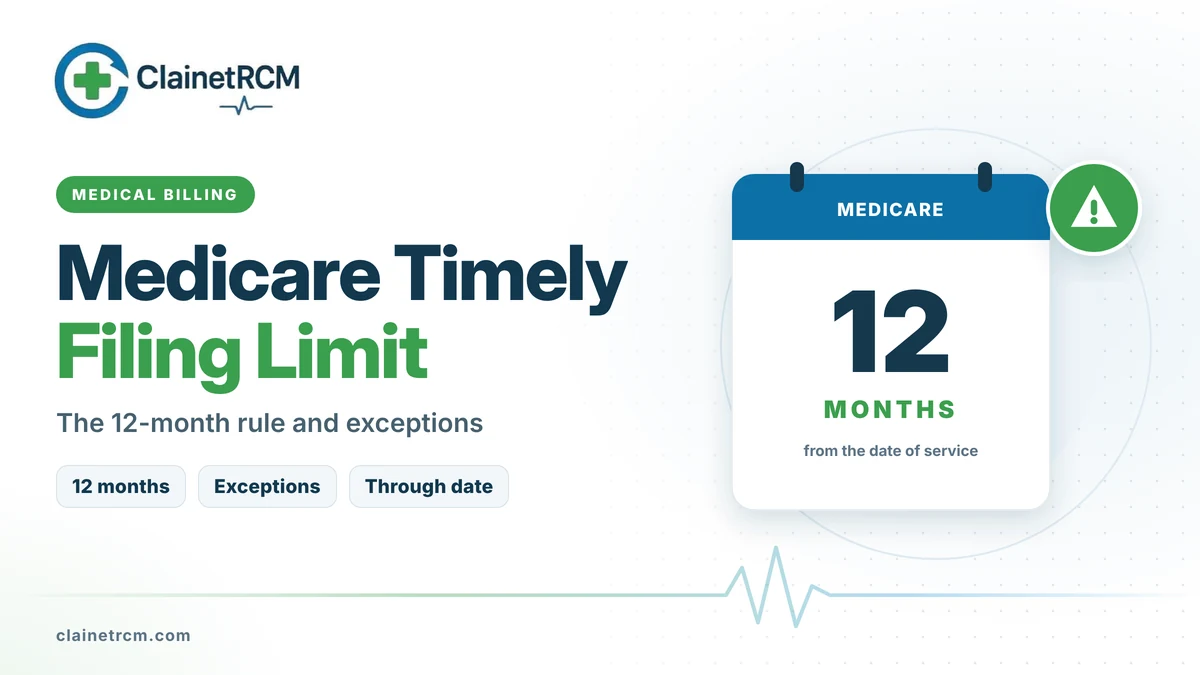
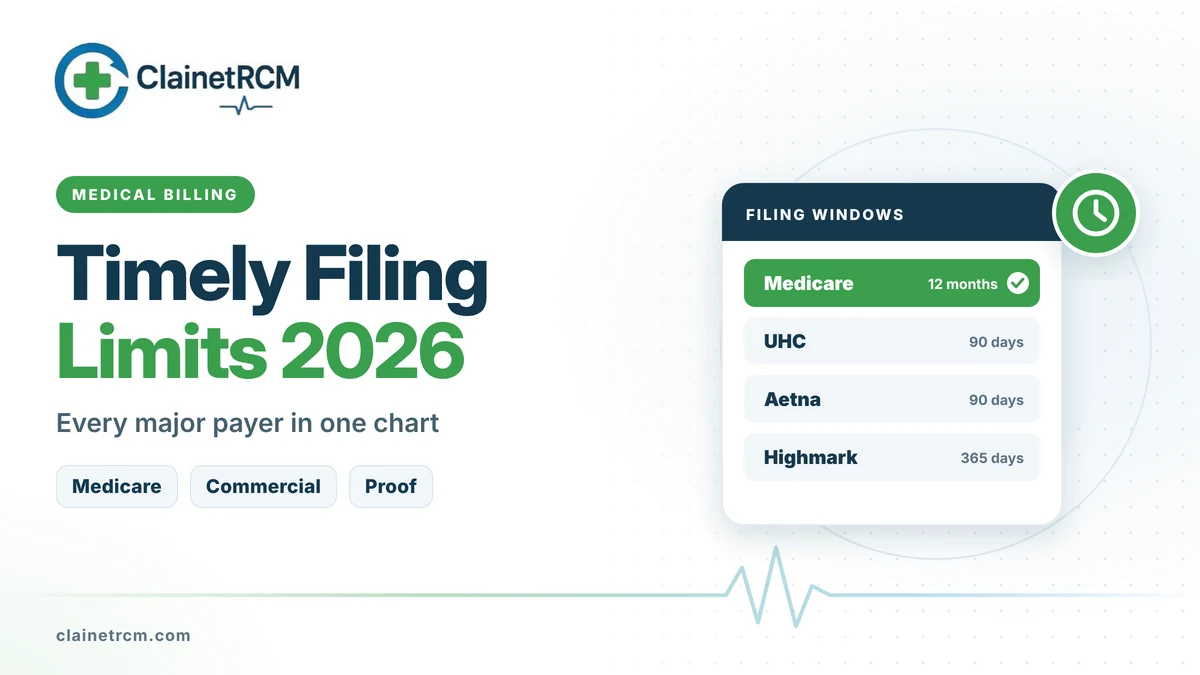
Quick answer: Original Medicare allows 12 months from the date of service. Federal rules cap Medicaid at 12 months, but many states set shorter limits, such as 95 days in Texas and 90 days in New York. Commercial payers commonly allow 90 to 180 days for participating providers: UnitedHealthcare and Cigna use 90 days in-network, many Anthem plans use 90 days, and other Blue plans range from 180 to 365 days. TRICARE allows one year. Your provider agreement always controls, so confirm each payer’s limit in writing.
Timely Filing Limits for All Insurance Companies: 2026 Chart
| Payer | Initial claim limit (typical) | Notes |
|---|---|---|
| Original Medicare | 12 months from the date of service | Narrow exceptions; see our Medicare timely filing guide |
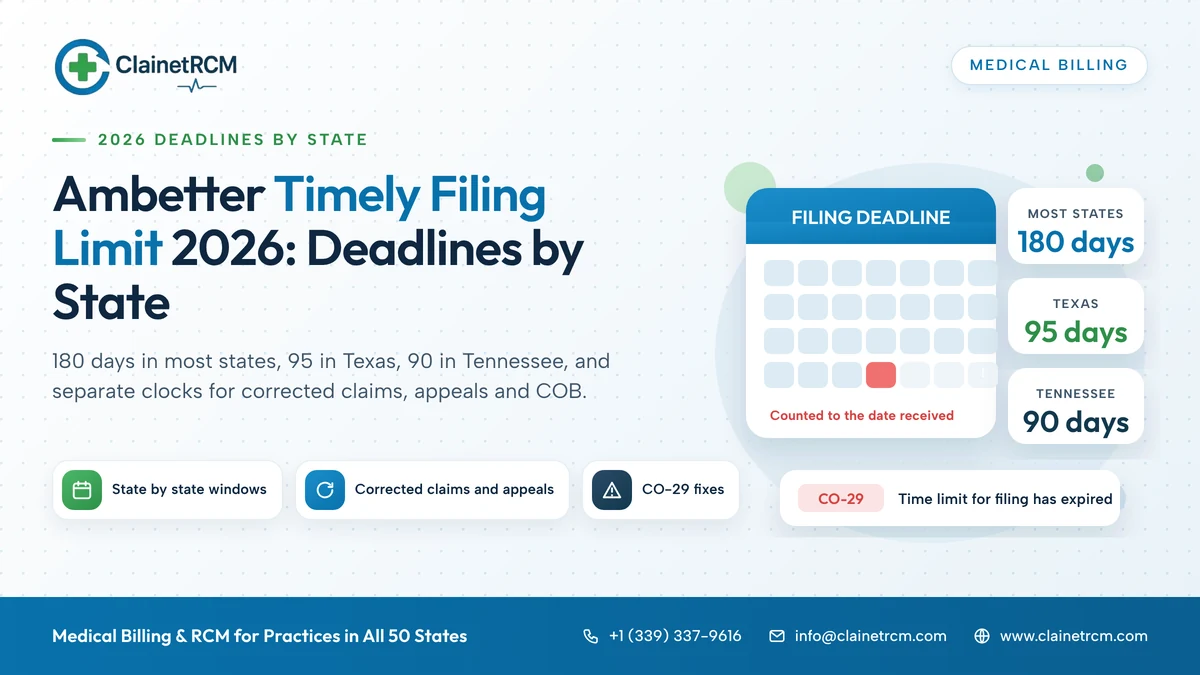
| Medicaid (fee-for-service) | Up to 12 months; many states shorter | Texas 95 days, New York 90 days; Medicaid plans follow state contracts |
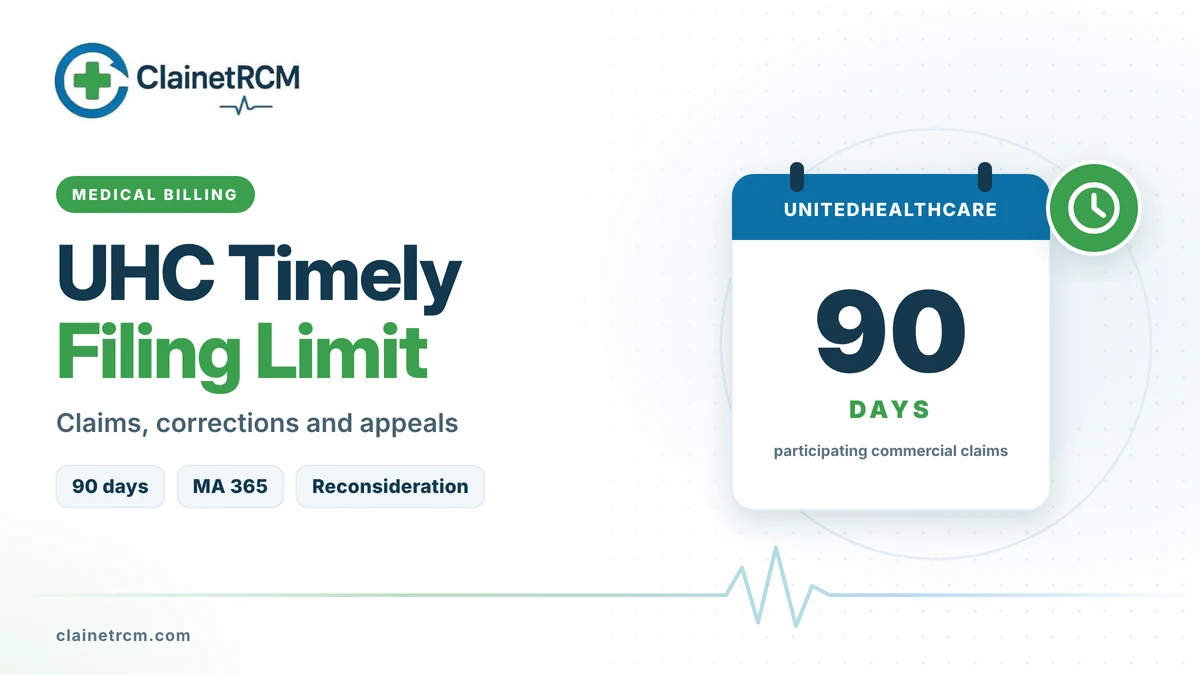
| UnitedHealthcare commercial | 90 days participating; 180 days non-participating | Agreement can set a different period |
| UnitedHealthcare Medicare Advantage | Per agreement; 365 days for non-contracted providers | Counted from the through date of service |
| Aetna commercial | Commonly 90 days participating (some agreements 120); 12 months non-participating | Non-participating limit has been 12 months since 2022 |
| Cigna commercial | 90 days in-network; 180 days out-of-network | Check your agreement |
| Anthem Blue Cross Blue Shield | 90 days for contracted commercial and Medicare Advantage professional claims | In place since October 2019 |
| Other Blue plans | Commonly 180 to 365 days | Varies by plan; see our BCBS timely filing guide |
| Humana Medicare Advantage | One year from the date of service, or per agreement | Medicaid plans vary by state |
| TRICARE | One year from the date of service or discharge | Separate rules for some claim types |
| VA Community Care Network | 180 days | Administered through the regional CCN contractors |
These are typical published limits as of 2026 and are not a substitute for your contract. A payer can shorten or lengthen the window for your practice in its agreement, and state prompt-pay laws can change it for state-regulated plans.
How the Clock Is Counted
- Start date. Most payers count from the date of service. For inpatient and other institutional claims with a date span, the clock usually starts on the “through” or discharge date.
- End date. The payer’s receipt date, not the date you printed the claim or the clearinghouse date in your system.
- Calendar days. Count calendar days, including weekends and holidays, unless the payer says otherwise.
- Rejections do not stop the clock. A claim rejected at the clearinghouse or payer front end was never received. Fix and resubmit quickly.
Corrected Claims, Secondary Claims and Appeals
Initial filing limits are only one of three clocks:
- Corrected or replacement claims. Submit with claim frequency code 7 (replacement) and the payer’s original claim number, or frequency code 8 to void. Many payers set a separate window for corrections, often counted from the original remittance date.
- Secondary claims. Most payers count from the primary payer’s remittance date, commonly 60 to 180 days. Medicare is the exception: its 12-month limit from the date of service still applies when Medicare is secondary.
- Appeals and disputes. Appeal windows run from the denial or payment date, typically 60 to 365 days depending on the payer and state.
How to Prove Timely Filing
When a claim denies for timely filing but you filed on time, request a reconsideration with proof of timely filing, such as:
- Clearinghouse acceptance reports (999 and payer-level 277CA acknowledgments) showing the payer received the claim
- A payer portal submission confirmation with date and claim number
- An earlier remittance or correspondence from the same payer about the claim
- Documentation that the patient gave you the wrong insurance, plus proof you billed the other payer promptly
Screenshots of your billing system’s “sent” status are usually not enough. Payers want evidence of their own receipt or the clearinghouse’s acceptance.
How to Stay Ahead of Every Deadline
- Submit within 48 to 72 hours of the visit. Short lag times make most deadlines irrelevant.
- Work rejections daily. A rejected claim is the most common way a timely claim becomes a late one.
- Verify insurance before the visit. Billing the wrong payer for months is a leading cause of timely filing losses. See our insurance verification checklist.
- Build payer limits into your AR system. Flag unbilled and unpaid claims 30 days before each payer’s deadline.
- Track secondary claims separately. Their clock starts at the primary payer’s remittance.
Frequently Asked Questions
No. Commercial payers commonly allow 90 to 180 days for participating providers. Medicare allows 12 months, and Medicaid allows up to 12 months, with many states setting shorter limits.
Usually not. Network agreements and the CO group code make the late filing the provider’s responsibility.
No. A rejection means the payer never accepted the claim. Only accepted claims count, so correct and resubmit rejections right away.
It varies by payer. Many count from the original remittance date and set a window between 90 days and 12 months.
Ambetter plans set their own limits by state and network status. See our Ambetter timely filing guide.
Final Thoughts
Timely filing limits only cost money when claims sit. Submit quickly, clear rejections daily and keep proof of every payer acceptance. Our medical billing services team submits claims within days of service and tracks every payer’s deadline. For payer-specific detail, see our guides to the UnitedHealthcare timely filing limit and the Aetna timely filing limit.
Never Lose a Claim to a Filing Deadline
We submit claims within days of service, track every payer’s filing window and keep acceptance reports ready if a payer ever disputes timeliness.
Protect My Claims
Written by
ClainetRCM Billing Team
ClainetRCM is a Boston-based revenue cycle management company specializing in medical billing, coding, credentialing and denial management for healthcare providers across all 50 states. Our AAPC and AHIMA certified team works inside your existing EHR, files claims within 24 to 48 hours and reviews every AR bucket on a 14-day cycle.