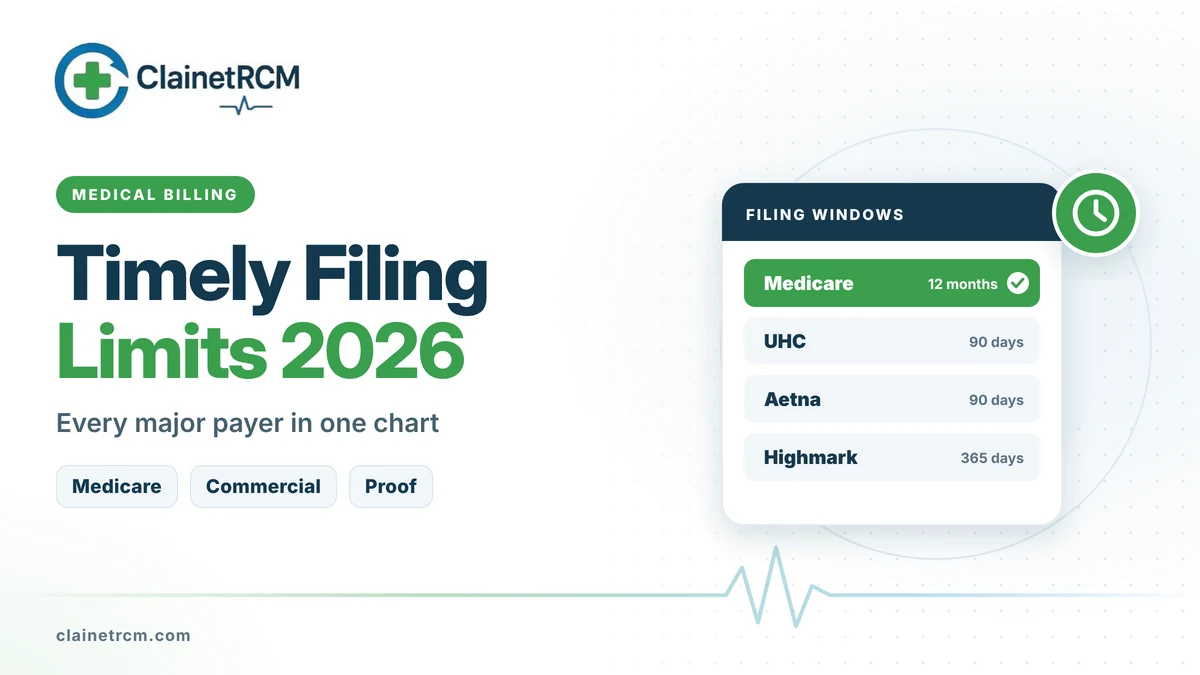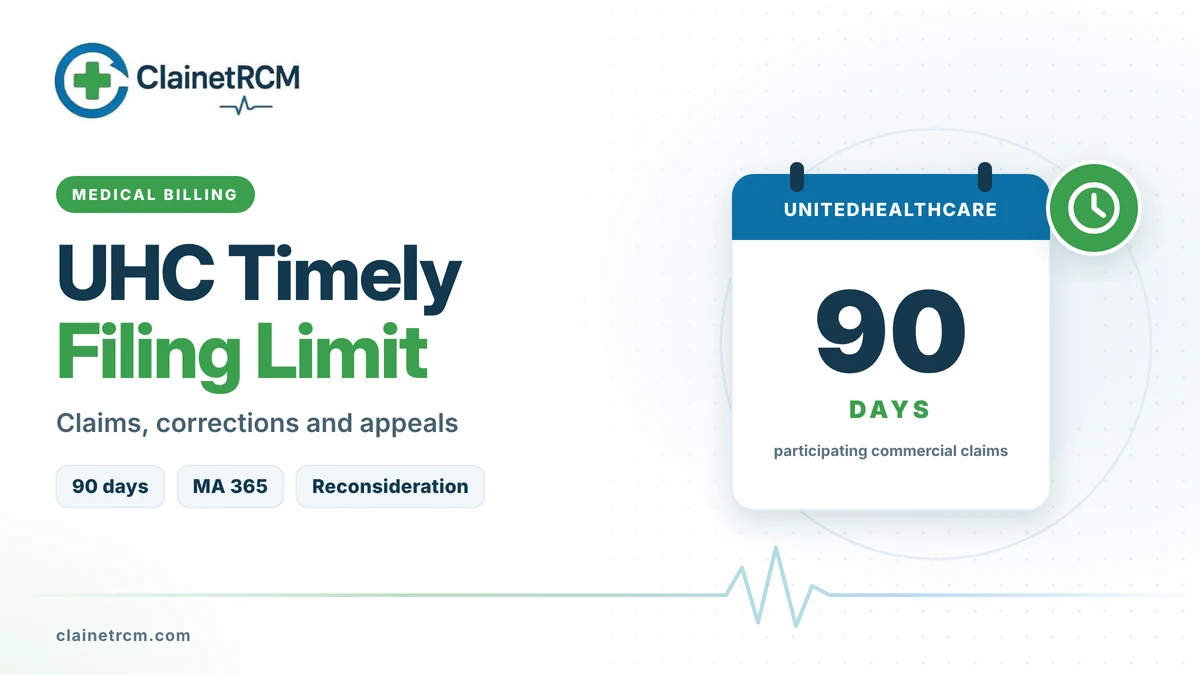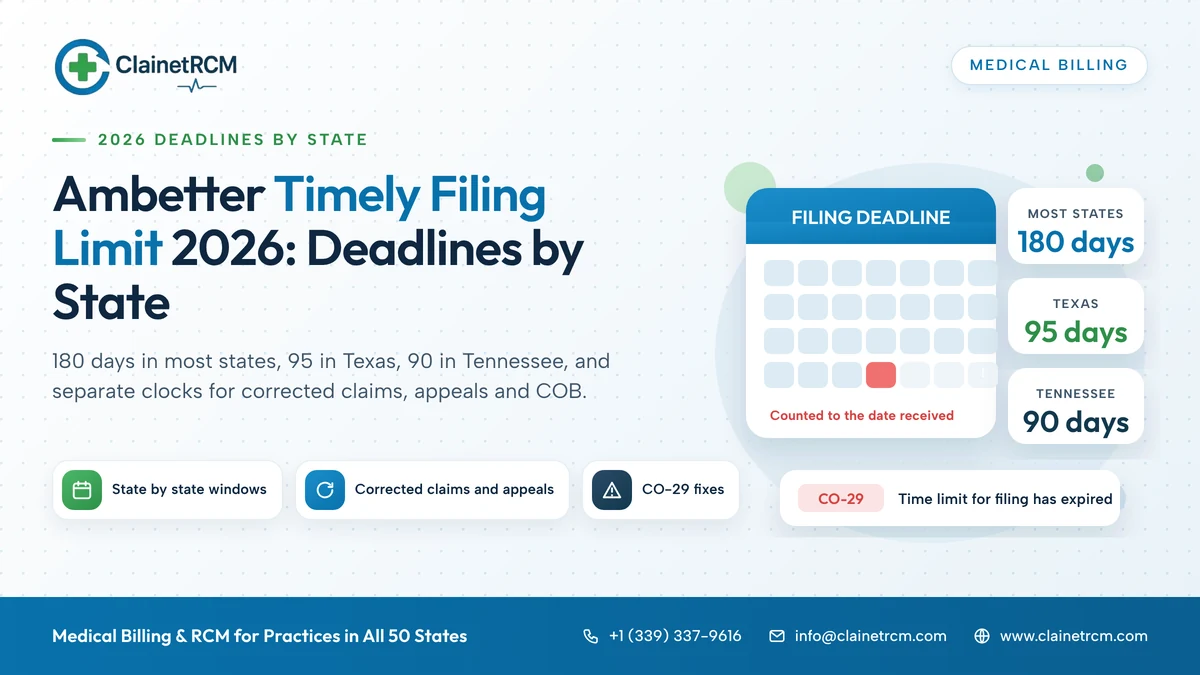
The Aetna timely filing limit is not a single number. Aetna commercial plans, Aetna Medicare Advantage plans and Aetna Better Health Medicaid plans each follow different rules, and your participation status changes the deadline again. Billing teams that treat every Aetna card the same way are the ones that lose claims to timely filing denials.
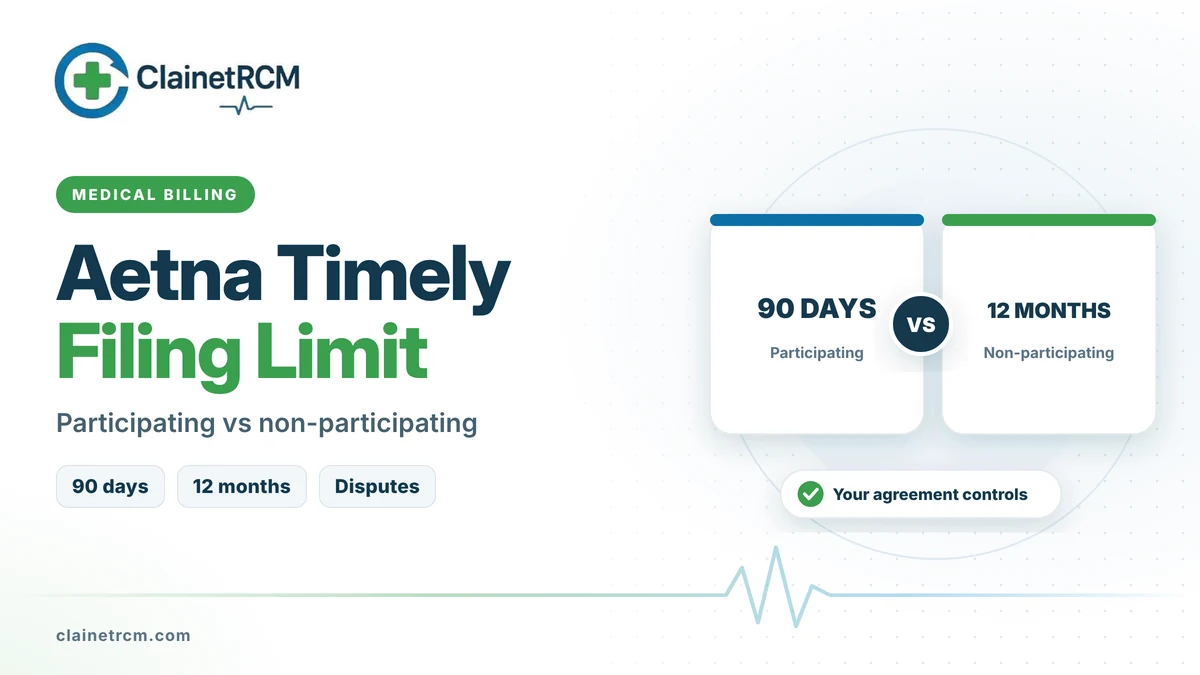
Quick answer: For Aetna commercial plans, participating providers commonly have 90 days from the date of service, although some agreements allow 120 days and your contract controls. Non-participating providers have 12 months for traditional medical claims, a limit Aetna adopted in 2022 (dental remains 27 months). Medicare Advantage claims follow your agreement, or one year for non-contracted providers. Aetna Better Health Medicaid plans follow each state contract, often 180 days. Claim-payment disputes have their own deadlines, with longer windows required by some states.
Aetna Timely Filing Limit by Plan Type
| Aetna product | Provider status | Initial claim limit (typical) |
|---|---|---|
| Commercial | Participating | Commonly 90 days from the date of service; some agreements 120 days |
| Commercial | Non-participating | 12 months for traditional medical claims (27 months for dental) |
| Medicare Advantage | Contracted | Per your agreement |
| Medicare Advantage | Non-contracted | One year from the date of service |
| Aetna Better Health (Medicaid) | Participating | Set by state contract; for example, 180 days in Illinois and 120 days in New York |
| Aetna Better Health (Medicaid) | Non-participating | Set by state contract, often longer than for participating providers |
State law can override contract terms for state-regulated commercial plans, and self-funded employer plans administered by Aetna may follow plan-specific rules. Always confirm the limit in your agreement or the plan’s provider manual.
Corrected Claims
To change a claim Aetna already processed:
- Submit a replacement claim with frequency code 7 and the original Aetna claim number, or code 8 to void it.
- Send the complete corrected claim with all lines.
- Do not send a brand-new claim, which will deny as a duplicate.
Corrected claim windows vary by product. Aetna Better Health plans publish their own limits, such as 365 days from the original determination in some states and two years in others, while commercial corrections follow your agreement and Aetna’s dispute rules. Submit corrections as soon as you find the error.
Secondary Claims
When Aetna is the secondary payer, the deadline is usually counted from the primary payer’s remittance date. Aetna Better Health of Illinois, for example, requires secondary claims within 90 days of the primary payer’s final determination. Include the primary payer’s payment information electronically or attach the EOB.
Claim-Payment Disputes and Appeals
If you disagree with how Aetna processed a claim, start with a claim-payment dispute (reconsideration), then a formal appeal if needed. Aetna publishes a standard dispute timeframe and a list of state-specific exceptions. Several states give providers longer, for example 12 months in Colorado and Florida (for licensed physicians and certain practitioners) and up to 18 months in states such as Oregon and Rhode Island. Medicare Advantage disputes follow Medicare’s rules for contracted and non-contracted providers.
How to Prove Timely Filing to Aetna
If Aetna denies a claim for timely filing and you have proof of earlier submission, file a dispute with:
- The clearinghouse acceptance report or payer acknowledgment (277CA) showing the original receipt date
- Aetna portal confirmation of the submission
- An earlier Aetna remittance or letter about the claim
- Evidence that you billed the wrong payer in good faith and then submitted to Aetna promptly
Examples: Which Aetna Deadline Applies?
- In-network commercial. A participating practice sees an Aetna PPO member on May 10. With a 90-day agreement, Aetna must receive the claim by August 8.
- Out-of-network commercial. A non-participating specialist treats the same member. The 12-month limit for traditional medical claims applies.
- Medicaid plan. A patient with Aetna Better Health of Illinois is seen on May 10. The 180-day state contract limit applies, counted from the discharge date for inpatient stays.
- Secondary to another payer. When Aetna Better Health of Illinois is secondary, the claim is due within 90 days of the primary payer’s final determination.
Building Aetna Deadlines Into Your Workflow
Set up separate payer records in your billing system for Aetna commercial, Aetna Medicare Advantage and each Aetna Better Health plan, with the correct filing limit on each. Run a weekly report of unbilled and unpaid Aetna claims that are within 30 days of their limit, and route rejections to a same-day work queue. These steps prevent nearly every timely filing denial.
Common Aetna Timely Filing Mistakes
- Assuming Aetna Better Health follows commercial Aetna rules
- Billing a patient’s old plan after they switched to Aetna Medicare Advantage
- Treating a rejection as a submission
- Missing that a self-funded plan uses a different deadline
- Sending duplicates instead of corrected claims
Frequently Asked Questions
Commonly 90 days from the date of service for commercial plans, unless your agreement sets a different period such as 120 days.
Twelve months for traditional medical claims, effective since January 1, 2022. Dental claims remain at 27 months.
Contracted providers follow their agreement. Non-contracted providers generally have one year from the date of service.
It depends on the product and state. Aetna publishes a standard timeframe and longer state-specific exceptions, so check the provider appeals page for your state.
Yes. Clearinghouse acceptance reports and payer acknowledgments are the strongest proof.
The claim is denied for untimely filing, usually with reason code CO-29, and a participating provider generally cannot bill the patient for it. Your options are limited to proving the claim was filed on time or showing an exception that your contract or state law allows, so track every Aetna deadline from the date of service.
Final Thoughts
The Aetna timely filing limit depends on the product, the state and your contract. Identify the plan at check-in, submit within days and track disputes separately from initial claims. Our medical billing services team manages Aetna claims across commercial, Medicare Advantage and Medicaid products. For other payers, see our timely filing limits chart and our Ambetter timely filing guide.
Keep Aetna Claims Inside the Window
We file Aetna claims fast, track product-specific deadlines and handle disputes and corrected claims before time runs out.
Get Billing Help
Written by
ClainetRCM Billing Team
ClainetRCM is a Boston-based revenue cycle management company specializing in medical billing, coding, credentialing and denial management for healthcare providers across all 50 states. Our AAPC and AHIMA certified team works inside your existing EHR, files claims within 24 to 48 hours and reviews every AR bucket on a 14-day cycle.