The UHC timely filing limit depends on which UnitedHealthcare product the patient has and whether you are in its network. A commercial claim, a Medicare Advantage claim and a Community Plan (Medicaid) claim seen on the same morning can each have a different deadline. Knowing which clock applies is the difference between a paid claim and a CO-29 denial you cannot bill to the patient.
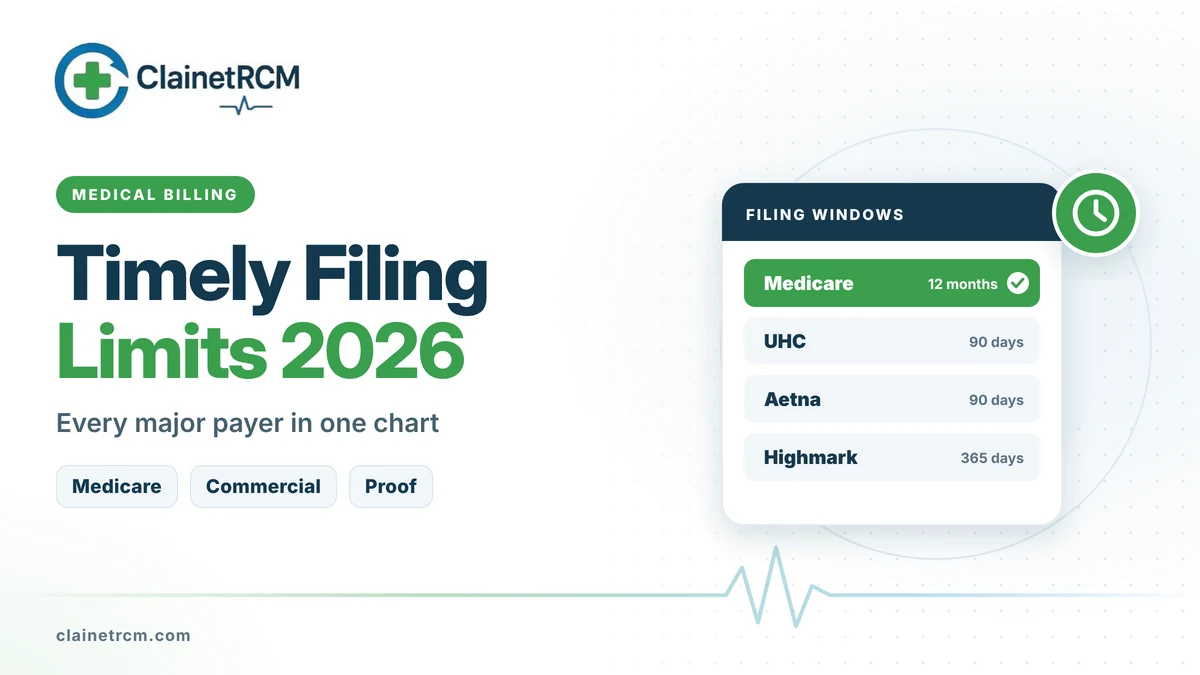
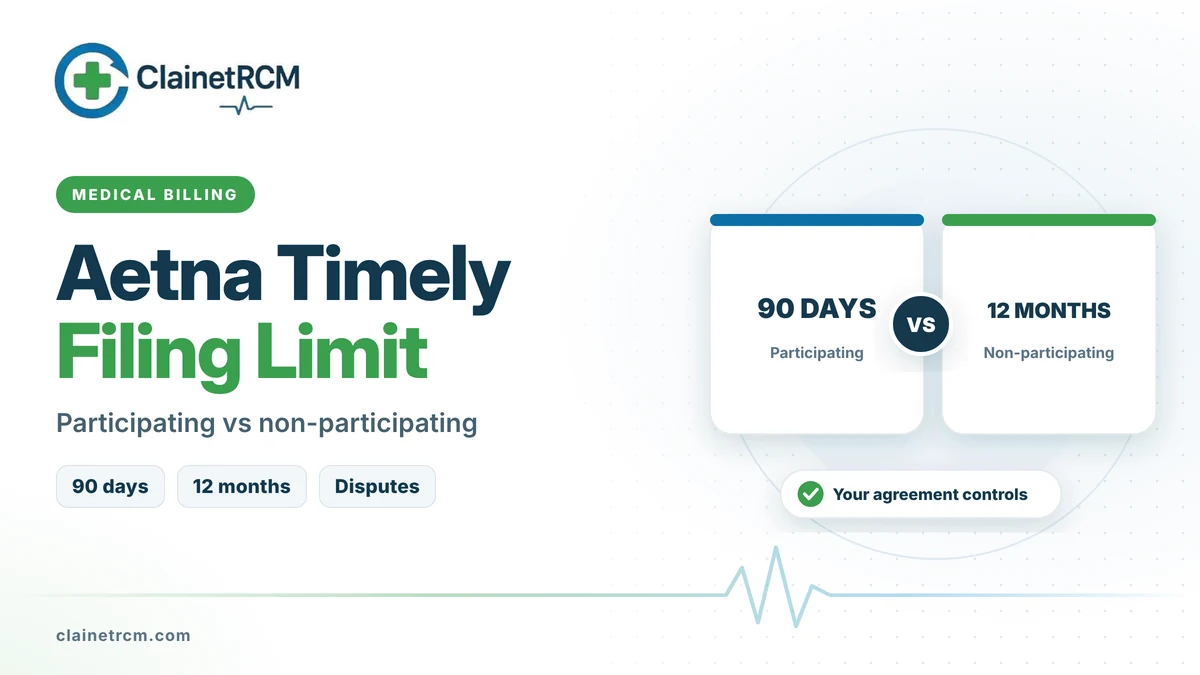
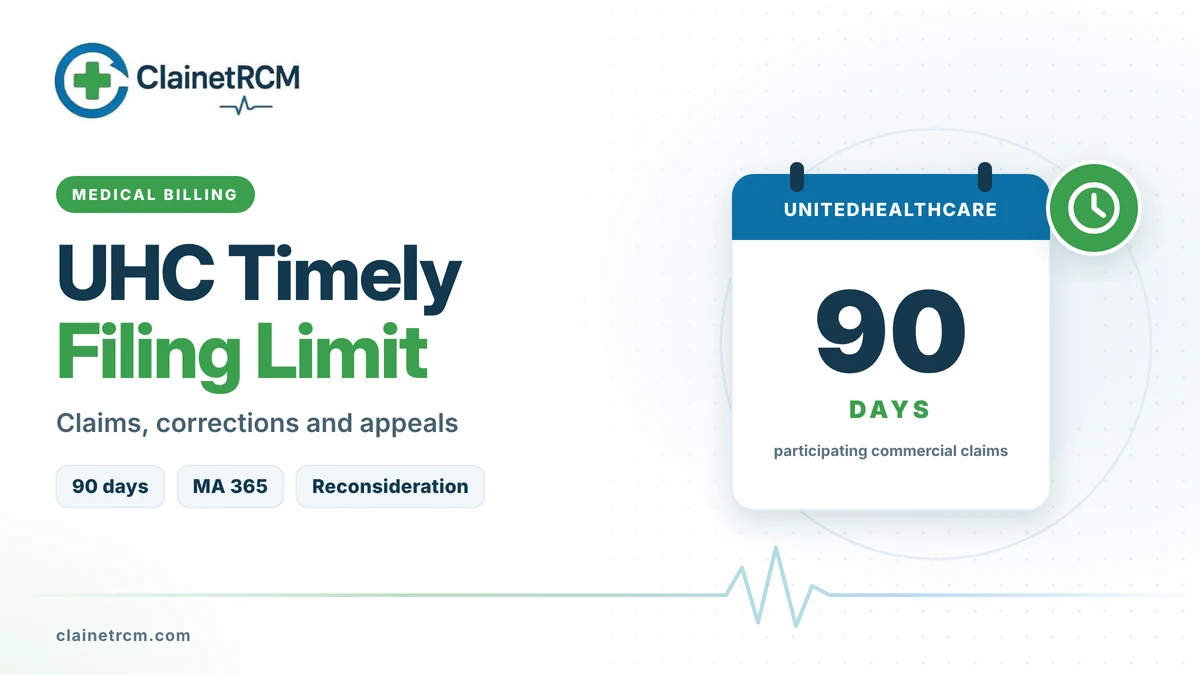
Quick answer: For UnitedHealthcare commercial plans, participating providers generally have 90 days from the date of service, unless the participation agreement says otherwise, and non-participating providers have up to 180 days. For UnitedHealthcare Medicare Advantage, contracted providers follow their agreement, and non-contracted providers have 365 days from the through date of service. Community Plan limits are set by each state contract. When UHC is the secondary payer, the clock usually starts with the primary payer’s remittance. Reconsiderations and appeals generally must be filed within 12 months of the original claim decision unless your agreement or state law says otherwise.
UHC Timely Filing Limit by Product
| UnitedHealthcare product | Provider status | Initial claim limit | Clock starts |
|---|---|---|---|
| Commercial and Individual Exchange | Participating | 90 days, unless your agreement sets another period | Date of service |
| Commercial | Non-participating | Up to 180 days | Date of service |
| Medicare Advantage (including AARP-branded plans) | Contracted | Per your agreement | Per your agreement |
| Medicare Advantage | Non-contracted | 365 days | Through date of service |
| Community Plan (Medicaid) | Participating | Set by the state contract and plan manual | Usually date of service |
| Any product as secondary payer | Any | Commonly 90 days, unless your agreement differs | Primary payer’s payment or denial |
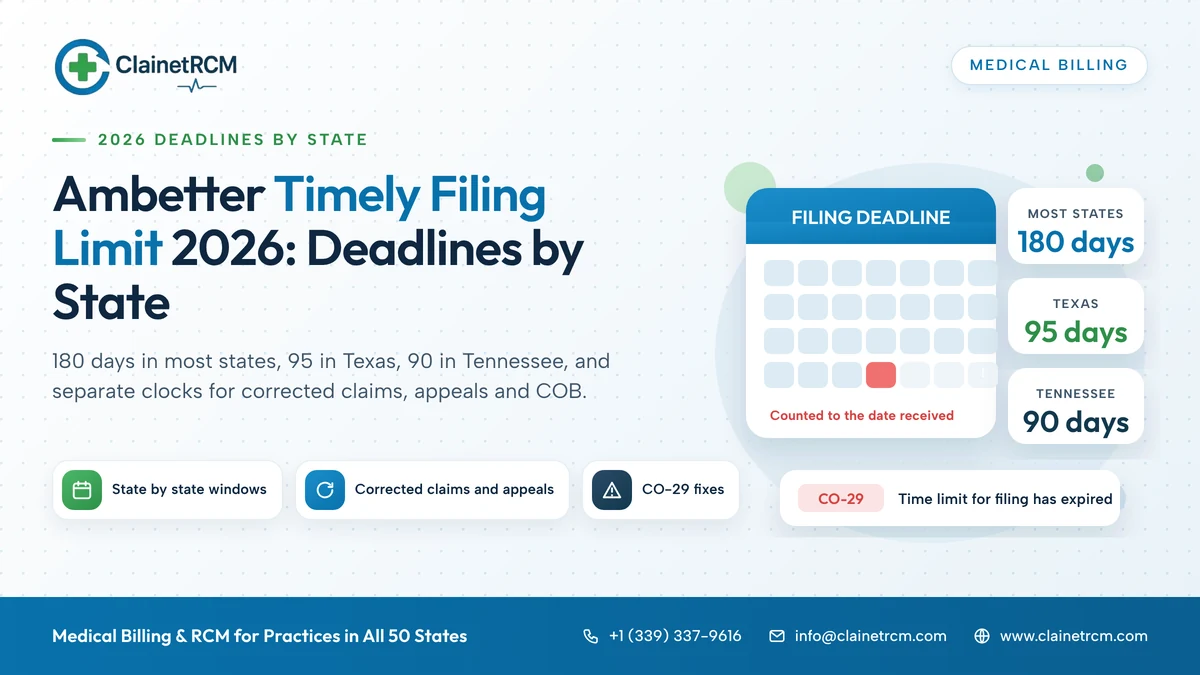
UnitedHealthcare’s annual Administrative Guide for commercial, Individual Exchange and Medicare Advantage plans points providers to their participation agreement for the controlling timely filing period, so check your contract first. Community Plan rules live in separate state manuals; for example, Texas Medicaid plans follow the state’s 95-day standard.
Corrected Claims
When you need to fix a claim UHC already processed, send a corrected claim instead of a new one:
- Use claim frequency code 7 (replacement) with the original UHC claim number, or code 8 to void a claim sent in error.
- Send the entire corrected claim, not just the changed line.
- Submit electronically when possible so you have a clearinghouse acceptance record.
Corrections and reconsiderations follow UHC’s reconsideration timeframes in the Administrative Guide and your agreement rather than restarting the original filing clock. Do not wait until the end of the window.
Secondary Claims
When UnitedHealthcare is secondary, submit the claim with the primary payer’s payment information, either as electronic COB data in the 837 or with the primary EOB on paper claims. The deadline is commonly counted from the date of the primary payer’s determination. Our guide to coordination of benefits explains how to confirm which plan is primary.
Reconsiderations and Appeals
UnitedHealthcare uses a two-step process for most claim disputes:
- Claim reconsideration. The first step for a disagreement about how a claim was processed, including timely filing denials when you have proof.
- Appeal. If the reconsideration is upheld, you can file a formal appeal.
For commercial and Medicare Advantage claims, UHC generally allows 12 months from the original claim decision to complete these steps, unless your agreement or state law sets different timeframes. Non-contracted Medicare Advantage providers follow Medicare’s appeal rules.
How to Prove Timely Filing to UnitedHealthcare
If a claim denies as late but you filed on time, include with your reconsideration:
- The clearinghouse acceptance report or 277CA showing UHC received the claim
- UHC portal confirmation with the submission date
- An earlier UHC remittance or letter about the same claim
- Proof that another payer was billed first because the patient gave incorrect coverage information
Proof of timely filing must show the payer’s receipt, not just that the claim left your system.
Examples: Applying the Right UHC Deadline
- Commercial, in-network. A patient with a UnitedHealthcare employer plan is seen on March 3. Unless the agreement says otherwise, the claim must reach UHC within 90 days, by June 1.
- Medicare Advantage, out-of-network. A non-contracted provider treats an AARP Medicare Advantage member on March 3. The claim is timely if UHC receives it within 365 days of the through date of service.
- Community Plan. A Texas Medicaid patient enrolled in UnitedHealthcare Community Plan follows the state’s 95-day standard, not the commercial 90-day rule.
- Secondary. UHC is secondary behind a spouse’s plan that paid on April 20. The secondary claim’s clock generally starts on April 20, not on the date of service.
Build these product rules into your practice management system so each claim ages against the correct deadline automatically.
Common UHC Timely Filing Mistakes
- Applying the commercial 90-day limit to a Medicare Advantage claim, or the reverse
- Missing that a patient changed from a commercial UHC plan to a Community Plan
- Letting rejected claims sit in the clearinghouse queue
- Sending a new claim instead of a corrected claim, which then denies as a duplicate
- Waiting on a primary payer without following up
Frequently Asked Questions
Generally 90 days from the date of service for commercial claims, unless your participation agreement sets a different period.
Contracted providers follow their agreement. Non-contracted providers have 365 days from the through date of service.
It is set by each state’s Medicaid contract and plan manual, so it varies by state.
Generally 12 months from the original claim decision for reconsiderations and appeals, unless your agreement or state law says otherwise.
No. Corrections follow UHC’s reconsideration timeframes. They do not create a new 90-day window.
Final Thoughts
The UHC timely filing limit is easy to meet when you identify the product at check-in, submit within days and clear rejections daily. Our medical billing services team manages UnitedHealthcare claims by product and contract. See our master chart of timely filing limits for every major payer, and our Ambetter timely filing guide for marketplace plans.
Get UnitedHealthcare Claims In On Time
We track UHC filing windows by product and contract, file corrected claims properly and appeal timely filing denials with the right proof.
Talk to a Billing Expert
Written by
ClainetRCM Billing Team
ClainetRCM is a Boston-based revenue cycle management company specializing in medical billing, coding, credentialing and denial management for healthcare providers across all 50 states. Our AAPC and AHIMA certified team works inside your existing EHR, files claims within 24 to 48 hours and reviews every AR bucket on a 14-day cycle.