The Medicare timely filing limit is one of the most generous in healthcare, and one of the least forgiving. Providers get a full year to submit a claim, but once that year passes, Medicare will deny the claim, and there are only a handful of narrow exceptions. Knowing how the clock is counted and which exceptions exist protects revenue from the claims that slip through the cracks.
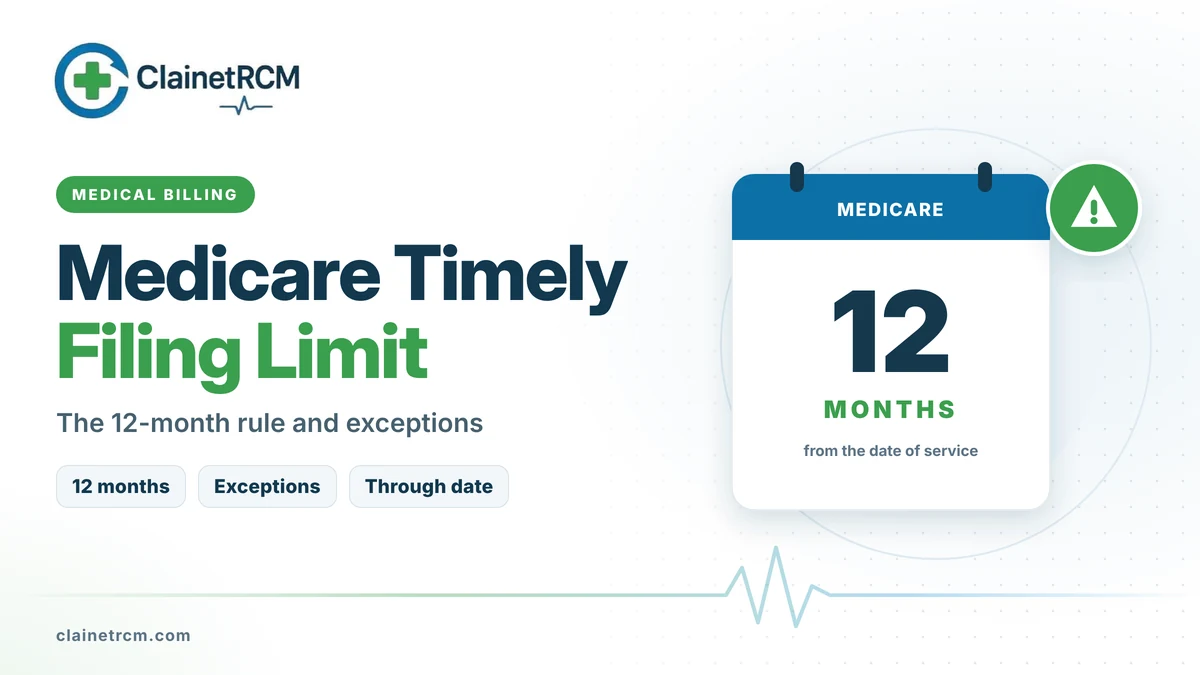
Quick answer: Original Medicare requires claims to be filed within 12 months (one calendar year) of the date of service, under 42 CFR 424.44. For institutional claims with a date span, the clock starts on the through date; for professional claims with a span, it starts on the “from” date. CMS allows exceptions only for administrative error, retroactive Medicare entitlement (including cases involving state Medicaid agencies) and retroactive disenrollment from a Medicare Advantage or PACE plan. A timely filing denial is not appealable, so the fix is prevention.
How the Medicare Timely Filing Limit Works
Medicare must receive a claim no later than 12 months after the date the service was furnished. Medicare counts its own receipt date, so a claim rejected at the front end or sitting in a clearinghouse queue has not been filed.
| Claim type | Date that starts the 12-month clock |
|---|---|
| Professional claim, single date of service (CMS-1500 or 837P) | The date of service |
| Professional claim with span dates, such as some equipment rentals | The “from” date |
| Institutional claim (UB-04 or 837I) with span dates | The “through” date of the statement covers period |
| Medicare as secondary payer | Still the date of service; the primary payer’s delay does not extend the limit |
The Exceptions CMS Allows
Medicare can extend the deadline only in specific circumstances. When one applies, the claim generally must be filed within six months after the month in which the circumstance was resolved.
- Administrative error. Medicare, its contractor or another government agency caused the delay through misrepresentation, error or other action.
- Retroactive Medicare entitlement. The patient was not entitled to Medicare on the date of service but later received entitlement back to that date.
- Retroactive entitlement involving state Medicaid agencies or other payers. A state Medicaid agency or another payer paid first, later learned the patient had Medicare, and recovered its payment.
- Retroactive disenrollment from Medicare Advantage or PACE. The patient was retroactively disenrolled from a Medicare Advantage or PACE plan, and the plan recouped its payment.
A busy office, staff turnover, software problems, a slow primary payer or a patient who forgot to show their card do not qualify.
What Happens to a Late Claim
Medicare denies late claims, and the denial is not an initial determination with appeal rights. That means you cannot use the redetermination process to overturn a timely filing denial. If you believe Medicare made a mistake about the receipt date, or an exception applies, contact your MAC with documentation.
For claims that were filed on time but need changes, the tools are different:
- Reopening. A clerical error or minor fix can be reopened within one year of the initial determination for any reason, and up to four years for good cause.
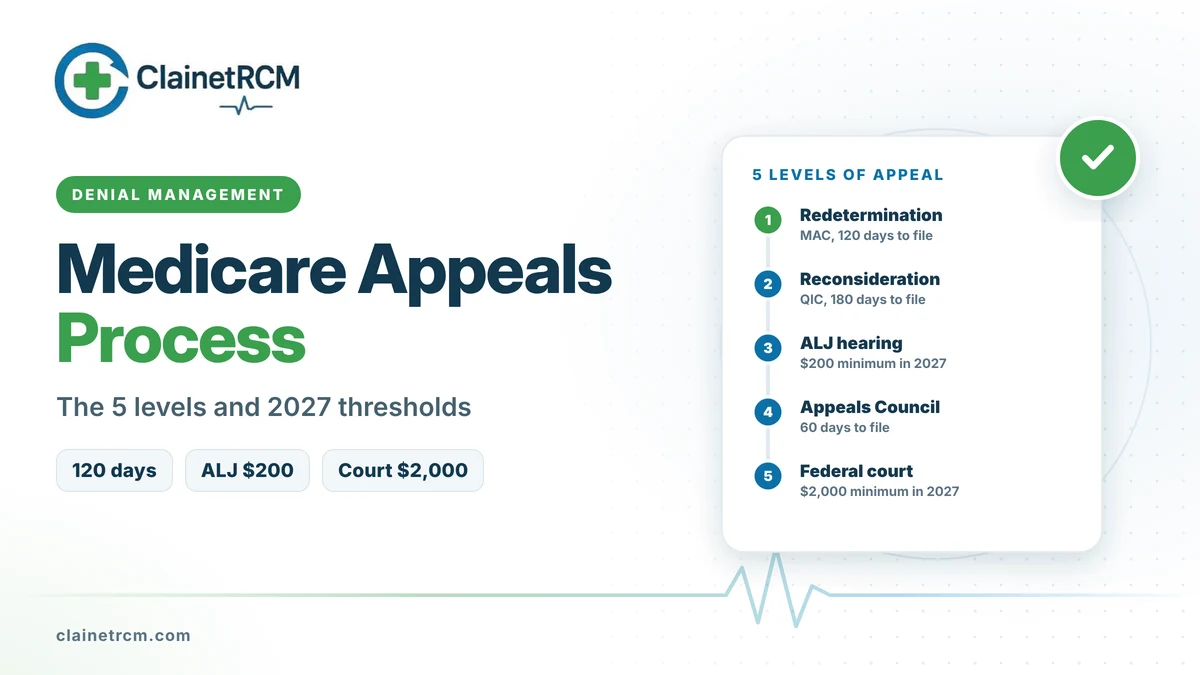
- Redetermination. The first level of appeal must be requested within 120 days of receiving the initial determination. Our guide to the Medicare appeals process explains every level.
Medicare Advantage and Medicare-Related Payers
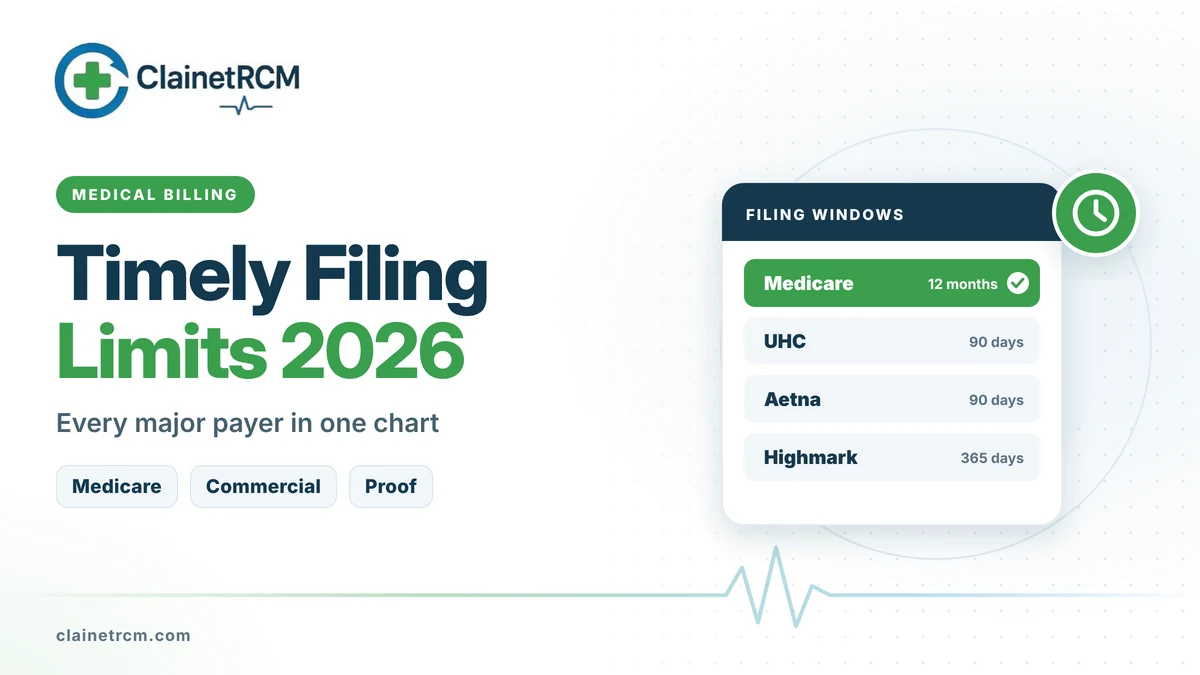
The 12-month rule applies to Original Medicare. Medicare Advantage plans set deadlines in their contracts with network providers, often 90 to 180 days, while non-contracted providers generally have one year. Medigap plans usually receive claims automatically through Medicare’s crossover process, and Medicaid generally requires crossover claims within a set period after Medicare pays.
Example: Counting the 12 Months
A patient is seen in the office on February 14, 2026. Medicare must receive the claim by February 14, 2027. For a hospital inpatient stay from December 28, 2025 to January 3, 2026, the clock runs from the January 3 through date, so the claim is due by January 3, 2027.
Common Reasons Medicare Claims Go Late
- Rejected claims that were never corrected and resubmitted
- Medicare billed as secondary while the practice waited on a primary payer that never paid
- Patients who did not disclose Medicare coverage until months later
- New providers whose enrollment approval came late, leaving claims on hold
- Claims held for missing documentation or coding questions
How to Stay Within the Medicare Timely Filing Limit
- Submit within days of service. The 12-month window should be a safety net, not a target.
- Check the 277CA. Confirm Medicare accepted every claim, not just that the clearinghouse received it.
- Follow up on MSP claims. When another payer is primary, chase its decision well before month 10.
- Track enrollment holds. If a new provider’s PECOS enrollment is pending, track the claims waiting on it. See our PECOS enrollment guide.
- Run a monthly unbilled report that flags anything older than 60 days.
Frequently Asked Questions
Twelve months, or one calendar year, from the date of service.
No. A timely filing denial is not an initial determination and has no appeal rights. Contact the MAC only if an exception applies or Medicare’s receipt date is wrong.
No. The limit still runs from the date of service, so follow up with the primary payer early.
From the through date on the institutional claim, which is usually the discharge date.
Not for network providers, whose contracts usually set shorter deadlines. Non-contracted providers generally have one year.
Final Thoughts
The Medicare timely filing limit gives you a full year, but almost nothing outside a few narrow exceptions can rescue a claim after that. Submit fast, confirm acceptance and follow up on anything pending. Our medical billing services team keeps Medicare claims moving, and our guide on how to bill Medicare as a provider covers the rest of the process. For other payers, see our timely filing limits chart.
Get Medicare Claims Out the Door Fast
We submit Medicare claims within days of service, correct rejections immediately and pursue exceptions when a late claim qualifies.
Talk to a Medicare Billing Expert
Written by
ClainetRCM Billing Team
ClainetRCM is a Boston-based revenue cycle management company specializing in medical billing, coding, credentialing and denial management for healthcare providers across all 50 states. Our AAPC and AHIMA certified team works inside your existing EHR, files claims within 24 to 48 hours and reviews every AR bucket on a 14-day cycle.